











Can enclomiphene help boost your testosterone and maintain fertility as you age? Testosterone deficiency and hypogonadism affect men across a broad age range and become more common as men get older. Clinicians increasingly seek treatments that not only raise testosterone levels but also preserve fertility and support hormonal balance without the drawbacks of traditional testosterone replacement therapy (TRT). One such option is Enclomiphene citrate 1, a selective estrogen receptor modulator (SERM), which stimulates the body’s own hormone production and sperm count rather than replacing testosterone externally.
At Vita Bella, we understand the importance of maintaining both testosterone levels and fertility, especially as you age. That's why we offer Enclomiphene therapy, a safe and effective alternative to traditional testosterone replacement. Our expert team ensures that you receive personalized care, with a focus on restoring natural hormone balance without compromising your long-term health. Whether you're under 35 or navigating your 40s and beyond, enclomiphene can help you maintain optimal testosterone levels while preserving your fertility.
How Does Enclomiphene Work as a Natural Signal Rather Than a Replacement?
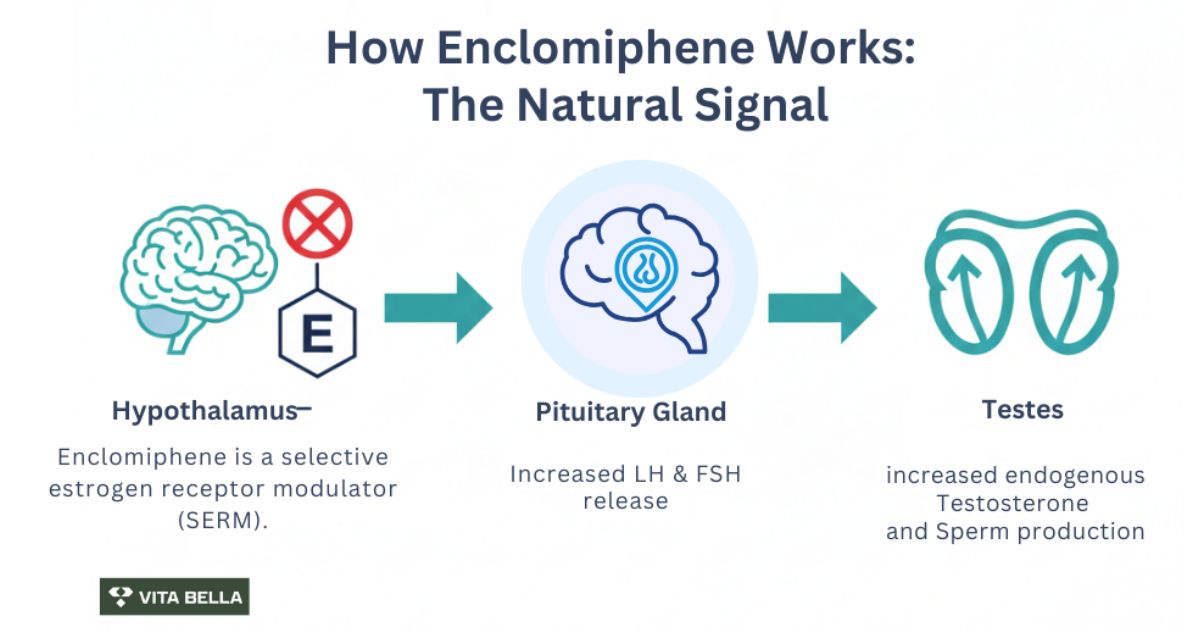
Unlike TRT, which provides exogenous testosterone and suppresses the hypothalamic‑pituitary‑gonadal (HPG) axis, enclomiphene stimulates the HPG axis. It blocks estrogen receptors in the hypothalamus, prompting increased release of luteinizing hormone (LH) and follicle‑stimulating hormone (FSH), which signal the testes to produce more testosterone and support spermatogenesis. This mechanism helps maintain natural testosterone production, which is essential for preserving fertility.
Does Age Matter When It Comes to Enclomiphene’s Effectiveness in Older Individuals?
The effectiveness of enclomiphene depends less on chronological age and more on residual endogenous hormone function. If the testes and HPG axis retain functional capacity, enclomiphene can be effective even in older men. Clinical trial 1 data confirm that oral enclomiphene citrate increases total testosterone, LH, and FSH levels across adult men with low testosterone, including older participants.
Importantly, in these trials, enclomiphene preserved sperm concentration in the normal range, even while raising testosterone, something TRT failed to do. This suggests that enclomiphene can be effective across a broad age spectrum, provided that hypothalamic and testicular function remains intact. This could be an essential consideration in the treatment of hypogonadal men wishing to preserve fertility.
What Are the Benefits of Enclomiphene Over Testosterone ReplacementTherapy (TRT)?
Enclomiphene offers several benefits over traditional testosterone replacement therapy (TRT). Unlike TRT, which replaces testosterone and can suppress natural production, enclomiphene stimulates the body's own testosterone production, preserving fertility and maintaining hormonal balance. Additionally, enclomiphene comes in oral form, eliminating the need for injections or other invasive methods. Other benefits include:
Oral dosing makes enclomiphene simple to administer. No shots, gels, or pellets.
According to clinical trials 2, it stimulates endogenous testosterone production rather than replacing it, which helps preserve the body’s natural regulation.
Enclomiphene maintains sperm production and fertility while increasing testosterone levels. This is a key advantage over TRT, which often suppresses LH/FSH and leads to reduced sperm output.
Research 3 shows that it typically has lower rates of estrogen‑related side effects compared with older SERMs, due to its selective mechanism.
What Are the Benefits of Enclomiphene, According to Clinical Studies?
Enclomiphene effectively increases testosterone levels while preserving fertility, unlike traditional testosterone replacement therapy (TRT), which can suppress sperm production. It has demonstrated that enclomiphene stimulates the body's natural testosterone production by acting on the hypothalamic-pituitary-gonadal (HPG) axis, resulting in increased testosterone and improved overall hormonal balance. Further benefits include:
1- Testosterone and Sperm Preservation
Oral enclomiphene citrate stimulated testosterone production while preventing oligospermia, unlike topical testosterone, which often reduced sperm counts. Treatment with topical testosterone gel also suppressed gonadotropins to less than the normal range. Many men become oligospermic or azoospermic when treated with topical Testosterone.
2- Hormone Levels and Fertility
Enclomiphene citrate has been shown in several clinical studies to have a profile that could be beneficial for men with low testosterone who wish to maintain their fertility. It raises serum testosterone and also increases LH and FSH in hypogonadal men, leading to preserved sperm concentration in the normal range over months of treatment.
3- Safety and Side Effects
Studies indicate that enclomiphene produces similar testosterone increases compared to testosterone therapy, but with fewer documented adverse events and less estrogenic activity. Enclomiphene provides improvement in testosterone levels with a lower rate of documented adverse events. These findings support enclomiphene as a comparable treatment option for hypogonadal men while minimizing the risk of adverse effects.
How Does Enclomiphene Work to Raise Testosterone Levels in Men and Induce Ovulation in Women?
Enclomiphene is thought to compete with estrogen for estrogen receptor binding sites, limiting suppression of gonadotropin release. According to research 4, in women, this leads to ovulation, and in men, it raises testosterone levels by increasing LH and FSH levels. By encouraging the body’s own testosterone production, enclomiphene aligns more naturally with physiological processes, often resulting in fewer adverse effects and better hormonal balance.
Revive Your Energy and Get Enclomiphene Solutions Now
Testosterone deficiency can impact your quality of life, leading to weight gain, decreased energy, and low motivation. Over time, these symptoms can affect your overall well-being and emotional health, making it harder to maintain a healthy lifestyle. While TRT provides a quick fix, it can suppress natural hormone production and decrease sperm count.
At Vita Bella, we prescribe Enclomiphene, which boosts your testosterone naturally while keeping fertility intact. This innovative treatment helps restore your body’s natural rhythm, offering a more sustainable solution for long-term health. Our team ensures personalized care, offering a safe and effective solution to restore your hormonal balance without the risks of traditional testosterone therapy. With our expert guidance, you can regain energy and vitality while maintaining overall health.
FAQs
Is enclomiphene effective for older individuals with low testosterone?
Yes, enclomiphene can be effective in older individuals as long as their hypothalamic-pituitary-gonadal (HPG) axis remains functional. Clinical studies have shown that even in men over 40, enclomiphene can stimulate the body’s natural testosterone production, leading to increased testosterone levels while preserving fertility and hormonal balance.
Can enclomiphene be used as a safer alternative to testosterone therapy (TRT)?
Yes, enclomiphene is considered a safer alternative to testosterone replacement therapy (TRT). Unlike TRT, which provides exogenous testosterone and can suppress natural hormone production, enclomiphene stimulates the body’s own testosterone production. This helps maintain fertility and avoids the side effects commonly seen with TRT, such as sperm suppression.
Is enclomiphene effective in preserving fertility while boosting testosterone?
Yes, enclomiphene is effective in preserving fertility while boosting testosterone levels. Clinical studies show that it helps maintain natural sperm production by stimulating the release of LH and FSH, which are essential for spermatogenesis. This makes enclomiphene a preferred choice for men who want to preserve fertility while addressing low testosterone.
Should enclomiphene be used before considering testosterone therapy (TRT)?
Yes, enclomiphene is often recommended as the first-line treatment for men with low testosterone, particularly those under 35. It stimulates the body’s natural testosterone production without the risk of fertility suppression associated with TRT. Enclomiphene should be considered before TRT, especially for men who wish to maintain their fertility.
References:
Kim, E. D., McCullough, A., & Kaminetsky, J. (2016). Oral enclomiphene citrate raises testosterone and preserves sperm counts in obese hypogonadal men, unlike topical testosterone: Restoration instead of replacement. BJU International, 117(4), 677–685. https://doi.org/10.1111/bju.13337
Wiehle, R. D., Fontenot, G. K., Wike, J., Hsu, K., Nydell, J., & Lipshultz, L. (2014). Enclomiphene citrate stimulates testosterone production while preventing oligospermia: A randomized phase II clinical trial comparing topical testosterone. Fertility and Sterility, 102(3), 720–727. https://doi.org/10.1016/j.fertnstert.2014.06.004
Saffati, G., Kassab, J., Orozco Rendon, D., Hinojosa‑Gonzalez, D. E., Kronstedt, S., Lipshultz, L. I., & Khera, M. (2024). Safety and efficacy of enclomiphene and clomiphene for hypogonadal men. Translational Andrology and Urology, 13(9), 1984–1990. https://doi.org/10.21037/tau‑24‑238
Rodriguez, K. M., Pastuszak, A. W., & Lipshultz, L. I. (2016). Enclomiphene citrate for the treatment of secondary male hypogonadism. Expert Opinion on Pharmacotherapy, 17(11), 1561–1567. https://doi.org/10.1080/14656566.2016.1204294