











Vitamin B12 is more than just an important nutrient; it is a cornerstone of brain health, energy production, and healthy aging. Yet, many people underestimate its importance until deficiency symptoms appear. Low levels can result in fatigue, cognitive decline, and accelerated aging.
Maintaining optimal B12 1 levels helps to support sharper cognition, higher energy, and cellular protection throughout life. Low B12 can result in low energy and detrimentally affect your overall health. So, don’t let fatigue, brain fog, or early aging hold you back. Vita Bella’s B12 solutions restore energy, sharpen focus, and protect long-term health. Start today and feel the difference in both body and mind.
What Is Vitamin B12 and Why It Matters
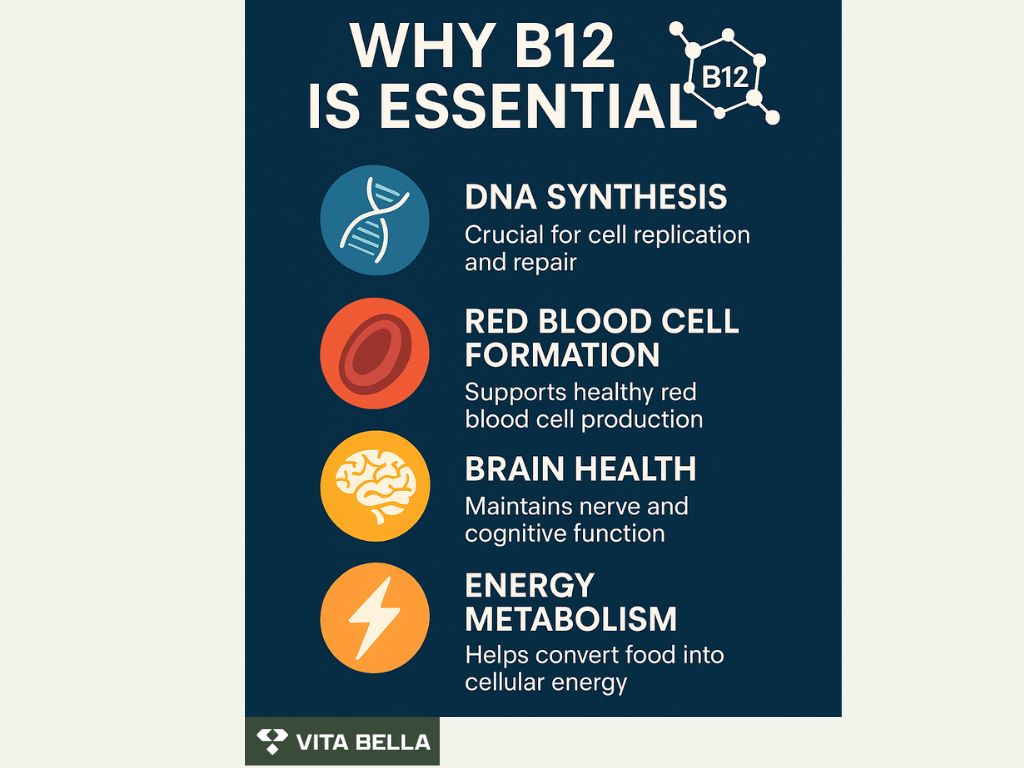
Vitamin B12 2, also known as cobalamin, is a water-soluble vitamin involved in DNA synthesis, red blood cell formation, and neurological function. The body cannot produce B12 on its own, making dietary intake and supplementation essential.
Found primarily in animal products (meat, eggs, fish, dairy), B12 deficiency risk is higher among vegetarians, vegans, and older adults.
Adequate levels support homocysteine metabolism, protecting cardiovascular and nervous system health as reported by the study 3.
Maintaining B12 is therefore vital for survival and maintaining optimal levels ideal for thriving with energy and resilience.
Why is B12 essential?
Vitamin B12 is essential because it supports DNA synthesis, red blood cell formation, and neurological function, all of which are critical for energy and cognition. It also regulates homocysteine metabolism, protecting against cardiovascular and neurodegenerative risks.
1- B12 and Cognitive Health
One of the most well established and studied 2 roles of B12 is its effect on the brain. Deficiency has been consistently linked with impaired memory, mood disorders, and dementia risk. Clinical studies 2 reveal that people with low B12 levels are more likely to experience brain atrophy. In fact, supplementation in older adults with mild cognitive impairment slowed the rate of brain shrinkage by up to 30% compared to controls.
Furthermore, analysis 4 shows that B12 plays a direct role in myelin synthesis, which protects nerve fibers and supports communication between brain cells. Higher levels are associated with better concentration, reduced risk of depression, and improved long-term memory performance.
2- Energy, Metabolism and Cellular Function
B12 is essential for energy metabolism because it acts as a cofactor in the conversion of food into ATP, the body’s fuel. In clinical observations 3, individuals with healthy B12 levels report higher physical endurance and reduced fatigue compared to deficient groups.
It supports red blood cell formation, preventing anemia and fatigue.
It reduces homocysteine accumulation, lowering oxidative stress and protecting mitochondria.
It supports methylation, a process that regulates gene expression and cellular repair.
Clinical Evidence and Limitations
Research 1 consistently highlights the importance of B12 for health. A meta-analysis confirmed its strong association with cognitive health, energy production, and aging resilience.
However, limitations exist. Supplementation shows the greatest benefit in individuals who are deficient or at risk of deficiency. Research 5 shows that in populations with already adequate B12, additional supplementation may not significantly enhance cognition or energy.
The positive takeaway is clear: where deficiency or sub-optimal levels exist, supplementation has measurable and clinically relevant benefits.
Who Should Consider B12 Supplementation
Certain groups are more likely to benefit from targeted supplementation. For these groups, supplementation is not only beneficial but often necessary to maintain optimal energy, cognitive clarity, and resilience.
Older adults: absorption naturally declines with age.
Vegetarians and vegans: limited dietary intake raises deficiency risk.
Individuals with digestive issues: conditions like celiac disease, Crohn’s, or gastric surgery can impair absorption.
People on long-term medications: metformin and proton pump inhibitors lower B12 absorption.
Dosage, Forms and Safety of B12
Vitamin B12 is available in several forms, including cyanocobalamin, methylcobalamin, and hydroxocobalamin. Clinical studies 1 show all forms are effective, though methylcobalamin is often preferred for neurological support. B12 must be absorbed in the small intestine, and this process requires several key steps in the stomach and gut. In some individuals, these steps are impaired so no matter how much B12 they take orally, their body cannot absorb it effectively. In these cases, B12 injections bypass the issues in the digestive system entirely, delivering the vitamin directly into the bloodstream where it can be used immediately by the body.
Oral tablets, sublingual drops, and intramuscular injections are commonly used.
Dosages vary, but even high doses are safe since B12 is water-soluble and excess amounts are excreted.
Studies 2 confirm that supplementation is well tolerated with minimal side effects.
Practical Tips and Lifestyle Integration
Maximizing B12’s benefits requires a mix of smart supplementation and lifestyle choices. By integrating these habits, you can unlock B12’s full potential for energy, cognition, and longevity.
Eat B12-rich foods: fish, eggs, dairy, and fortified cereals.
Combine supplementation with folate and vitamin B6 to further support methylation and cardiovascular protection.
Regularly check blood levels, especially if you are at higher risk of deficiency.
Support absorption by maintaining good gut health and limiting excessive alcohol.
Age Smarter, Live Stronger with Vita Bella
Feeling older than your years may potentially be linked to B12 deficiency. Vita Bella helps restore healthy levels, protecting your mind, boosting stamina, and supporting graceful aging.
It’s not just about adding years, it’s about adding quality to every one of them.
With consistent support, you can reclaim energy, sharpen your focus, and enjoy life at its fullest. Choose Vita Bella today and experience the difference B12 makes in longevity and energy.
FAQs
What are the main benefits of vitamin B12?
Vitamin B12 supports brain function, boosts energy production, forms healthy red blood cells, and helps slow age-related decline. Studies show that adequate B12 can reduce fatigue and improve overall quality of life in deficient individuals.
How does B12 improve cognitive health?
B12 protects nerve cells, aids myelin production, and lowers homocysteine levels, which together support memory, focus, and mental clarity. Research links low B12 to up to a 30% faster rate of brain atrophy in older adults.
Who is most at risk of B12 deficiency?
Older adults, vegetarians, vegans, and people with digestive issues or on medications like metformin are at higher risk of low B12. In fact, nearly 20% of adults over 60 show signs of deficiency.
Is vitamin B12 supplementation safe?
Yes, B12 is water-soluble and considered safe, even at high doses. Supplementation is well-tolerated and helps restore optimal levels quickly. Clinical reviews confirm minimal side effects, making it one of the safest vitamins to supplement.
References:
Martí-Carvajal, A. J., Solà, I., Lathyris, D., & Dayer, M. (2017). Homocysteine‐lowering interventions for preventing cardiovascular events. Cochrane Database of Systematic Reviews, 2017(8), CD006612. https://doi.org/10.1002/14651858.CD006612.pub5
Health Quality Ontario. (2013). Vitamin B12 and cognitive function: An evidence-based analysis. Ontario Health Technology Assessment Series, 13(23), 1–45. https://www.ncbi.nlm.nih.gov/pmc/articles/PMC3874776/
Sangle, P., Sandhu, O., Aftab, Z., Anthony, A. T., & Khan, S. (2020). Vitamin B12 supplementation: Preventing onset and improving prognosis of depression. Cureus, 12(11), e11440. https://doi.org/10.7759/cureus.11440
Simonenko, S. Y., Bogdanova, D. A., & Kuldyushev, N. A. (2023). Emerging roles of vitamin B12 in aging and inflammation. Biomedicines, 11(11), 3066. https://doi.org/10.3390/biomedicines11113066
Umekar, M., Premchandani, T., Tatode, A., Qutub, M., Raut, N., Taksande, J., & Hussain, U. M. (2025). Vitamin B12 deficiency and cognitive impairment: A comprehensive review of neurological impact. Discover Mental Health, 5, 100353. https://doi.org/10.1016/j.dscmnt.2025.100353