










What if clearer thinking were just one scoop away? Creatine monohydrate fuels rapid energy recycling in muscle and brain cells. This simple supplement can boost energy, sharpen cognition, and even help clear “brain fog,” especially in women. A double-blind crossover trial 1 found that 5 g/day for six weeks improved working memory and intelligence test scores (p < 0.0001) in healthy young adults.
Ready to think clearly, feel energized, and boost your mental performance naturally? At Vita Bella, we spotlight science-backed solutions that truly support women’s wellness. Discover how creatine, a simple, proven supplement, can sharpen cognition, lift brain fog, and protect long-term brain health. Your clarity journey starts here.
How does creatine improve energy and thinking?
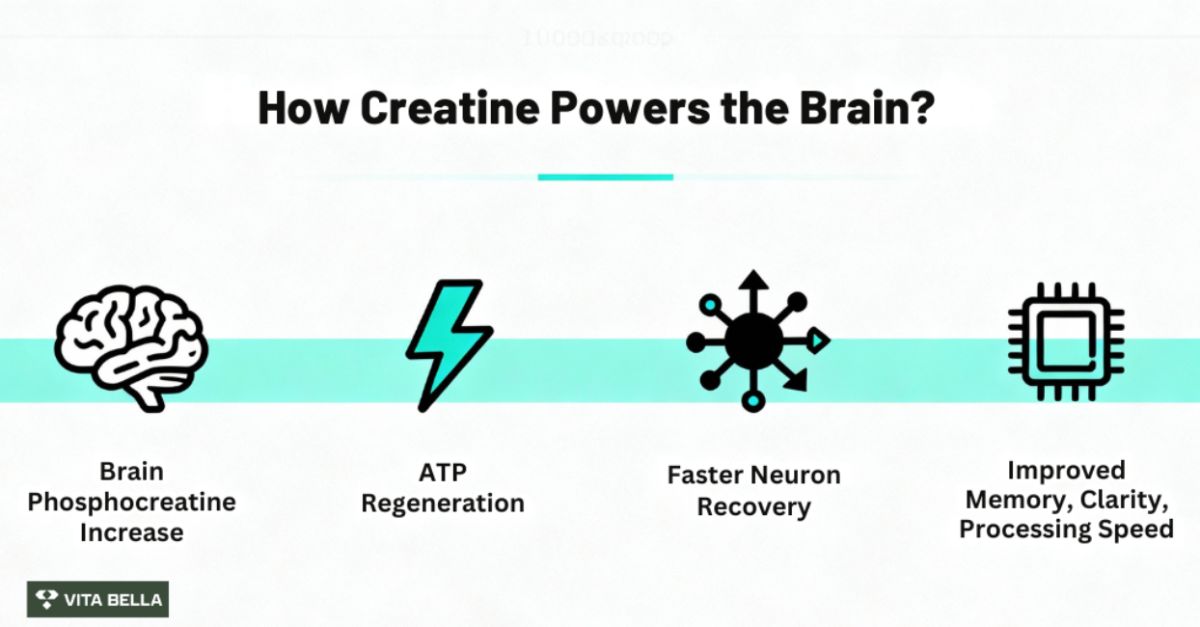
Creatine increases brain phosphocreatine and supports ATP recycling, so neurons recover faster after bursts of activity and stress. Human imaging and biochemical studies 2 confirm that supplementing with creatine raises brain creatine stores, which correlates with better processing speed and attention in some trials.
Acute studies 3 also show benefit: a single oral dose improved cognitive processing speed and maintained high-energy phosphate levels during sleep deprivation, suggesting creatine helps the brain resist temporary energy shortfalls. It inhibits a reduction in pH and alters PCr/Pi, ATP, and tCr/tNAA.
Can creatine reduce “brain fog,” particularly in women?
Perimenopause and menopause often bring fatigue, slowed thinking, and “brain fog” that many women report. Reviews and human research indicate women, especially those with lower baseline creatine (e.g., low dietary meat intake), may gain cognitive benefits from supplementation. A comprehensive review 4 of creatine in women’s health highlights that supplementing with creatine has been shown to increase brain function and cognitive performance in humans, as well as lessen mental fatigue during demanding mental activities in healthy people.
Are there clinical signals that creatine may help with dementia prevention and neuroprotection?
Researchers hypothesize that creatine’s energy-support role could slow neurodegenerative processes; preliminary human trials now test that idea. A recent feasibility trial 5 in people with Alzheimer’s disease showed oral creatine raised brain total creatine by ~11% after weeks of supplementation. It produced small but statistically significant gains on composite cognitive tests (global and fluid cognition), suggesting potential for further study.
Modest but consistent benefits for memory and information processing effects that appear stronger in older adults and in populations under metabolic or energetic stress. These patterns support creatine’s promise as an adjunct strategy for cognitive health rather than a standalone cure.
What do human trials show about practical creatine dosing and safety?
Study 6 reports that 5 g/day protocols raise brain creatine levels and improve cognitive performance in many cohorts, while long-term safety at these doses is well supported by extensive exercise-focused literature. Human trials typically use either:
Creatine supplementation (5 g/day for 6 weeks) significantly improved working memory
Creatine supplementation (20 g/day for 7 days) improves cognitive function performance
What is the Key Evidence Supporting Creatine’s Cognitive and Brain Health Benefits?
Creatine increases brain energy stores and supports ATP regeneration, which helps neurons perform under stress. Its use shows improved working memory and processing speed after 5 g/day for weeks. Creatine can blunt cognitive decline from acute stressors (e.g., sleep loss), improving reaction time and attention. Women, especially peri/postmenopausal or low-creatine diets, may experience reduced “brain fog” and faster processing with supplementation.
Get a Sharper, Faster, Stronger Brain with Vita Bella
Is constant mental fatigue slowing you down? Your brain may be running on low energy reserves without you realizing it. Creatine depletion is common in women, reducing ATP production and slowing cognition. That’s why thinking feels harder than it should be. But the good news is that restoring cellular energy can quickly shift how clear and capable you feel.
Vita Bella helps replenish brain creatine stores naturally and effectively. With science-supported dosing, we boost your mental speed, memory, and clarity, experience steady, reliable energy, not stimulants, just real cellular support. Choose Vita Bella and power your brain with what it truly needs. Feel the difference as your mind becomes sharper, brighter, and more energized each day.
FAQs
Does creatine improve cognitive performance?
Yes, human clinical trials show that daily creatine supplementation, particularly 5 g/day for several weeks, can enhance working memory, processing speed, and mental resilience during stress. Studies using brain imaging also confirm increased brain creatine stores, which support ATP recycling and neuronal energy availability, explaining its measurable cognitive benefits across multiple populations.
Can creatine reduce “brain fog,” especially in women?
Yes, evidence suggests women, particularly during perimenopause or menopause, may experience clearer thinking and reduced mental fatigue with creatine supplementation. Research shows that women often have lower baseline creatine levels, and supplementation supports energy metabolism, improving reaction time, cognitive processing, and perceived mental clarity in several human studies.
Is creatine potentially helpful for dementia or Alzheimer’s disease?
Yes, early pilot trials show creatine supplementation can raise total brain creatine by around 10–11% in Alzheimer’s patients and produce small but statistically meaningful gains in composite cognitive scores. While promising, these findings remain preliminary; large, long-term randomized trials are required to confirm whether creatine can meaningfully slow neurodegenerative decline.
Is creatine safe for long-term use at ordinary doses?
Yes, decades of research show that doses of 3–5 g/day are safe for healthy adults, with no evidence of kidney harm in controlled trials. Most cognitive studies use these exact amounts and report strong tolerability. Extensive systematic safety reviews also confirm creatine’s excellent safety profile when taken as recommended.
References:
Rae, C., Digney, A. L., McEwan, S. R., & Bates, T. C. (2003). Oral creatine monohydrate supplementation improves brain performance: A double-blind, placebo-controlled, cross-over trial. Proceedings of the Royal Society B: Biological Sciences, 270(1529), 2147-2150. https://doi.org/10.1098/rspb.2003.2492
Xu, C., Bi, S., Zhang, W., & Luo, L. (2024). The effects of creatine supplementation on cognitive function in adults: A systematic review and meta-analysis. Frontiers in Nutrition, 11, 1424972. https://doi.org/10.3389/fnut.2024.1424972
Gordji-Nejad, A., Matusch, A., Kleedörfer, S., Patel, H. J., Drzezga, A., Elmenhorst, D., Binkofski, F., & Bauer, A. (2024). Single dose creatine improves cognitive performance and induces changes in cerebral high energy phosphates during sleep deprivation. Scientific Reports, 14, 4937. https://doi.org/10.1038/s41598-024-54249-9
Gordji-Nejad, A., Matusch, A., Kleedörfer, S., Patel, H. J., Drzezga, A., Elmenhorst, D., Binkofski, F., & Bauer, A. (2024). Single dose creatine improves cognitive performance and induces changes in cerebral high energy phosphates during sleep deprivation. Scientific Reports, 14, 4937. https://doi.org/10.1038/s41598-024-54249-9
Smith, A. N., Burns, J. M., Choi, I.-Y., Lee, P., Sullivan, D. K., Swerdlow, R. H., Kelly, E., & Taylor, M. K. (2025). Creatine monohydrate pilot in Alzheimer’s: Feasibility, brain creatine, and cognition. Alzheimer's & Dementia: Translational Research & Clinical Interventions, 11(2), e70101. https://doi.org/10.1002/trc2.70101
Kreider, R. B., Kalman, D. S., Antonio, J., Ziegenfuss, T. N., Wildman, R., Collins, R., Candow, D. G., Kleiner, S. M., Almada, A. L., & Lopez, H. L. (2017). International Society of Sports Nutrition position stand: Safety and efficacy of creatine supplementation in exercise, sport, and medicine. Journal of the International Society of Sports Nutrition, 14(1), Article 18. https://doi.org/10.1186/s12970-017-0173-z