









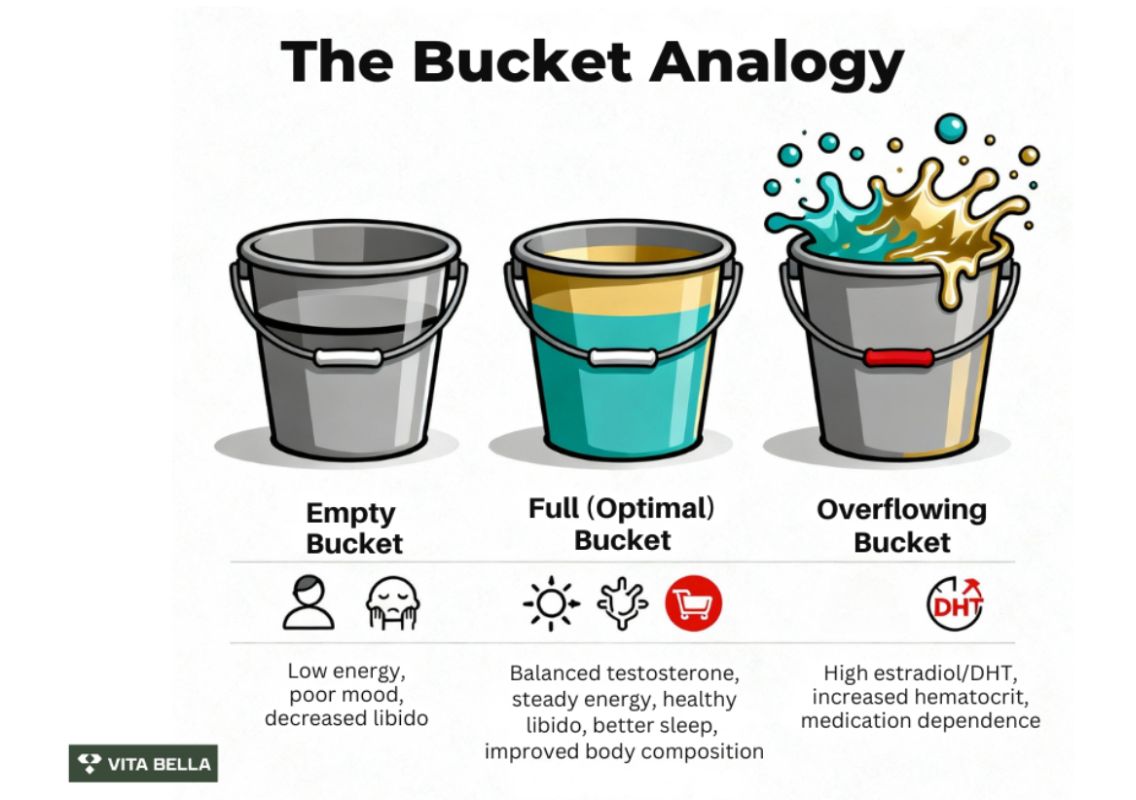
Ever feel like you’re running on empty–no drive, no energy, no edge? That’s what happens when your testosterone bucket runs dry. But here’s the catch: filling it too high can be just as damaging. Overflowing testosterone doesn’t mean more strength or stamina; it means excess conversion into estradiol, DHT, and red blood cells that throw your system off balance. The secret isn’t to pour harder; it’s to pour smarter and keep your hormone bucket right at its sweet spot.
At Vita Bella, we believe true transformation starts with balance, not overload. Your testosterone journey isn’t about chasing numbers; it’s about restoring the rhythm your body was designed for. Our tailored approach helps you boost strength, energy, and confidence while keeping hormones in perfect harmony. Experience more intelligent optimization, deeper strength, and results that truly last only with Vita Bella.
What Is the Testosterone “Bucket,” and Why Does It Matter?
The testosterone “bucket” is a simple way to visualize your hormone balance. When your bucket is too empty, you experience low energy, poor mood, and reduced libido. When it’s overflowing, side effects emerge. When testosterone levels rise, your body metabolizes it through several enzymatic pathways, which include:
1- Aromatase conversion to estradiol (E2):
Aromatase is found in fat tissue and other organs. While small amounts of E2 support mood and libido, excessive conversion can lead to gynecomastia, water retention, and emotional instability. A clinical review 1 in the World Journal of Men’s Health suggests that maintaining a testosterone-to-estradiol ratio of 10–30 supports optimal health in men.
2- 5α-reductase conversion to DHT:
This enzyme converts testosterone into dihydrotestosterone, a more potent androgen that strongly binds to androgen receptors. DHT supports libido and cognitive focus but can contribute to acne, hair loss, and prostate enlargement when elevated. A human study 2 found that changes in DHT correlated more with sexual desire than total testosterone levels. It was also predicted that increases in hemoglobin and sexual desire were higher when DHT levels changed more than when DHT levels changed less.
3- Erythropoiesis (red blood cell production):
Testosterone stimulates the kidneys to release erythropoietin, increasing red blood cell production. This subsequently increases your hematocrit which is the percentage of your blood that is made up of red blood cells. An elevated hematocrit thickens the blood, increasing cardiovascular risk. A 2022 meta-analysis 3 confirmed that injectable testosterone formulations increased hematocrit more than topical forms. Together, these pathways explain how overfilling your “hormone bucket” can cause spillover and side effects.
Why Low Testosterone Is a Problem
When the bucket is nearly empty, you’re dealing with clinical testosterone deficiency (hypogonadism), a condition affecting up to 6–12% of adult men. Symptoms include reduced libido, fatigue, depressed mood, loss of muscle mass, and increased fat accumulation. Filling your bucket to optimal physiological levels can restore energy, sexual health, and body composition, but overfilling can undo those benefits.
A 2023 review 4 found that low testosterone levels were linked with higher all-cause mortality and worse metabolic health outcomes. It was also explained that potential underlying nutritional or metabolic pathways would be necessary because SHBG may affect risk for all-cause and CVD mortality in a different way than its association with total testosterone.
What are the Signs that Your Bucket Is Overflowing?
When your testosterone “bucket” overflows, your body starts sending warning signs. You may notice mood swings, bloating, or tender nipples from excess estradiol; oily skin, acne, or hair loss from elevated DHT; and headaches or fatigue from thickened blood due to high hematocrit. These symptoms signal hormonal imbalance and the need for recalibration. Here are the most common indicators that your bucket is spilling over:
1- High Estradiol (E2):
Too much testosterone can overwhelm the aromatase pathway. Men on testosterone replacement therapy (TRT) often experience a rise in estradiol over the first year. Elevated E2 may cause bloating, nipple tenderness, or mood swings.
2- High DHT:
DHT levels can climb 2–3× baseline with injectable testosterone. Elevated DHT supports libido but increases the risk of androgenic alopecia and acne. The DHT drives androgenic effects independently of testosterone.
3- High Hematocrit (Thick Blood):
Testosterone therapy can increase hematocrit, raising the risk of stroke or clotting. It was also explained that therapeutic phlebotomy is effective for managing TRT-induced erythrocytosis.
How to Fill Your Bucket to the Right Level
Filling your testosterone bucket to the right level means aiming for balance, not extremes. Optimal hormone therapy focuses on steady, physiological levels that restore energy, strength, and health without triggering excess conversion. This requires personalized dosing, appropriate delivery methods, and regular monitoring to maintain balance among testosterone, estradiol, DHT, and red blood cell production. Below are key strategies to help you fill your bucket safely and effectively:
Target the mid-normal range: For most men, the optimal total testosterone range is 600–900 ng/dL. Going significantly above this range shows diminishing returns and increases conversion risk.
Choose the correct delivery route: The route determines your peaks and troughs. Intramuscular injections can cause sharp rises, whereas transdermal gels provide smoother levels. A 2022 review 5 confirmed that hematocrit increases are formulation-dependent, with injections showing the most considerable change.
Monitor key biomarkers: Total & Free Testosterone, Estradiol (E2, sensitive assay), DHT and Hemoglobin & Hematocrit
Routine testing every 3–6 months helps you catch early signs of overflow before symptoms appear.
Support naturally through lifestyle: Sleep 7–8 hours, lift weights, reduce body fat, and ensure sufficient intake of zinc, magnesium, and vitamin D. Lower visceral fat reduces aromatase activity and improves testosterone balance naturally.
Transform Chaos into Productivity with Expert Optimization Solutions with Vita Bella
Low energy, poor mood, and fading confidence aren’t just signs of age; they’re signals of hormonal imbalance. Many men overcorrect, flooding their system with testosterone that spills into estradiol, DHT, and thickened blood. The problem isn’t too little or too much. It’s misalignment. You don’t need more hormones. You need precision.
At Vita Bella, we tailor testosterone therapy to your unique biology. Our approach restores natural balance, optimizes performance, and prevents the “pour-over” effect. We track your biomarkers, refine your dose, and keep your bucket perfectly full, not overflowing. Rebuild your energy, confidence, and clarity more innovatively with Testosterone by Vita Bella.
FAQs
Can too much testosterone really turn into estrogen?
Yes, when testosterone levels become excessively high, the body increases aromatase activity, which converts testosterone into estradiol (a form of estrogen). While a moderate amount of estradiol supports mood and sexual health, too much can lead to water retention, irritability, and gynecomastia. Proper dosing keeps this conversion balanced.
Is DHT always harmful for men taking testosterone?
No, Dihydrotestosterone (DHT) is actually vital for libido, motivation, and cognitive sharpness. However, when testosterone doses are too high or injected too frequently, DHT can spike beyond the healthy range. Elevated DHT may accelerate hair loss or cause oily skin. When maintained in balance, DHT is an essential part of male health.
Does testosterone therapy always make your blood too thick?
No, testosterone can stimulate red blood cell production, but hematocrit only rises excessively when dosing is excessive or unmonitored. With proper medical oversight, regular blood tests, hydration, and sometimes blood donations, men can safely maintain optimal testosterone without crossing into thick-blood territory. Smart dosing significantly reduces this “pour-over” effect.
Is higher testosterone always better for performance and energy?
No, beyond a certain threshold, raising testosterone doesn’t produce more energy or strength; it only increases side effects. The body’s hormone receptors can become saturated, leading to more conversion of testosterone into estradiol and DHT rather than usable energy. Staying within physiological levels maximizes performance naturally while avoiding unnecessary medication or hormonal imbalance.
References:
Swislocki, A. L. M., & Eisenberg, M. L. (2025). A review on testosterone: estradiol ratio—Does it matter, how do you measure it, and can you optimize it? World Journal of Men’s Health, 43(3), 453-464. https://doi.org/10.5534/wjmh.240029
Stephens-Shields, A. J., Snyder, P. J., Ellenberg, S. S., Taylor, L., & Bhasin, S. (2022). Relation of testosterone, dihydrotestosterone, and estradiol with changes in outcome measures in the Testosterone Trials. The Journal of Clinical Endocrinology & Metabolism, 107(5), 1257-1269. https://doi.org/10.1210/clinem/dgac028
Nackeeran, S., Ory, J., Gonzalez, D., Kohn, T., White, J., & Ramasamy, R. (2022). The effect of route of testosterone on changes in hematocrit: A systematic review and Bayesian network meta-analysis of randomized trials. The Journal of Urology, 207(1), 44-51. https://doi.org/10.1097/JU.0000000000002188
Nackeeran, S., Kohn, T., Gonzalez, D., Ory, J., White, J., & Ramasamy, R. (2022). The effect of route of testosterone on changes in hematocrit: A systematic review and Bayesian network meta-analysis of randomized trials. The Journal of Urology, 207(1), 44–51. https://doi.org/10.1097/JU.0000000000002188