










Testosterone Replacement Therapy (TRT) restores energy, strength, and sexual wellness in men with low testosterone. Clinical research 1 confirms that TRT significantly improves libido, erectile function, mood, and overall quality of life. Moreover, TRT increased sexual desire and satisfaction compared with placebo, showing clear benefits for hypogonadal men.
At Vita Bella, we combine medical precision with personalized care to help men feel their best again. Understanding what to expect during your first 90 days on TRT ensures a smoother, safer, and more rewarding experience. Let’s explore how this science-driven therapy can help you thrive.
What would be the journey of the First 90 Days on TRT?
The first 90 days are crucial because they determine how well your body adapts to restored hormone levels. These early weeks help balance dosage, reduce side effects, and optimize long-term outcomes.
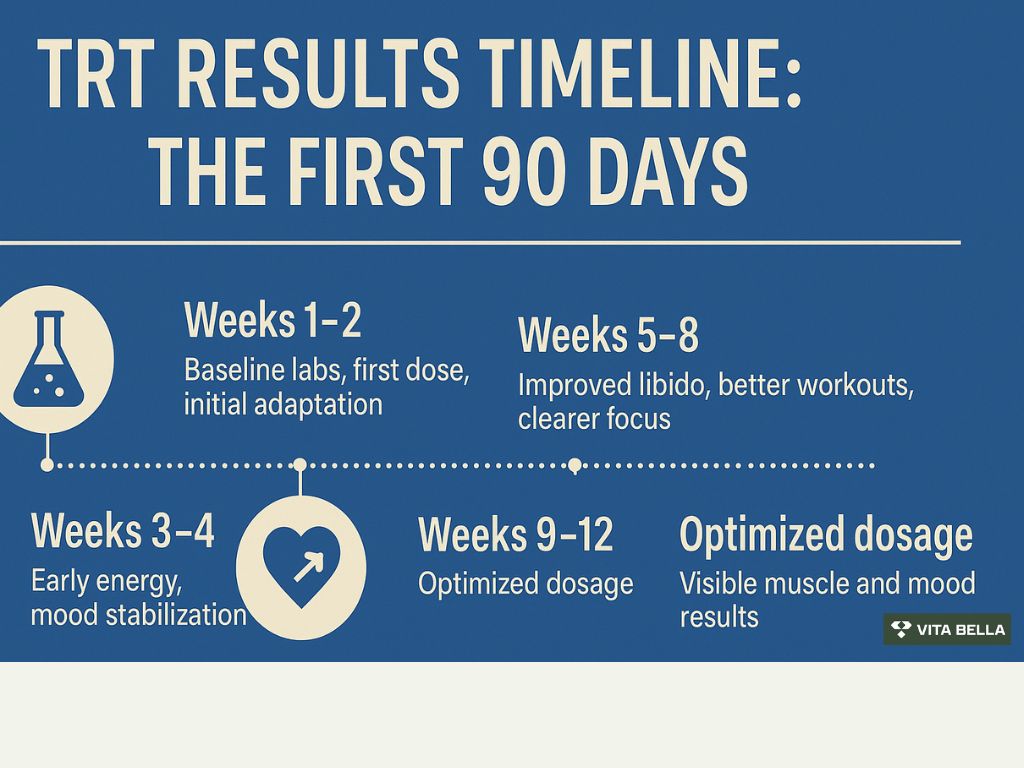
Week 1: Getting Started
Before TRT 2 begins, a physician orders baseline labs including total and free testosterone, estradiol, LH, FSH, hematocrit, PSA, and lipid profile. Establishing these baselines ensures safe dosing and proper follow-up.
After the first dose via injection, gel, or patch, patients rarely feel dramatic effects immediately, though some notice subtle improvements in mood or alertness. The body is beginning its hormonal recalibration.
During the first week, adjustments are standard. Physicians may modify injection intervals or formulation type to maintain stable serum testosterone levels 1 and minimize fluctuations. This proactive management builds a strong foundation for success.
Weeks 2–4: Hormonal Adjustment
As testosterone levels rise, mild physical and emotional changes often occur. Men may experience transient acne, skin oiliness, fluid retention, or slight mood swings, signs that the endocrine system is adapting.
These effects typically fade as hormone levels stabilize. Close monitoring during this phase helps your provider fine-tune dosage and ensure safe red-blood-cell and estradiol levels. Research 1 shows early laboratory reassessment at 4 weeks optimizes patient outcomes and limits side effects.
Weeks 5–8: Visible and Mental Improvements
Around weeks 5 to 8, most men report tangible improvements in energy, mood, libido, and concentration. In controlled human studies 1, TRT led to a 20–30 percent increase in sexual desire and erectile quality by the second month.
Workout performance also improves. TRT enhances lean muscle mass and shortens recovery time, helping men train more effectively. Better sleep and sharper cognition frequently accompany these benefits, as testosterone supports the balance of serotonin and dopamine.
Weeks 9–12: Optimization Phase
This period focuses on fine-tuning. Physicians may adjust dosage, injection frequency, or delivery route to achieve mid-normal serum testosterone levels without adverse effects.
A follow-up visit near week 12 includes new bloodwork to assess hematocrit, PSA, lipids, and hormone balance. Continuous review ensures both efficacy and safety, and it sets realistic expectations for long-term success.
At this stage, most men feel stronger, more motivated, and emotionally stable. The focus shifts from symptom relief to performance and health optimization.
What are Nutrition, Fitness and Lifestyle Tips for TRT?
Diet and exercise amplify TRT’s impact. Evidence 3 suggests that very-low-fat diets can lower testosterone, while balanced diets rich in monounsaturated and omega-3 fats help maintain optimal hormone levels. Practical tips include:
Eat nutrient-dense foods: eggs, olive oil, nuts, lean meats, fatty fish.
Train 3–4 times per week with resistance exercises.
Avoid overtraining; recovery is as important as lifting.
Adequate sleep, 7 to 9 hours per night, is critical. Poor sleep decreases testosterone production and dulls energy, while consistent rest improves hormone response and mental focus.
What Supporting Therapies are used with TRT?
Human Chorionic Gonadotropin (hCG): When used alongside TRT, low-dose hCG preserves fertility and prevents testicular atrophy. A clinical study 4 found that men receiving TRT + hCG (500 IU every other day) maintained sperm production and avoided azoospermia for 12 months.
Peptides & Micronutrients: Peptides like CJC-1295 or Ipamorelin can complement TRT by stimulating growth hormone release, improving muscle recovery, and enhancing fat metabolism. In addition, ensuring adequate vitamin D, zinc, and DHEA supports hormone synergy and metabolic health. These adjuncts are best introduced under medical supervision to balance benefits with individualized goals.
What is the Long-Term TRT Outlook?
After 90 days, most patients experience sustained energy, improved body composition, and enhanced mental clarity. Long-term studies 5 report increased bone density, better insulin sensitivity, and significant quality-of-life gains when TRT is adequately monitored.
Routine follow-ups every 3–6 months maintain progress and ensure safety. Regular lab checks help track hematocrit, prostate health, and hormone ratios. Consistency with treatment, nutrition, and lifestyle yields durable results that extend far beyond the first 90 days.
Revive Your Spark - Reclaim Your Drive and Thrive with Vita Bella
Feeling constantly tired, unmotivated, or not quite like yourself anymore? As testosterone levels naturally decline with age, it’s common to experience reduced energy, slower recovery, and a fading sense of drive.
You don’t have to accept declining energy and performance as part of aging. With Vita Bella’s expert TRT programs, you can optimize your hormones, elevate your performance, and rediscover unstoppable confidence. Your first 90 days can redefine your future. Join Vita Bella now.
FAQs
Will I notice results from TRT within the first few weeks?
Yes, most men begin noticing improvements in energy, mood, and focus within 3–4 weeks of starting therapy. You may first feel mental clarity and motivation return before physical changes appear. Consistency and proper monitoring help ensure these early benefits continue to build throughout the 90 days.
Is testosterone replacement therapy safe when monitored by a doctor?
Yes, when supervised with regular lab testing and dosage adjustments, TRT is considered safe and effective for men with low testosterone. Routine checkups track key health markers like hematocrit, PSA, and estradiol to maintain balance and prevent side effects. With expert guidance, TRT becomes a precise and controlled treatment plan.
Can TRT help improve muscle strength and body composition?
Yes, studies show TRT enhances lean muscle mass and reduces fat over time, especially when combined with exercise and proper nutrition. Many men notice faster recovery after workouts and gradual improvements in muscle tone. By maintaining healthy hormone levels, TRT helps optimize your body’s natural ability to build and sustain strength.
Do I need to take supporting medications like HCG while on TRT?
Yes, in some cases, HCG may be recommended alongside TRT to maintain fertility and prevent testicular shrinkage. It acts like luteinizing hormone (LH), keeping natural testosterone and sperm production active. Your provider will determine whether HCG is right for your personalized TRT plan.
References:
Ponce, O. J., Spencer-Bonilla, G., Alvarez-Villalobos, N., Serrano, V., Singh-Ospina, N., Rodriguez-Gutierrez, R., Salcido-Montenegro, A., Benkhadra, R., Prokop, L. J., Bhasin, S., & Brito, J. P. (2018). The efficacy and adverse events of testosterone replacement therapy in hypogonadal men: A systematic review and meta-analysis of randomized, placebo-controlled trials. The Journal of Clinical Endocrinology & Metabolism, 103(5), 1745–1754. https://doi.org/10.1210/jc.2018-00404
Heidelbaugh, J. J., & Belakovskiy, A. (2024). Testosterone replacement therapy for male hypogonadism. American Family Physician, 109(6), 543-549. https://www.aafp.org/pubs/afp/issues/2024/0600/testosterone-replacement-therapy-male-hypogonadism.pdf
Whittaker, J., & Wu, K. (2021). Low-fat diets and testosterone in men: systematic review and meta-analysis of intervention studies. The Journal of Steroid Biochemistry and Molecular Biology, 210, Article 105878. https://doi.org/10.1016/j.jsbmb.2021.105878
Xu, Z., Chen, X., Zhou, H., Ren, C., Wang, Q., Pan, Y., Liu, L., & Liu, X. (2024). An updated systematic review and meta-analysis of the effects of testosterone replacement therapy on erectile function and prostate. Frontiers in Endocrinology, 15. https://doi.org/10.3389/fendo.2024.1335146