










Struggling with fine lines, slower healing, or tired-looking skin? GHK-Cu 1 is a naturally occurring copper-binding tripeptide made of glycine, histidine, and lysine. It appears in plasma, saliva, and urine. Its levels decline sharply with age, reducing the body’s natural capacity to repair and regenerate skin because of its copper-binding ability, making it currently one of the most researched skin peptides for anti-aging applications.
Discover the science-backed power of Luminosa Glow Cream with Vita Bella’s advanced skincare solutions. Known for boosting collagen, repairing skin, and restoring youthful energy, this copper peptide is redefining anti-aging care. Start your journey with Vita Bella and experience skin that looks firmer, healthier, and more radiant at every age.
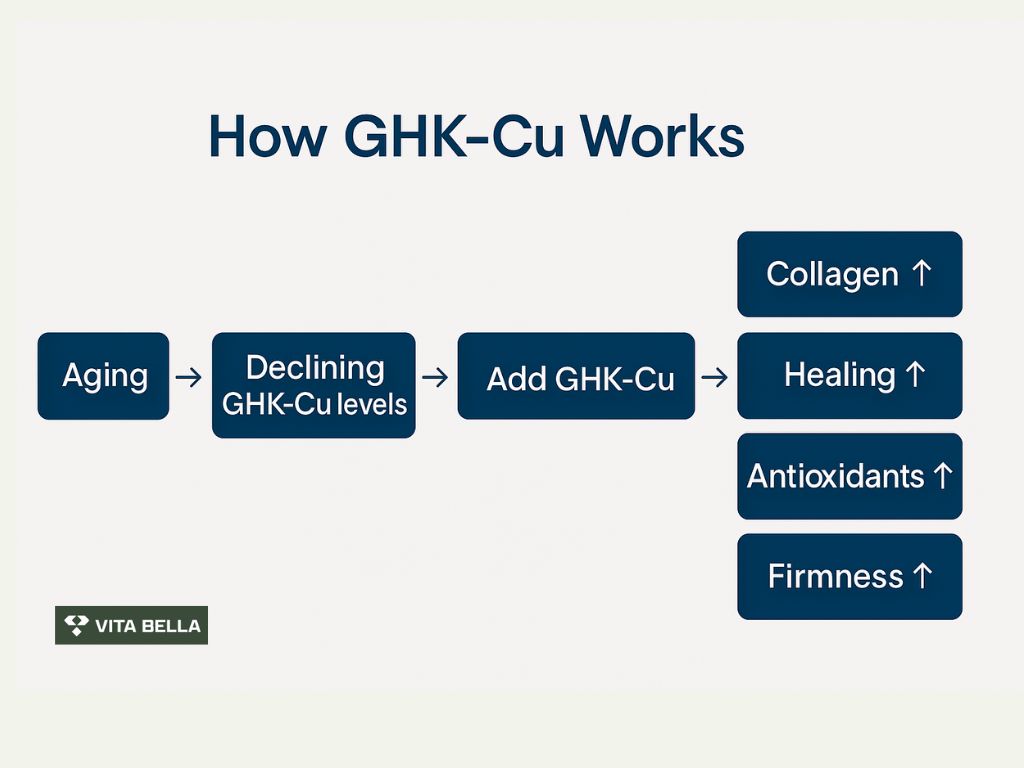
How GHK-Cu Works in the Skin?
GHK-Cu functions as a signaling peptide, directing cells to activate repair pathways. It regulates over 4000 human genes, with the end result being a potential improvement in skin health which can support a more youthful look. Additionally, research2 says that it stimulates fibroblasts, increases angiogenesis, and balances extracellular matrix (ECM) turnover, which collectively may rejuvenate skin and accelerate healing.
Key Benefits of GHK-Cu for Skin Health
GHK-Cu stimulates collagen and elastin production, helping restore firmness and reduce wrinkles. The peptide also reduces oxidative stress and inflammation by regulating antioxidant gene expression, protecting skin from aging triggers. Additionally, it strengthens the skin barrier and improves hydration, making skin smoother and more resilient.
1. Accelerates Wound Healing
GHK-Cu promotes faster closure of skin wounds by recruiting fibroblasts and endothelial cells. In controlled studies 3, wound area reduction reached ~60.9% within five days when GHK-Cu derivatives were applied, far outperforming untreated controls. In some trials, complete closure was observed in over 95% of wounds by day 15 under GHK-Cu treatment.
2. Boosts Collagen and Skin Firmness
Collagen production is essential for maintaining skin elasticity and firmness. Research 5 shows that GHK-Cu stimulates collagen and glycosaminoglycan synthesis in human dermal fibroblasts, improving skin structure and hydration. By enhancing both collagen and hyaluronic acid production, GHK-Cu helps reduce wrinkles, restore firmness, and improve overall skin texture.
3. Provides Antioxidant and Anti-Inflammatory Protection
GHK-Cu reduces levels of inflammatory cytokines (IL-6, TNF-α) and enhances antioxidant enzymes. This helps limit oxidative damage from UV radiation and pollution, as concluded by the research 4. By regulating iron release and reducing free radical stress, it supports skin resilience against environmental aging triggers.
4. Restores Skin Barrier and Elasticity
GHK-Cu increases the expression of barrier proteins such as filaggrin and loricrin, strengthening the epidermis. It also enhances elasticity by promoting elastin production, leading to a smoother, firmer skin surface.
Clinical Evidence and Statistics
A clinical trial 6 involving topical GHK-Cu in human volunteers (n = 40, age 40–65) showed significant reductions in wrinkle volume (~31.6 %) and depth (~32.8 %) compared to vehicle control over 8 weeks. The study also demonstrated increased collagen and elastin production in human dermal fibroblasts treated in vitro.
Delivery Methods in Skincare
Topical creams 5 and serums are the most common and effective for cosmetic skin improvements. Microneedle delivery enhances penetration and stimulates collagen production synergistically. Combination therapy works well alongside retinoids, hyaluronic acid, and growth factors. However, strong acids or oxidising agents should be avoided in parallel use, as they can destabilise peptide molecules.
Safety Profile of GHK-Cu
GHK-Cu is generally well tolerated in cosmetic use. It is non-toxic at topical concentrations and shows no evidence of irritation in human studies 6. However, long-term systemic use requires further investigation.
Wrinkles and weak skin aren’t your destiny – fight them with Vita Bella!
As collagen declines, skin becomes fragile, slower to heal, and prone to visible aging. Covering it up won’t restore your natural energy. Vita Bella’s GHK-Cu peptide solution rebuilds strength at the cellular level. It repairs damage, restores elasticity, and protects against future aging.
Choose Vita Bella and let your skin tell a story of renewal, not decline. Vita Bella brings you advanced skincare with Luminosa Glow Cream, a potent GHK-Cu formulation designed to restore, repair, and reveal youthful, radiant skin.
FAQs
What is GHK-Cu peptide, and how does it work on the skin?
GHK-Cu is a naturally occurring copper peptide that stimulates collagen production, supports wound healing, and protects against oxidative damage. It signals skin cells to repair and restore, helping improve firmness, elasticity, and overall radiance.
Is GHK-Cu peptide safe for all skin types?
Yes, studies show GHK-Cu is well-tolerated and non-toxic at cosmetic concentrations. It is suitable for most skin types, including sensitive skin, when used in professionally formulated skincare like Vita Bella’s.
How soon can I expect results with GHK-Cu skincare?
Many users notice improved hydration and smoother texture within weeks. Visible changes in firmness, reduced fine lines, and better healing typically appear with consistent use over 4–8 weeks, as collagen and skin barrier proteins rebuild.
Can GHK-Cu be combined with other skincare ingredients?
Yes, GHK-Cu works well alongside hyaluronic acid, peptides, and growth factors. However, it’s best to avoid pairing it with strong acids or oxidizing agents that may destabilize the peptide. Vita Bella’s formulations are designed for safe, effective synergy.
References:
He, B., Wang, F., & Qu, L. (2023). Role of peptide–cell surface interactions in cosmetic peptide application. Frontiers in Pharmacology, 14, 1267765. https://www.frontiersin.org/journals/pharmacology/articles/10.3389/fphar.2023.1267765/full
Pickart, L., & Margolina, A. (2018). Regenerative and Protective Actions of the GHK-Cu Peptide in the Light of the New Gene Data. International Journal of Molecular Sciences, 19(7), Article 1987. https://doi.org/10.3390/ijms19071987
Badenhorst, T., Svirskis, D., Merrilees, M., Bolke, L., & Wu, Z. (2016). Effects of GHK-Cu on MMP and TIMP expression, collagen and elastin production, and facial wrinkle parameters. Journal of Aging Science, 4, 166. https://www.walshmedicalmedia.com/open-access/effects-of-ghkcu-on-mmp-and-timp-expression-collagen-and-elastin-production-and-facial-wrinkle-parameters-2329-8847-1000166.pdf