









What if the $500 cream you’re buying hydrates your skin but does nothing to repair it? As you’ve seen, the luxury jars labelled with lofty promises yet many “premium” creams focus almost exclusively on hydration, not meaningful repair. While moisturizing is valuable, it doesn’t address the root causes of your skin’s structural decline: collagen breakdown, a deteriorated matrix, and hormonal shifts. Instead of pouring money into surface-only fixes, evidence shows that internal repair via hormones and peptides offers far stronger results.
Tired of spending hundreds on creams that only hydrate and smooth temporarily? At Vita Bella, we believe in real skin repair from the inside out. Our approach combines powerful peptides and hormones to rebuild collagen, restore elasticity, and rejuvenate your skin on a deeper level. Don’t settle for surface-level results; choose the science-backed solution that works long-term.
Why $500 Skin Creams Fail to Deliver Real Anti-Aging Results?
Most high-end skin creams emphasize hydration and surface ingredients such as humectants or silicones. Hydration can temporarily plump and smooth, but it doesn’t restore structural integrity or rebuild collagen networks. Meanwhile, one of the primary drivers of skin aging, especially in women, is estrogen decline. Estrogen supports collagen production, skin thickness, and hydration from within.
A randomized human study 1 found that topical estradiol significantly increased procollagen I and III mRNA and collagen I protein levels in naturally aged hip skin of postmenopausal women (38% increase in total collagen and hydroxyproline content in estradiol-treated skin after 3 months).
Another review 2 observed that estrogen therapy increases skin collagen content and thickness, and improves skin hydration by increasing hyaluronic acid and mucopolysaccharides. The cellular and subcellular locations and mechanisms of estrogen action remain poorly understood, despite the substantial effects of estrogens on the skin.
Can Estrogen Be the Key to Inside-Out Skin Repair?
When estrogen levels fall, the processes that maintain collagen, moisture, and skin thickness slow. In post-menopausal women, studies 3 show that estrogen therapy led to measurable increases in skin thickness and collagen content in sun-protected areas. Another study 4 shows that estrogen supports skin barrier function and hydration by increasing the levels of acid mucopolysaccharides, hyaluronic acid, and sebum.
Therefore, when skin creams ignore hormonal repair, they address only surface symptoms, not the underlying biology that drives aging. This results in temporary improvements, without tackling the root causes of collagen breakdown and skin thinning. In contrast, integrating hormone-based or hormone-mimicking interventions helps rebuild skin from the inside out, providing long-term benefits for skin health.
Are Peptides the Next Generation of Skin Repair?
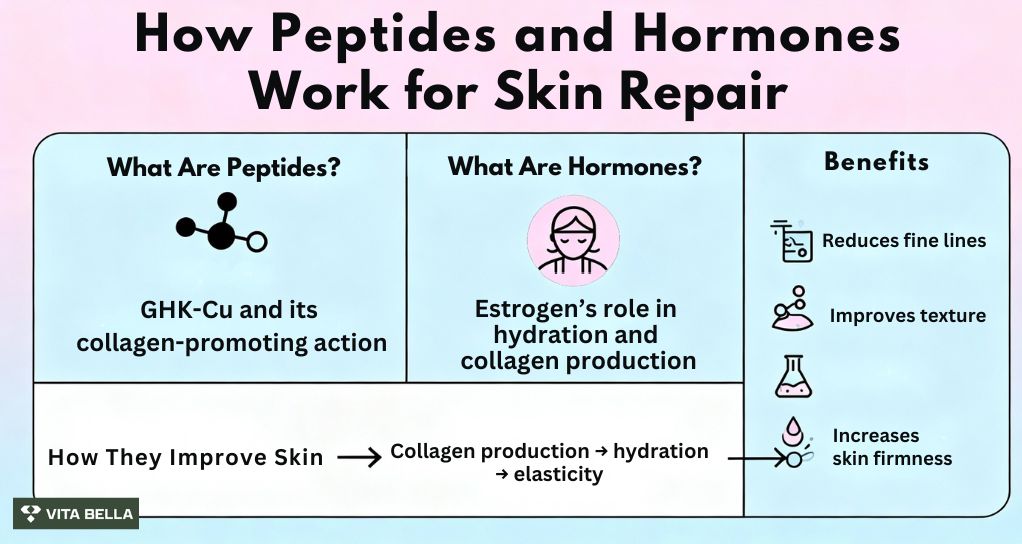
Peptides are short chains of amino acids that can signal skin cells to rebuild, repair, and regenerate. Among the best-studied is GHK-Cu (glycyl-L-histidyl-L-lysine-copper), a naturally occurring tripeptide found in human plasma. Topical GHK-Cu stimulates collagen and elastin gene expression, improves skin firmness and clarity, and is a highly credible repair agent in humans.
GHK-Cu has been shown in several clinical trials 5 to enhance the look of aged skin. 71 women with mild to severe photoaging were treated with a GHK-Cu-containing cream on their facial skin for 12 weeks. This resulted in enhanced skin density and thickness, decreased laxity, greater clarity, fewer fine lines, and deeper wrinkles. While many creams simply moisturize, peptide-enhanced formulations support repair mechanisms, boost collagen production, and stimulate actual change, not surface illusion.
To determine its impact on several components of the healing process, research 6 employed the 15-amino acid agent BPC 157, which has demonstrated broad-spectrum organoprotective effects in various experimental models. Granulation tissue development, angiogenesis, and collagen production are considered the most crucial components of the healing process.
How Do Peptides and Hormones Outperform Expensive Skin Creams?
Estrogen therapy significantly restores collagen content and skin thickness. GHK-Cu also supports measurable reductions in fine lines, improved clarity, and increased collagen gene expression. Creams that cost hundreds of dollars may only hydrate and temporarily smooth the skin, but they do not rebuild core structure.
Hormonal and peptide interventions address the biology beneath the surface, repairing collagen, boosting skin matrix, and improving skin resilience over time. In short, you pay more for less when the luxury jar only touches surface hydration. Real skin repair means going deeper; hormones + peptides do that.
What You Should Look For in Real Skin Results?
When seeking real skin results, focus on treatments that go beyond surface hydration. While moisturizing is helpful, it won’t address the root causes of aging, such as collagen breakdown and hormonal decline. Look for hormone support and peptide therapies that stimulate collagen production, restore skin structure, and improve elasticity. The key factors to look for include:
Hormone-based ingredients or medically supervised hormonal support (e.g., estrogens approved for skin benefit).
Peptide-active ingredients with human clinical data (e.g., GHK-Cu) show structural improvements, not just hydration.
Evidence of improved skin collagen, elasticity, density, or thickness not only provides a “moisturized feel.”
Transparent studies with human participants, not just marketing claims or animal data.
By applying these criteria, you steer away from overpriced creams and towards interventions that deliver measurable results.
Cut Through the Hype, Find Clinically-Proven Skin Care with Vita Bella
Tired of spending a fortune on creams that don’t deliver? Most high-end products only hydrate and temporarily smooth, but don’t fix the deeper issues. The real problem lies in collagen depletion, loss of skin elasticity, and hormonal decline. Without targeting these issues, no cream will provide lasting skin improvements. True skin rejuvenation starts by addressing these core factors from within.
Vita Bella’s peptide and hormone therapies target the skin’s structural needs from the inside. Our solutions naturally restore collagen production, increase hydration, and rebuild skin health. Why settle for a temporary fix when you can choose a long-term, science-backed approach? Invest in Vita Bella and experience true skin rejuvenation today.
FAQs
Do peptides and hormones provide better skin repair than traditional creams?
Yes, peptides and hormones act at the cellular level, stimulating collagen production, improving skin elasticity, and addressing underlying aging factors such as hormonal decline. Unlike traditional creams that focus only on hydration or surface smoothing, peptides and hormones rebuild skin from within, offering long-term structural improvements and more effective results.
Can estrogen help improve skin hydration and collagen production?
Yes, estrogen plays a critical role in supporting collagen production and skin hydration. Studies show that estrogen therapy can increase collagen content, skin thickness, and overall skin hydration. By targeting the internal causes of skin aging, estrogen helps improve the skin's structural integrity and moisture retention from the inside out.
Are expensive creams a waste of money if they only offer hydration?
Yes, while hydration is important, most expensive creams only address temporary symptoms without targeting the deeper biological causes of skin aging, such as collagen breakdown and hormonal shifts. To achieve lasting results, it's better to invest in hormone and peptide therapies that rebuild skin structure and promote long-term skin health.
Can peptides like GHK-Cu really improve skin appearance and texture?
Yes, peptides like GHK-Cu are scientifically proven to improve skin appearance by stimulating collagen production and enhancing skin texture. Clinical studies show that topical GHK-Cu significantly reduces fine lines and improves skin clarity. These peptides help repair skin from the inside out, offering longer-lasting, more profound benefits than surface-level creams.
References:
Rittié, L., Kang, S., & Voorhees, J. J. (2008). Induction of collagen by estradiol: Difference between sun-protected and photodamaged human skin in vivo. Archives of Dermatology, 144(9), 1129-1140. https://doi.org/10.1001/archderm.144.9.1129
Verdier‑Sťvrain, S., Bonté, F., & Gilchrest, B. (2006). Biology of estrogens in skin: Implications for skin aging. Experimental Dermatology, 15(2), 83‑94. https://doi.org/10.1111/j.1600‑0625.2005.00377.x
Yoon, H. S., & Chung, J. H. (2015). Long‑term estrogen effects on sun‑exposed human skin. In Textbook of Aging Skin (pp. 1‑11). Springer. https://doi.org/10.1007/978-3-642-27814-3_139-1
Pickart, L., & Margolina, A. (2018). Regenerative and protective actions of the GHK‑Cu peptide in the light of the new gene data. International Journal of Molecular Sciences, 19(7), 1987. https://doi.org/10.3390/ijms19071987
Seiwerth, S., Sikiric, P., Grabarevic, Z., Zoricic, I., Hanzevacki, M., Ljubanovic, D., Coric, V., Konjevoda, P., Petek, M., Rucman, R., Turkovic, B., Perovic, D., Mikus, D., Jandrijevic, S., Medvidovic, M., Tadic, T., Romac, B., Kos, J., Peric, J., & Kolega, Z. (1997). BPC‑157’s effect on healing. Journal of Physiology (Paris), 91(3‑4), 173‑178. https://doi.org/10.1016/S0928‑4257(97)01033‑9