
NAD+ therapy replenishes nicotinamide adenine dinucleotide, the coenzyme your cells depend on for energy production, DNA repair, and metabolic regulation. Levels fall significantly with age, and that decline is tied to fatigue, reduced cellular resilience, and cognitive slowdown. Whether delivered by IV or subcutaneous injection, NAD+ therapy is a core tool in anti-aging medicine because it addresses cellular function directly.
What does NAD+ therapy do for your body?
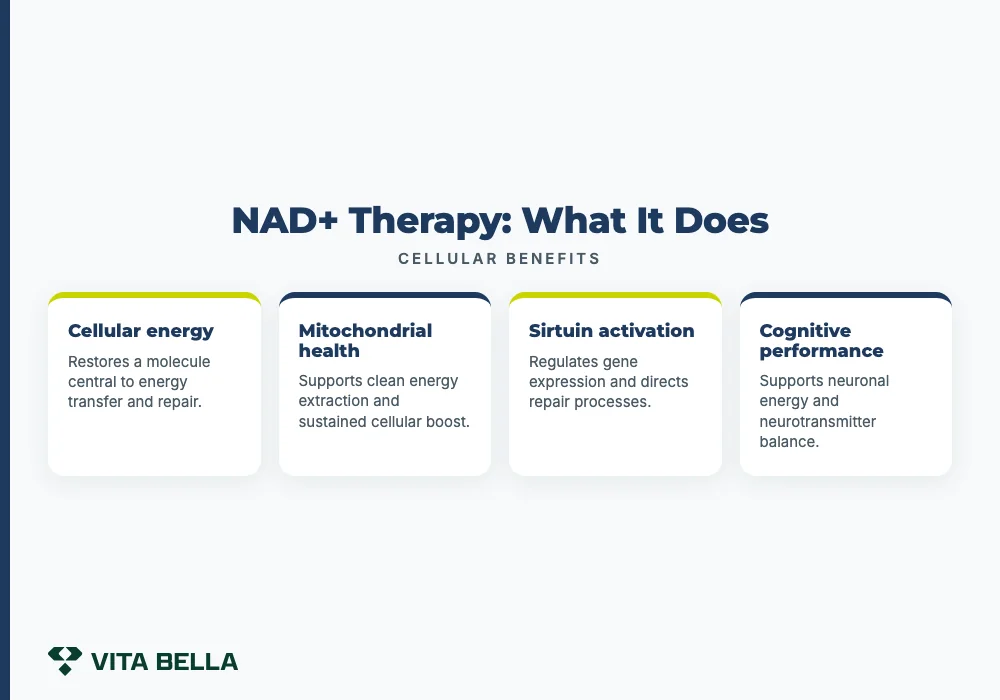
It restores a molecule at the center of cellular energy transfer, repair, and gene regulation. Without adequate NAD+, several key processes slow or stall. The downstream effects compound with age.
Cellular energy and mitochondrial health
Mitochondria use NAD+ to extract usable energy from food. When NAD+ is plentiful, this process runs cleanly and generates a sustained cellular energy boost that reaches muscles, brain, and every other tissue. A 2025 systematic review in the Journal of Translational Medicine confirmed that mitochondrial health is fundamental to tissue function and recovery across organ systems, which is part of why restoring this cofactor draws clinical interest.
When NAD+ falls short, mitochondrial efficiency drops. Research published in Heart Failure Reviews in 2024 found that impaired mitochondrial maintenance accelerates cellular dysfunction. Restoring adequate levels addresses that directly by supplying the cofactor mitochondria need.
Sirtuin activation and longevity pathways
Sirtuins regulate gene expression, manage cellular stress, and direct repair processes. They need NAD+ to function. Low NAD+ leaves these proteins under-resourced and unable to maintain tissue quality over time. Sirtuin activation is consistently cited as a core mechanism through which this coenzyme supports healthy aging. A 2014 study in Cell Metabolism found that restoring NAD+ precursor availability improved mitochondrial function in animal models, supporting the idea that replenishing this coenzyme reengages essential repair pathways.
Brain fog and cognitive performance
NAD+ supports neuronal energy metabolism and neurotransmitter balance. When levels decline, the result is often brain fog, slower recall, and reduced focus. Brain fog treatment is one of the most common reasons adults seek this kind of protocol. A 2018 study in Cell Metabolism found improvements in executive function in middle-aged and older adults following NAD+ and NR replenishment, providing clinical evidence for the neuronal mechanism. Key benefits
| Benefit | Mechanism | Evidence |
|---|---|---|
| Sustained energy | NAD+ fuels mitochondrial ATP production | 2014 Cell Metabolism; 2025 Journal of Translational Medicine |
| Cognitive clarity | Supports neuronal energy and neurotransmitter balance | 2018 Cell Metabolism study on executive function |
| Muscle maintenance | Sirtuins regulate muscle cell repair and guard against age-related atrophy | Preclinical sirtuin activation research |
| Mitochondrial function | Restores the cofactor mitochondria use for quality control | 2024 Heart Failure Reviews on autophagy and mitochondrial health |
| Cellular aging support | NAD+ decline is directly linked to age-related tissue changes | Oyovwi et al., 2024; published aging research |
How NAD+ levels change with age
NAD+ availability falls steadily from early adulthood onward. Research published in the Journal of Molecular Neuroscience in 2024 found that impaired mitochondrial clearance compounds this decline, creating a cycle in which lower NAD+ leads to worse mitochondrial quality, which further suppresses NAD+ production. The result is a progressive loss of cellular energy capacity that tracks closely with many common signs of aging.
Restoring NAD+ levels interrupts that cycle. By raising cellular levels directly, it bypasses the conversion steps that limit oral precursors, which is why clinical longevity infusion protocols use IV or injectable formats rather than supplements alone.
How NAD+ therapy is delivered
The treatment is administered by IV infusion or subcutaneous injection. IV delivery puts the molecule directly into circulation for rapid cellular uptake. Injectable formats require less time and are often used for maintenance. For a side-by-side look at how these options compare, choosing between NAD+ delivery formats covers the practical tradeoffs in detail.
A licensed provider determines which delivery method fits your health status and goals. Most programs start with an initial series of sessions, followed by maintenance at intervals the provider sets based on how you respond.
How long does a NAD+ therapy session last?
Session length depends on the delivery method. IV infusions require a slower, controlled rate to minimize discomfort and take longer than subcutaneous injections. There is no fixed duration that applies to every patient. Patients who are new to IV protocols may begin with shorter sessions to assess tolerance before longer or more frequent sessions are scheduled. A licensed provider sets the method, pace, and total session count based on your lab values, symptoms, and protocol goals. Frequency may also be adjusted as your response is tracked over time.
Who is a good candidate for NAD+ therapy?
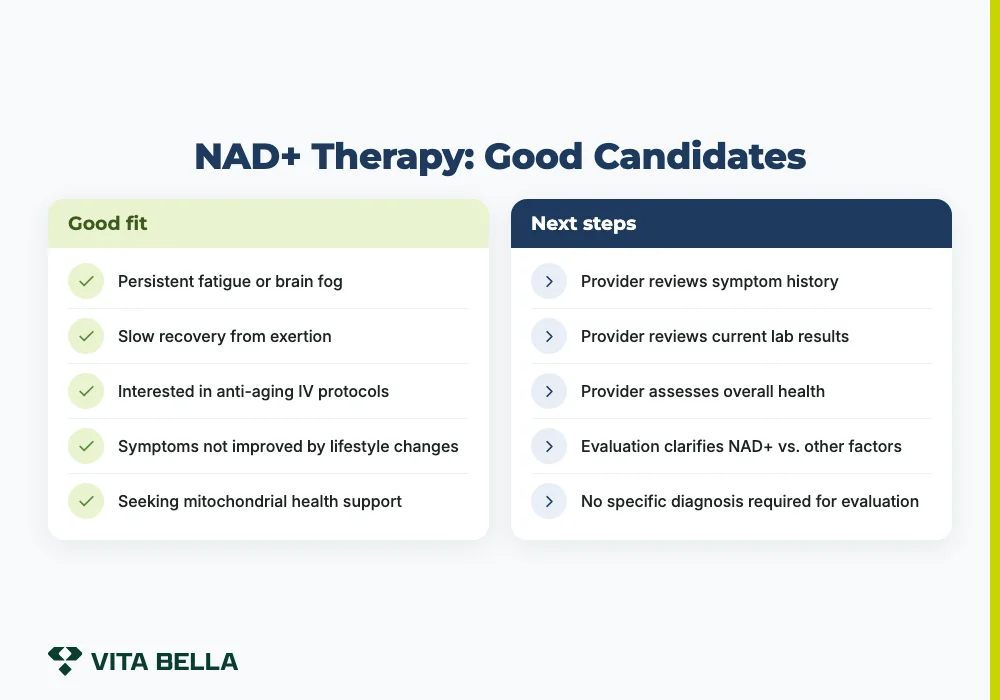
Adults experiencing persistent fatigue, brain fog, slow recovery, or signs of accelerated cellular aging are the most common candidates. No specific diagnosis is required to start an evaluation. A licensed provider reviews your symptom history, current labs, and overall health picture before recommending a protocol.
People who tend to benefit most include:
- Adults noticing progressive declines in energy or cognitive sharpness
- Those who recover slowly from physical exertion
- Individuals interested in evidence-based anti-aging IV drip protocols
- Anyone whose symptoms have not improved with lifestyle changes alone
- People looking to support mitochondrial health as part of a broader optimization plan
A provider evaluation also clarifies whether symptoms point to NAD+ decline specifically, or to overlapping factors such as hormonal or metabolic imbalance. For a deeper foundation on how this depletion develops, the biology of NAD+ depletion over time is a useful next read.
What are the side effects of NAD+ therapy?
This treatment is well tolerated by most people. Possible side effects, uncommon at physiological levels, may include temporary nausea, flushing, or lightheadedness during IV infusions. These responses are typically mild and resolve quickly when the infusion rate is slowed. Injectable formats carry fewer infusion-related effects. Side effects tend to be most noticeable in early sessions and often diminish as the body adjusts to the protocol. A licensed provider monitors your response throughout and adjusts as needed.
Is NAD+ therapy worth it?
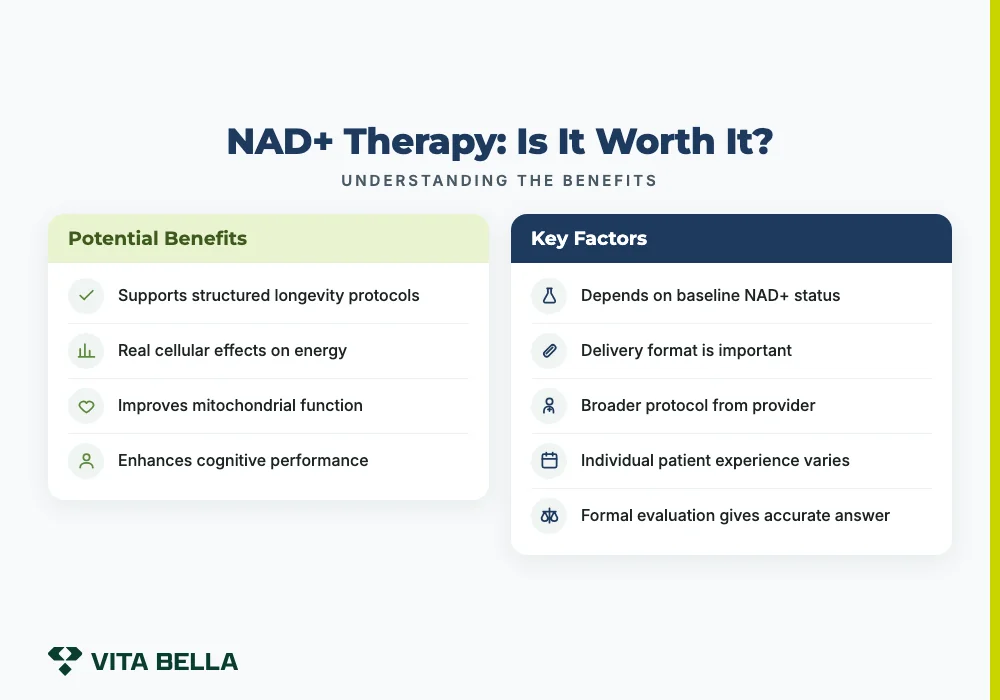
For adults with fatigue, brain fog, or poor recovery consistent with NAD+ decline, the evidence supports including this approach as part of a structured longevity protocol. The research base, including the 2014 and 2018 Cell Metabolism studies and the 2025 Journal of Translational Medicine systematic review, points to real cellular effects on energy, mitochondrial function, and cognitive performance.
Results depend on baseline NAD+ status, delivery format, and the broader protocol a provider builds. Vita Bella members access this through member wholesale pricing, with a licensed provider overseeing every protocol step. What a patient experiences varies, and a formal evaluation gives a more accurate answer than any general estimate.
Start exploring NAD+ therapy
At Vita Bella, a licensed provider reviews your labs and symptom history before recommending a protocol. That means a plan built around your biology, not a generic template. Get Started
Frequently asked questions
It replenishes a coenzyme that drives cellular energy production, supports mitochondrial maintenance, and activates sirtuin proteins involved in DNA repair and gene regulation. Low NAD+ is linked to fatigue, cognitive decline, and faster cellular aging. Restoring those levels can support energy, mental clarity, and cellular resilience.
Session duration depends on the delivery method and the protocol your provider prescribes. IV infusions require a controlled infusion rate and run longer than injectable formats. A licensed provider determines timing, frequency, and total session count based on your individual health profile.
For adults with symptoms consistent with NAD+ decline, such as persistent fatigue, brain fog, or slow recovery, the evidence supports it as a useful part of a structured longevity protocol. Results vary by individual, and a provider evaluation is the most reliable way to know whether this approach fits your situation.
Possible side effects are uncommon and typically mild, and may include temporary nausea, flushing, or lightheadedness during IV infusions. These effects usually resolve when the infusion rate is slowed. Injectable formats carry fewer infusion-related reactions, and a provider monitors your response throughout.
Adults with persistent fatigue, brain fog, slow recovery, or signs of accelerated cellular aging are common candidates. A licensed provider reviews your labs and symptoms to confirm fit. No single diagnosis is required to begin an evaluation.
Sources
- Zhang X et al. (2025). Exploring mitochondrial health and transplantation strategies in DCD heart transplantation: a systematic review. Journal of Translational Medicine. PubMed
- Tang Y et al. (2024). Autophagy protects mitochondrial health in heart failure. Heart Failure Reviews. PubMed
- Mitchell WR et al. (2014). Nicotinamide riboside, a precursor to NAD+, improves mitochondrial function and protects against metabolic disease in mice. Cell Metabolism.
- Najjar Y et al. (2018). NR and NAD+ replenishment stimulate neurogenesis and improve executive function in middle-aged and older adults. Cell Metabolism.
- Oyovwi MO et al. (2024). Mitophagy unveiled: exploring the nexus of mitochondrial health and neuroendocrinopathy. Journal of Molecular Neuroscience. PubMed