
Switching from TRT to enclomiphene is clinically feasible for the right patient, but it requires provider oversight, lab work, and an individualized plan. Testosterone replacement therapy supplies testosterone from an outside source; enclomiphene works differently, stimulating your body's own hormonal signaling axis. Stopping TRT on your own is not recommended. Enclomiphene is available only as a compounded medication prescribed through a licensed provider, not as a standalone approved drug.
Why men switch from TRT to enclomiphene
TRT and enclomiphene serve different goals. TRT delivers testosterone directly, which works well for many men, but it does so by signaling the brain that testosterone is already adequate. That signal shuts down the hormonal pathway the body normally uses to produce testosterone on its own.
Enclomiphene keeps that pathway active. For men who want to restore natural testosterone production or preserve fertility, that distinction matters. The right path depends on individual history and a full provider evaluation. Men still weighing both options can review the clinical comparison of enclomiphene vs. TRT before committing to either direction.
As the Endocrine Society Clinical Practice Guideline (Bhasin et al., 2018) notes, neither approach is inherently superior; candidacy depends on the clinical picture. A 2024 evidence synthesis in Health Technology Assessment (Cruickshank et al.) reinforces that TRT remains appropriate for many men, while others have specific reasons to consider alternatives.
Fertility and testicular function
TRT suppresses luteinizing hormone (LH) and follicle-stimulating hormone (FSH). Without LH and FSH signaling, sperm production drops and testicular volume can decrease over time. For men who want to conceive or who want to maintain testicular function, this suppression is the most common clinical reason a provider considers a different approach.
Enclomiphene preserves or may improve these parameters by keeping the HPG axis active rather than bypassing it. For a detailed look at enclomiphene's impact on testosterone and sperm function, the evidence is covered in a dedicated article.
Restoring endogenous testosterone production
Some men on TRT want to return to producing their own testosterone rather than depending on injections or other exogenous delivery. Enclomiphene works by blocking estrogen receptors at the pituitary, which prompts the brain to signal the testes to produce testosterone. The HPG axis stays engaged throughout treatment.
A 2025 systematic review and meta-analysis in Archives of Endocrinology and Metabolism (Hohl et al.) found that clomiphene and enclomiphene citrate raised total testosterone and gonadotropins in men with hypogonadism, supporting enclomiphene's mechanism as a central driver of endogenous production. A 2016 review in Expert Opinion on Pharmacotherapy (Rodriguez et al.) identified enclomiphene as a viable option for secondary male hypogonadism specifically because it stimulates rather than replaces.
How the transition works
TRT signals the brain that testosterone is adequate, which suppresses LH and FSH production. When TRT stops, the body needs time to clear the exogenous testosterone and for the pituitary to resume normal signaling. Starting enclomiphene after TRT is a staged process: it is introduced to stimulate the pituitary during or after this washout phase.
This process requires timing and monitoring. A provider tracks labs to gauge when the HPG axis is ready to respond and adjusts the plan accordingly. For a full explanation of the mechanism, how enclomiphene works and what to expect covers the biology in detail.
Enclomiphene does not have FDA approval as a standalone drug. It is available only as a compounded medication prescribed through a licensed provider under a valid prescription.
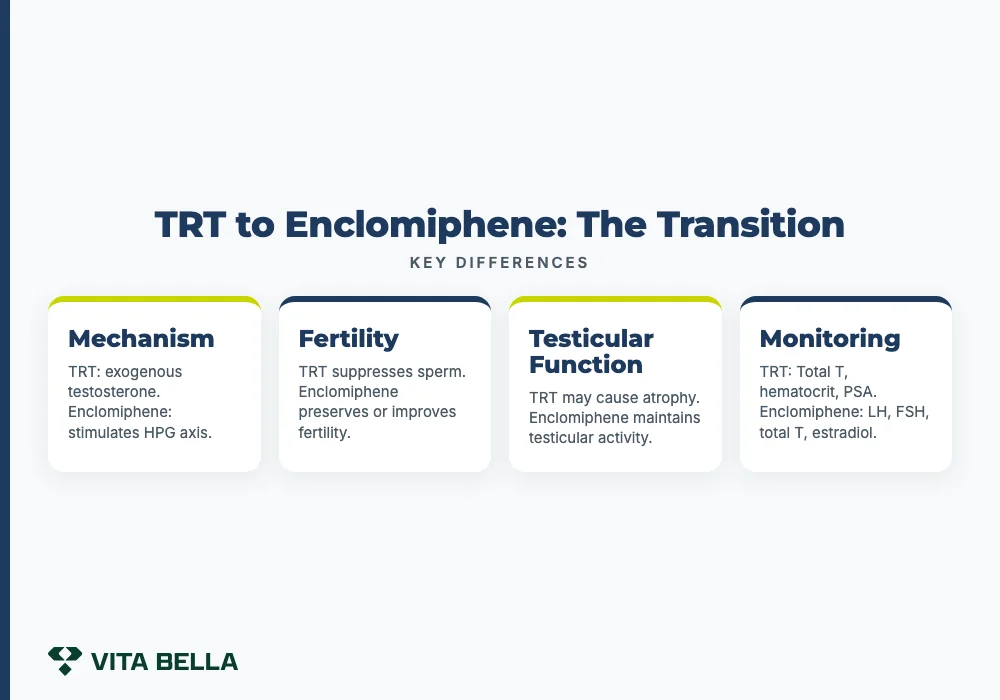
| TRT | Enclomiphene | |
|---|---|---|
| Mechanism | Exogenous testosterone | Stimulates HPG axis via LH/FSH |
| Fertility impact | Suppresses sperm production | Preserves or may improve fertility |
| Testicular function | May cause atrophy over time | Maintains testicular activity |
| Testosterone source | External | Endogenous |
| Monitoring panel | Total T, hematocrit, PSA | LH, FSH, total T, estradiol |
| FDA status | Approved | Compounded; no standalone FDA approval |
Can you switch from TRT to enclomiphene?
Yes. The switch is clinically possible for men with secondary hypogonadism whose testes can still respond to stimulation, but it requires a provider-ordered lab workup and an individualized plan. Stopping TRT independently is not recommended, and individual outcomes vary.
Who is a good candidate for the switch?
Provider evaluation determines eligibility. No universal protocol exists, and the right answer depends on how long TRT was used, the degree of HPG axis suppression, and whether the testes retain the capacity to respond.
The clinical profile that tends to make the trt to enclomiphene transition appropriate includes:
- Men on TRT who want to conceive or restore sperm production
- Patients with secondary (pituitary-driven) hypogonadism, where the testes can still respond to LH/FSH stimulation
- Men seeking to restore endogenous testosterone production rather than continue exogenous therapy
- Patients whose provider confirms testicular function is preserved enough to respond
The switch may not be appropriate for men with primary hypogonadism, where the testes themselves cannot respond to stimulation regardless of pituitary signaling. Certain medical histories and clinical contexts also make TRT the more appropriate ongoing path. A provider determines which category applies after reviewing labs and history.
What happens to testosterone levels when you switch?
After stopping TRT, testosterone levels typically drop before enclomiphene stimulation takes effect. The depth and duration of this dip depend on how long TRT was used, the individual's baseline HPG axis function, and how well the body responds to the transition.
The washout period: what to expect first
When TRT stops, the pituitary does not immediately resume full LH and FSH output. The duration of suppression and testicular recovery varies. A temporary dip in energy or mood is possible during this window.
This is the phase that sends many men searching for answers online, including guidance on coming off TRT with enclomiphene, often landing in spaces that offer dose-specific advice without clinical context. That approach carries real risk. A provider tracks labs during the washout period to assess recovery, confirm timing, and decide when to introduce enclomiphene. The goal is not to manage discomfort with guesswork; it is to protect the transition with data.
How long does enclomiphene take to work after TRT?
Enclomiphene typically raises LH and FSH within days of initiation. Testosterone levels follow over weeks, with the full response varying by individual. Labs confirm progress, and a provider adjusts the plan based on results.
Response depends on baseline testicular function and the degree of suppression from TRT. The Hohl et al. 2025 meta-analysis found that enclomiphene raised testosterone levels in men with hypogonadism, but individual variation is real. The Rodriguez et al. 2016 review similarly noted that response in secondary hypogonadism depends on intact testicular reserve.
Labs that guide the TRT-to-enclomiphene transition
Labs are ordered and reviewed by the provider before and throughout the switch. They are billed separately from the membership fee. No protocol is set without reviewing results first; a licensed provider determines the approach after labs.
The transition panel typically includes:
- LH and FSH: confirm HPG axis suppression before switching and track recovery during transition
- Total testosterone: baseline and ongoing monitoring of response to enclomiphene stimulation
- Estradiol: enclomiphene influences estrogen balance; monitored for shifts
- Semen analysis: for men with active fertility goals, tracks sperm parameters over time
Understanding where your labs fall relative to optimal ranges matters beyond just whether numbers are in the reference range. The article on when "normal" labs still leave you feeling suboptimal explains this distinction in practical terms.
If you are weighing this transition, a licensed provider's review of your labs and medical history is the right starting point. Explore hormone therapy at Vita Bella to see how provider-supervised care works, or Get Started to begin your intake evaluation.
How your body may change after the switch
Testosterone levels after switching to enclomiphene may stabilize at a different set point than they did on TRT. For men with secondary hypogonadism, fertility markers often improve as LH, FSH, and sperm production recover. Some patients experience symptom shifts during the adjustment period.
Honest framing matters here. Individual outcomes vary, and how well the HPG axis recovers determines the ceiling of what enclomiphene can achieve. Some men reach testosterone levels comparable to what TRT provided; others see a lower set point. The Hohl et al. 2025 review found meaningful testosterone improvements with enclomiphene in secondary hypogonadism, but the range of outcomes was wide.
Enclomiphene is a compounded medication prescribed and supervised by a licensed provider. It is not a self-directed option, and no aspect of this transition should be managed without ongoing clinical oversight.
Working with a provider on the switch
A licensed provider manages every step of switching from TRT to enclomiphene: reviewing labs, confirming HPG axis candidacy, timing the switch, and monitoring progress over time. Because enclomiphene is available only as a compounded medication through a licensed provider, the transition requires a valid prescription and ongoing supervision.
No patient stops TRT independently and simply adds enclomiphene. The biology of suppression and washout requires clinical judgment, not self-direction. Providers at Vita Bella review your full picture before recommending any change to your protocol. Learn more about provider-supervised hormone optimization and what that process looks like in practice.
Is switching from TRT to enclomiphene right for you?
If restoring fertility or natural testosterone production is a priority, the first step is a provider evaluation of your labs and history. Vita Bella's licensed providers review your full picture before recommending any change to your protocol. Get Started to begin your intake, or Book a Free Consult to talk through whether this transition fits your goals.
Frequently asked questions
Yes, the switch is clinically possible for men whose hypogonadism is secondary and whose testes can still respond to stimulation. A licensed provider evaluates labs and history to determine whether you are a candidate; stopping TRT without provider guidance is not recommended.
Testosterone typically drops during the washout period after stopping TRT before enclomiphene stimulation takes effect. The depth and duration of this dip vary by individual; a provider tracks labs throughout to manage the transition.
Yes. A provider orders labs, including LH, FSH, total testosterone, and estradiol, before and during the transition to confirm HPG axis recovery and guide timing. Labs are billed separately and reviewed by your provider.
Enclomiphene does not have FDA approval as a standalone drug. It is available as a compounded medication prescribed through a licensed provider under a valid prescription.
Some men experience a temporary dip in energy or mood during the washout phase before enclomiphene takes effect. This varies by individual and depends on factors such as how long TRT was used. A provider monitors your labs and symptoms throughout.
Sources
- Bhasin S et al. (2018). Testosterone Therapy in Men With Hypogonadism: An Endocrine Society Clinical Practice Guideline. Journal of Clinical Endocrinology & Metabolism. PubMed
- Cruickshank M et al. (2024). The effects and safety of testosterone replacement therapy for men with hypogonadism: the TestES evidence synthesis and economic evaluation. Health Technology Assessment. PubMed
- Hohl A et al. (2025). Clomiphene or enclomiphene citrate for the treatment of male hypogonadism: a systematic review and meta-analysis of randomized controlled trials. Archives of Endocrinology and Metabolism. PubMed
- Rodriguez KM et al. (2016). Enclomiphene citrate for the treatment of secondary male hypogonadism. Expert Opinion on Pharmacotherapy. PubMed