











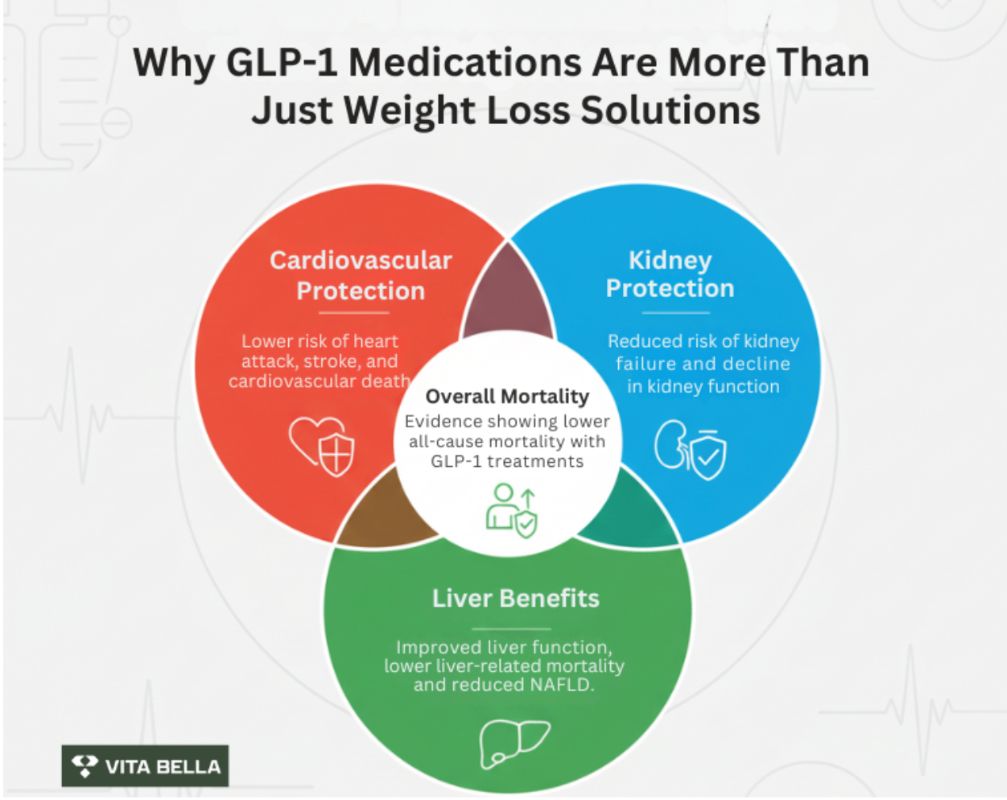
GLP-1 medications are no longer just about weight loss; they're rapidly emerging as some of the most powerful tools in modern medicine for protecting the heart, kidneys, and long-term metabolic health. Glucagon-like peptide-1 receptor agonists (commonly known as GLP-1 medications) began as treatments for type 2 diabetes, but recent human research reveals multisystem benefits beyond glucose control or weight loss alone.
GLP-1 medications, including semaglutide, are changing the landscape of modern medicine. At Vita Bella, we harness their full potential with precision and clinical expertise. From cardiovascular protection to metabolic resilience, we focus on outcomes that truly matter. Our approach combines advanced science, strategic oversight, and individualized care. This is not one-size-fits-all medicine. This is Vita Bella’s standard of care.
Can GLP-1 Medications Protect the Heart, Kidneys, Liver, and Overall Survival?
Glucagon-like peptide-1 receptor agonists (GLP-1 RAs) have emerged as a promising class of medications for the management of type 2 diabetes (T2D). According to a 2024 review 1, GLP-1 glucose-lowering effects are well-established, and their long-term impact on cardiovascular outcomes remains under ongoing research and debate. Semaglutide and similar medications are now linked with protective effects on the heart, kidneys, liver, and overall mortality in adults with metabolic disease.
What Are the Cardiovascular Benefits of Reducing Major Adverse Events?
The newest meta-analyses 2 show that GLP-1 receptor agonists significantly reduce major cardiovascular events, a cluster of outcomes including heart attack, stroke, and cardiovascular death in adults with type 2 diabetes.
In a systematic review of over 180,000 participants across 15 randomized trials, GLP-1 RA treatment was associated with a 12–13% relative reduction in composite major adverse cardiovascular events (MACE) compared with placebo or standard care, and lower risks of stroke and myocardial infarction.
Importantly, GLP-1 therapies improve traditional cardiovascular risk factors by lowering blood pressure, improving lipid profiles (reducing LDL and triglycerides), improving endothelial function, exerting anti-inflammatory effects, and enhancing systemic insulin sensitivity, benefits that extend beyond weight loss alone.
Research 3 also explains that the heart-protective effects of GLP-1 RAs may involve activation of the eNOS pathway, improved endothelial function, enhanced coronary blood flow, and inhibition of myocardial apoptosis and fibrosis.
How Does Kidney Protection Help in Slowing Decline and Reducing Composite Risk?
One of the most exciting developments from human clinical trials is kidney protection. Meta-analysis 4 study shows that GLP-1 receptor agonists were associated with a reduced risk of eGFR (estimated glomerular filtration rate) decline. The risk of all-cause mortality was also lower in the GLP-1 receptor agonist group, though heterogeneity was high. The protective effects also extend to reducing all-cause mortality and cardiovascular outcomes, suggesting a kidney-specific benefit independent of glucose lowering.
What Are the Liver Outcomes and Metabolic Health Implications Beyond Weight?
Emerging human research also points toward significant reductions in liver-related death and metabolic complications among people with type 2 diabetes using GLP-1 receptor agonists. A randomized controlled trial 5 in 52 people with NASH showed that liraglutide improved liver function, had a significantly 30% higher rate of NASH resolution, and a 27% lower risk of progression of liver fibrosis.
These effects align with improvements in insulin sensitivity and reductions in hepatic inflammation mechanisms that are increasingly understood to drive conditions like non-alcoholic fatty liver disease (NAFLD), which frequently accompany obesity and diabetes.
Nonalcoholic fatty liver disease, especially nonalcoholic steatohepatitis, has a higher liver-related and overall mortality risk than the general population. It has been shown that GLP-1 RAs can reduce the risk of all-cause mortality compared with placebo in patients with T2D.
What Are the Emerging Areas of Benefit Beyond Classical Outcomes?
While not yet established through large trials in non-diabetic populations, these early signs point to a multi-organ protective role for GLP-1 therapies that extends beyond traditional endpoints and underscores their evolving clinical importance. Although large randomized controlled trials primarily focus on cardiovascular, kidney, and mortality outcomes, recent human observational and cohort studies suggest even broader systemic benefits:
Potential cognitive protection: Large analyses of health records indicate lower dementia risk among patients using GLP-1 medications.
Inflammation reduction: GLP-1 RAs lower systemic inflammatory markers, which may mediate protection across tissues, including the liver, vascular endothelium, and metabolic organs.
Outsmart Your Condition with Vita Bella. Consult Experts Today.
GLP-1 medications are backed by strong science, yet patient outcomes vary widely. Many individuals receive a prescription without a long-term roadmap or proper clinical context. This gap limits both results and the full range of protective benefits these therapies can offer. Medication alone, without strategy or monitoring, is not a complete solution for lasting metabolic health. True progress requires guidance that evolves with the patient.
At Vita Bella, we restore intention and structure to GLP-1 therapy. Our multidisciplinary team aligns treatment with advanced metabolic science and real-world patient data. We focus on protection, performance, and sustainability at every stage of care. Each plan is personalized, actively monitored, and adjusted as needed. This is how real, long-term transformation takes place with Semaglutide.

FAQs
Do GLP-1 medications provide health benefits beyond weight loss?
Yes, human clinical trials and large meta-analyses show that GLP-1 medications improve cardiovascular outcomes, reduce kidney disease progression, lower all-cause mortality, and improve metabolic health. These benefits occur alongside weight loss but also extend independently through improved insulin sensitivity, reduced inflammation, and favorable effects on blood pressure and lipid profiles.
Can GLP-1 medications reduce the risk of heart disease and stroke?
Yes, multiple large randomized trials demonstrate that GLP-1 receptor agonists significantly reduce major adverse cardiovascular events, including heart attack and stroke. These medications simultaneously improve several cardiovascular risk factors, including glycemic control, blood pressure, and cholesterol, thereby reducing long-term cardiovascular risk in adults with metabolic disease.
Do GLP-1 medications protect kidney function in adults?
Yes, GLP-1 receptor agonists have been shown to reduce the risk of kidney function decline and kidney-related complications. These protective effects are observed in adults with type 2 diabetes and chronic kidney disease and appear to occur independently of glucose-lowering, suggesting direct renal benefits beyond blood sugar control.
Are GLP-1 medications beneficial for people without diabetes?
Yes, emerging human evidence indicates that adults with obesity but without diabetes may still experience significant benefits from GLP-1 medications, including reduced cardiovascular events and lower all-cause mortality. These findings suggest GLP-1 therapies may offer broader metabolic and organ-protective effects beyond traditional diabetes management.
References:
Tariq, S., Cheema, B. S., Iftikhar, H. M. H., Ali, M. A., Fareh Ali, M., Shah, S. Q. A., Perveen, F., & Zaman, T. (2024). Long‑term cardiovascular outcomes of glucagon‑like peptide‑1 (GLP‑1) receptor agonists in type 2 diabetes: A systematic review. Cureus, 16(11), e73705. https://doi.org/10.7759/cureus.73705
Tariq, S., Cheema, B. S., Iftikhar, H. M. H., Ali, M. A., Fareh Ali, M., Shah, S. Q. A., Perveen, F., & Zaman, T. (2024). Long‑term cardiovascular outcomes of glucagon‑like peptide‑1 (GLP‑1) receptor agonists in type 2 diabetes: A systematic review. Cureus, 16(11), e73705. https://doi.org/10.7759/cureus.73705
Chen, X., Zhang, X., Xiang, X., Fang, X., & Feng, S. (2024). Effects of glucagon‑like peptide‑1 receptor agonists on cardiovascular outcomes in high‑risk type 2 diabetes: A systematic review and meta‑analysis of randomized controlled trials. Diabetology & Metabolic Syndrome, 16, Article 251. https://doi.org/10.1186/s13098-024-01497-4
Chen, J.‑Y., Hsu, T.‑W., Liu, J.‑H., Pan, H.‑C., Lai, C.‑F., Yang, S.‑Y., & Wu, V.‑C. (2025). Kidney and cardiovascular outcomes among patients with CKD receiving GLP‑1 receptor agonists: A systematic review and meta‑analysis of randomized trials. American Journal of Kidney Diseases, 85(5), 555–569.e1. https://doi.org/10.1053/j.ajkd.2024.11.013
Yen, F. S., Hou, M. C., Wei, J. C.‑C., Shih, Y.‑H., Hwu, C. M., & Hsu, C.‑C. (2024). Effects of glucagon‑like peptide‑1 receptor agonists on liver‑related and cardiovascular mortality in patients with type 2 diabetes. BMC Medicine, 22, Article 8. https://doi.org/10.1186/s12916-023-03228-