










If you’re struggling with fatigue, low libido, stubborn weight gain, or declining motivation and your doctor keeps telling you your testosterone is “normal,” you’re not alone. This diagnostic failure isn’t just common; it’s built into the system itself. The truth is that population-wide testosterone ranges, outdated diagnostic thresholds, and incomplete hormone testing leave millions of men undiagnosed.
Feeling off, tired, or unlike yourself even though your doctor says your testosterone is “normal”? At Vita Bella, we know this is where many men miss out on life-changing TRT support. Outdated lab ranges often block men from receiving the therapy they truly need. Let’s uncover what your numbers aren’t showing and explore whether TRT could help restore your energy.
Are Population-Wide Testosterone Ranges Misleading Your Diagnosis?
Lab ranges used to diagnose low testosterone (hypogonadism) often pool men aged 18 through 65, producing extremely broad reference intervals. According to a study 1, in many U.S. labs, the “normal” total testosterone range is 264–916 ng/dL, despite enormous age-related hormonal differences.
This means a 22-year-old athlete and a 62-year-old retiree fall under the same "normal" umbrella, even though their optimal levels are dramatically different. A 48-year-old man sitting at 350 ng/dL may be told he's fine, even though many healthy men his age function best above 550 ng/dL. It was also confirmed that primary care settings frequently underdiagnose testosterone deficiency because physicians rely solely on “normal” population-based TT values, not on symptoms or optimal ranges.
How Do Free and Total Testosterone Differences Explain Your Symptoms?
One of the biggest mistakes in diagnosing low testosterone is measuring total testosterone (TT) alone. TT includes testosterone bound to SHBG or albumin, plus the tiny fraction that remains biologically active. But only 1–3% of all testosterone, your free testosterone (FT), actually activates receptors and drives energy, libido, muscle strength, cognition, and mood.
This is where many diagnoses fall apart. A man can show a “normal” TT level while still having low free testosterone, meaning the hormone is present on paper but not active in his body. This mismatch explains why so many men have classic symptoms of low testosterone despite reassuring lab results. Primary care physicians frequently test TT alone, leaving crucial diagnostic information completely unseen.
How Does SHBG Alter Your Testosterone Levels?
Sex Hormone-Binding Globulin (SHBG) determines how much testosterone actually becomes free. High SHBG binds more testosterone, leaving less available to tissues. Low SHBG does the opposite. A large study 2 showed that 73% of men with adult-onset low testosterone had SHBG below 30 nmol/L, dramatically influencing TT vs. FT interpretation.
Another peer-reviewed evaluation 3 found that accurate diagnosis requires both total and free testosterone, especially when SHBG levels are abnormal. Only a small percentage of men using testosterone therapy receive the proper diagnosis and monitoring, which could result in less-than-ideal results. Yet most primary care providers never measure SHBG. That means they miss:
Men with high SHBG have “normal” TT but low FT
Men with low SHBG have low TT but adequate FT
Men whose symptoms come from binding issues, not production issues
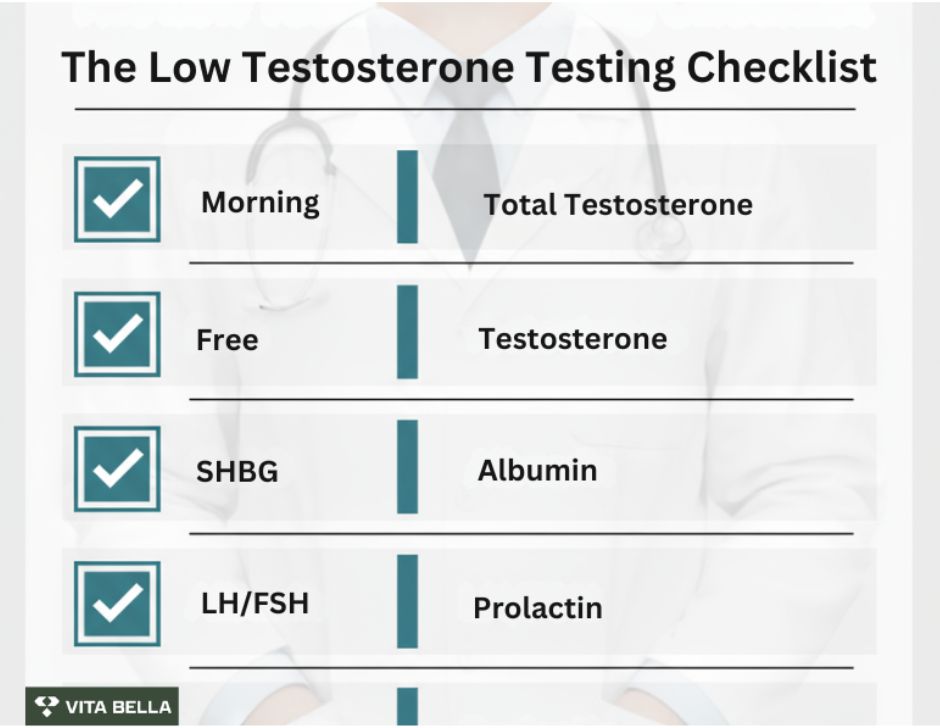
What Men Should Test When Symptoms Don’t Match the Numbers?
Age, circadian rhythms, location, genetics, lifestyle choices, comorbid conditions, and intra-individual daily variability are some of the factors that affect observed T levels. According to research 4, it is arguable if free T (fT) is more useful than total T, and the proper threshold values must be used to evaluate the two. Equilibrium dialysis and mass spectrometry are the gold standards among test methods. If you suspect low testosterone, here’s the science-backed blood panel you need:
Total Testosterone (morning draw, 7–10 a.m)
Free Testosterone (preferably by equilibrium dialysis)
SHBG
Albumin (needed to calculate FT accurately)
LH and FSH (to assess testicular vs. pituitary origin)
Prolactin (can suppress T)
Testing testosterone alone is insufficient. Comprehensive hormone testing is essential.
Why Primary Care Doctors Keep Missing Low Testosterone Cases?
Primary care doctors often miss low testosterone because they rely solely on broad population-wide total testosterone ranges that fail to reflect optimal levels for men of different ages. Many also skip testing free testosterone and SHBG, which are essential for understanding true hormonal function. Here’s why you’re stuck in a TRT blackout:
1. They follow outdated guidelines requiring very low TT (<300 ng/dL).
But symptoms often appear long before TT drops below population-derived cutoffs.
2. They rarely check free testosterone.
Despite the AUA recommending FT measurement when TT is near the low-normal edge or SHBG is abnormal.
3. They don’t measure SHBG unless specifically asked.
Yet SHBG directly determines your FT level.
4. They ignore age-adjusted “optimal” testosterone ranges.
A 40-year-old with 320 ng/dL is “normal,” but far from functioning optimally.
5. They treat your lab value, not your symptoms.
Low libido, depression, brain fog, fatigue, central weight gain—these may all stem from low FT even when TT looks fine.
Get Tested, Get Treated, Personalized Plans by Vita Bella
You may feel exhausted, unfocused, and disconnected, but still be told your testosterone is “fine.” The real issue is that standard lab ranges do not reflect optimal male health. Doctors often skip free T and SHBG, leaving low testosterone untreated. This creates a silent epidemic of undiagnosed hormonal decline. It’s time to challenge the outdated system that keeps men from the answers they deserve.
Vita Bella looks beyond generic ranges to uncover what’s truly affecting you. We guide you through comprehensive testing and accurate interpretation. Our science-backed approach helps you determine whether TRT is the solution. Take control of your hormonal health and rebuild your power from the inside out. Your journey to renewed strength and confidence begins with a deeper understanding of your hormones.
FAQs
Can I have low testosterone even if my total testosterone is “normal”?
Yes, many men experience classic symptoms of low testosterone despite having total testosterone values that fall inside broad population-based ranges. This happens because total testosterone doesn’t reflect how much hormone is actually active in the body. Free testosterone can be low even when total testosterone appears normal, especially if SHBG is elevated.
Should free testosterone be tested if I suspect low T?
Yes, free testosterone provides a far more accurate picture of hormonal function than total testosterone alone. Since only 1–3% of testosterone is biologically active, relying on total testosterone can easily miss deficiencies. Testing free testosterone, especially when symptoms are present, helps uncover hidden imbalances that primary care evaluations often overlook.
Can SHBG levels affect how much testosterone my body actually uses?
Yes, SHBG significantly influences how much testosterone remains free and available for biological activity. When SHBG is high, it binds more testosterone and reduces free testosterone, even if total levels look normal. When SHBG is low, free testosterone may appear higher than expected. Understanding SHBG is critical for accurate diagnosis and treatment decisions.
Do most primary care doctors miss early testosterone deficiency?
Yes, many primary care physicians rely solely on total testosterone thresholds and outdated reference ranges that combine men aged 18 to 65. This approach ignores symptoms, free testosterone levels, and SHBG abnormalities. As a result, men with genuine hormonal decline often go untreated simply because their lab numbers fall within a broad “normal” zone.
References:
Travison, T. G., Vesper, H. W., Orwoll, E., Wu, F., & Kaufman, J. M. (2017). Harmonized reference ranges for circulating testosterone levels in men of four cohort studies in the United States and Europe. Journal of Clinical Endocrinology & Metabolism, 102(4), 1161-1173. https://doi.org/10.1210/jc.2016-2935
Winters, S. J. (2020). SHBG and total testosterone levels in men with adult onset hypogonadism: What are we overlooking? Clinical Diabetes & Endocrinology, 6, 17. https://doi.org/10.1186/s40842-020-00106-3
Guzelce, E. C., Galbiati, F., Goldman, A. L., Gattu, A. K., Basaria, S., & Bhasin, S. (2022). Accurate measurement of total and free testosterone levels for the diagnosis of androgen disorders. Best Practice & Research: Clinical Endocrinology & Metabolism, 36(4), 101683. https://doi.org/10.1016/j.beem.2022.101683
Trost, L. W., & Mulhall, J. P. (2016). Challenges in testosterone measurement, data interpretation, and methodological appraisal of interventional trials. The Journal of Sexual Medicine, 13(7), 1029-1046. https://doi.org/10.1016/j.jsxm.2016.04.068