










Many men seek testosterone therapy to feel stronger and more energized but few realize it can quietly impact their fertility if not carefully managed. Testosterone Replacement Therapy (TRT) delivers clear benefits: improved libido, mood, muscle mass, and energy. Yet when used without precaution, TRT can undermine fertility by suppressing the body’s own sperm-making machinery.
Experience renewed strength and balanced energy with Vita Bella’s advanced TRT and fertility-preserving protocols. Designed for men who want results without compromise, our physician-led programs optimize testosterone while protecting what matters most to your reproductive health and long-term wellness.
How TRT Impacts the Male Reproductive System?
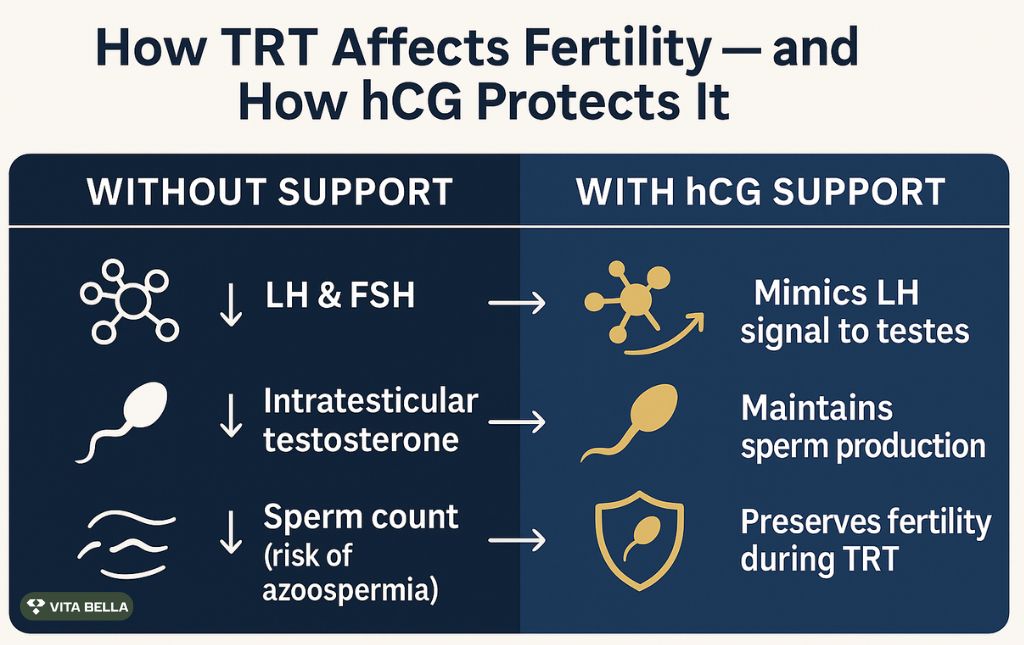
When you introduce exogenous testosterone, your hypothalamus and pituitary sense “enough” hormone and reduce or shut off GnRH, LH, and FSH output. Without LH/FSH, testicular testosterone production and spermatogenesis (sperm formation) decline dramatically. Clinical reviews 1 show TRT can lead to azoospermia (no sperm) or severe oligospermia (very low sperm) in many men.
In one retrospective cohort 2, researchers treating men who previously used testosterone found that even with intensive hCG + FSH “reboot” therapy, fewer than half regained full semen parameters. It was noted that most men recover spermatogenesis after stopping TRT, but that recovery often takes months to years and may not reach original levels. Age and length of TRT significantly influence recovery time: older men and those on TRT for a longer period tend to recover more slowly (or incompletely).
What are the Strategies to Safeguard Fertility During TRT?
You don’t have to choose between energy and fertility. Several medical strategies help men use TRT while preserving reproductive function:
1- Add low-dose HCG (human chorionic gonadotropin):
HCG mimics LH and stimulates the testes to maintain intratesticular testosterone and sperm production. In men on TRT 3 plus hCG (e.g., 500 IU every other day), testicular size and sperm output were better preserved than in men using TRT alone.
2- Reboot with hCG + FSH after TRT cessation:
According to research 4, in men who’ve already suppressed sperm production, combining hCG with purified FSH is an advanced strategy to rescue spermatogenesis. Results vary, but up to 64.9% of men may respond favorably.
3- Cycle or microdose TRT:
Some clinicians use alternating TRT and recovery periods or lower TRT doses paired with hCG to reduce suppression risk. It may preserve fertility in men needing long-term hormone support.
Who Should Consider Fertility-Protecting Measures?
Men planning to have children while on TRT should discuss fertility preservation early. Those over 35, on long-term therapy, or with a history of low sperm count benefit most from protective strategies like hCG co-administration to maintain sperm production and hormonal balance.
1- Age over 35
Because age is associated with reduced hypothalamic–pituitary–gonadal responsiveness, men ≥35 are more likely to experience stronger suppression of LH/FSH on TRT and slower recovery of spermatogenesis after discontinuation.
Reviews 5 also note that shutdown severity and recovery difficulty increase with age-related (functional) hypogonadism, so fertility-protecting add-ons should be discussed before starting therapy.
2- Long-term TRT plans
The duration and dose of exogenous testosterone correlate with the depth of HPG-axis suppression and the time required for sperm recovery; longer courses generally mean slower or incomplete return of semen parameters.
Planning fertility preservation (e.g., banking sperm and/or adding gonadotropin support) is prudent when TRT is expected to be ongoing.
3- History of low sperm count
Men who begin TRT with oligospermia or borderline semen parameters have a lower probability of achieving full “normal” recovery if suppression occurs; recent retrospective data show variable responses even with active rescue (hCG + FSH), underscoring the value of proactive protection. Baseline semen testing and early co-administration strategies can improve the odds.
4- Use of high-dose or supraphysiologic testosterone
Men with a history of anabolic-androgenic 6 steroid exposure are at greater risk for severe suppression (azoospermia/severe oligospermia) and may require longer, more intensive protocols to recover fertility; standardized regimens can help but recovery rates vary. This group benefits most from early counseling and gonadotropin-based protection if TRT is pursued.
Why consider hCG from day one?
Low-dose hCG given alongside TRT helps maintain intratesticular testosterone the critical driver of spermatogenesis thereby reducing the risk of azoospermia while on therapy. Clinical studies 7 demonstrate that co-administration can preserve sperm production in many men who need TRT and want to protect near-term fertility.
What are the Safety & Monitoring Considerations of TRT?
TRT is safe when prescribed and monitored by qualified physicians. Regular testing of testosterone, LH, FSH, hematocrit, and semen parameters ensures hormonal balance and fertility preservation to manage fertility safely during TRT:
Use pharmaceutical-grade agents under physician supervision.
Monitor LH, FSH, serum testosterone, semen analysis, and testicular volume at baseline and every 3–6 months.
Adjust hCG dose based on response (500 IU every other day is common starting point).
Be patient: Recovery may take 6–24 months, and full restoration is never guaranteed, as described by research 8.
Counsel on lifestyle: avoiding heat, smoking, and optimizing diet/sleep helps fertility alongside medical therapy.
Achieve Hormone Balance and Feel Your Best - Begin Now with Vita Bella
Low energy, fading libido, and hormonal imbalance can quietly erode your confidence and quality of life. For many men, TRT offers renewal, but it can also threaten fertility if not managed correctly. You deserve peak energy without losing your ability to build a family.
Vita Bella’s advanced TRT protocols combine testosterone therapy with fertility-protective measures that keep sperm health and hormone function aligned delivering true, lasting balance and complete peace of mind.
FAQs
Can men on TRT still maintain fertility?
Yes, men on TRT can maintain fertility if therapy is managed under medical supervision with protective measures like low-dose hCG co-administration. hCG mimics natural LH, preserving testicular testosterone and sperm production. Regular semen analysis and hormone monitoring ensure reproductive health stays intact throughout treatment.
Does stopping TRT restore natural sperm production?
Yes, most men can regain sperm production after stopping TRT, though recovery time varies from a few months to over a year depending on age, dosage, and treatment duration. Medical “reboot” therapies using hCG and FSH can accelerate recovery and improve the likelihood of returning to baseline fertility.
Is TRT safe for men planning to have children?
Yes, TRT can be used safely by men planning families if fertility-preserving protocols are implemented from day one. Physicians often prescribe hCG or selective gonadotropin therapy alongside testosterone to prevent suppression of the hypothalamic-pituitary-gonadal axis. Early planning and regular hormone tracking minimize fertility risks while maintaining hormonal balance.
Should men with low sperm count start TRT?
No, men with already low sperm counts should avoid starting TRT without fertility support. Testosterone therapy alone can further suppress spermatogenesis. Instead, doctors may recommend combined approaches such as hCG therapy or clomiphene citrate to raise testosterone levels naturally while preserving or improving sperm production.
References:
Naelitz, B. D. (2022). Testosterone replacement therapy and spermatogenesis in reproductive age men. Translational Andrology and Urology, 11(6), 757–766. https://doi.org/10.21037/tau-21-1088
Stocks, B., Oppenheimer, A., Huang, J., & Lipshultz, L. (2022). Optimal restoration of spermatogenesis following testosterone therapy using hCG and FSH. Fertility and Sterility, 118(4), e222. https://doi.org/10.1016/j.fertnstert.2022.07.613
Kohn, T. P., Louis, M. R., Pickett, S. M., Lindgren, M. C., Kohn, J. R., Pastuszak, A. W., & Lipshultz, L. I. (2019). Concomitant intramuscular human chorionic gonadotropin preserves spermatogenesis in men undergoing testosterone replacement therapy. The Journal of Urology, 201(5), 1069–1075. https://doi.org/10.1097/JU.0000000000000018
Stocks, B. T., Oppenheimer, A. G., Huang, J. B., & Lipshultz, L. I. (2022). Optimal restoration of spermatogenesis following testosterone therapy using hCG and FSH. Fertility and Sterility, 118(4), e222. https://doi.org/10.1016/j.fertnstert.2022.07.613
Fink, J. (2024). Management of male fertility in hypogonadal patients on testosterone replacement therapy. World Journal of Men's Health, 42(1), 40–52. https://doi.org/10.5534/wjmh.240147
Ledesma, B. R., & Lipshultz, L. I. (2022). Fertility outcomes in men with prior history of anabolic steroid use. Fertility and Sterility, 118(4), e221–e222. https://doi.org/10.1016/j.fertnstert.2022.07.610
Avila, D., Gittens, P. R., Hwang, K., Weedin, J. W., Rumohr, J. A., & Lipshultz, L. I. (2019). Low-dose human chorionic gonadotropin prevents azoospermia and maintains fertility in hypogonadal men on testosterone replacement therapy. BJU International, 123(5), 846–853. https://doi.org/10.1111/bju.14619
Stahl, P. J. (2022). Recovery of spermatogenesis after hormone therapy: What to expect and when to expect it. World Journal of Men's Health, 40(1), 1–12. https://doi.org/10.5534/wjmh.210158
QUICK SUMMARY:
Here are the key points from the document, keeping it informal:
Heads Up on TRT and Fertility: You might be taking Testosterone Replacement Therapy (TRT) to feel great—more energy, better mood, bigger muscles—but a big downside is that it can mess with your sperm production and fertility if you don't manage it carefully.
The Fertility Problem: When you add outside testosterone, your body basically thinks it has enough and shuts down the natural signals (LH and FSH) that tell your testicles to make sperm. This can lead to very low sperm count or even no sperm at all (azoospermia).
Recovery Can Be a Drag: If you stop TRT, your sperm production usually comes back, but it can take a long time—like months or even years. And you might not get back to your original fertility level. Older guys and those on TRT for a long time generally have a tougher time recovering.
Protect Your Swimmers—Strategies That Work: You don't have to choose between feeling energized and having kids.
Add low-dose hCG: This stuff acts like LH, which keeps your testicles working and making sperm while you're on TRT. A common starting dose is around 500 IU every other day.
The "Reboot" After TRT: If you've already suppressed your sperm production by stopping TRT, your doctor can try a mix of hCG and FSH to "rescue" it. It works for a decent number of guys, but not everyone.
Cycling/Microdosing: Some doctors try alternating TRT with recovery periods or using lower TRT doses combined with hCG for long-term users.
Who Should Be Extra Careful?
Guys over 35: Your body is more likely to shut down your natural hormone production, and recovery will probably be slower.
Planning Long-Term TRT: If you plan to be on it for a while, you should definitely talk about fertility preservation (like sperm banking or adding hCG) from the start.
History of Low Sperm Count: Starting TRT when your sperm count is already low can make things even worse. Get checked and use protection strategies.
Used High-Dose Steroids: Previous use of high-dose testosterone or anabolic steroids means you're at a higher risk for severe suppression and may need more intense recovery treatments.
Why hCG from Day One? It keeps the critical process of sperm production going right from the start, significantly lowering the risk of having no sperm while you're on TRT.
Keep it Safe and Monitored: TRT is safe, but you need a qualified doctor to monitor things. Get regular check-ups that include your testosterone, LH, FSH, and sperm analysis every 3–6 months.
The Vita Bella Pitch: They offer advanced TRT programs that include those fertility-protective measures so you can get the benefits of testosterone without sacrificing your ability to start a family.