









What does Tirzepatide really cost, and how can it be made more affordable? Let’s break down the numbers and uncover innovative ways to save without compromising your results. With the rising popularity of Tirzepatide for weight management and type 2 diabetes, understanding the cost ahead of time helps readers make informed decisions and plan financially. A recent economic evaluation study 1 found that Tirzepatide generates significant lifetime health gains, but its net price remains a significant barrier.
Confused about Tirzepatide pricing? You’re not alone. With rising demand and varying pharmacy costs, knowing what you’ll really pay can feel overwhelming. At Vita Bella, we believe financial clarity is part of wellness. That’s why we break down the actual cost of Tirzepatide, helping you understand, plan, and invest wisely in your health transformation.
Is Tirzepatide More Cost-Effective Than Other Weight Loss Drugs?
In comparative analysis 2, all three dosages of tirzepatide were linked to increased direct expenses, better life expectancy, reduced incidence of diabetes-related complications, and greater quality-adjusted life expectancy. Comparing tirzepatide 5 mg, 10 mg, and 15 mg to semaglutide, the incremental cost-effectiveness ratios were US$75,803, 58,908, and 48,785 per quality-adjusted life year gained, respectively. Despite a variety of sensitivity tests, tirzepatide was still more affordable than other drugs.
According to research 3, the 15 mg dose gave an average gain of 0.69 quality-adjusted life years (QALYs) and 0.58 extra years of life, saving about $1,409 overall. The 10 mg dose added 0.60 QALYs and 0.49 extra life years, costing about $1,855 more, but is still very cost-effective at just $3,092 per QALY gained. Sensitivity analysis showed these results were robust and reliable, with a ~99% probability that both doses are cost-effective.
What are the Current List Prices of Tirzepatide Products?
For uninsured U.S. patients, the list price for a 28-day supply of Tirzepatide brands reaches approximately $1,079.77 and $1,086.37. Without insurance or discounts, these monthly costs may exceed $14,000 annually. It’s important to note that actual costs can vary depending on the required dosage strength and frequency; higher doses typically raise the list price.
Furthermore, pharmacies and regions may display significant price fluctuations; some patients report retail costs north of $1,200 per month before discounts. Meanwhile, manufacturer programs offer lower cash-pay rates; for example, some list specific dosages as low as $349–$499 per month for eligible patients without insurance.
In a comparative study 4 related to semaglutide, tirzepatide 10 mg once-weekly was linked to higher costs and a larger decrease in weight and A1c. When compared to semaglutide 1 mg, tirzepatide 10 mg is more affordable. Given the advantages of better blood glucose and weight control, payers could find these expenses tolerable.
What are the Price Variations based on Geography, Dosage & Plans?
Pricing can differ based on dosage strength (e.g., 5 mg vs 15 mg), local pharmacy network, and region. For example, self-pay vials introduced by the manufacturer allow access at reduced rates (≈ $499/month for specific vial sizes via Self-Pay Journey Program). These variations mean your actual cost may be significantly different from the headline list price.
What are the Insurance Coverage and Assistance Programs for Tirzepatide?
Insurance coverage for Tirzepatide varies; some plans require prior authorization, copays, or classify it as elective for weight-loss rather than diabetes. Manufacturer savings cards and patient-assistance programs may reduce out-of-pocket costs, and discount cards or mail-order pharmacies might further lower expenses.
Additionally, many telehealth providers and specialty clinics partner with pharmacy networks that help patients access Tirzepatide at negotiated rates. Some clinics offer membership-based pricing or subscription plans that bundle medication, consultations, and monitoring for a fixed monthly cost. Exploring these alternative options can make treatment more affordable while maintaining consistent, supervised care.
Are there any hidden Costs, Monitoring, & Side Effects of Tirzepatide?
The medication cost is only part of the total financial picture. You may also face expenses for doctor visits, injection training, lab work (such as HbA1c or liver/kidney monitoring), and potential side-effect management. For example, cost-effectiveness models factor in lifetime treatment costs beyond the drug price alone.
It’s also essential to plan for possible dose adjustments or additional follow-up visits, especially during the first few months of treatment. Managing common side effects like nausea or gastrointestinal discomfort may require over-the-counter remedies or temporary prescription support. By anticipating these potential costs and discussing them with your provider in advance, you can create a realistic budget that ensures consistent progress without financial surprises.
How to Estimate Your Personal Cost of Tirzepatide Step-by-Step?
Estimating your personal cost of Tirzepatide involves understanding several key factors that influence overall pricing. Start by reviewing insurance coverage, self-pay plan, prescribed dosage, frequency, consultation fees, lab testing, and follow-up visits. The step-by-step method to calculate the cost of Tirzepatide injection can be explained as follows:
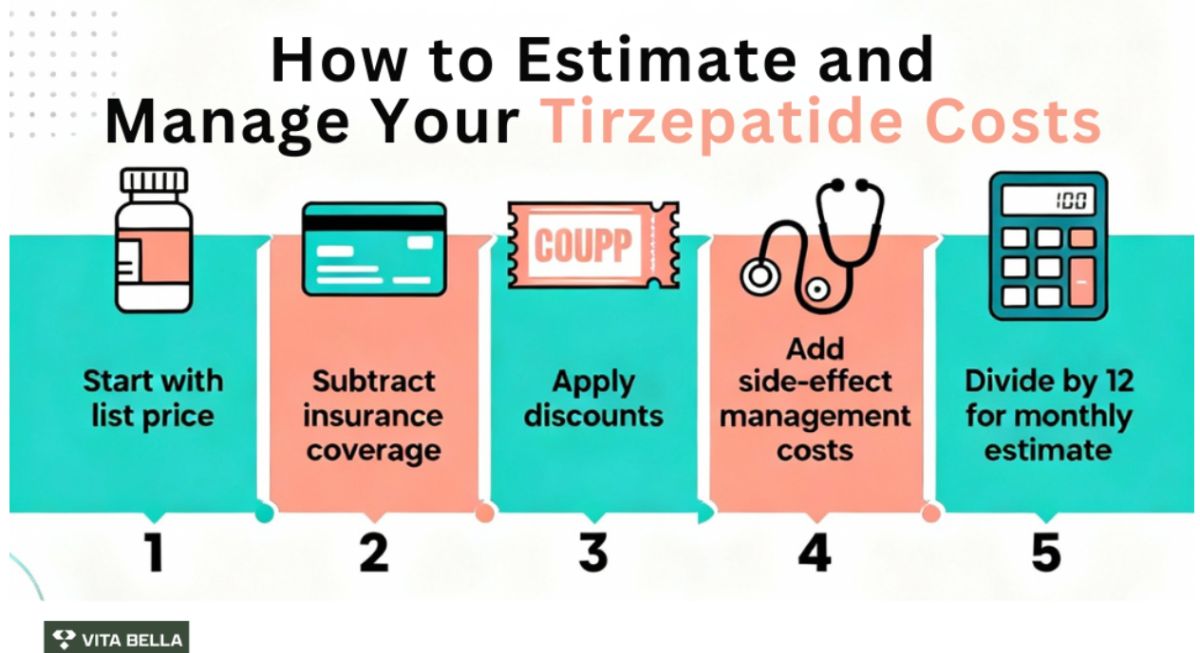
Use a simple approach: Start with the list price for your dose and supply (e.g., $1,079.77/month).
Subtract any insurance coverage or savings-program discounts.
Add expected monitoring and administration costs (e.g., $100/month for labs/visits).
Divide by 12 to calculate your monthly budgeted cost. Example: if list price = $1,079.77, discount = $800, monitoring costs = $100 → estimated out-of-pocket ≈ $379/month.
What are the Tips to Reduce Your Tirzepatide Cost?
To reduce your Tirzepatide cost, there are different ways to choose from. Here are some actionable strategies to help you lower your Tirzepatide costs and maximize savings, ensuring you get the most out of your treatment. By combining these cost-saving methods with consistent medical guidance, you can make your Tirzepatide journey more affordable without compromising on safety or results. These methods include:
Compare local pharmacies vs mail-order for the best pricing.
Utilise manufacturer coupons and savings programs promptly.
Discuss dose optimization and duration with your healthcare provider to reduce cost escalation.
Supporting your therapy with lifestyle interventions, good nutrition, and exercise may reduce the required dose and hence lower cost.
Get Your Health on Track: Discover Vita Bella's Personalised Solutions
Tirzepatide’s price tag can feel unpredictable and overwhelming. Dosage differences, regional pricing, and insurance gaps leave many patients unsure of what they’ll pay. Without expert insight, people often overpay or delay treatment altogether. That uncertainty can stall progress and motivation.
At Vita Bella, we redefine clarity. Our specialists demystify Tirzepatide pricing, outline realistic options, and find ways to make treatment sustainable. You’ll know what to expect, how to save, and when to adjust, guided by evidence-based care. Let Vita Bella make your health journey transparent, affordable, and empowering.
FAQs
Is Tirzepatide an expensive medication to maintain long-term?
Yes, Tirzepatide can be costly, especially for those without insurance, with average retail prices exceeding $1,000 per month. However, insurance coverage, savings cards, and manufacturer assistance programs can help reduce out-of-pocket expenses and make ongoing treatment more affordable for many patients.
Does insurance cover Tirzepatide for weight loss and diabetes?
Yes, most insurance plans are more likely to cover Tirzepatide when prescribed for type 2 diabetes rather than weight loss alone. Coverage levels vary, and some plans require prior authorization. Patients should contact their insurance provider to verify eligibility and potential copay assistance.
Can discount programs or coupons significantly lower Tirzepatide costs?
Yes, manufacturer coupons and patient-assistance programs can dramatically reduce Tirzepatide costs, sometimes lowering monthly expenses from over $1,000 to under $500. These programs typically apply to eligible patients and may be accessed through pharmaceutical company websites or partnering pharmacies.
Are there additional costs beyond the medication price itself?
Yes, beyond the drug’s list price, patients should budget for doctor visits, lab tests, injection supplies, and side-effect management. These hidden costs can influence overall spending but are essential for safe and effective treatment monitoring throughout Tirzepatide therapy.
References:
Hwang, J. H., Laiteerapong, N., Huang, E. S., & Kim, D. D. (2025). Lifetime health effects and cost-effectiveness of tirzepatide and semaglutide in US adults. JAMA Health Forum, 6(3), e245586. https://doi.org/10.1001/jamahealthforum.2024.5586
Valentine, W. J., Hoog, M., Mody, R., Belger, M., & Pollock, R. (2023). Long-term cost-effectiveness analysis of tirzepatide versus semaglutide 1.0 mg for the management of type 2 diabetes in the United States. Diabetes, Obesity and Metabolism, 25(5), 1292–1300. https://doi.org/10.1111/dom.14979
Tang, M., Shi, L., Guan, D., Winberg, D., Tang, T., Shao, H., & Fonseca, V. (2024). Long-term cost-effectiveness of tirzepatide for individuals with type 2 diabetes and comorbid obesity. Value in Health, Advance online publication. https://doi.org/10.1016/j.jval.2024.02.460
Zhang, X., & McAdam Marx, C. (2023). Short-term cost-effectiveness analysis of tirzepatide for the treatment of type 2 diabetes in the United States. Journal of Managed Care & Specialty Pharmacy, 29(3), 276-284. https://doi.org/10.18553/jmcp.2023.29.3.276