
CJC 1295 vs ipamorelin is one of the most common questions in peptide therapy: two growth hormone peptides, two distinct receptor pathways, and one shared goal of optimizing the GH/IGF-1 axis. CJC-1295 amplifies natural GH pulses through the GHRH receptor; ipamorelin triggers independent GH pulses through the ghrelin receptor. Both support fat metabolism, lean mass retention, and tissue repair. The mechanisms are different. A licensed provider determines which approach fits your profile, or whether combining them makes more sense.
CJC 1295 vs ipamorelin: how the mechanisms differ
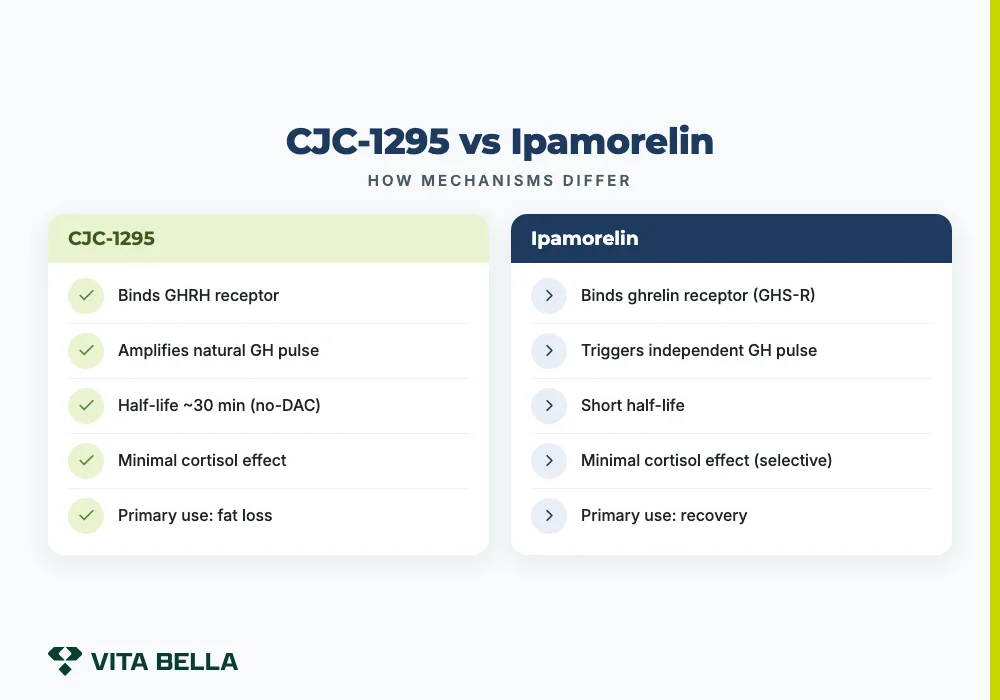
The core difference is receptor-level.
CJC-1295 is a synthetic analog of growth hormone-releasing hormone (GHRH). It binds the GHRH receptor on the anterior pituitary and amplifies the GH pulse the body would naturally produce. At Vita Bella, the no-DAC formulation is used. That version matters. It has a half-life of approximately 30 minutes and strengthens individual GH pulses rather than causing prolonged elevation. Effects build through consistent dosing over time rather than from a single large administration.
Ipamorelin is a GH secretagogue. It acts on the ghrelin receptor (GHS-R) to trigger its own GH pulses, independent of the GHRH pathway. A 1998 study in European Journal of Endocrinology (Raun et al.) established ipamorelin as the first selective GH secretagogue: it stimulates GH release with minimal effect on cortisol, prolactin, or ACTH. That selectivity is clinically significant. Cortisol drives fat storage and muscle catabolism, so a GH-stimulating compound that does not raise cortisol is substantially more useful for body recomposition.
| Feature | CJC-1295 | Ipamorelin |
|---|---|---|
| Receptor | GHRH receptor | GHS-R (ghrelin receptor) |
| Mechanism | Amplifies natural GH pulse | Triggers independent GH pulse |
| Half-life | ~30 min (no-DAC) | Short |
| Cortisol effect | Minimal | Minimal (selective) |
| Primary use | Fat loss, body composition | Recovery, acute repair |
Because the two pathways target separate receptors, combining them creates no redundancy. That is precisely what makes the CJC 1295 vs ipamorelin stack clinically useful rather than duplicative.
What is the difference between CJC-1295 and ipamorelin?
CJC-1295 amplifies GH pulses through the GHRH receptor on the anterior pituitary; ipamorelin generates its own GH pulses through the ghrelin receptor. The practical difference is accumulation versus acute peaks: CJC-1295 builds effects through regular dosing over time, while ipamorelin produces sharp, selective GH bursts that can be timed strategically within a protocol.
CJC 1295 fat loss: how cumulative GH support works
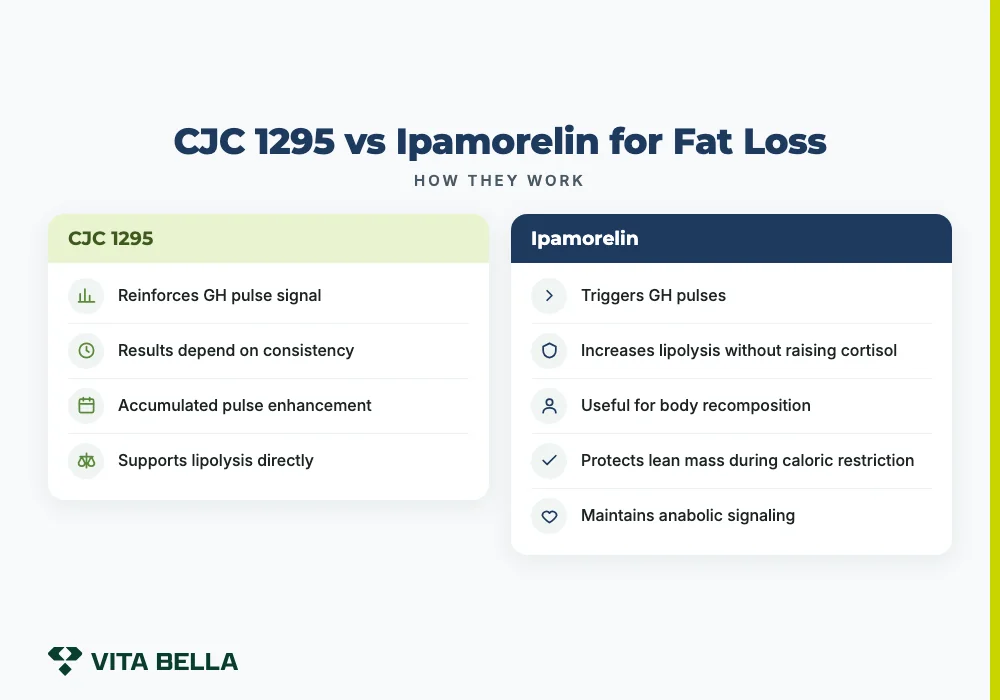
Growth hormone is a direct driver of lipolysis. A 2020 review in Endocrinology and Metabolism Clinics of North America (Hjelholt et al.) confirmed the inverse relationship between GH activity and visceral fat accumulation. CJC-1295 supports fat loss by reinforcing the GH pulse signal with each dose. Results are not immediate. They depend on dosing consistency, diet, and training load.
A 2009 study in Growth Hormone & IGF Research (Sackmann-Sala et al.) found that the DAC version of CJC-1295 produced measurable changes in metabolic serum protein profiles in healthy adults. At Vita Bella, the no-DAC form is used, which enhances one GH pulse per administration. The fat-loss mechanism is the same receptor pathway; the timeline is shaped by accumulated pulse enhancement across multiple doses rather than a single prolonged elevation.
For CJC 1295 fat loss, consistency matters more than any single dose.
What does ipamorelin do for fat loss?
Ipamorelin triggers GH pulses that increase lipolysis and support fat oxidation without raising cortisol. Because cortisol promotes fat storage and muscle breakdown, that selectivity is what makes ipamorelin more useful for body recomposition than older, non-selective secretagogues. Ipamorelin benefits for men specifically include improved body composition, lean mass protection during caloric restriction, and recovery quality, all tied directly to acute GH pulse strength.
Research on lean tissue preservation during a deficit consistently includes ipamorelin because it maintains anabolic signaling when food intake is reduced, which is where body composition changes are most vulnerable to reversal.
Which peptide is better for muscle recovery?
For acute post-training repair, ipamorelin has a clear edge. Its GH peaks stimulate local IGF-1 in muscle and connective tissue, signaling tissue regeneration. A 1999 study in Growth Hormone & IGF Research (Johansen et al.) found that ipamorelin induced longitudinal bone growth in rats, direct evidence of anabolic activity through the GH/IGF-1 axis in hard tissue, which implies similar signaling in soft tissue repair.
CJC-1295 contributes to peptide stack recovery differently. Each dose raises the average GH pulse strength, building a higher anabolic baseline over weeks. That baseline is the environment in which recovery happens. It does not generate acute repair signals the way ipamorelin does, but it keeps the system consistently primed.
For active individuals, combining both compounds addresses both dimensions: acute repair signaling from ipamorelin alongside sustained anabolic support from CJC-1295.
Can you stack CJC-1295 and ipamorelin together?
Yes. Stacking growth hormone peptides with non-overlapping receptors is the foundation of combined gh secretagogue therapy: CJC-1295 fires through the GHRH receptor; ipamorelin fires through GHS-R. Using both simultaneously activates the GH/IGF-1 axis from two directions, producing a secretion pattern that more closely mirrors the body's natural pulsatile rhythm than either compound alone.
A 2009 analysis (Sackmann-Sala et al., Growth Hormone & IGF Research) documented measurable metabolic protein changes from sustained GH/IGF-1 activation using the DAC version of CJC-1295. The no-DAC form builds toward comparable outcomes through repeated pulse amplification. Cycling and receptor maintenance protocols, including structured breaks and rotating injection sites, are part of what keeps a stacked approach effective long-term.
Side effects from either compound are possible but uncommon at physiological doses. They may include mild injection-site irritation or transient fluid retention. Both are generally mild and reversible under provider monitoring.
How long does CJC-1295 take to work?
Timeline depends on which formulation and what outcome you are measuring. In the Teichman et al. 2006 trial in Journal of Clinical Endocrinology & Metabolism, the DAC version raised GH two- to ten-fold for approximately six days after a single injection and elevated IGF-1 for nine to eleven days. Those results apply to the DAC form only.
At Vita Bella, the no-DAC form is used. Half-life is roughly 30 minutes. The mechanism is pulse amplification, not sustained elevation, which means effects accumulate through regular administration over weeks. Most people notice changes in sleep quality and recovery within the first few weeks of a consistent protocol. Body composition shifts follow over a longer timeframe and depend on training, nutrition, and overall hormonal context.
This is why comparing CJC 1295 vs ipamorelin timelines requires context: the no-DAC form of CJC-1295 builds gradually, while ipamorelin's acute GH peaks can produce earlier changes in how the body responds to training and recovery stress.
What providers weigh when building an ipamorelin dosing protocol
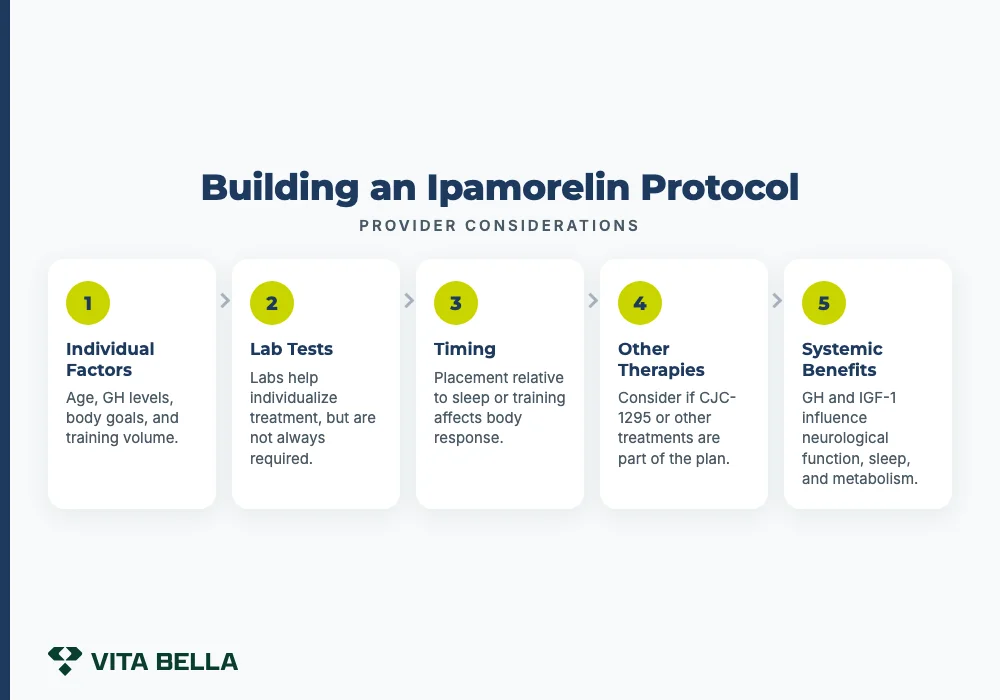
An ipamorelin dosing protocol is not a fixed schedule. A licensed provider considers age, baseline GH and IGF-1 values, body composition goals, training volume, and whether CJC-1295 or other therapies are part of the plan. Labs are recommended because they help individualize the approach, but they are not a hard requirement for initiating treatment. Standard protocols exist and can be adjusted based on response.
Timing within the day also shapes outcomes. Ipamorelin produces acute GH pulses, so placement relative to sleep or training affects how the body uses the signal. The right schedule comes from a provider conversation, not a generic template.
For men, ipamorelin benefits for men extend beyond body composition. A 2026 review in Physiology (Aguiar-Oliveira et al.) detailed how GH and IGF-1 influence neurological function, sleep architecture, and metabolic regulation across multiple systems. Optimizing GH pulse frequency and strength through a structured protocol affects more than muscle and fat, it supports systemic function in ways that direct supplementation does not replicate.
Start your protocol
If the question of CJC 1295 vs ipamorelin, or which combination fits your goals, is on your list, a licensed provider evaluation is where that answer lives. Vita Bella connects you with a provider who reviews your health history, recommends labs if useful, and builds a protocol around your actual goals.
Frequently asked questions
CJC-1295 amplifies GH pulses through the GHRH receptor; ipamorelin triggers independent GH pulses through the ghrelin receptor. The two pathways do not overlap, which is why combining them produces complementary effects rather than redundant ones.
Yes. Because they act on separate receptors, stacking them addresses both GHRH-axis and GHS-R axis activation simultaneously. The combination produces a GH secretion pattern that more closely mirrors natural pulsatility than either compound alone.
Ipamorelin triggers GH pulses that increase lipolysis without raising cortisol, which is what makes it useful for fat loss and body recomposition. Its selectivity sets it apart from older, less targeted secretagogues that activate secondary hormones along with GH.
Ipamorelin produces sharp GH peaks suited to acute tissue repair after training; CJC-1295 builds a higher anabolic baseline over time that keeps recovery conditions favorable. Providers often combine both for full coverage across acute and cumulative recovery needs.
The no-DAC form used at Vita Bella has a short half-life and builds effects through consistent dosing rather than a single sustained elevation. Most people notice sleep and recovery changes within the first few weeks; body composition shifts typically take longer depending on protocol structure and lifestyle factors.
Sources
- Teichman SL et al. (2006). Prolonged stimulation of growth hormone (GH) and insulin-like growth factor I secretion by CJC-1295, a long-acting analog of GH-releasing hormone, in healthy adults. The Journal of Clinical Endocrinology & Metabolism. PubMed
- Sackmann-Sala L et al. (2009). Activation of the GH/IGF-1 axis by CJC-1295, a long-acting GHRH analog, results in serum protein profile changes in normal adult subjects. Growth Hormone & IGF Research. PubMed
- Raun K et al. (1998). Ipamorelin, the first selective growth hormone secretagogue. European Journal of Endocrinology. PubMed
- Johansen PB et al. (1999). Ipamorelin, a new growth-hormone-releasing peptide, induces longitudinal bone growth in rats. Growth Hormone & IGF Research. PubMed
- Hjelholt A et al. (2020). Growth Hormone and Obesity. Endocrinology and Metabolism Clinics of North America. PubMed
- Aguiar-Oliveira MH et al. (2026). Growth Hormone and IGF-1 Actions in the Brain and Neuropsychiatric Diseases. Physiology (Bethesda, Md.). PubMed