Does testosterone make you angry? The answer depends entirely on whether your levels are low, high, or being restored through a TRT evaluation. Low testosterone is the more common driver of irritability in everyday men, not excess testosterone. Therapeutic TRT, monitored by a licensed provider, carries a neutral to positive mood profile for most patients, and mood changes that do occur trace to specific, manageable protocol variables.
The short answer
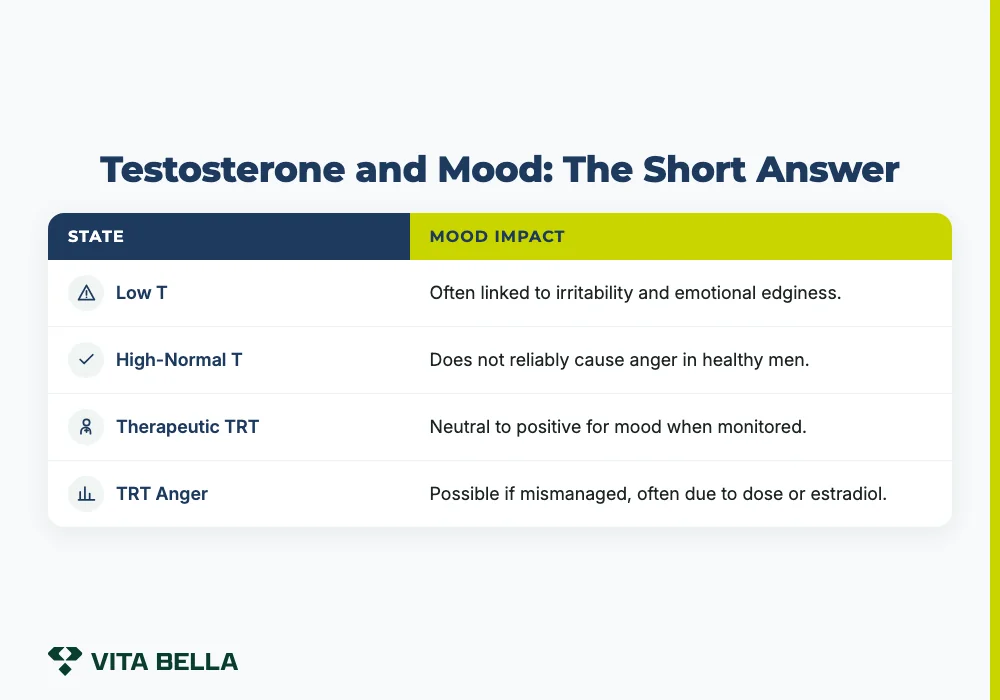
Can testosterone make you angry? The honest answer is that it depends on three distinct hormonal states. Low T consistently correlates with irritability and emotional edginess. High-normal T does not reliably produce anger in healthy men. Therapeutic TRT is neutral to positive for mood when monitored by a provider, and manageable when changes do occur. The table below shows how each state differs in pattern and what resolves it.
| Low T | High T (normal range) | TRT | |
|---|---|---|---|
| Primary mood pattern | Irritability, low frustration tolerance | Minimal mood change | Stable, improves in most; anger possible when mismanaged |
| Typical anger character | Chronic low-grade, sustained | Reactive, situational | Trough dips or estradiol-driven if unmanaged |
| Research verdict | Consistent association | Weak / no reliable link | Neutral to positive with provider monitoring |
| Key variable | Level of T | Supraphysiologic vs. normal | Dose, estradiol, injection timing |
| What resolves it | Restore T | Usually none needed | Protocol adjustment by provider |
Can low testosterone make you angry?
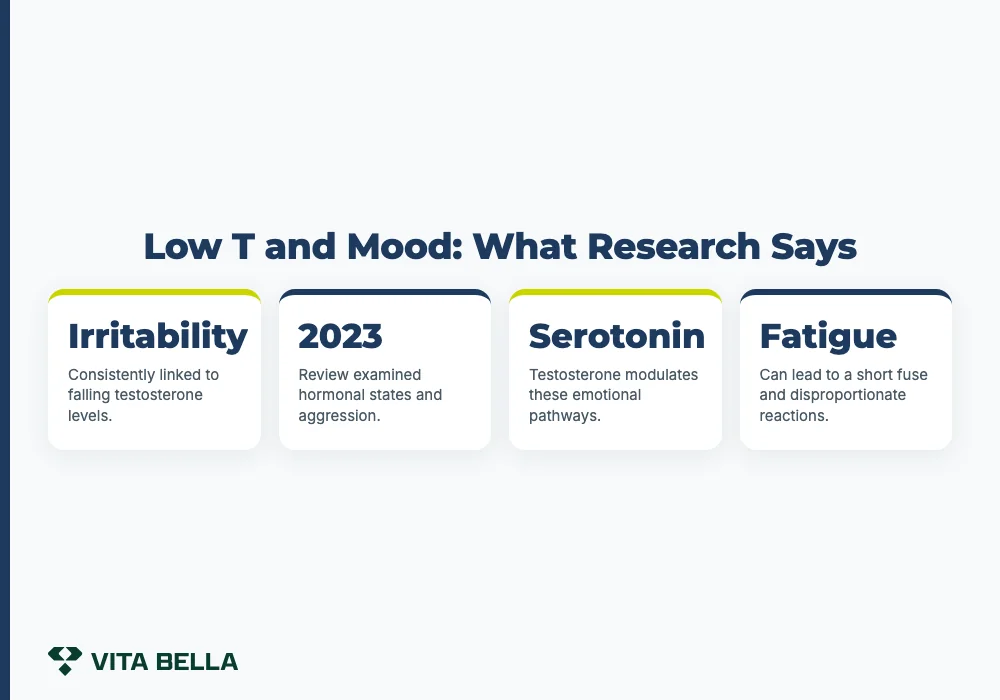
Men asking "does low testosterone make you angry" will find that clinical data consistently supports the connection between falling T levels and irritability, a link better established than the high-T-equals-anger stereotype. Low T consistently correlates with irritability, low frustration tolerance, and emotional dysregulation. Testosterone modulates serotonin and dopamine pathways, and when levels fall, the emotional buffering that depends on those pathways becomes less reliable. A 2023 narrative review by Potegal et al. in Neuroscience and Biobehavioral Reviews examined the physiology of affective arousal and aggression across hormonal states, providing context for how neurochemical shifts contribute to irritability and reactive anger responses.
Signs low T is driving your mood
- Fatigue-driven short fuse: exhaustion from disrupted sleep and chronically low energy makes minor frustrations feel disproportionate and difficult to let go.
- Snap reactions out of proportion to the trigger: a neutral comment or small setback produces a response that surprises the person having it.
- Emotional flatness between episodes: irritability coexists with stretches of blunted motivation and reduced positive engagement rather than sustained energy.
- Low frustration tolerance: situations that once felt manageable become genuinely irritating before any real obstacle appears.
- Poor sleep compounding mood: disrupted sleep, itself a symptom of low T, depletes next-day emotional resilience and restarts the cycle.
- Difficulty recovering from stress: the stress response that should resolve within a normal window lingers, keeping the emotional baseline elevated longer than it should.
Labs are necessary to confirm what is actually driving these symptoms. The overlap between low T, thyroid dysfunction, poor sleep quality, and situational stress is large enough that symptoms alone cannot distinguish them. A provider reads the full picture rather than individual complaints in isolation.
Why low T causes irritability, not rage
Low T reduces stress resilience rather than amplifying aggressive drive. The resulting pattern looks like sustained edginess or emotional withdrawal. Not explosive outbursts. If your anger feels like a chronic low hum, a persistent background irritability that flares easily, declining testosterone is a more plausible explanation than excess testosterone. This distinction matters clinically because the management path differs in each case, and chasing the wrong cause delays resolution.
Does high testosterone cause anger?
Does testosterone make you angry when levels run high naturally? The question "does high testosterone make you angry" has a consistent answer in the research: at normal physiologic concentrations, no. High endogenous testosterone within a normal physiologic range does not reliably cause anger in healthy men. Research correlates high-normal T with confidence, competitive motivation, and social engagement rather than unprovoked aggression. Does having high testosterone make you angry at physiologically normal concentrations? The data says no. The behavior changes linked to very high androgens appear at supraphysiologic concentrations, far above what occurs naturally or through a provider-monitored therapeutic program. Potegal et al. (2023) distinguish proactive aggression from reactive anger, two different behavioral patterns that do not map cleanly onto a single hormone measurement, which helps explain why high-normal T and supraphysiologic androgen use produce different behavioral profiles.
Does TRT make you angry?
The question "does taking testosterone make you angry" comes up often before men begin therapy. Does testosterone therapy make you angry when prescribed by a provider? For most men on monitored TRT, anger is not a predictable outcome. Does too much testosterone make you angry? It can when levels run above the therapeutic range without provider correction, but that is a calibration question, not an inherent property of testosterone therapy itself. When mood changes do occur on TRT, they trace to three specific and manageable variables. Understanding each one gives a patient and provider the clarity to identify the root cause rather than abandon a protocol that is otherwise working. A structured provider-monitored testosterone program accounts for all three from the start by pairing regular labs with reported symptoms.
Why some men feel anger on TRT: three real causes
- Dose calibrated too high: when testosterone levels exceed the therapeutic range, mood effects become less predictable, and some men experience heightened irritability that resolves when a provider adjusts the dose downward based on lab results.
- Excess aromatization converting testosterone to estradiol: testosterone converts to estradiol via the aromatase enzyme, and when that conversion exceeds normal levels, the resulting estradiol elevation produces mood instability that closely resembles the irritability pattern of low T.
- Injection peak-trough timing: injections create a hormonal arc from a post-injection peak to a pre-injection trough, and mood can dip in that trough window for some men, which is a timing and frequency issue, not an inherent property of the therapy.
All three are protocol variables. A provider adjusts each one based on labs and reported symptoms rather than treating mood changes as a reason to stop testosterone therapy.
The estradiol factor: when aromatization runs high
Testosterone converts to estradiol via the aromatase enzyme, primarily in adipose tissue. Levels matter here. When that conversion outpaces normal levels, estradiol rises and mood instability can follow alongside other signs of estrogen excess such as water retention and reduced libido. Checking estradiol on a comprehensive hormone panel is standard practice in TRT management. A provider who sees elevated estradiol on labs has clear, established options for addressing it. [Flag for medical review team: clinical source needed on estradiol elevation and mood/irritability in TRT men; no applicable source in S1-S6.]
Do testosterone injections change your mood?
Testosterone injections can affect mood, particularly when the injection interval is long enough to produce a significant hormonal trough before the next dose. Does injecting testosterone make you angry? It depends on where in the injection cycle the mood shift occurs. The arc runs from a peak in the days after injection to a low before the next scheduled dose, and some men notice mood changes consistently in that trough window. Does testosterone shots make you angry in that pattern? That is a timing issue, not an inherent feature of injections. Testosterone injections side effects aggression, when it appears in this trough-linked pattern, typically resolves with more frequent injections or a change in delivery method. A licensed provider determines the right adjustment after reviewing labs and reported symptom timing.
Roid rage vs. therapeutic TRT: not the same thing
The roid rage association comes from supraphysiologic androgen use outside medical supervision. The compounds and doses involved bear no resemblance to a monitored therapeutic protocol. Does testosterone make you angry at therapeutic doses? The data says no when provider monitoring is in place. A 2025 systematic review by Liu et al. in Clinical Psychology Review examined the global prevalence and risk factors of intermittent explosive disorder, providing population context for pathological explosive anger as a distinct clinical entity, separate from the hormonal irritability associated with low T or TRT imbalances.
Does more testosterone make you angry at supraphysiologic concentrations? The research documents behavioral changes at those levels. The men in those case reports are not the men being evaluated for low T by a clinician. Testosterone and aggression at supraphysiologic levels involves compounds, doses, and behavioral patterns that have no equivalent in therapeutic TRT. A reader weighing treatment for low T should not conflate their clinical situation with steroid abuse, and the data does not support doing so.
Does anger raise your testosterone levels?
In the short term, yes. Acute anger and competitive arousal produce measurable testosterone spikes, and this bidirectional relationship is part of why the testosterone and aggression research literature looks complicated at first read. A single confrontation or high-pressure situation can briefly elevate T in the hours that follow. Potegal et al. (2023) examine the physiology of aggressive arousal and escalation in ways that clarify this short-term hormonal response.
The opposite also holds true over longer time frames. Chronic stress and persistent anger suppress testosterone through cortisol's inhibitory effect on the HPG axis. Sustained emotional tension elevates cortisol, which competes directly with the signaling pathways that drive testosterone production. A man in a prolonged pattern of chronic anger may therefore carry lower T as a downstream consequence, which then worsens the underlying irritability. The causal arrow runs in both directions. Labs matter more than assumptions about which came first.
What to do if testosterone is affecting your mood
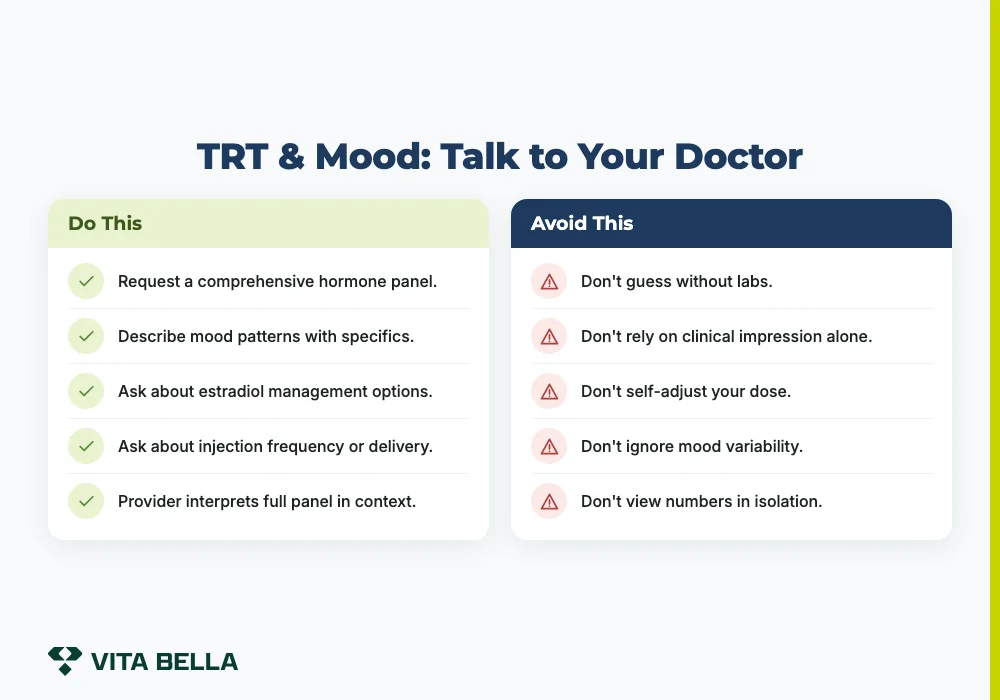
If mood changes concern you and you suspect hormones are involved, the starting point is a comprehensive panel. Labs first, not guesses. The symptom overlap between low T, elevated estradiol, thyroid dysfunction, and situational stress is too substantial to sort on presentation alone. Here is what to bring to a provider conversation:
- Request a comprehensive hormone panel covering total T, free T, estradiol, LH, and FSH, because the overlap between these markers and mood symptoms is large enough that sorting them requires numbers, not clinical impression alone.
- Describe mood patterns with specifics: note whether irritability correlates with injection timing, how long episodes last, and how severe they feel day to day, because timing data often points directly to the cause.
- Ask about estradiol management options, because estradiol-driven mood instability is one of the most common and correctable causes of mood changes during TRT.
- Ask about injection frequency or delivery method alternatives, since shortening the injection interval or switching delivery form can address peak-trough mood variability for many men.
- Do not self-adjust your dose, because doing so without current labs can move testosterone in the wrong direction and compound the problem.
A provider interprets the full panel in context, not individual numbers in isolation. Our guide to essential lab testing for hormones and peptides walks through which markers matter and why. For context on why a result inside the normal range does not always mean optimal, see our piece on when normal labs still leave you feeling suboptimal. For ongoing provider-led support across all of these variables, a comprehensive hormone monitoring program provides the structure to catch and correct them over time. [Flag for medical review team: clinical source needed on mood monitoring protocols in TRT; no applicable source in S1-S6.]
If you recognize these patterns, a provider-led hormone evaluation starts here.
Ready to understand what your hormones are actually doing?
Vita Bella pairs you with a licensed provider you choose yourself. Every member gets 1:1 provider care each quarter, discreet shipping from FDA-inspected U.S. pharmacies, and free injection supplies. You pick your provider. Real providers. Real medicine. Honest prices.
Get Started Take the 60-second quiz and get a provider-led assessment of where your hormones actually stand.
Frequently asked questions
Low testosterone is more likely to cause irritability than high testosterone. Therapeutic TRT monitored by a provider does not cause pathological anger in most men; when mood changes occur on TRT, they typically trace to estradiol imbalance or injection timing, not testosterone itself.
TRT can produce mood swings in some men, usually from estradiol rising too high or from the peak-trough pattern of injection-based delivery. Both are protocol variables that a provider can adjust; mood instability is not an inherent feature of properly monitored TRT.
Yes. Low T disrupts the neurochemical pathways that regulate stress tolerance, producing a chronic low-frustration pattern that many men describe as a persistent short fuse or emotional edge. A comprehensive hormone panel confirms whether T levels are contributing.
High testosterone within a normal physiologic range does not reliably produce anger in healthy men. The aggression associated with very high androgen levels appears at supraphysiologic concentrations, far above therapeutic TRT levels.
They can, particularly if the injection interval is long enough to produce a significant trough before the next dose. Mood dips near injection day are a timing issue, not a reason to stop TRT. More frequent injections or an alternative delivery method often resolves the problem.
Sources
- Liu F et al. (2025). Angry without Borders: Global prevalence and factors of intermittent explosive disorder: A systematic review and meta-analysis. Clinical Psychology Review. PubMed
- Potegal M et al. (2023). Non-angry aggressive arousal and angriffsberietschaft: A narrative review of the phenomenology and physiology of proactive/offensive aggression motivation and escalation in people and other animals. Neuroscience and Biobehavioral Reviews. PubMed