
Enclomiphene results in men with secondary hypogonadism are consistent across clinical trials: testosterone rises within weeks while sperm production stays intact, making it a genuine fertility-safe TRT alternative for men who want natural testosterone restoration without suppressing their own hormone axis. Unlike testosterone therapy, which delivers testosterone from outside the body, enclomiphene amplifies the body's own output. A licensed provider determines candidacy and dosage after reviewing labs.
What enclomiphene is and how it works
Enclomiphene is the trans-isomer of clomiphene citrate, a compound that belongs to the class of selective estrogen receptor modulators (SERMs). It binds to estrogen receptors in the hypothalamus and pituitary gland. That binding blocks the inhibitory signal that estrogen normally sends to the brain. Without that signal, the pituitary releases more luteinizing hormone (LH) and follicle-stimulating hormone (FSH). The testes respond to elevated LH by producing more testosterone.
This sequence is what separates enclomiphene from exogenous testosterone. The pituitary-gonadal axis stays engaged throughout treatment. Sperm production does not stop. This mechanism makes enclomiphene a recognized SERM for hypogonadism, specifically for secondary hypogonadism, where the deficiency originates in hormone signaling at the brain level rather than in testicular failure. Men with functioning testes and low-normal LH are typically the strongest candidates.
Clomiphene vs enclomiphene: what actually differs
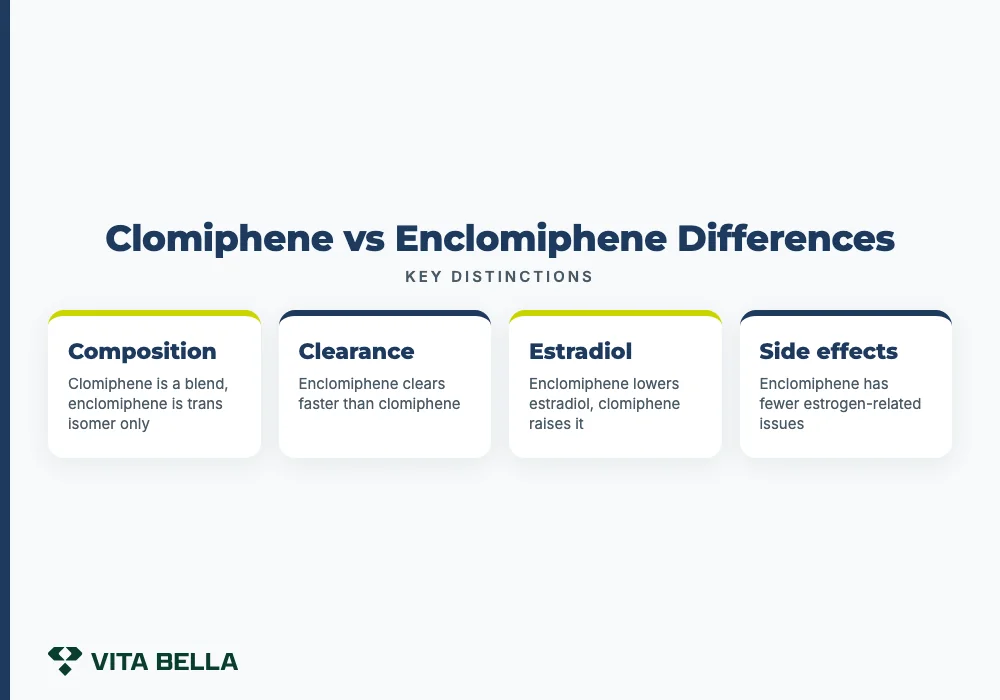
Clomiphene citrate contains two isomers: enclomiphene (trans) and zuclomiphene (cis). They do not behave the same way in the body.
| Property | Clomiphene | Enclomiphene |
|---|---|---|
| Composition | Trans + cis isomer blend | Trans isomer only |
| Clearance speed | Slow (zuclomiphene accumulates) | Faster elimination |
| Estrogen activity | Weak agonist (zuclomiphene) | Antagonist only |
| Common side effects | Mood swings, fatigue, gynecomastia risk | Fewer estrogen-related issues |
| Spermatogenesis | Preserved | Preserved |
Zuclomiphene has a long half-life and acts as a weak estrogen agonist. That activity is behind the mood swings, fatigue, and gynecomastia complaints that clomiphene users frequently report. Enclomiphene carries none of that. It clears faster and acts purely as an estrogen antagonist.
A 2024 study in Translational Andrology and Urology tracked 66 men who switched from clomiphene to enclomiphene. The enclomiphene group reported significantly fewer adverse events, including reduced libido disruption, less fatigue, and fewer mood complaints. Estradiol elevation was sharply lower: -5.92 pg/mL with enclomiphene versus +17.50 pg/mL with clomiphene (P = 0.001) (Saffati et al., 2024). A 2025 systematic review and meta-analysis in Archives of Endocrinology and Metabolism confirmed that enclomiphene's cleaner isomer profile makes it the more precise tool for secondary hypogonadism therapy (Hohl et al., 2025).
Enclomiphene results in clinical trials
The evidence behind enclomiphene results is more robust than most summaries convey. A randomized phase II trial in Fertility and Sterility demonstrated that enclomiphene stimulated testosterone production while preventing oligospermia, an outcome exogenous testosterone cannot achieve without supplementary fertility protocols (Wiehle et al., 2014). That trial used a double-blind, placebo-controlled design.
A six-month pharmacodynamic and pharmacokinetic study in BJU International followed men with secondary hypogonadism through sustained enclomiphene treatment. Testosterone levels normalized in the majority of participants and held steady without meaningful shifts in hematocrit or lipid profiles (Wiehle et al., 2013). Systemic safety markers stayed stable across the full follow-up period.
A 2016 expert opinion review in Expert Opinion on Pharmacotherapy described enclomiphene's effectiveness for low testosterone treatment in men with a functional but underactive HPG axis, and noted that dosage titration guided by serial lab results was the central variable in achieving consistent testosterone normalization (Rodriguez et al., 2016). These trials establish what enclomiphene results look like under controlled conditions, not only in self-reported experience.
Is enclomiphene better than testosterone therapy?
For men who want to preserve fertility, enclomiphene results are more favorable than standard TRT. Exogenous testosterone suppresses LH and FSH, halts spermatogenesis, and causes testicular atrophy over time. Enclomiphene amplifies that same hormonal signaling rather than replacing it.
That said, TRT is not the wrong choice in every scenario. Men with primary hypogonadism, where the testes themselves cannot respond to LH, may not respond to enclomiphene at all. Men who have completed their families and need more aggressive testosterone optimization may find conventional therapy more practical. The decision is not about one option universally outperforming the other. It comes down to labs, fertility goals, and a provider's clinical assessment.
Who tends to be a reasonable candidate for enclomiphene? Generally: men diagnosed with secondary hypogonadism, functional testes, active fertility goals, and LH and FSH levels confirming the problem is upstream. A provider identifies this from baseline labs before any protocol is written.
How long does enclomiphene take to work?
Most men see LH and FSH rise within two to four weeks. Testosterone climbs shortly after. Physical and subjective enclomiphene results take longer.
Energy, libido, and mental clarity typically improve noticeably around the three-month mark as testosterone stabilizes. By six months, hormone levels in most treated men reach a steady state. A retrospective study in Cureus tracking both compounds in men with infertility confirmed that enclomiphene maintained eugonadal testosterone while preserving sperm motility across this treatment timeline (Thomas et al., 2023). Some men notice how they feel before a follow-up panel confirms the numbers have caught up. Both matter.
What is the recommended enclomiphene dosage for men?
There is no universal enclomiphene dosage. A licensed provider sets the dose after reviewing baseline labs: total and free testosterone, LH, FSH, estradiol, and SHBG. Understanding why providers look beyond total testosterone before prescribing is part of why one number rarely gives the full picture.
The clinical approach starts conservatively and adjusts based on hormone response and symptom trajectory. Severity of the testosterone deficit, current estradiol level, and early tolerability all shape the decision. Rodriguez et al. (2016) noted that dosage titration guided by serial lab results was the key variable in achieving reliable testosterone normalization without estradiol-related side effects. Chasing a higher dose without lab oversight raises estrogenic side effect risk without delivering proportional gains in testosterone.
Enclomiphene dosage is a moving target, not a fixed prescription. It gets recalibrated at each monitoring visit based on how the hormones respond.
Can enclomiphene preserve fertility while raising testosterone?
Yes. This is one of the most clinically consistent enclomiphene results across the published literature. Enclomiphene raises LH, which drives testosterone production, and it keeps FSH active, which drives sperm production. Both remain online simultaneously. That is the structural advantage over TRT.
The phase II trial by Wiehle et al. (2014) showed testosterone rising while sperm concentration and motility remained intact throughout the study period. No suppression of spermatogenesis occurred. A retrospective comparison in Cureus confirmed that enclomiphene outperformed clomiphene on fertility-relevant outcomes while carrying a lower side effect burden (Thomas et al., 2023). For men evaluating how fertility outcomes compare across hormone therapy approaches, enclomiphene's mechanism gives it a clear advantage over testosterone-based protocols.
What are the side effects of enclomiphene?
Enclomiphene is well-tolerated in clinical studies. Saffati et al. (2024) reported no serious adverse events in the enclomiphene group across the full comparative cohort. The side effects most often linked to clomiphene, including mood instability, fatigue, and libido disruption, appeared at substantially lower rates in enclomiphene users.
Side effects that warrant monitoring during treatment include:
- Visual disturbances: uncommon, but any changes should be reported to a provider promptly
- Mild headaches during the early weeks of treatment, typically transient
- Mood shifts in the first month, usually self-limiting as estradiol stabilizes
- Minor estradiol elevation, which a provider can address by adjusting the dose
Most men who use enclomiphene as a low testosterone treatment describe a gradual and steady improvement rather than sharp hormonal spikes or crashes. Side effects, when they appear, generally resolve with dose adjustment.
Monitoring during treatment
Consistent monitoring shapes how enclomiphene results unfold over time. Providers typically check total and free testosterone, LH, FSH, and estradiol every three to six months. These panels confirm that the HPG axis is responding correctly and that estradiol is not climbing outside a healthy range.
Semen analysis during secondary hypogonadism therapy confirms that fertility outcomes stay intact. Hematocrit and liver function monitoring during extended treatment adds a further safety check, though the six-month data from Wiehle et al. (2013) showed no significant shifts in either marker. Reporting symptoms between scheduled visits matters. Visual disturbances, persistent headaches, or notable mood changes warrant prompt provider review rather than waiting for the next scheduled panel.
Ready to find out if enclomiphene fits your goals?
Understanding enclomiphene results is a starting point. The next step is labs and a provider conversation to see where your hormone levels actually stand. Vita Bella's licensed providers review your baseline panel, build a protocol around your goals, and check in quarterly as your levels respond.
Frequently asked questions
Most men see LH and FSH rise within two to four weeks, with testosterone climbing shortly after. Noticeable improvements in energy, libido, and mood typically become clear around the three-month mark as hormone levels stabilize.
Clinical studies describe enclomiphene as well-tolerated, with fewer estrogen-related side effects than clomiphene. The most common reports include mild headaches and transient mood shifts; no serious adverse events were recorded in comparative trials.
For men who want to preserve fertility, enclomiphene results are more favorable because the drug keeps LH, FSH, and spermatogenesis active. For men without fertility concerns, a provider may recommend testosterone therapy based on the specific hormone profile and goals.
A licensed provider sets the enclomiphene dosage after reviewing labs including testosterone, estradiol, LH, FSH, and SHBG. There is no fixed starting point; the dose is calibrated based on how hormones respond at each monitoring visit.
Yes. Clinical trials show enclomiphene raises testosterone and LH while sperm concentration and motility remain intact throughout treatment. Unlike TRT, enclomiphene does not suppress FSH, the gonadotropin responsible for driving sperm production.
Sources
- Wiehle RD et al. (2014). Enclomiphene citrate stimulates testosterone production while preventing oligospermia. Fertility and Sterility. PubMed
- Wiehle R et al. (2013). Testosterone restoration using enclomiphene citrate in men with secondary hypogonadism: a pharmacodynamic and pharmacokinetic study. BJU International. PubMed
- Saffati G et al. (2024). Safety and efficacy of enclomiphene and clomiphene for hypogonadal men. Translational Andrology and Urology. PubMed
- Thomas J et al. (2023). Efficacy of clomiphene citrate versus enclomiphene citrate for male infertility treatment: a retrospective study. Cureus. PubMed
- Hohl A et al. (2025). Clomiphene or enclomiphene citrate for the treatment of male hypogonadism: a systematic review and meta-analysis of randomized controlled trials. Archives of Endocrinology and Metabolism. PubMed
- Rodriguez KM et al. (2016). Enclomiphene citrate for the treatment of secondary male hypogonadism. Expert Opinion on Pharmacotherapy. PubMed