Tirzepatide for beginners is a once-weekly injectable that activates both GIP and GLP-1 receptors to reduce appetite, improve blood-sugar control, and support meaningful weight loss over time. Treatment starts at the lowest available dose tier and escalates gradually under provider supervision. In clinical trials, the median time to losing at least 5% of body weight was roughly twelve to sixteen weeks, and average reductions kept building to about 5–20% by around 72 weeks, depending on dose. A licensed provider reviews your labs and health history before setting your dosage schedule.
What is the starting dose of tirzepatide?
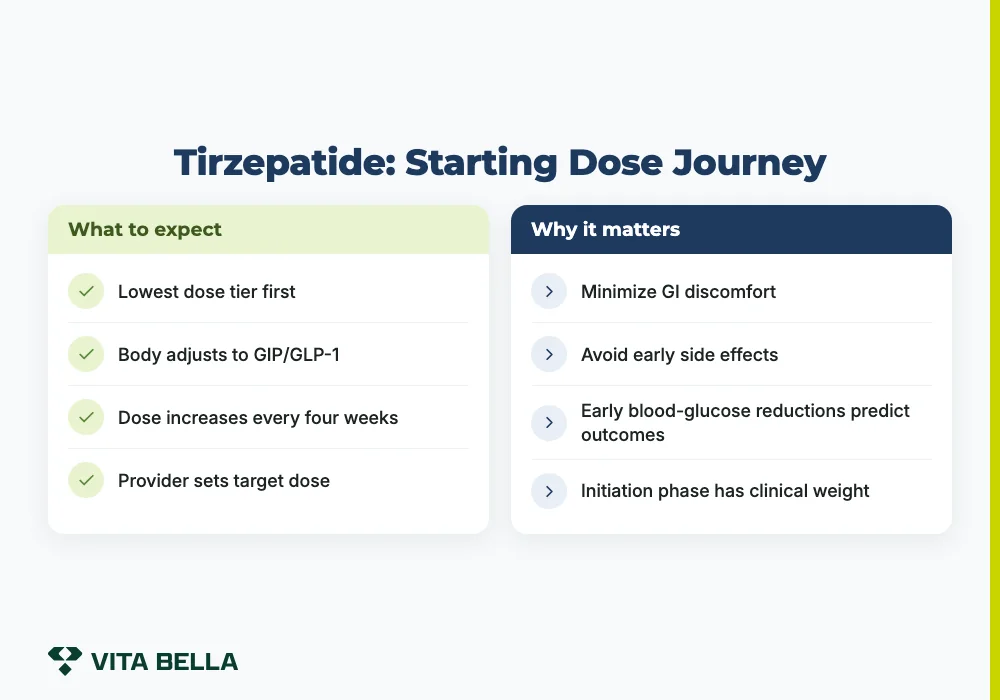
The tirzepatide starting dose is the lowest available dose tier, escalated gradually under provider supervision to minimize GI discomfort while building toward a therapeutic level. This matters: starting too high, too fast leads to unnecessary side effects that push people to stop early.
In the SURPASS trials, researchers began participants at the tirzepatide 2.5 mg dose tier for the first four weeks before escalating in increments every four weeks. A 2024 post-hoc analysis by Giorgino et al. in Diabetes Care confirmed that early fasting blood-glucose reductions at week four predicted stronger long-term outcomes, meaning the initiation phase carries real clinical weight.
| Phase | Approx. weeks | What typically happens |
|---|---|---|
| Initiation | Weeks 1–4 | Lowest dose tier; body adjusts to GIP/GLP-1 activation |
| Escalation | Weeks 5–16 | Dose increases every four weeks per provider guidance |
| Maintenance | Week 16+ | Provider-set target dose based on response and labs |
A licensed provider determines your exact tirzepatide dosage schedule based on your tolerability, labs, and metabolic response. The table shows a general framework, not a fixed prescription.
How long does it take for tirzepatide to work?
Tirzepatide begins producing early glycemic changes and appetite suppression within the first four weeks. Meaningful weight loss typically arrives between weeks twelve and sixteen, and results keep building for more than a year.
The tirzepatide weight loss timeline breaks into three distinct phases. Knowing what to expect on tirzepatide at each stage keeps realistic expectations in place and prevents early dropout.
Early phase (weeks 1–4)
Appetite changes are the first thing most people notice. Hunger decreases. Food feels less urgent. A 2024 SURPASS analysis (Giorgino et al., Diabetes Care) found that meaningful glycemic improvements can begin within the first month, even before significant weight change appears. These early metabolic signals matter because they predict stronger results at six and twelve months.
Mid phase (weeks 4–12)
Measurable weight loss and HbA1c improvements typically emerge during this window. A time-to-event analysis by Viljoen et al. (Diabetes Therapy, 2023) across SURPASS-2 and SURPASS-3 reported median time to 5% or greater weight loss at approximately twelve weeks for higher-dose groups and roughly sixteen weeks for lower-dose groups. That places the most visible early progress squarely in the mid phase.
Long-term (3–6+ months)
This is where the full commitment pays off. In obesity trials reviewed by Sokary and Bawadi (Primary Care Diabetes, 2025), participants achieved average body-weight reductions of 5–20% by approximately 72 weeks, in a dose-dependent pattern. The reduction in fat mass, rather than lean tissue, accounted for most of the change. If you want to understand how to protect lean tissue during this phase, how to protect lean mass on a GLP-1 protocol covers the evidence in detail.
Tirzepatide for beginners: what side effects to expect
Many people search "tirzepatide side effects first week" before starting, at proper initiation doses these are possible but uncommon. The most frequently reported involve the GI tract: nausea, mild stomach discomfort, and reduced appetite. These may appear as your body adapts to GIP and GLP-1 receptor activation. They are usually mild and resolve as the body adjusts.
The step-up tirzepatide dosage schedule exists specifically to reduce this risk. Starting at the lowest tier and escalating gradually gives your digestive system time to adapt at each level before the next increase. Persistent or severe symptoms warrant a conversation with your provider before proceeding further.
A 2026 systematic review and meta-analysis by Masson et al. in Reviews in Endocrine & Metabolic Disorders found anti-inflammatory effects associated with tirzepatide use, suggesting the metabolic benefits extend beyond appetite suppression and glucose control. These effects compound over time under consistent provider monitoring.
Key benefits for beginners: what the research shows
Tirzepatide for beginners produces measurable metabolic improvements that build from the first weeks forward. The dual GIP/GLP-1 mechanism is a key reason it outperforms single-pathway agents in head-to-head data. A 2024 network meta-analysis by Karagiannis et al. in Diabetologia found tirzepatide was associated with greater HbA1c and body-weight reductions compared to semaglutide across randomized controlled trials in adults with type 2 diabetes.
Clinical research from multiple SURPASS trials documents these consistent effects:
- Blood-sugar control: Meaningful HbA1c reductions begin as early as week four (Giorgino et al., 2024).
- Weight reduction: Obesity trials recorded 5–20% body-weight reductions by 72 weeks, dose-dependent (Sokary & Bawadi, 2025).
- Appetite and food intake: Total appetite scores and caloric consumption fell significantly alongside weight across trials.
- Cardiovascular markers: Participants also saw improvements in waist circumference, blood pressure, and lipid profiles.
- Adherence: Once-weekly dosing supports consistent use relative to daily treatment formats (Sokary & Bawadi, 2025).
Going beyond weight to track fat loss and lean mass gives a fuller picture of how to interpret progress throughout your protocol.
When should you increase your tirzepatide dose?
Your provider determines when to increase the dose based on tolerability, metabolic response, and labs. This is not self-managed. The tirzepatide dosage schedule is a framework your provider adjusts to fit your individual response.
If nausea or other side effects have not resolved, a provider may hold the current level longer before escalating. Good tolerability and improving markers support moving forward on the standard timeline. Some providers incorporate body composition data alongside total weight to guide escalation decisions. For context on how tirzepatide compares to other options in the same class before your first visit, comparing GLP-1 options before your first provider visit is worth reviewing.
Ready to start
Tirzepatide for beginners requires a personalized plan, not a generic one-size protocol. At Vita Bella, a licensed provider reviews your health history before setting your tirzepatide dosage schedule. Quarterly provider check-ins, discreet shipping from FDA-inspected U.S. pharmacies, and free injection supplies are built into the program from the start.
Frequently asked questions
The tirzepatide starting dose begins at the lowest available tier. In clinical trial protocols, this was the tirzepatide 2.5 mg dose level, used for an initial period before escalation. A licensed provider determines whether and how that framework applies to your specific case after reviewing labs and health history.
Early appetite suppression and glycemic changes can appear within the first four weeks, according to a 2024 SURPASS analysis (Giorgino et al., Diabetes Care). Meaningful weight loss typically takes twelve to sixteen weeks, and average reductions of about 5–20% build over roughly 72 weeks, depending on dose.
Weight loss in the first month is modest. The main change most people notice early is reduced appetite. Clinical data from SURPASS-2 and SURPASS-3 show median time to 5% or greater weight loss at approximately twelve to sixteen weeks, meaning significant weight change is a mid-phase outcome, not a first-month result.
Yes. Although initially developed for type 2 diabetes, clinical trials confirm tirzepatide's weight-loss benefits in people without diabetes. It supports fat reduction, improved metabolic markers, and reduced appetite, making it a viable option for adults pursuing provider-supervised weight management.
Sources
- Giorgino F et al. (2024). Early fasting serum glucose or weight reduction with tirzepatide and metabolic outcomes in people with type 2 diabetes: A post hoc analysis of the SURPASS trials. Diabetes Care. PubMed
- Viljoen A et al. (2023). Time to reach glycaemic and body weight loss thresholds with tirzepatide in patients with type 2 diabetes. Diabetes Therapy. PubMed
- Sokary S & Bawadi H (2025). The promise of tirzepatide: A narrative review of metabolic benefits. Primary Care Diabetes. PubMed
- Karagiannis T et al. (2024). Subcutaneously administered tirzepatide vs semaglutide for adults with type 2 diabetes: a systematic review and network meta-analysis of randomised controlled trials. Diabetologia. PubMed
- Masson W et al. (2026). Anti-inflammatory effects of tirzepatide: a systematic review and meta-analysis. Reviews in endocrine & metabolic disorders. PubMed