When people ask about peptides vs HRT, the most useful answer is this: these two treatment categories work through separate biological pathways and address separate clinical goals. They are not competing alternatives. HRT supplements declining estrogen, with or without a progestogen, to treat vasomotor and genitourinary symptoms of menopause; peptides are a broad drug class studied for specific, targeted goals that vary by molecule. For an overview of provider-guided peptide care, see peptide-based treatments at Vita Bella.
What Are Peptides? What Is HRT?
Peptides are short amino acid chains, and many act as molecular signals, binding specific receptors to trigger targeted biological responses. They are a diverse drug class. More than 80 peptide drugs have reached the market across varied therapeutic areas since insulin, according to a 2021 review in Nature Reviews Drug Discovery [S3]. Each peptide is its own molecule with its own evidence base, and results from one do not transfer to another.
HRT is a different category entirely. It addresses the hormonal changes of perimenopause and menopause by supplementing the estrogen the body produces less of over time, with or without a progestogen. For an overview of how care works, see how hormone therapy works at Vita Bella. The North American Menopause Society (NAMS) identifies HRT as the most effective treatment for vasomotor symptoms and the genitourinary syndrome of menopause [S1].
Different biological systems, different clinical goals. That separation is what makes peptides vs HRT a comparison between two distinct tools, not two versions of the same thing.
Table 1: Side-by-side overview
| Peptides | HRT | |
|---|---|---|
| Mechanism | Often targeted signaling at specific receptors | Supplements declining estrogen, with or without a progestogen |
| Primary evidence base | Specific to each peptide | Vasomotor symptoms, GSM, bone protection [S1] |
| Research context | More than 80 peptide drugs have reached the market across diverse conditions [S3] | Guided by the NAMS 2022 hormone therapy position statement [S1] |
| Who evaluates | Licensed provider after intake and history review | Licensed provider after intake and labs |
How Each Works in the Body
Both treatments act through distinct biological layers. The contrast is not about which is "better" in the abstract; it is about which system each acts on and what goals that system governs.
Peptides: targeted signaling molecules
Many peptides bind specific receptors to produce targeted responses, and each one is judged on its own evidence. Sermorelin, as one example covered here, works as a growth hormone-releasing hormone (GHRH) analog: it binds pituitary receptors to stimulate the body's own growth hormone production rather than delivering exogenous growth hormone [S4]. Walker (2006) in Clinical Interventions in Aging describes this mechanism in an editorial proposing sermorelin for further study; that paper reports no outcome data for women or in a menopause context.
HRT: replacing declining hormones
HRT addresses the hormonal decline of perimenopause and menopause by supplementing estrogen directly, with or without a progestogen. NAMS 2022 identifies it as the most effective treatment for hot flashes, night sweats, and the genitourinary syndrome of menopause. It also prevents bone loss and fracture [S1]. Its risks differ by hormone type, dose, duration of use, route, timing of initiation, and whether a progestogen is used. For women under 60 or within 10 years of menopause onset who have no contraindications, NAMS finds the benefit-risk ratio favorable for bothersome hot flashes and night sweats and for preventing bone loss [S1].
Symptoms and Goals: What Each Treatment Addresses
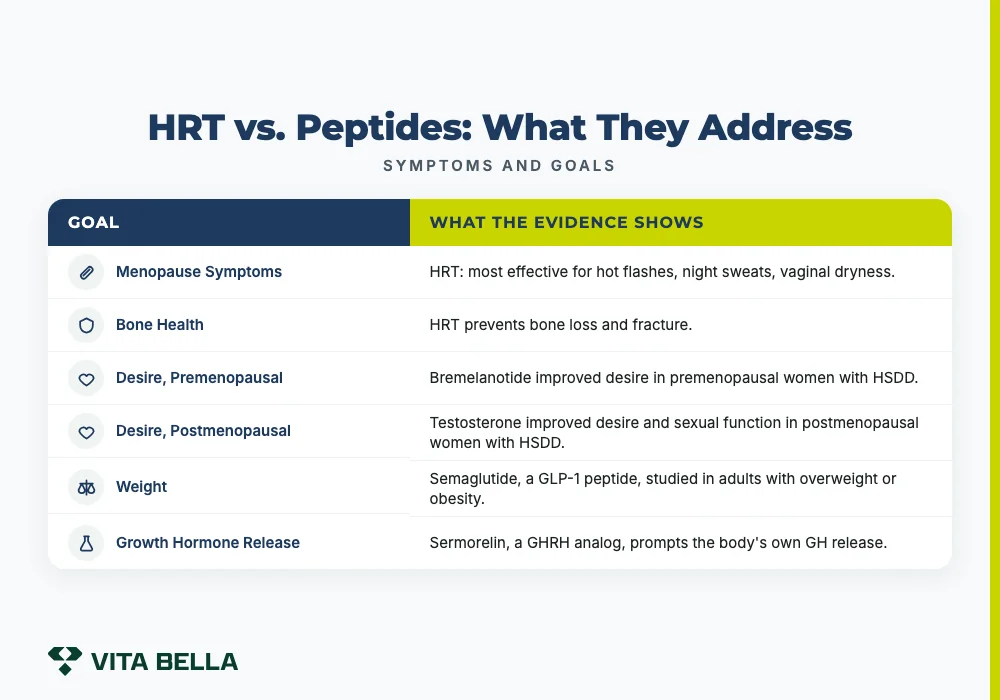
HRT has an established evidence base for the core symptoms of menopause. Peptides covered in the studies cited here were studied for distinct, separate goals. Understanding peptides vs HRT at the symptom level helps clarify which treatment serves which purpose. For a broader guide, see hormone replacement therapy for women.
Table 2: Symptom and goal mapping
| Symptom or Goal | HRT | Peptides |
|---|---|---|
| Hot flashes, night sweats | Most effective treatment [S1] | Not what the peptides covered here were studied for |
| Vaginal dryness, GSM | Most effective treatment [S1] | Not what the peptides covered here were studied for |
| Bone loss prevention | Shown to prevent bone loss and fracture [S1] | Not what the peptides covered here were studied for |
| Low sexual desire with distress (premenopausal) | Bremelanotide improved desire and related distress in premenopausal women with HSDD in the RECONNECT trials [S5] | |
| Low sexual desire with distress (postmenopausal) | Testosterone therapy is effective for postmenopausal women with low sexual desire causing distress, per a meta-analysis of randomized trials [S6] | The RECONNECT trials of bremelanotide enrolled premenopausal women [S5] |
| Weight management (overweight/obesity) | Not among the uses NAMS lists [S1] | Semaglutide (a GLP-1 peptide) studied in adults with overweight or obesity [S7] |
| Growth hormone release | Not applicable | Sermorelin, a GHRH analog, prompts the body's own growth hormone release [S4] |
The Peptides vs HRT Comparison: What Actually Differs?
HRT supplements foundational hormone levels to address the symptoms of hormonal decline. Peptides are a separate drug class studied for specific, targeted goals. That distinction captures the core answer to the question of HRT vs peptides.
A provider's question is not "which one?" but "which tool fits which goal in this patient's profile?" The evidence behind each points to different goals. HRT is the most effective treatment for hot flashes, night sweats, and the genitourinary syndrome of menopause, and it prevents bone loss and fracture [S1]. The peptides covered here serve other goals: sermorelin prompts the body's own growth hormone release [S4], bremelanotide was studied for low sexual desire in premenopausal women [S5], and semaglutide for weight in adults with overweight or obesity [S7].
Which Is Right for Perimenopause: Peptides or HRT?
For the core symptoms of perimenopause and menopause, including hot flashes, night sweats, and vaginal dryness, the clinical evidence supports HRT [S1]. That is the direct answer. A 2016 review in the Journal of Women's Health by Santoro notes that menopausal symptoms are bothersome enough to lead almost 90% of women to ask their healthcare provider for advice on how to cope [S2].
The peptides covered here (sermorelin, bremelanotide, and semaglutide) serve other goals and were not developed as perimenopause treatments. Stage also matters for low sexual desire: bremelanotide was studied specifically in premenopausal women with hypoactive sexual desire disorder in the RECONNECT trials [S5], while a meta-analysis of 36 randomized trials found testosterone effective for postmenopausal women with low sexual desire causing distress, improving desire, arousal, pleasure, and satisfying sexual events [S6]. These are different populations at different hormonal stages.
If hot flashes, night sweats, or vaginal dryness are your main concerns, HRT is where the evidence points [S1], and a licensed provider can walk you through it. Vita Bella's hormone therapy page explains how provider-led care works.
Can You Take Peptides and HRT Together?
Why peptides vs HRT is not an either/or question
A licensed provider can evaluate both and design a protocol that fits your history and goals. Whether both belong in one plan is a clinical call, made after a full review of your goals. None of the studies cited here tested the combination, so a provider reviews any combination against your history and current medications.
A provider may evaluate both when a patient's goals include:
- Managing vasomotor or genitourinary symptoms of menopause, an established HRT indication [S1]
- A separate, distinct goal that a specific peptide has been studied for
The decision rests on a full clinical evaluation, not a checklist.
How a Provider Evaluates Your Options
When a provider works through peptides vs HRT, the evaluation is not about picking a winner; it is about matching the right tool to the right goal. For hormone therapy at Vita Bella, labs are ordered first through Quest Diagnostics and billed separately from the membership, then reviewed with your provider during a 30- to 45-minute initial consultation.
Care continues with 1:1 provider care every quarter, so a provider, not a general protocol, tracks progress and adjusts the plan over time. Whether one approach or both fit your goals is a decision your provider makes with you. For the men's side of this question, covering testosterone therapy specifically, how peptides and testosterone therapy compare for men covers the TRT angle in depth. If you want to understand how lab reference ranges are set, why "normal" lab results do not tell the whole story is a useful primer.
To see how an evaluation works, visit Vita Bella's hormone therapy page.
Ready to Find the Right Approach?
Peptides vs hormone replacement is a question your provider answers after reviewing your symptoms, history, and goals. At Vita Bella, that means every peptides vs HRT conversation starts with a clinical evaluation, not a predefined protocol. From there, a licensed provider evaluates which options fit your situation. Get Started to begin your evaluation, or learn more about peptide therapy at Vita Bella and hormone therapy at Vita Bella before you book.
Frequently asked questions
No. Peptides and HRT work through different mechanisms and address different goals. HRT is the most effective treatment for vasomotor and genitourinary symptoms of menopause [S1], while the peptides covered here serve other goals. A provider determines which treatment fits your situation after reviewing your history and goals.
The peptides covered in the studies cited here were not studied for vasomotor symptoms. Hot flashes and night sweats are vasomotor symptoms for which HRT is the most effective treatment [S1]. If those are your primary concerns, a licensed provider can walk you through hormone therapy.
For most perimenopausal women, hormone therapy can be used safely on a short-term basis, according to Santoro (2016) in the Journal of Women's Health [S2]. NAMS 2022 finds the benefit-risk ratio favorable for treating bothersome hot flashes and night sweats and for preventing bone loss in women under 60 or within 10 years of menopause onset who have no contraindications [S1]. A licensed provider reviews your full history before recommending HRT.
For hormone therapy at Vita Bella, labs are ordered first through Quest Diagnostics and billed separately from the membership, then reviewed with your provider. For peptide protocols, a provider reviews your history and goals to design the right approach for your situation. A licensed provider tailors the plan to your individual profile after that review.
HRT supplements declining estrogen, with or without a progestogen, and is the most effective treatment for hot flashes, night sweats, and vaginal dryness in menopause; it also prevents bone loss and fracture [S1]. Peptides are a broad drug class [S3]; the ones covered here have specific roles: sermorelin prompts the body's own growth hormone release [S4], bremelanotide was studied for low sexual desire in premenopausal women [S5], and semaglutide for weight in adults with overweight or obesity [S7]. The two are not interchangeable; the right choice depends on your symptoms, goals, and what a provider finds in your evaluation.
Sources
- The North American Menopause Society (2022). The 2022 hormone therapy position statement of The North American Menopause Society. Menopause. PubMed
- Santoro N (2016). Perimenopause: From Research to Practice. Journal of Women's Health. PubMed
- Muttenthaler M et al. (2021). Trends in peptide drug discovery. Nature Reviews Drug Discovery. PubMed
- Walker RF (2006). Sermorelin: a better approach to management of adult-onset growth hormone insufficiency? Clinical Interventions in Aging. PubMed
- Kingsberg SA et al. (2019). Bremelanotide for the Treatment of Hypoactive Sexual Desire Disorder: Two Randomized Phase 3 Trials. Obstetrics and Gynecology. PubMed
- Islam RM et al. (2019). Safety and efficacy of testosterone for women: a systematic review and meta-analysis of randomised controlled trial data. Lancet Diabetes & Endocrinology. PubMed
- Wilding JPH et al. (2021). Once-Weekly Semaglutide in Adults with Overweight or Obesity. New England Journal of Medicine. PubMed