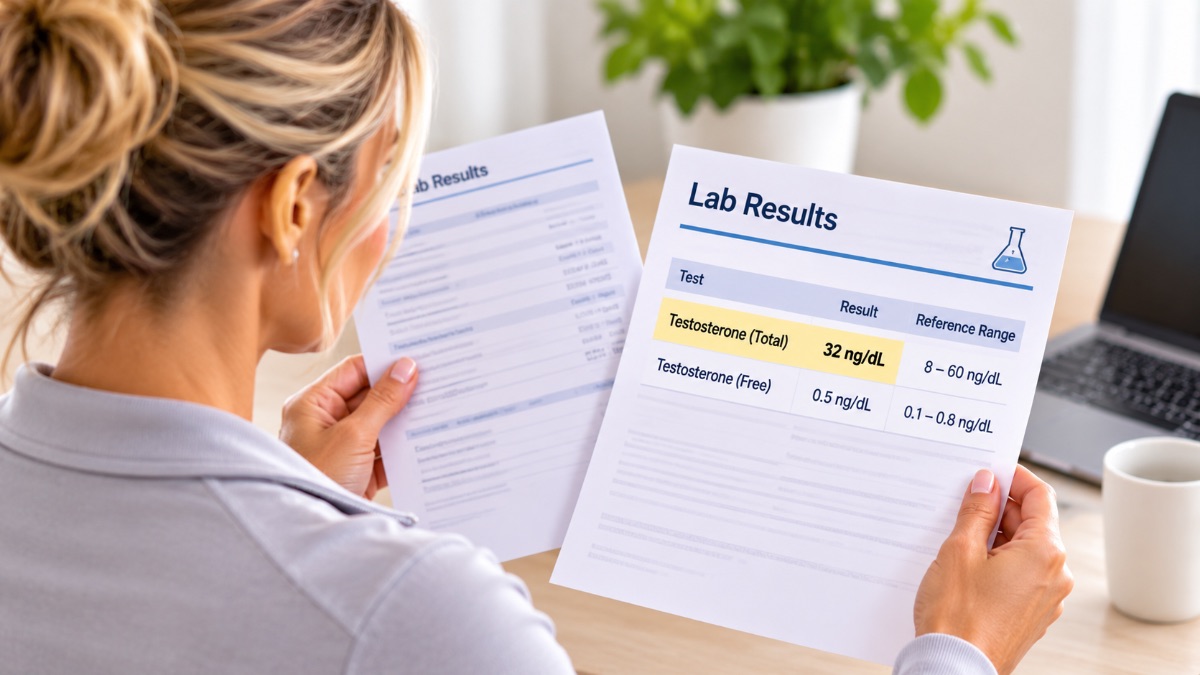
Testosterone is a normal and important hormone for women, and a lab result gives you and your provider a useful starting point. Testosterone levels for women have no single normal value. A result is read against the reference range of the lab that ran it, because ranges differ by lab and assay method (Teede et al., 2023) and levels change with age (Davison et al., 2005). If you are considering a provider-led hormone evaluation, your provider reads the number together with your symptoms and history.
What does testosterone do in the female body?
A 2025 review in Climacteric describes testosterone as a normal female hormone with important effects in many tissues (Davis, 2025). In women, testosterone comes from the ovaries and the adrenal glands. The ovary appears to keep producing it after menopause (Davison et al., 2005). It works in more than one way. It can act directly on androgen receptors, be converted to the more potent androgen dihydrotestosterone, or be converted to estradiol (Davis et al., 2019).
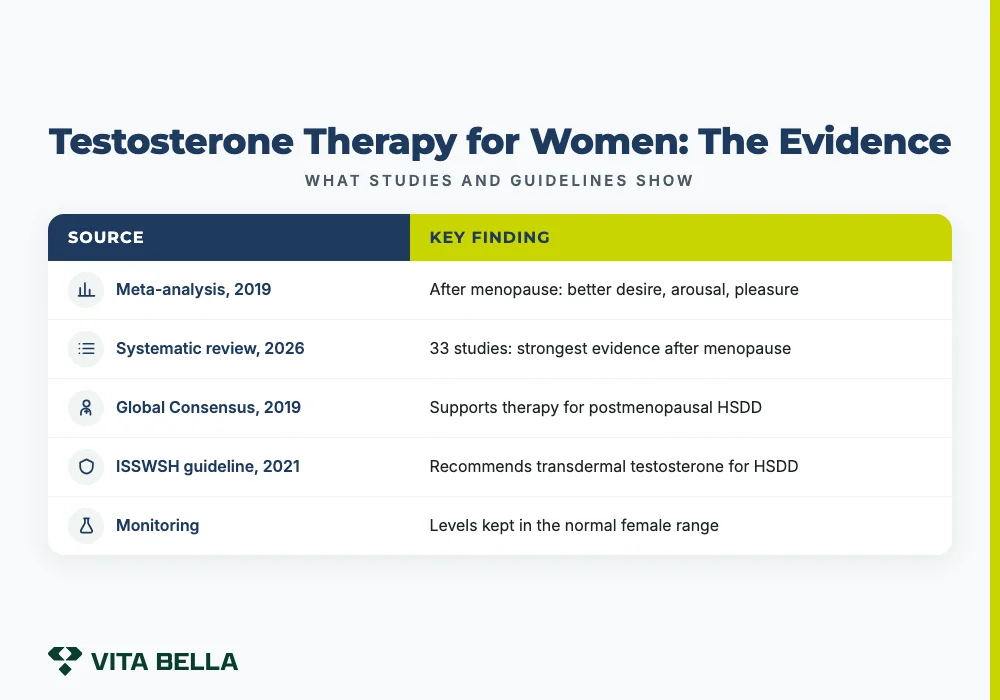
Testosterone therapy also has strong evidence in sexual health after menopause, and early research in younger women is promising:
- A 2019 meta-analysis of 36 randomized trials with 8,480 participants found that, in postmenopausal women, testosterone improved sexual desire, arousal, orgasm, pleasure, responsiveness, self-image, and the frequency of satisfying sexual events, and reduced sexual concerns and distress (Islam et al., 2019).
- A 2026 systematic review of 33 studies found testosterone therapy effective for improving key aspects of sexual function. The strongest evidence was in postmenopausal women, where randomized trials show robust benefit, and early evidence in premenopausal women was promising (Furlan et al., 2026).
- Clinical guidelines support its use. The Global Consensus Position Statement, endorsed by The Endocrine Society, The North American Menopause Society, and other professional societies, supports testosterone therapy for postmenopausal women with hypoactive sexual desire disorder (HSDD), meaning low sexual desire that causes distress, with data supporting a moderate therapeutic effect (Davis et al., 2019). The ISSWSH guideline recommends transdermal testosterone for women with HSDD after a full biopsychosocial assessment (Parish et al., 2021), and a 2025 review in Obstetrics & Gynecology summarizes these guidelines on treatment and monitoring for clinicians (Kling, 2025).
Lab testing plays a practical part in that care, as the sections below explain.
What is a normal testosterone level for women?
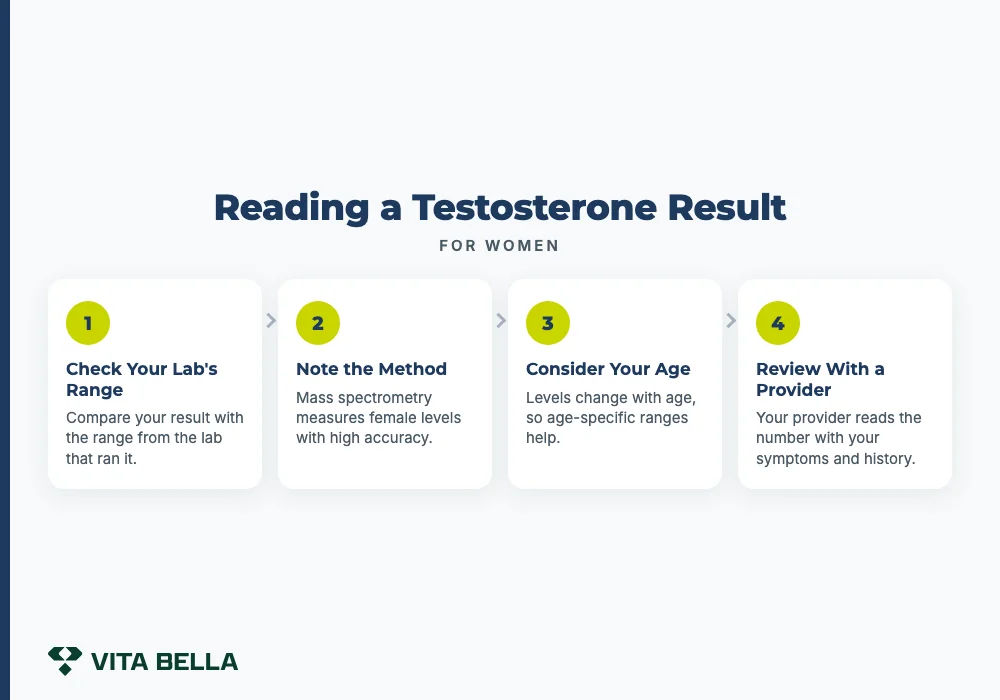
There is no single normal number. Testosterone levels for women are reported against a reference range, and ranges differ by lab and assay method. When people ask "what levels of testosterone is normal for women," the most practical reference is the range on their own lab report for that lab's method, and for the matching age group if the lab gives one.
One study shows what such a range looks like. Haring et al. (2012) measured total testosterone with liquid chromatography-tandem mass spectrometry (LC-MS/MS) in 985 women aged 20 to 80 from a population study in Germany, not counting women using oral contraceptives or hormone therapy. Across that whole age span, the reference range, meaning the 2.5th to 97.5th percentile, was 0.35 to 1.97 nmol/L. That converts to about 10 to 57 ng/dL. The study was designed to produce age-specific ranges, and it found a distinct decline across 10-year age groups. These figures describe one cohort and one method. They are not a US lab's reference interval.
Why reference ranges differ between labs
A testosterone range for women from one lab may not match another lab's range. Three things drive the gap.
The first is the method. Total testosterone can be measured with high accuracy by LC-MS/MS, while direct assays are highly unreliable at the low levels found in women (Davis et al., 2019). Haring et al. (2012) note that radioimmunoassays offer only limited precision at these low concentrations. Results from different methods are therefore hard to compare.
The second is the reference population. The international PCOS guideline notes that lab ranges vary widely and are often built on populations that were not fully characterized and are highly likely to include women with PCOS (Teede et al., 2023).
The third is standardization. The consensus calls for reference labs to be harmonized with biological standards, in coordination with the US Centers for Disease Control and Prevention (Davis et al., 2019).
In practice, results are most comparable when they come from the same lab and method. For general background on how lab reference ranges are built, see our labs explainer.
Free testosterone vs. total testosterone: which number matters for women?
Total testosterone is all the testosterone in a blood sample. Free testosterone is the small share not bound to proteins such as sex hormone-binding globulin (SHBG). It can be calculated from total testosterone and SHBG, as in the Haring study, or measured with specialized methods (Teede et al., 2023).
Which number matters depends on the question being asked:
- Testosterone therapy for HSDD: the consensus uses total testosterone, with a baseline level before treatment and repeat levels during it (Davis et al., 2019).
- Assessing PCOS: the international PCOS guideline uses both total and free testosterone to assess biochemical androgen excess, and free testosterone can be estimated with the calculated free androgen index. It prefers LC-MS/MS over direct immunoassays (Teede et al., 2023).
Some medications also shape a result. In a study of 347 US women aged 65 to 98, oral estrogen users had total and free testosterone 47% lower than never users, and corticosteroid users had 75% lower total testosterone than nonusers (Cappola et al., 2007). That is one reason a provider asks about your medications when reading testosterone levels for women.
Monitoring during hormone or peptide therapy involves other markers too. The overview of lab markers tracked during hormone and peptide therapy covers them.
Is there an optimal testosterone level for women?
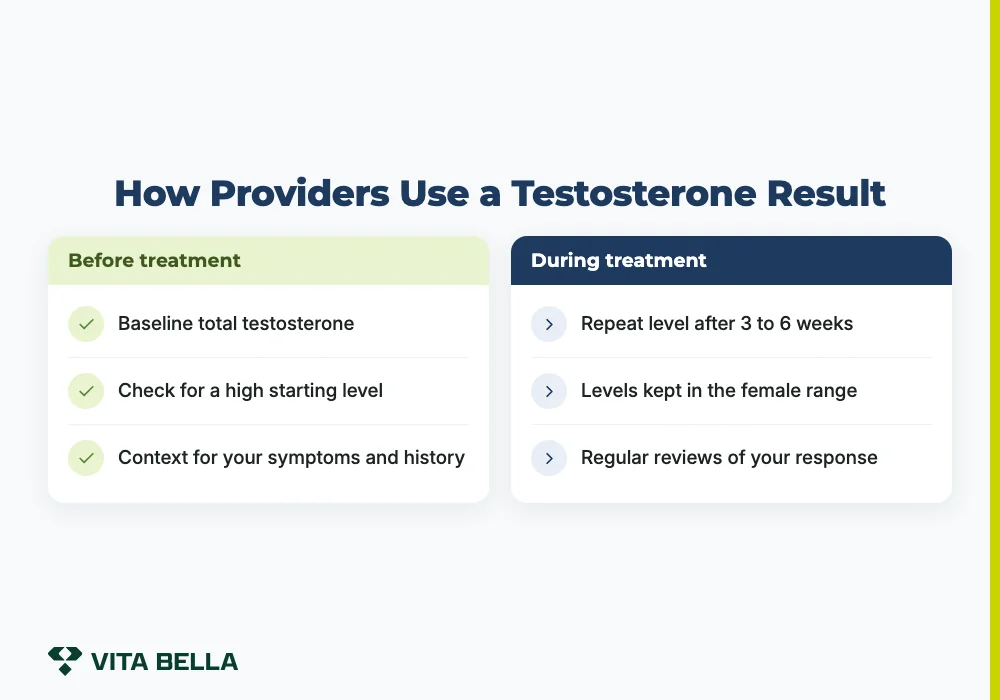
Guidelines set a safe range rather than one optimal number. When testosterone is prescribed, total testosterone is kept within the normal premenopausal female range, checked with a baseline level before starting and a repeat level 3 to 6 weeks after (Davis et al., 2019; Parish et al., 2021).
Within that range, your response guides care. Your provider looks at symptoms, history, and labs together, and uses total testosterone as a baseline for monitoring rather than as a diagnosis (Parish et al., 2021). So the useful answer to the question of an optimal testosterone level for women is simple: a level within the female range, and a plan built around how you respond.
How do testosterone levels in women change with age?
Testosterone levels for women change with age, though not in the pattern many people expect. In a community study of women aged 18 to 75 (1,423 recruited, 595 in the healthy reference group), total testosterone, calculated free testosterone, DHEAS, and androstenedione declined steeply with age. The decline was greater in the earlier decades than in the later ones (Davison et al., 2005).
Natural menopause does not appear to be the turning point. In women aged 45 to 54, menopausal status had no independent effect on androgen levels (Davison et al., 2005).
| Life stage or factor | What studies found | Source |
|---|---|---|
| Early adult years | The steepest age-related decline in total and free testosterone | Davison et al., 2005 |
| Ages 20 to 80 | A distinct decline across 10-year age groups | Haring et al., 2012 |
| Natural menopause (ages 45 to 54) | No independent effect of menopausal status on androgen levels | Davison et al., 2005 |
| Removal of both ovaries | In women 55 and older not taking steroid hormones, lower total and free testosterone; in women 65 and older, 23% lower total and 16% lower free testosterone than women with at least one ovary | Davison et al., 2005; Cappola et al., 2007 |
| Age 65 and older | The consensus says levels appear to be maintained after 65; in one cross-sectional US cohort aged 65 to 98, total testosterone was lower at older ages up to 80, while free testosterone did not vary by age | Davis et al., 2019; Cappola et al., 2007 |
Age shapes what a normal result looks like. Davison et al. (2005) concluded that these variations must be taken into account when normal ranges are reported, and Haring et al. (2012) built age-specific ranges for the same reason. Where a lab gives them, testosterone levels for women by age are the best comparison: the range for your age group and assay.
For a look at symptoms often linked with testosterone, see symptoms of low testosterone in women.
What causes high testosterone in women?
Polycystic ovary syndrome (PCOS) is the most common hormonal condition in women of reproductive age, affecting about 10% to 13% of them, and measuring androgens is part of how it is assessed (Teede et al., 2023).
When androgen levels are markedly above the lab's range, the PCOS guideline lists other causes for a doctor to consider, including some ovarian and adrenal conditions. The timing and pace of symptoms matter too, so the history counts as much as the number (Teede et al., 2023).
For unwanted hair growth in premenopausal women, the Endocrine Society suggests testing androgens when a hirsutism score is abnormal (Martin et al., 2018). The PCOS guideline also lists tests such as TSH, prolactin, and 17-hydroxyprogesterone that help a doctor complete the picture (Teede et al., 2023). Care depends on the cause, so these signs call for an evaluation by your doctor.
Why is testosterone measured in women?
In the guidelines reviewed here, testosterone levels for women are measured for two practical purposes.
- Guiding testosterone therapy. When testosterone is used for HSDD, a baseline total testosterone is measured before starting and repeated 3 to 6 weeks later, with a level about every 6 months after that, so treatment stays within the female range (Davis et al., 2019).
- Checking for androgen excess. In premenopausal women, testing for elevated androgens is suggested with an abnormal hirsutism score (Martin et al., 2018), and androgen testing is part of assessing PCOS (Teede et al., 2023).
What a testosterone result helps with:
- A baseline before testosterone therapy starts
- Keeping levels within the normal female range during treatment
- Showing whether a level sits above the lab's range, which, together with your symptom history, can prompt a PCOS evaluation
- Comparing on-treatment results over time, using the same lab and method
For women before menopause with low sexual desire, early research on testosterone therapy is promising (Furlan et al., 2026). For what treatment involves, see the overview of testosterone therapy for women. If low desire with distress is your concern, a licensed provider can evaluate which options fit you.
Ready to review your hormone labs with a licensed provider?
Your testosterone level is most useful alongside your symptoms and history. At Vita Bella, labs come first: a licensed provider orders them through Quest Diagnostics, and the results are reviewed with you in a consultation. Labs are billed separately from membership. From there, your provider explains which options fit your goals.
Frequently asked questions
There is no universal number. Normal testosterone levels for women are defined by the reference range of the lab that ran the test, for that lab's method and, if given, the matching age group. As one example, a German study using LC-MS/MS reported a reference range (2.5th to 97.5th percentile) of 0.35 to 1.97 nmol/L, which converts to about 10 to 57 ng/dL, across women aged 20 to 80 (Haring et al., 2012).
Guidelines set a safe range rather than one number. When testosterone is prescribed, total testosterone is kept within the normal premenopausal female range, checked with a baseline level before starting and a repeat level 3 to 6 weeks after (Davis et al., 2019). Your provider reads levels together with how you are responding.
The benefits shown in clinical trials are in sexual wellness. A meta-analysis of 36 trials found improvements in desire, arousal, orgasm, pleasure, and the frequency of satisfying sexual events in postmenopausal women (Islam et al., 2019). A 2026 systematic review of 33 studies found the strongest evidence in postmenopausal women, where randomized trials show robust benefit (Furlan et al., 2026).
Not because of natural menopause itself, according to one large community study. In women aged 45 to 54, menopausal status had no independent effect on androgen levels, and the larger decline happens earlier in adult life (Davison et al., 2005). Surgical removal of both ovaries is different: in studies of women aged 55 and older, it was linked to lower total and free testosterone (Davison et al., 2005; Cappola et al., 2007).
PCOS is the most common hormonal condition in women of reproductive age, and androgen testing is part of assessing it (Teede et al., 2023). When levels are markedly above the lab's range, a doctor also considers other causes, including some ovarian and adrenal conditions, guided by the timing and pace of symptoms (Teede et al., 2023).
Testing makes sense before and during testosterone therapy, to set a baseline and keep levels within the female range (Davis et al., 2019). In premenopausal women, it is also suggested with an abnormal hirsutism score (Martin et al., 2018) and as part of assessing PCOS (Teede et al., 2023).
Sources
- Davis SR, Baber R, Panay N, et al. (2019). Global Consensus Position Statement on the Use of Testosterone Therapy for Women. J Clin Endocrinol Metab. PubMed
- Islam RM, Bell RJ, Green S, Page MJ, Davis SR. (2019). Safety and efficacy of testosterone for women: a systematic review and meta-analysis of randomised controlled trial data. Lancet Diabetes Endocrinol. PubMed
- Furlan VA, Hammad MAM, Quesada S, Nguyen S, Yih J. (2026). Testosterone therapy for female sexual dysfunction: a systematic review of the literature demonstrating outcomes in premenopausal and postmenopausal women. J Sex Med. PubMed
- Parish SJ, Simon JA, Davis SR, et al. (2021). International Society for the Study of Women's Sexual Health Clinical Practice Guideline for the Use of Systemic Testosterone for Hypoactive Sexual Desire Disorder in Women. J Sex Med. PubMed
- Kling JM (2025). Testosterone for the Treatment of Hypoactive Sexual Desire Disorder in Perimenopausal and Postmenopausal Women. Obstet Gynecol. PubMed
- Davis SR (2025). Not just sex: other roles for testosterone in women. Climacteric. PubMed
- Davison SL, Bell R, Donath S, et al. (2005). Androgen levels in adult females: changes with age, menopause, and oophorectomy. J Clin Endocrinol Metab. PubMed
- Haring R, Hannemann A, John U, et al. (2012). Age-specific reference ranges for serum testosterone and androstenedione concentrations in women measured by liquid chromatography-tandem mass spectrometry. J Clin Endocrinol Metab. PubMed
- Cappola AR, Ratcliffe SJ, Bhasin S, et al. (2007). Determinants of serum total and free testosterone levels in women over the age of 65 years. J Clin Endocrinol Metab. PubMed
- Teede HJ, Tay CT, Laven JJE, et al. (2023). Recommendations From the 2023 International Evidence-based Guideline for the Assessment and Management of Polycystic Ovary Syndrome. J Clin Endocrinol Metab. PubMed
- Martin KA, Anderson RR, Chang RJ, et al. (2018). Evaluation and Treatment of Hirsutism in Premenopausal Women: An Endocrine Society Clinical Practice Guideline. J Clin Endocrinol Metab. PubMed