Testosterone is not a weight-loss treatment for women, and the evidence does not support using it that way. International guidance found insufficient data for any use beyond low sexual desire after menopause, and research on belly fat points in the opposite direction. For weight goals, a provider-led medical weight loss program is a better-supported starting point.
Does testosterone help women lose weight?
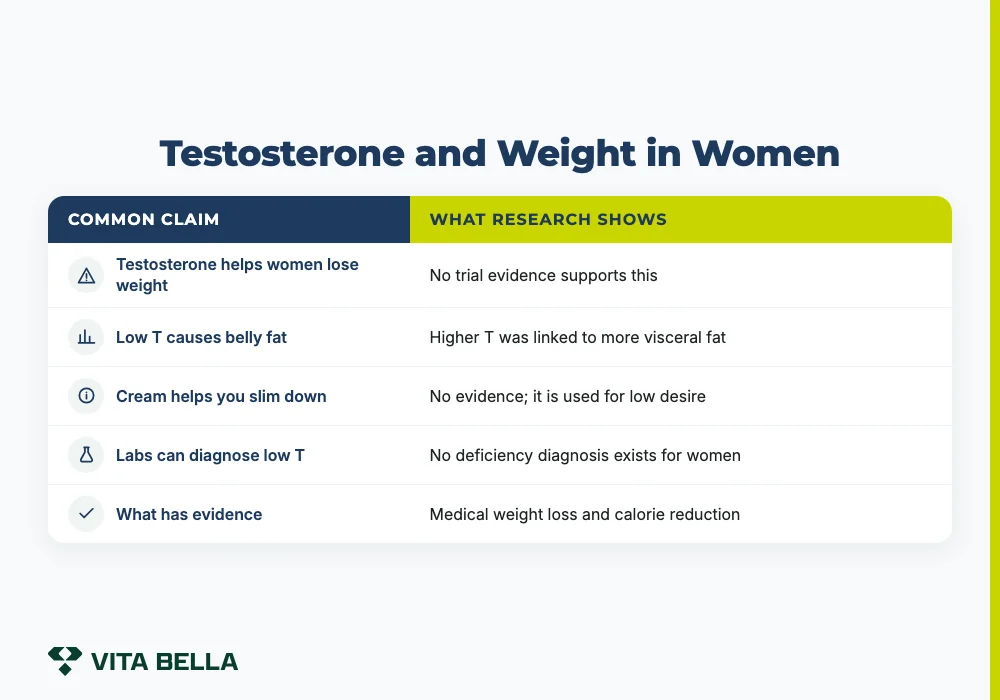
Not on current evidence. The 2019 Global Consensus Position Statement on testosterone therapy for women, endorsed by the Endocrine Society, the North American Menopause Society, and other international societies, found insufficient data to support testosterone for any symptom or condition other than low sexual desire with distress after menopause (Davis et al., 2019).
A 2025 review in Obstetrics and Gynecology reached the same conclusion with newer data. It found that testosterone can be modestly helpful for carefully selected postmenopausal women with low desire, while current data do not support it for bone health, brain health, energy, or cognition (Kling JM, 2025). Weight loss is not among the supported uses.
That matters for anyone researching testosterone for women weight loss. In the US, no testosterone product is approved by the FDA for use in women, so any prescription is off-label (Kling JM, 2025). A treatment with no approved formulation and no weight-loss evidence is a poor first step.
What testosterone does in a woman's body
Testosterone is a normal female hormone. Women produce it in the ovaries and adrenal glands, and it has physiological roles in many tissues, including muscle, bone, and sexual function (Davis SR, 2025).
Having a role is not the same as benefiting from more. Whether testosterone therapy brings any benefit beyond sexual function in postmenopausal women remains uncertain, according to the same 2025 review in Climacteric. That gap sits at the center of the testosterone and weight loss in women question.
What the research shows about testosterone and belly fat
Visceral fat, the fat stored deep around the abdominal organs, increases with menopause and predicts metabolic and cardiovascular risk. The SWAN fat patterning study examined how testosterone relates to it in 359 women aged 42 to 60, using CT scans to measure visceral fat (Janssen et al., 2010).
The finding surprises many readers. Higher bioavailable testosterone was associated with more visceral fat, not less, independent of age, race, total body fat, and other cardiovascular risk factors. Bioavailable testosterone was a stronger predictor than estradiol, and the link held after adjusting for insulin resistance.
The authors suggested that a shift toward relative testosterone predominance during the menopause transition may contribute to visceral fat gain (Janssen et al., 2010). The study was cross-sectional. It shows an association, not a cause, but it gives no support to the idea that raising testosterone would shrink belly fat.
Why "low testosterone causes weight gain" is the wrong frame
Searches for low testosterone weight gain women often assume a clear cause and effect. The evidence does not support that assumption. There is no recognized androgen-deficiency diagnosis for women (Kling JM, 2025), and a testosterone level on its own cannot explain a change in weight.
Many pages on testosterone for women weight loss start from that premise anyway. The pattern of low testosterone weight gain women often describe in midlife usually has several overlapping drivers instead. The menopause transition, sleep disruption, stress, lower activity, gradual muscle loss with age, and some medications can all play a part.
A provider sorts through these with a full history and labs. A single hormone number cannot do that work.
Why do women gain weight around menopause?
Weight and body shape often change during the menopause transition, and visceral fat in particular tends to rise (Janssen et al., 2010). Falling estrogen is part of that picture. That is why the evidence on estrogen-based hormone therapy and weight deserves its own look.
The guide to hormone replacement therapy and weight loss covers what estrogen-based HRT can and cannot do for weight. It is a separate question from testosterone, with a separate evidence base.
What has evidence for weight loss in women?
Start with approaches that were tested for weight loss. That sounds obvious. Yet much of the content on testosterone for women weight loss skips this step entirely and goes straight to hormones.
Medical weight loss under a provider
Prescription weight-loss medications in the GLP-1 class have been tested in large randomized trials with weight loss as the main outcome. The tirzepatide guide for beginners walks through what those trials found and what the first months typically look like.
Whether a medication fits depends on your health history, other conditions, and current medications. A licensed provider reviews your labs and history before recommending any option.
Calorie reduction, including intermittent fasting
Calorie reduction remains the foundation. A 2020 systematic review in Canadian Family Physician examined 27 intermittent fasting trials in adults with overweight or obesity (Welton et al., 2020). All of them found weight loss, ranging from 0.8% to 13.0% of baseline weight, with no serious adverse events.
In the 12 studies that compared intermittent fasting with standard calorie restriction, the results were equivalent. The trials were small and short, so the authors called the approach promising rather than proven. The eating pattern you can sustain matters more than its label.
Strength training and protein
Keeping muscle while losing weight is a common goal, especially on a weight-loss medication. The guide to protecting lean mass on a GLP-1 protocol covers the evidence on strength training and protein intake in detail.
When is testosterone therapy used for women?
Testosterone has one evidence-based use in women: hypoactive sexual desire disorder (HSDD), meaning low sexual desire that causes personal distress, after menopause. The consensus supports a trial only at doses that approximate normal premenopausal levels (Davis et al., 2019).
Pellets and injections are not part of that picture. The consensus states that any testosterone preparation resulting in supraphysiologic concentrations, including pellets and injections, is not recommended. Most of the trial evidence comes from transdermal products, such as a cream or gel.
If you are weighing those options for low desire rather than weight, the guides to testosterone cream for women and testosterone pellets for women explain how each works and what the guidance says. Neither is a route to weight loss.
Can testosterone cream help with weight loss?
Questions about testosterone cream for women weight loss come up often, and the answer is the same as for any other form. No trial evidence supports it, and the consensus found insufficient data for any outcome other than low desire after menopause (Davis et al., 2019).
Cream matters for a different reason. Small daily doses can be kept within the normal female range, which is how most trials dosed testosterone. That is about safety, not about the scale.
Monitoring when testosterone is prescribed
When a provider does prescribe testosterone for low desire, the consensus describes a clear monitoring framework (Davis et al., 2019). It is designed to catch levels that drift above the female range.
- Before starting: a baseline total testosterone level is measured, mainly to rule out high levels.
- 3 to 6 weeks after starting: a repeat level checks that testosterone stays within the normal female range.
- Every 6 months: clinical response and signs of excess testosterone are reviewed with a repeat level.
- At 6 months: if there is no benefit, treatment should be stopped.
Possible side effects, uncommon at physiological doses, may include acne or increased facial or body hair. These are usually mild and reversible under provider monitoring. Voice deepening is rare, but it may be permanent, which is one reason supraphysiologic levels are avoided.
What labs can and cannot tell you
Labs are useful, just not in the way many weight-loss pages suggest. Testosterone is measured before treatment to rule out high levels and during treatment to keep levels in range, not to diagnose a deficiency (Davis et al., 2019).
For weight concerns, a provider usually looks at a broader panel, which can include thyroid function, glucose and other metabolic markers, and lipids. The explainer on why total testosterone alone can be misleading shows how SHBG changes what a result means. The guide to how lab reference ranges are built covers reading results alongside symptoms.
The bottom line on testosterone and weight loss in women
The research on testosterone and weight loss in women points in one direction. There is no evidence that testosterone therapy helps women lose weight, and higher bioavailable testosterone in midlife has been linked to more visceral fat, not less (Janssen et al., 2010).
That does not make midlife weight change any less real. For anyone weighing testosterone for women weight loss, it means the better-supported paths are medical weight loss, sustainable calorie reduction, strength training, and an evaluation that takes the menopause transition into account. For the male side of this topic, the men's guide to testosterone and weight loss covers a different evidence base.
Talk to a provider about weight and hormones
If midlife weight changes are your main concern, the right next step is an evaluation with a licensed provider who reviews your history and labs and explains which options have evidence for you.
You can also learn more about Vita Bella's hormone therapy care or read the overview of testosterone therapy for women to see what a full evaluation covers.
Frequently asked questions
No. Current evidence does not support testosterone for women weight loss. The 2019 Global Consensus found insufficient data for any use other than low sexual desire after menopause, and a 2025 review found no support for benefits such as energy (Davis et al., 2019; Kling JM, 2025).
Not in any established way. There is no recognized androgen-deficiency diagnosis for women, and in the SWAN study higher bioavailable testosterone was associated with more visceral fat in midlife women (Kling JM, 2025; Janssen et al., 2010). Midlife weight change usually has several drivers.
There is no trial evidence for testosterone cream for women weight loss. Cream is used off-label for low sexual desire after menopause, dosed to stay within the normal female range, and it is not a weight-loss treatment.
Approaches that were tested for weight loss: medical weight loss with a provider, calorie reduction including intermittent fasting, and strength training to protect muscle. Intermittent fasting trials found weight loss of 0.8% to 13.0% of baseline weight, similar to standard calorie restriction (Welton et al., 2020).
At doses that keep levels within the normal female range, short-term trial data are reassuring, but long-term safety data are limited (Davis et al., 2019; Kling JM, 2025). Pellets and injections are not recommended because they can push levels above the female range.
Sources
- Davis SR et al. (2019). Global Consensus Position Statement on the Use of Testosterone Therapy for Women. Journal of Clinical Endocrinology and Metabolism. PubMed
- Kling JM. (2025). Testosterone for the Treatment of Hypoactive Sexual Desire Disorder in Perimenopausal and Postmenopausal Women. Obstetrics and Gynecology. PubMed
- Davis SR. (2025). Not just sex: other roles for testosterone in women. Climacteric. PubMed
- Janssen I et al. (2010). Testosterone and visceral fat in midlife women: the Study of Women's Health Across the Nation (SWAN) fat patterning study. Obesity. PubMed
- Welton S et al. (2020). Intermittent fasting and weight loss: systematic review. Canadian Family Physician. PubMed