
Enclomiphene vs TRT comes down to one clinical question: does your hormonal system need a signal boost or a direct replacement. TRT supplies testosterone externally and suppresses the body's own production; enclomiphene stimulates the brain-pituitary axis so the testes continue producing testosterone on their own. Lab values, specifically LH, FSH, and total testosterone, tell a provider which option is clinically appropriate. At Vita Bella, every TRT evaluation and enclomiphene evaluation starts with those labs before any prescription is written.
How does enclomiphene work, and how is it different from TRT?
Both enclomiphene and TRT raise testosterone. They do it through opposite mechanisms. With TRT enclomiphene explained through mechanism rather than marketing, this choice becomes a clinical determination, not a personal preference.
TRT: external testosterone, internal shutdown
TRT delivers testosterone directly. It enters the body through an injection, gel, or patch. Elevated blood levels signal the hypothalamus and pituitary to cut their LH and FSH output, the hormones that normally drive the testes to produce testosterone.
Without that signal, the testes' own production shuts down for the duration of treatment, as documented in the Endocrine Society's clinical practice guideline on testosterone therapy (Bhasin S et al., 2018). Spermatogenesis follows the same path: without LH and FSH, sperm production slows substantially.
Enclomiphene: stimulating the axis you already have
Enclomiphene blocks estrogen receptors at the hypothalamus and pituitary, removing the feedback signal that tells those glands to ease off. The glands respond. They push out more LH and FSH, which drives the testes to produce more testosterone through their existing pathway.
The HPG axis stays intact. A 2016 review in Expert Opinion on Pharmacotherapy confirmed that enclomiphene raises serum testosterone while preserving gonadotropin function in men with secondary hypogonadism (Rodriguez KM et al., 2016). Enclomiphene testosterone levels rise as the HPG axis responds, with LH and FSH remaining active throughout.
Enclomiphene does not have standalone drug clearance; it is available only as a compounded medication prescribed and monitored by a licensed provider, who determines the appropriate dose after reviewing labs.
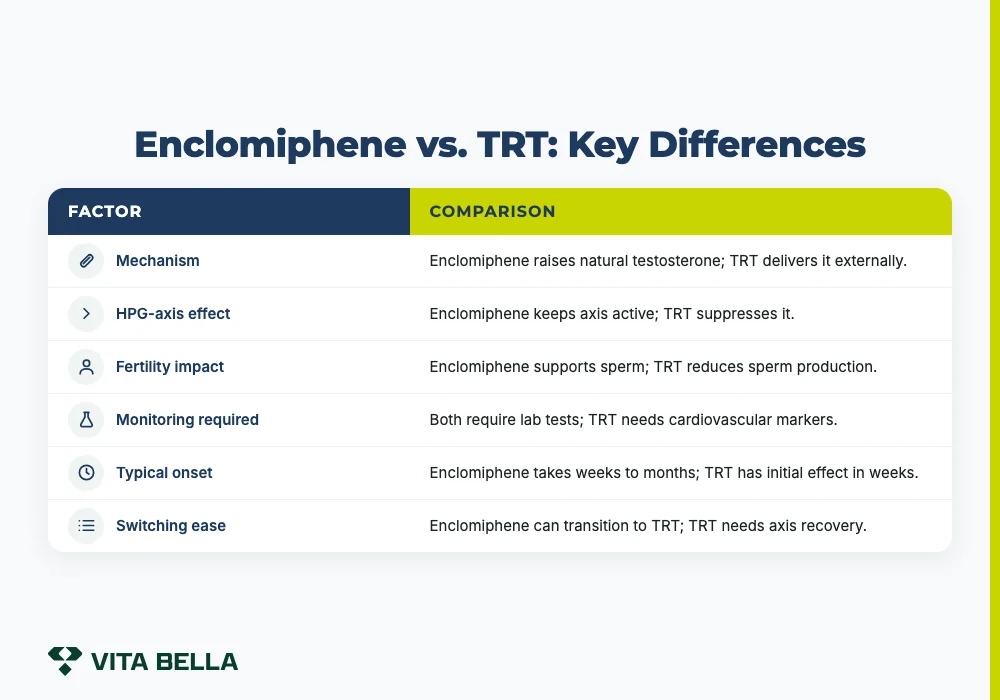
Enclomiphene vs TRT: side-by-side comparison
| Factor | Enclomiphene | TRT |
|---|---|---|
| Mechanism | Stimulates LH and FSH; raises natural testosterone | Delivers testosterone externally |
| HPG-axis effect | Axis stays active | Axis suppressed during use |
| Fertility impact | LH/FSH maintained; spermatogenesis supported | LH/FSH suppressed; sperm production reduced |
| Estrogen effect | May raise estrogen as testosterone rises; provider monitors | Testosterone aromatizes to estrogen; provider monitors |
| Monitoring required | Testosterone, LH/FSH, estradiol, CBC | Testosterone, hematocrit, PSA, estradiol, cardiovascular markers |
| Typical onset | Weeks to months as the axis responds | Weeks for initial effect |
| Switching ease | Can transition to TRT if axis response is insufficient | HPG axis requires recovery time after stopping; provider guides transition |
A 2024 systematic review and meta-analysis in Expert Opinion on Drug Safety confirmed that cardiovascular monitoring is a standard component of ongoing TRT management (Corona G et al., 2024). No row in the table above names a winner. The right column depends on what your labs show.
Secondary vs. primary hypogonadism: why your labs decide
This is the distinction that actually determines which option fits in the enclomiphene vs TRT decision. Most clinical comparisons treat this as a matter of personal preference. It is not.
Low testosterone has two root causes. Primary hypogonadism means the testes themselves are not producing enough testosterone due to a structural or developmental cause. Secondary hypogonadism means the testes are capable but are not receiving adequate signaling from the hypothalamus or pituitary. LH and FSH values in a standard hormone panel reveal which pattern is present.
Enclomiphene works by amplifying the pituitary signaling chain, typically suiting secondary hypogonadism where LH and FSH are low or low-normal alongside low testosterone. TRT addresses low testosterone regardless of cause, relevant to both primary and secondary patterns as well as mixed presentations (Bhasin S et al., 2018).
Lab numbers alone do not decide the path. A provider interprets them alongside symptoms and clinical history.
Does enclomiphene preserve fertility better than TRT?
TRT suppresses LH and FSH, which reduces sperm production during use. Enclomiphene maintains or raises LH and FSH, supporting spermatogenesis. In enclomiphene vs TRT evaluations, fertility impact is one of the most clinically significant factors for men who may want to father children.
A 2025 systematic review and meta-analysis in Archives of Endocrinology and Metabolism found that enclomiphene raises testosterone while maintaining sperm parameters in men with hypogonadism (Hohl A et al., 2025). TRT-induced suppression is typically reversible after stopping, though recovery timelines vary by individual and by duration of prior use.
Enclomiphene fertility outcomes are part of what a provider discusses before recommending either path. For a detailed review of enclomiphene's impact on testosterone and sperm function, that resource covers the published evidence in full.
How is enclomiphene different from Clomid?
Enclomiphene is the trans-isomer of clomiphene (Clomid), isolating the LH/FSH-stimulating effect without the estrogenic activity of the cis-isomer, zuclomiphene. The 2025 meta-analysis by Hohl et al. found enclomiphene raises testosterone more selectively than clomiphene, with a more favorable hormonal profile. Both are compounded medications prescribed by a licensed provider. For a detailed comparison, how enclomiphene and clomiphene differ structurally and clinically covers the mechanistic detail.
Who should consider enclomiphene? Who should consider TRT?
A provider determines the right enclomiphene vs TRT path after reviewing labs and conducting a clinical evaluation. The scenarios below describe what each option typically suits, not a self-selection checklist.
Enclomiphene may be a fit when:
- Labs show low or low-normal LH and FSH alongside low testosterone, suggesting secondary hypogonadism
- Fertility preservation is a clinical priority, since the HPG axis remains active throughout treatment
- Maintaining natural testosterone production matters to the patient rather than replacing it externally
- Trying enclomiphene instead of TRT is part of the clinical discussion because axis suppression is a concern
- The patient is earlier in life and wants to preserve gonadal function during treatment
TRT may be a fit when:
- Labs confirm primary hypogonadism or a mixed pattern where the testes are not responding to signaling
- Symptoms are substantial and a more direct hormonal approach is clinically appropriate
- Fertility is not a current priority, and suppression of natural production is acceptable
- Axis-stimulating approaches have not produced adequate response based on follow-up labs
For a full review of the evidence for axis-sparing testosterone support, the clinical benefits of enclomiphene covers what published research shows. If you are unsure which category fits your labs, a Vita Bella provider reviews results and clinical goals in a 45-minute consultation. Get Started.
Can you switch from TRT to enclomiphene?
Switching is possible, but it requires medical oversight. The HPG axis does not restart immediately after stopping TRT. Suppression can persist for weeks to months depending on how long TRT was used and individual variation (Rodriguez KM et al., 2016).
A licensed provider guides the transition, orders follow-up labs to track LH, FSH, and testosterone as the axis recovers, and adjusts the protocol if the response is insufficient. No universal self-managed transition protocol exists.
For context on what enclomiphene therapy looks like once the axis is functional, what patients starting enclomiphene therapy can expect covers the progression from initial labs through ongoing monitoring.
What bloodwork do you need before starting?
A provider orders a core hormone panel before recommending enclomiphene or TRT, because those results determine which option is clinically appropriate. Symptoms suggest a problem. Labs identify its source.
Standard labs a provider reviews before prescribing include:
- Total testosterone: the baseline measure of circulating testosterone
- LH (luteinizing hormone): distinguishes secondary from primary hypogonadism
- FSH (follicle-stimulating hormone): relevant to fertility assessment and axis function
- Estradiol: baseline estrogen level before introducing any testosterone-modifying treatment
- CBC (complete blood count): baseline hematocrit, particularly relevant for TRT monitoring
- PSA (prostate-specific antigen): relevant to prostate health before initiating testosterone therapy; a digital rectal exam may also be considered if in-clinic care is involved
Lab values, read alongside clinical history, determine the path. At Vita Bella, labs are ordered through Quest Diagnostics before the provider consultation; they are billed separately from the membership fee.
For context on what a provider monitors once treatment begins, how providers read and interpret testosterone levels on TRT covers the monitoring targets in detail. Both are part of the complete hormone assessment a Vita Bella provider conducts.
Ready to find out which option fits you?
Vita Bella's approach to enclomiphene vs TRT starts with labs. A provider orders the full hormone panel through Quest Diagnostics, reviews results in a 45-minute consultation, and determines the right path, whether that is enclomiphene (available as a compounded medication prescribed by a licensed provider), a testosterone treatment plan, or another approach. Enclomiphene is available as a compounded medication prescribed and dosed by a licensed provider based on individual lab results. Quarterly provider check-ins are part of the model so protocol adjustments are made on data, not guesswork. Get Started.
Frequently asked questions
TRT delivers testosterone externally and suppresses the body's own production via HPG-axis shutdown; enclomiphene stimulates the brain-pituitary axis to increase natural testosterone without that suppression. Which option fits depends on lab results and clinical goals evaluated by a provider.
For men with secondary hypogonadism who respond well, enclomiphene may support testosterone levels over time with ongoing provider monitoring. It is not a universal substitute for TRT; the decision is made clinically based on labs and individual response.
Possible side effects, uncommon at physiological doses, may include visual changes, mood shifts, or elevated estrogen; these are typically mild and reversible under provider monitoring. A provider reviews individual risk factors before starting and adjusts the protocol if needed.
If testosterone levels drop or symptoms return, a provider reassesses labs and may adjust the protocol or consider a different approach. Regular quarterly provider check-ins are part of the Vita Bella model and are designed to catch this early.
Combining them is not a standard protocol; they work through opposing mechanisms, TRT suppresses LH/FSH while enclomiphene stimulates them. A provider determines whether any combination approach is appropriate based on labs and clinical goals.
Sources
- Rodriguez KM et al. (2016). Enclomiphene citrate for the treatment of secondary male hypogonadism. Expert Opinion on Pharmacotherapy. PubMed
- Hohl A et al. (2025). Clomiphene or enclomiphene citrate for the treatment of male hypogonadism: a systematic review and meta-analysis of randomized controlled trials. Archives of Endocrinology and Metabolism. PubMed
- Bhasin S et al. (2018). Testosterone Therapy in Men With Hypogonadism: An Endocrine Society Clinical Practice Guideline. Journal of Clinical Endocrinology and Metabolism. PubMed
- Corona G et al. (2024). Cardiovascular safety of testosterone replacement therapy in men: an updated systematic review and meta-analysis. Expert Opinion on Drug Safety. PubMed