
Clinical research to date has not shown significant enclomiphene liver toxicity: a 24-week randomized controlled trial found no statistically significant elevation in liver enzyme levels among participants. Long-term hepatic data remain limited, and provider monitoring is standard practice before and during treatment. Enclomiphene does not carry a standalone drug approval (the NDA for Encyzix was not approved); it is available only as a compounded medication dispensed through FDA-inspected U.S. pharmacies by a licensed provider. Men evaluating enclomiphene as part of a licensed hormone program can find out what provider evaluation and baseline lab review cover before any protocol begins.
How liver toxicity works: what makes a compound hepatotoxic?
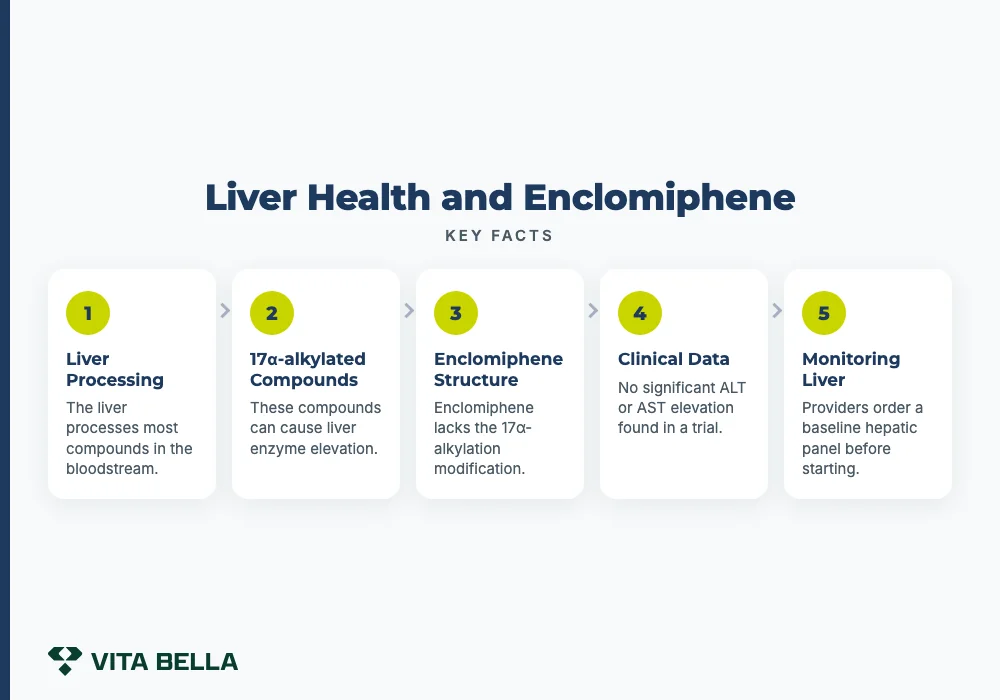
The liver processes nearly every compound entering the bloodstream. Two mechanisms drive most drug-induced hepatotoxicity: direct cellular damage from reactive metabolites and enzyme induction from high-volume hepatic first-pass processing.
17α-alkylated compounds are oral androgens modified at the 17th carbon position. That modification is intentional. It allows the compound to survive hepatic first-pass metabolism, but the liver processes high concentrations of a structurally resistant molecule repeatedly. A 2025 review in Nature Reviews Gastroenterology & Hepatology (Le Couteur et al.) describes how the liver's first-pass mechanisms create distinct vulnerability windows depending on molecular structure and metabolic load.
Enclomiphene does not carry that modification. That structural fact changes the enclomiphene liver question entirely. It shifts from "how toxic is it?" to "what does the clinical data actually show?"
Key takeaways:
- 17α-alkylated oral compounds force repeated hepatic first-pass processing, which generates reactive metabolites and can cause liver enzyme elevation; enclomiphene lacks that structural modification
- A 24-week randomized controlled trial found no statistically significant ALT or AST elevation in participants taking enclomiphene (Wiehle et al. 2014, PMC4155868)
- Enclomiphene is the purified trans-isomer of clomiphene; the other isomer, zuclomiphene, has different hormonal downstream effects, and clinical research treats the two compounds separately
- Providers order a baseline hepatic panel (ALT, AST, GGT, and total bilirubin) before starting enclomiphene and recheck at provider-determined intervals
- Men with active hepatic disease, significant transaminase elevation, or a history of drug-induced liver injury require direct provider evaluation before starting any compounded hormone compound
Is enclomiphene liver toxic? What clinical studies show
Available clinical evidence does not classify enclomiphene as hepatotoxic. The evidence base is not large. Long-term hepatic outcomes have not been established in sustained published trials, and that honest limitation matters alongside the trial findings.
"Is enclomiphene bad for your liver?" is a question the data can partially answer, not fully settle. The primary published source is the 2014 randomized controlled trial by Wiehle et al. (PMC4155868), a pharmacodynamic and pharmacokinetic study of enclomiphene citrate in men with secondary hypogonadism. This is the trial most consumer discussions cite by name but rarely quote precisely. It ran for 24 weeks across multiple dose arms and included routine laboratory monitoring throughout.
What the studies found on enclomiphene liver enzyme levels
In the Wiehle et al. 2014 trial, ALT and AST levels showed no statistically significant elevation versus baseline in the enclomiphene arms at 24 weeks. The trial was designed primarily to evaluate testosterone restoration and pharmacokinetics, not hepatic safety as a primary endpoint. That design detail is an honest limitation: the study was not powered to detect rare hepatic events.
What the data does show: enclomiphene liver enzyme markers remained within expected ranges at the protocol studied over 24 weeks. No hepatotoxicity was reported. That is clinically meaningful, even as it acknowledges the modest size and finite duration of available evidence.
Why enclomiphene differs from oral steroid compounds
Enclomiphene is a selective estrogen receptor modulator (SERM). It acts by blocking estrogen receptors at the hypothalamus and pituitary, stimulating the body's own release of luteinizing hormone (LH) and follicle-stimulating hormone (FSH), which raises endogenous testosterone. That receptor-level mechanism differs fundamentally from androgen replacement.
Oral anabolic steroids carrying 17α-alkyl modifications are androgens. They must survive hepatic first-pass metabolism, and the structural modification is specifically designed to prevent their breakdown. The liver processes high concentrations of these compounds repeatedly. The Le Couteur et al. 2025 review in Nature Reviews Gastroenterology & Hepatology provides the physiological framework for why this creates a distinct enclomiphene hepatotoxicity contrast: the two classes start from structurally different premises.
Structural differences that affect liver load:
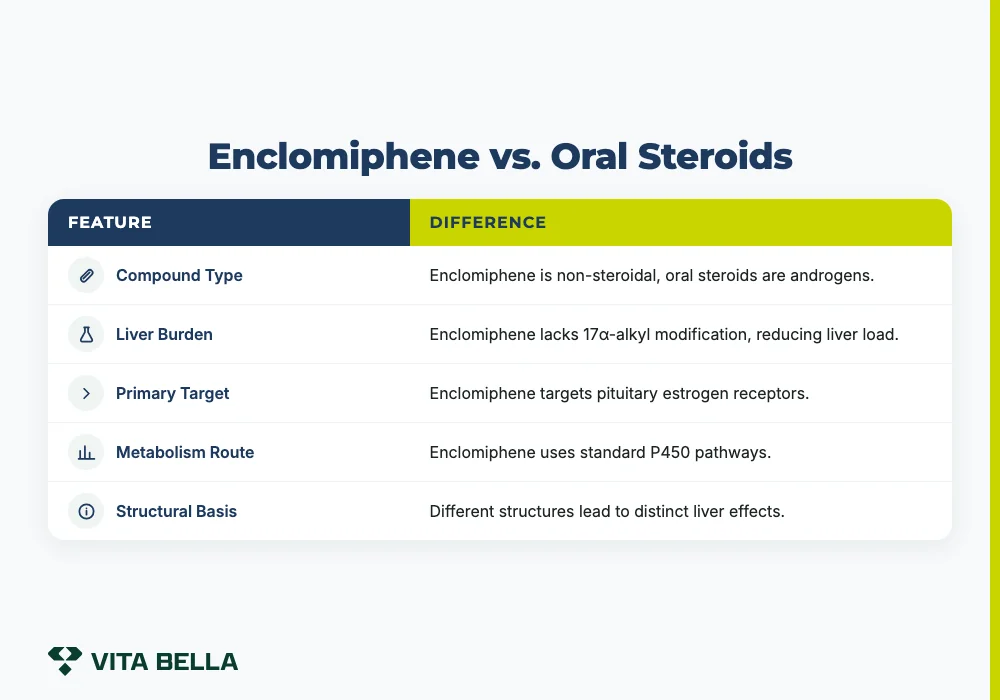
- Enclomiphene is non-steroidal; it does not share the steroidal backbone of oral androgens
- It carries no 17α-alkyl modification, so it does not impose the same hepatic first-pass metabolic burden
- Its primary target is the pituitary estrogen receptor, not androgen receptors or hepatic enzymes
- The liver metabolizes enclomiphene through standard cytochrome P450 pathways rather than the stress-inducing modified-androgen route
Understanding enclomiphene liver metabolism through this lens clarifies why the structural comparison with oral androgens is not merely a matter of degree. For more on enclomiphene's mechanism as a selective estrogen receptor modulator, the pharmacology background covers the full receptor and hormonal cascade in depth.
Enclomiphene vs. clomiphene: does the isomer affect liver risk?
This distinction matters and is frequently missed. Racemic clomiphene is a 50/50 mixture of two stereoisomers: enclomiphene (the trans-isomer) and zuclomiphene (the cis-isomer). Enclomiphene citrate, as a compounded medication, is the purified trans-isomer.
Zuclomiphene is a partial estrogen agonist at some receptor sites. Its downstream hormonal signals differ from enclomiphene's predominantly estrogen-antagonist profile. This is a key reason providers and researchers treat the two compounds separately in secondary hypogonadism protocols. The Wiehle et al. 2014 trial (PMC4155868) enrolled a population based on secondary hypogonadism criteria specifically to study the purified enclomiphene compound, not the racemic mixture.
From a liver standpoint, the available enclomiphene liver safety data comes from studies using the purified trans-isomer. Generalizing from racemic clomiphene data to enclomiphene, or vice versa, misrepresents both compounds. The Le Couteur et al. 2025 review reinforces that receptor-mediated hepatic effects depend on the specific ligand-receptor interaction, not just compound class.
Can you take enclomiphene if you have elevated liver enzymes?
Mildly or transiently elevated enzymes are evaluated case by case by the prescribing provider. The clinical context matters: why the enzymes are elevated, by how much, and for how long each change the picture. This is not a threshold patients can self-determine.
Enclomiphene liver clearance relies on standard cytochrome P450 pathways, the same system already under strain when hepatic function is compromised. Active or significant hepatic disease is a different scenario. A 2024 Lancet review on steatotic liver disease (Israelsen et al.) notes that pre-existing hepatic fat accumulation and inflammation alter how the liver processes compounds metabolized through cytochrome P450 pathways. Enclomiphene falls into that metabolic category. When baseline hepatic function is already compromised, any such compound warrants closer evaluation.
A 2024 Lancet report on acute liver failure (Maiwall et al.) identifies drug-induced liver injury as one of the leading causes in clinical populations, with the severity spectrum ranging from transient enzyme elevation to acute failure. That range is why baseline evaluation is non-negotiable for anyone with pre-existing liver conditions. For a broader look at enclomiphene's broader side-effect profile, the full side-effect overview covers other possible effects in clinical context.
The practical point: enclomiphene is a prescription compound. A licensed provider reviews complete health history and baseline labs before prescribing. If your liver enzymes are elevated at baseline, that review is exactly the step that determines eligibility.
What liver labs should be monitored on enclomiphene?
Providers typically order a hepatic panel including ALT, AST, and GGT at baseline and periodically during enclomiphene treatment. The monitoring cadence is provider-determined. Standardized published guidelines specific to compounded enclomiphene therapy are limited, which means the schedule reflects clinical judgment rather than a fixed protocol from a major medical body.
Understanding which markers matter helps patients engage productively with their provider's monitoring plan. For the complete picture of which labs providers order for hormone protocols, the full hormone and peptide lab guide walks through each marker in depth.
Labs before you start
A baseline hepatic panel before starting gives the provider a reference point. Without a baseline, it is not possible to distinguish a treatment-related change from a pre-existing elevation. That distinction drives clinical decisions.
Standard markers in a baseline hepatic panel include:
- ALT (alanine aminotransferase): the most liver-specific enzyme; elevation suggests hepatocellular stress or damage
- AST (aspartate aminotransferase): a broader marker also found in muscle and cardiac tissue; elevated in liver injury but interpreted alongside ALT
- GGT (gamma-glutamyl transferase): sensitive to alcohol intake, medication effects, and biliary obstruction; often used as a corroborating marker
- Total bilirubin: reflects the liver's conjugation and excretion capacity; elevated levels signal impaired hepatic function
These markers appeared in the routine laboratory monitoring in the Wiehle et al. 2014 trial. The Le Couteur et al. 2025 review in Nature Reviews Gastroenterology & Hepatology provides the physiological context for interpreting each one relative to compound exposure and hepatic load.
When to recheck: what to look for
Recheck timing is provider-guided. No published evidence-based standard exists for compounded enclomiphene monitoring intervals specifically. What providers apply is general hepatic monitoring practice calibrated to prescription compound protocols.
A mild transient elevation in ALT or AST in the first weeks differs clinically from a sustained or progressive increase. The former often reflects metabolic adjustment; the latter warrants pausing and investigation. Interpreting the difference requires clinical context: concurrent medications, alcohol use, exercise timing before the draw, and baseline values all factor in.
Long-term enclomiphene liver enzyme monitoring data specific to this therapy are not yet published in sufficient volume to establish evidence-based intervals. This is an honest gap. Men who want context on why lab values in the normal range don't always reflect optimal health can find that framing useful when discussing results with a provider.
Men who want a licensed provider to review their baseline hepatic labs and determine eligibility for enclomiphene can start through Vita Bella's clinical hormone program.
Enclomiphene vs. TRT vs. oral compounds: liver safety at a glance
The comparison below brings three compound categories together on a question men commonly research but rarely find answered directly: how their hepatic impact differs structurally. The differences are not anecdotal. They follow from molecular pharmacology.
| Compound | Mechanism | Hepatic impact in clinical data | Monitoring flag |
|---|---|---|---|
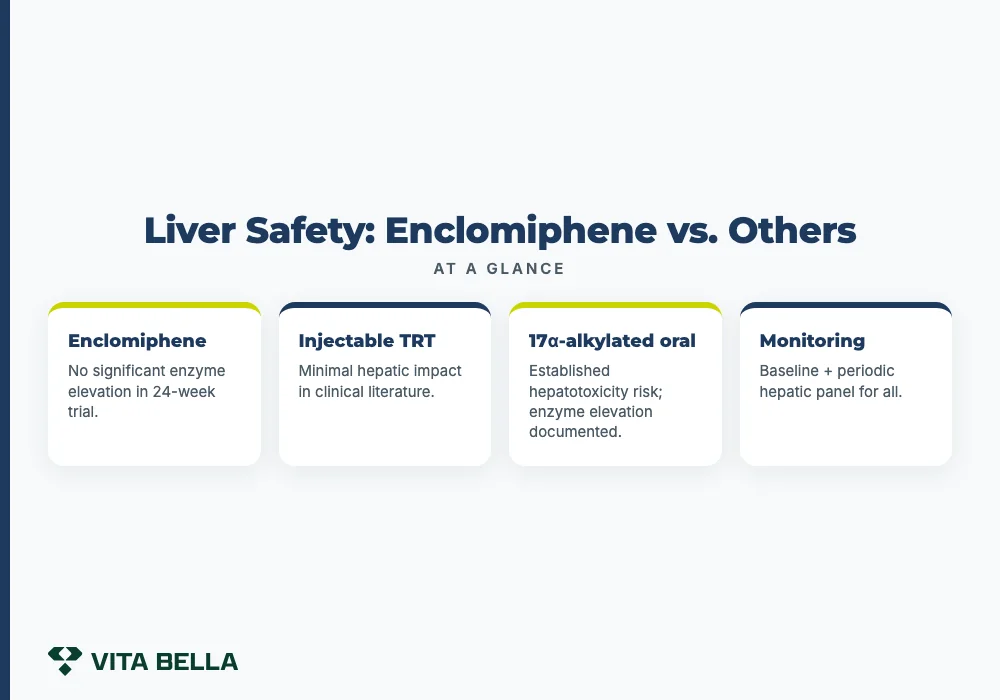
| Enclomiphene (compounded) | SERM, non-17α-alkylated | No significant enzyme elevation in 24-week randomized controlled trial (Wiehle et al. 2014) | Baseline + periodic hepatic panel |
| Testosterone cypionate (injectable TRT) | Androgen replacement | Oral testosterone forms carry higher hepatotoxicity risk; injectable forms show minimal hepatic impact in clinical literature | Baseline + periodic labs |
| 17α-alkylated oral compounds (e.g., oxandrolone) | Alkylated androgen, high hepatic first-pass | Established hepatotoxicity risk; enzyme elevation documented (Le Couteur et al. 2025) | Regular hepatic monitoring required |
This table reflects available clinical data, not a safety verdict. Enclomiphene and injectable testosterone occupy a markedly different risk category from 17α-alkylated oral compounds based on structural pharmacology. The two compound classes are not interchangeable clinically, regulatorily, or in terms of hepatic load. The enclomiphene liver column in that comparison, no significant enzyme elevation at 24 weeks, reflects both the SERM mechanism and the absence of a hepatic first-pass burden from an alkylated backbone.
Who should be cautious? Pre-existing liver conditions and contraindications
The liver-specific contraindication picture is more precise than a general caution list. These conditions change the enclomiphene liver risk calculus most directly:
- Active hepatitis or significant transaminase elevation: when baseline enzymes are already elevated, introducing a hepatically metabolized compound without provider clearance adds risk; the prescribing provider determines whether the elevation disqualifies or requires closer monitoring
- Cirrhosis or end-stage liver disease: a 2024 paper in Lancet Gastroenterology & Hepatology (Artru et al.) reviewing liver transplantation outcomes illustrates how underlying hepatic structural damage changes medication processing fundamentally; end-stage disease represents a contraindication the provider must evaluate directly
- History of drug-induced liver injury (DILI): prior DILI signals individual susceptibility to medication-related hepatic stress; a 2024 Lancet report (Maiwall et al.) categorizes DILI as a leading acute liver failure etiology and flags prior DILI history as clinically significant
- Complex focal hepatic lesions: the 2024 ACG Clinical Guideline on focal liver lesions (Frenette et al.) notes that complex hepatic abnormalities warrant provider evaluation before introducing hepatically metabolized compounds
A licensed provider reviews full medical history before prescribing any compounded medication. This review is the mechanism that catches these contraindications before treatment begins.
Ready to discuss enclomiphene with a licensed provider?
Enclomiphene's hepatic safety profile is studied and structurally distinct from 17α-alkylated compounds, but it remains a prescription compound ordered only after provider evaluation, which includes reviewing your baseline labs. The 24-week trial data are encouraging. The absence of long-term published enclomiphene liver data means monitoring is not optional.
At Vita Bella, a licensed provider reviews your health history and labs before any protocol begins. Review Vita Bella's hormone services overview to understand what that evaluation covers, or Get Started to connect with a provider directly. Transform Your Life. You Owe It To Yourself.
Frequently asked questions
Available clinical trial data, including a 24-week randomized controlled trial by Wiehle et al., did not show significant liver enzyme elevation in participants. The evidence base is limited in size and duration, so providers monitor hepatic markers as a standard precaution rather than relying on a "liver safe" classification.
No liver damage was reported in the controlled trial data reviewed to date, and enclomiphene lacks the 17α-alkylated structure associated with steroid-induced hepatotoxicity. Individual response varies, and anyone with pre-existing liver disease should discuss eligibility directly with a provider before starting.
A licensed provider typically orders ALT, AST, and GGT at baseline and at follow-up intervals; the specific schedule depends on the provider's clinical judgment and your starting values. These labs help detect any unexpected change before it becomes a concern.
Oral anabolic steroids that carry 17α-alkyl modifications are associated with established hepatotoxicity in the medical literature; enclomiphene does not share that structural feature. The clinical trial data available for enclomiphene show a distinct and markedly different liver enzyme profile, though the two classes are not interchangeable in any clinical or regulatory sense.
Long-term enclomiphene liver outcomes have not been established in published trials extending beyond 24 weeks. The available data show no significant enzyme elevation over that period, but ongoing provider monitoring addresses the gap in long-duration data. Patients should not interpret the absence of documented long-term harm as confirmation of indefinite safety, that determination belongs with the prescribing provider reviewing serial lab results.
Sources
- Wiehle R et al. (2014). Testosterone restoration using enclomiphene citrate in men with secondary hypogonadism: a pharmacodynamic and pharmacokinetic study. PMC. PubMed
- Le Couteur DG et al. (2025). Liver, ageing and disease. Nature Reviews Gastroenterology & Hepatology. PubMed
- Israelsen M et al. (2024). Steatotic liver disease. Lancet. PubMed
- Maiwall R et al. (2024). Acute liver failure. Lancet. PubMed
- Artru F et al. (2024). Liver transplantation for acute-on-chronic liver failure. Lancet Gastroenterology & Hepatology. PubMed
- Frenette C et al. (2024). ACG Clinical Guideline: Focal Liver Lesions. American Journal of Gastroenterology. PubMed