











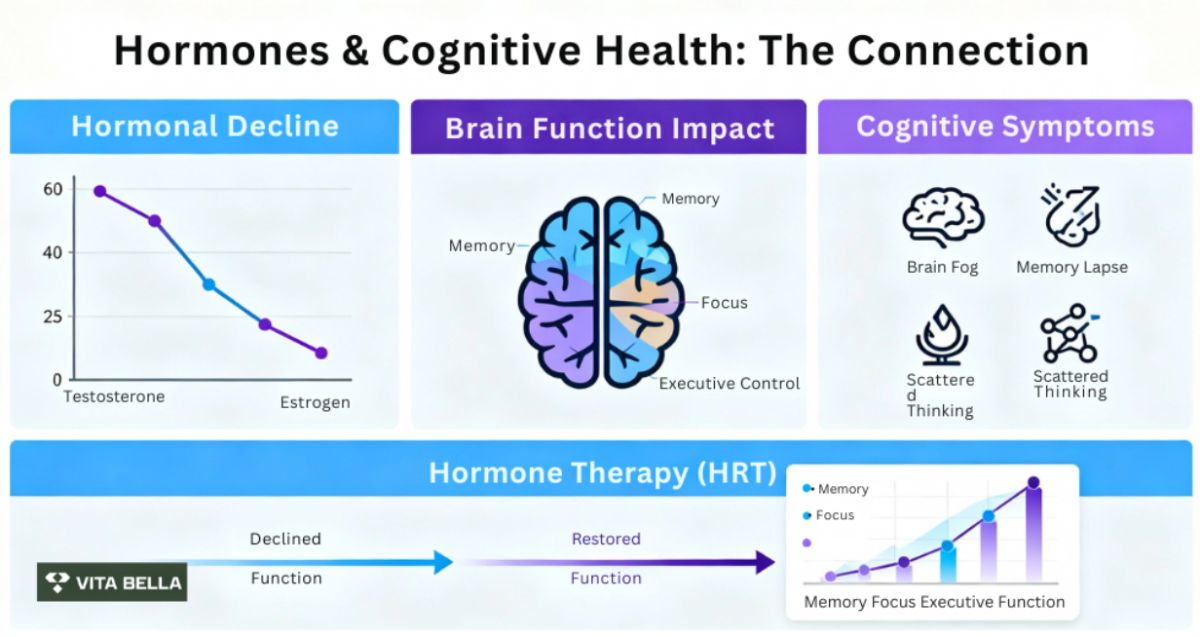
Struggling with brain fog, memory lapses, or scattered thinking? It’s not just a sign of aging. It could be your hormones at play, with testosterone and estrogen playing key roles in cognitive clarity and focus. As testosterone and estrogen gradually drop, brain regions like the hippocampus (central to memory) and the prefrontal cortex (responsible for focus and executive function) may suffer. In short, hormone balance isn’t just about energy, libido, or muscle; it’s also about mental clarity, focus, and cognitive resilience.
At Vita Bella, you deserve a sharp mind and clear focus, no matter your age. If brain fog and scattered thinking are holding you back, it might be time to address the root cause: hormone imbalance. Our expert team uses HRT to optimize testosterone and estrogen, helping you reclaim mental clarity, improve memory, and boost cognitive function. Don’t let hormonal decline cloud your potential. Take control of your mind and energy today with Vita Bella.
Why Hormonal Decline Affects Brain Function
Hormonal decline–particularly with testosterone and estrogen–directly impacts brain function by disrupting essential processes like memory, focus, and decision-making. As these hormones decrease, cognitive functions (such as executive control and verbal memory) often deteriorate. Hormone replacement therapy (HRT) can help restore balance, improving mental clarity, focus, and overall cognitive performance. These hormones play key roles in maintaining brain health:
1- Testosterone and cognition in men:
Epidemiological studies 1 indicate that men with lower total and bioavailable testosterone have a higher prevalence of cognitive decline and even dementia. For instance, a large observational review found men with lower testosterone levels had a significantly increased incidence of Alzheimer’s disease (RR ≈ 1.48; 95% CI 1.12‑1.96).
2- Estrogen and executive function in women:
Research 2 shows that estrogen supports prefrontal cortex function, the seat of executive tasks like planning, attention, and working memory. Estradiol (E2), one of the three primary physiological estrogens, is observed to fall rapidly during the menopausal transition. This decline in E2 has been linked to several alterations in the brain, including shifts in mood, sleep, and cognition.
Mid-life reductions in estrogen correlate with declines in verbal memory and processing speed. Thus, when testosterone or estrogen falls, the brain shifts from an anabolic, growth‑oriented state to one of under‑repair and inefficiency. As a result, mental fog steps in, memory falters, and focus suffers. With a greater understanding of who might benefit from such treatment, the use of sex hormone therapy in the future shows promise on tailored or precision medicine for the prevention or treatment of cognitive impairments throughout aging.
How Hormonal Drops Lead to Brain Fog & Scattered Thinking
Low levels of these hormones lead to a catabolic state in the brain, slowing cognitive processes. This can subsequently result in brain fog, scattered thinking, and difficulty concentrating. When hormonal support shrinks, you may feel like you’re working through fog even without an obvious neurological disease. This is how hormonal decline can translate into cognitive symptoms in practice:
Memory slips: Lower testosterone is associated with poorer performance on tests of processing speed, sustained attention, and working memory in older men. Free testosterone positively correlated with these domains.
Reduced executive control: In women, declining estrogen through menopause links to declines in the prefrontal cortex’s regulation of attention, multitasking, and verbal fluency.
Slowed neural repair & connectivity: Testosterone and estrogen support synaptic plasticity, myelination, and neuro‑vascular health. Their loss means slower cognitive recovery from stress, illness, or aging. A narrative review 3 notes that the decline in hormones corresponds with increased risk of dementia in men.
Why Rest Alone Isn’t Enough for Cognitive Clarity
Rest alone isn't always enough for cognitive clarity because brain health relies on hormonal balance, not just sleep. When testosterone and estrogen levels drop, cognitive functions like memory and focus are impaired. Hormone optimization through HRT helps restore brain function, making it essential to address hormonal imbalances alongside rest for true mental clarity. Many simply assume that more sleep or less stress will clear brain fog. Yet when hormones drop:
The brain’s repair systems slow. Lower testosterone reduces anabolic signals in the brain that support repair and growth.
Cognitive reserve is taxed. Executive networks strain when hormone‑mediated support falters, making rest insufficient.
Recovery is incomplete. Unlike muscle tissue, neural networks require hormonal “permission” to rebuild efficiently after injury or stress.
In short, rest helps, but it doesn’t replace hormonal support. Addressing the neuro‑endocrine foundation becomes essential, especially for those with documented decline in hormones.
Is Hormone Therapy a Viable Strategy for Cognitive Clarity?
Hormone therapy can be an effective solution for improving cognitive clarity. By restoring testosterone and estrogen levels, HRT helps support brain function, enhancing memory, focus, and executive performance. It offers a bridge back to clearer thinking and improved focus when applied thoughtfully:
Testosterone therapy in men: A randomized, placebo‑controlled trial 4 of testosterone gel in older men with low testosterone and memory impairment showed improvements in verbal and visual memory and executive function at 12 months.
Estrogen exposure in women: A cohort analysis 5 of 461 postmenopausal women found that timely hormone therapy correlated with better episodic memory (β = 0.106, p = 0.02) and working memory (β = 0.120, p = 0.005).
Thus, hormone therapy is not a magic bullet; rather, it reconstructs the biological foundation for cognitive clarity and performance.
Ignite Brain Performance: Claim Your HRT Strategy with Vita Bella
If brain fog is affecting your day-to-day life, it might be more than just stress or aging. It could be the result of hormonal imbalances that interfere with your mental clarity. Low testosterone and estrogen can disrupt cognitive functions like memory, focus, and processing speed. Understanding this connection is key to addressing the root cause of your brain fog. By correcting hormonal imbalances, you can support brain health and mental sharpness.
Vita Bella specializes in effective HRT that targets the core of your mental fog. We use personalized treatment plans to ensure your hormones are balanced for maximum cognitive benefit. Our therapies are designed to restore brain clarity, boost mental performance, and reduce cognitive fatigue. Experience focused, sharp thinking once again with Vita Bella’s specialized hormone solutions.

FAQs
Can low testosterone cause brain fog?
Yes, low testosterone levels can contribute to cognitive symptoms like brain fog, poor focus, and memory lapses. Testosterone supports brain functions like attention, memory, and executive control. When testosterone levels drop, the brain struggles to maintain mental clarity, leading to scattered thinking and reduced cognitive performance.
Does estrogen impact cognitive function in women?
Yes, estrogen plays a significant role in maintaining cognitive function, particularly in areas like memory and executive function. During menopause, when estrogen levels decline, women may experience difficulties with verbal memory, processing speed, and decision-making. Estrogen replacement therapy has shown promise in improving cognitive outcomes in postmenopausal women.
Can hormone replacement therapy (HRT) improve cognitive clarity?
Yes, hormone replacement therapy (HRT) can help restore cognitive clarity by optimizing testosterone and estrogen levels. Studies show that HRT, when used appropriately, improves memory, focus, and executive function by replenishing hormones that are essential for brain health and performance, especially in individuals with hormone deficiencies.
Is brain fog only related to aging?
No, brain fog isn’t just a natural part of aging. While aging can contribute to cognitive decline, hormonal imbalances—particularly low testosterone and estrogen–are major factors. These hormonal drops can lead to memory lapses, poor concentration, and mental fatigue, regardless of age. Addressing hormone imbalances can help alleviate these symptoms.
References:
Cai, Z., & Li, H. (2020). An updated review: Androgens and cognitive impairment in older men. Frontiers in Endocrinology, 11, 586909. https://doi.org/10.3389/fendo.2020.586909 🔗 https://www.frontiersin.org/articles/10.3389/fendo.2020.586909/full
Russell, J. K., Jones, C. K., & Newhouse, P. A. (2019). The role of estrogen in brain and cognitive aging. Neurotherapeutics, 16(3), 649‑665. https://doi.org/10.1007/s13311-019-00766-9
Yeap, B. B., & Flicker, L. (2022). Testosterone, cognitive decline and dementia in ageing men. Reviews in Endocrine and Metabolic Disorders, 23(6), 1243–1257. https://doi.org/10.1007/s11154-022-09728-7
Resnick, S. M., Matsumoto, A. M., & Stephens‑Shields, A. J. (et al.). (2017). Testosterone treatment and cognitive function in older men with low testosterone and age‑associated memory impairment. JAMA, 317(7), 717‑727. https://doi.org/10.1001/jama.2016.21044
Watts, A., Donofry, S., Ripperger, H., Eklund, N. M., Wan, L., Kang, C., Grove, G., Oberlin, L. E., Gujral, S., Vidoni, E. D., Burns, J. M., McAuley, E., Hillman, C. H., Kramer, A. F., Kamboh, M. I., & Erickson, K. I. (2025). Lifetime estrogen exposure and domain‑specific cognitive performance: Results from the IGNITE study. Frontiers in Aging Neuroscience, 17, 1524474. https://doi.org/10.3389/fnagi.2025.1524474 https://www.frontiersin.org/journals/aging-neuroscience/articles/10.3389/fnagi.2025.1524474/full