











In today’s fast‑paced world, stress isn’t just an emotional burden; it’s a physiological force that can seriously hamper your weight loss goals. When your body perceives crisis after crisis, it releases Cortisol, the so‑called “stress hormone,” which triggers survival modes like fat storage, elevated blood sugar, and muscle breakdown. Understanding this cycle is critical if you want to break free from stalled progress and finally get back to feeling in control.
At Vita Bella, we understand that weight loss isn’t just about diet and exercise; it’s about balancing your hormones. If stress and cortisol are sabotaging your progress, it’s time to take control. Our experts specialize in managing cortisol and optimizing your metabolism for lasting fat loss. Don’t let stress hold you back. Reclaim your energy, shed stubborn fat, and transform your body with Vita Bella’s personalized approach to wellness.
What Is the Evolutionary Role of Cortisol, and Why Does It Fight Fat Loss?
Cortisol evolved as an essential survival hormone: when faced with injury or a threat, it spiked to mobilize energy, raise blood sugar, and store fat as a buffer for future stress. In acute danger, this was useful; in modern chronic stress, it becomes counterproductive.
Cortisol increases hepatic gluconeogenesis (making sugar from non‑carbohydrate sources) and suppresses peripheral glucose uptake, which can drive higher insulin levels and fat accumulation. For instance, one review 1 stated that dysregulated glucocorticoid (cortisol) metabolism correlates with visceral obesity, insulin resistance, and dyslipidemia in humans.
According to research 2, in healthy men, increased regeneration of cortisol from cortisone within adipose tissue was associated with fat accumulation in fatty livers and insulin resistance (representing fat storage under high cortisol).
Thus, the mechanism is clear: chronic stress fosters a hormonal environment that signals “store fat, preserve energy, break down muscle,” exactly the opposite of what you need for fat‑loss and lean‑mass retention.
How Stress & Cortisol Lead to Fat Storage, Insulin Spikes, and Muscle Loss?
Cortisol evolved to help the body respond to acute stress by raising blood sugar and storing fat for energy. While this was beneficial during times of crisis, chronic stress in modern life causes sustained high cortisol levels, leading to fat storage, especially around the abdomen, and hindering fat loss efforts. When cortisol stays elevated over time rather than giving you short bursts, it initiates a cascade of metabolic shifts:
1- Fat storage promotion:
Cortisol upregulates lipoprotein lipase in visceral adipose tissue (which drives fat uptake in the abdomen) and downregulates hormone‑sensitive lipase that would normally release stored fat. Regarding the effects of hormones on metabolism, it is conceivable that stressors or depression could cause an increase in cortisol, which could lead to weight gain.
However, the metabolic alterations observed in study 3 should be attributed to the insulin rise in response to calorie intake. There are two primary enzymatic routes via which cortisol affects the metabolism of adipose tissue. Cortisol raises lipoprotein lipase activity when insulin is present, which causes fat to build up in visceral adipose tissue.
2- Insulin resistance & elevated blood sugar:
Chronic cortisol exposure blunts insulin signaling in muscle and fat, elevates hepatic glucose output, and reduces uptake of glucose into skeletal tissues. A review 4 found that Chronic hypercortisolism or, in certain situations, an insufficient cortisol response to stress can result from prolonged stress and/or poor stress regulation, which can contribute to insulin resistance, increased adiposity, and type 2 diabetes.
3- Muscle breakdown (catabolic state):
Instead of building or maintaining muscle, which burns more calories, high cortisol drives protein breakdown, activates catabolic pathways (like ubiquitin‑proteasome in muscle), and suppresses the synthesis of new muscle fibers. A large MR study 5 in humans showed that cortisol is causally associated with reduced muscle strength and mass and sarcopenia risk. In other words, your body is primed to store fat, spike insulin, and tear down muscle, all forces working against weight‑loss or lean mass gain.
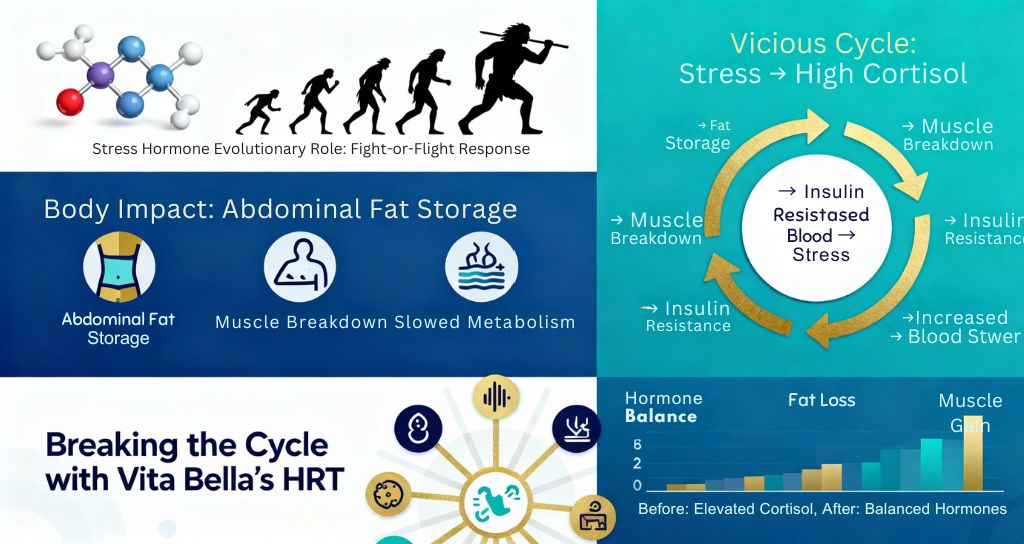
Why the Cycle Becomes ‘Vicious’?
The cycle becomes vicious when chronic stress keeps cortisol levels elevated, which promotes fat storage, especially in the abdominal area. As cortisol raises blood sugar and insulin, it becomes harder for the body to burn fat. This leads to muscle breakdown, slowed metabolism, and increased fat accumulation, making weight loss increasingly difficult. When stress is chronic, your body remains locked in “survival mode”:
You eat more (often through stress eating), and your metabolism shifts toward storage.
Cortisol raises blood sugar, so insulin stays elevated; insulin promotes fat storage and blocks fat release.
With muscle loss, your resting metabolic rate drops, making calorie deficits harder to maintain.
Visceral fat increases further, which is itself metabolically active and contributes to more insulin resistance + cortisol signaling.
Break the Stress Cycle, get back on Track with Expert Guidance with Vita Bella
High cortisol levels are blocking your progress, keeping your body in fat-storage mode and preventing muscle growth. This not only affects your ability to lose weight but also drains your energy and increases hunger. Stress not only impacts your mental health but also directly disrupts your metabolism and fat-burning potential. When cortisol remains high, it increases the storage of visceral fat, making it harder to shed pounds.
With Vita Bella’s hormone optimization therapy, we help you regulate cortisol and balance your hormones to unlock your body’s full potential. By addressing the root cause of your stress-related weight issues, we help you achieve sustainable fat loss. Our tailored approach boosts your metabolism, helping you shed fat, increase lean muscle mass, and regain control over your body. Finally, feel energized, focused, and confident as you work towards your fitness goals.
FAQs
Can high cortisol levels prevent weight loss?
Yes, elevated cortisol levels, often caused by chronic stress, can interfere with weight loss by promoting fat storage, particularly in the abdominal area. Cortisol increases blood sugar and insulin levels, which encourages the body to store fat while hindering fat burning, ultimately making it harder to lose weight.
Does cortisol contribute to muscle breakdown?
Yes, high cortisol levels are catabolic, meaning they can break down muscle tissue to provide energy in times of stress. This muscle breakdown slows metabolism and reduces lean muscle mass, which is essential for burning calories. Over time, this results in a slower metabolism and harder weight loss.
Can stress management help with weight loss?
Yes, managing stress can help lower cortisol levels, reducing fat storage and muscle breakdown. Techniques like mindfulness, deep breathing, and regular physical activity can help regulate cortisol, making it easier for the body to enter a fat-burning state. Lower cortisol levels also support better metabolic function and weight management.
Is cortisol always harmful to weight loss?
No, while chronically elevated cortisol can hinder weight loss, short-term spikes in cortisol are natural and beneficial for survival, providing quick energy during stress. However, when cortisol remains high for extended periods due to chronic stress, it disrupts fat metabolism and contributes to weight gain and muscle loss.
References:
Akalestou, E., Genser, L., & Rutter, G. A. (2020). Glucocorticoid metabolism in obesity and following weight loss. Frontiers in Endocrinology, 11, 59. https://doi.org/10.3389/fendo.2020.00059 https://www.frontiersin.org/journals/endocrinology/articles/10.3389/fendo.2020.00059/full
Westerbacka, J., Yki‑Järvinen, H., Vehkavaara, S., Häkkinen, A.‑M., Andrew, R., Wake, D. J., Seckl, J. R., & Walker, B. R. (2003). Body fat distribution and cortisol metabolism in healthy men: Enhanced 5β‑reductase and lower cortisol/cortisone metabolite ratios in men with fatty liver. The Journal of Clinical Endocrinology & Metabolism, 88(10), 4924‑4931. https://doi.org/10.1210/jc.2003-030596
Barton, A., & Yancy, W. S. (2014). Determining the culprit: Stress, fat, or carbohydrates. Biological Psychiatry, 78(4), e12. https://doi.org/10.1016/j.biopsych.2014.10.027
Gianotti, L., Belcastro, S., D’Agnano, S., & Tassone, F. (2021). The stress axis in obesity and diabetes mellitus: An update. Endocrines, 2(3), 334‑347. https://doi.org/10.3390/endocrines2030031
Katsuhara, S., Yokomoto‑Umakoshi, M., Umakoshi, H., Matsuda, Y., Iwahashi, N., Kaneko, H., Ogata, M., Fukumoto, T., Terada, E., & Sakamoto, R. (2022). Impact of cortisol on reduction in muscle strength and mass: A Mendelian randomization study. The Journal of Clinical Endocrinology & Metabolism, 107(4), E1477‑E1487. https://doi.org/10.1210/clinem/dgab862