



Could a small mitochondrial peptide influence how the body manages weight and metabolic balance? Mitochondria are widely known for producing cellular energy. However, modern research shows that they also release mitochondrial-derived peptides (MDPs) that regulate metabolic signaling across the body. One of the most important peptides in this group is MOTS-c, a signaling molecule that researchers1 have associated with metabolic balance, glucose regulation, muscle insulin sensitivity, and body weight management in humans.
Metabolic health plays a vital role in maintaining energy, body weight, and overall well-being. However, many individuals struggle with metabolic imbalance despite maintaining healthy lifestyle habits. At Vita Bella, personalized wellness programs focus on supporting metabolic health through evidence-based strategies and advanced therapies. MOTS-c peptide acts as a mitochondrial signal involved in weight regulation and metabolic balance.
How Do MOTS-c Levels Relate to Body Weight and Glucose Metabolism?
MOTS-c is a 16-amino-acid peptide encoded within mitochondrial DNA. Unlike most mitochondrial molecules, it can travel into the cell nucleus, where it influences genes involved in metabolism and stress responses. Human research2 also shows that circulating MOTS-c levels correlate with metabolic markers related to body weight and glucose metabolism. These findings highlight the peptide’s potential role in maintaining metabolic stability and supporting healthy metabolic function.
How MOTS-c Influences Weight Regulation?
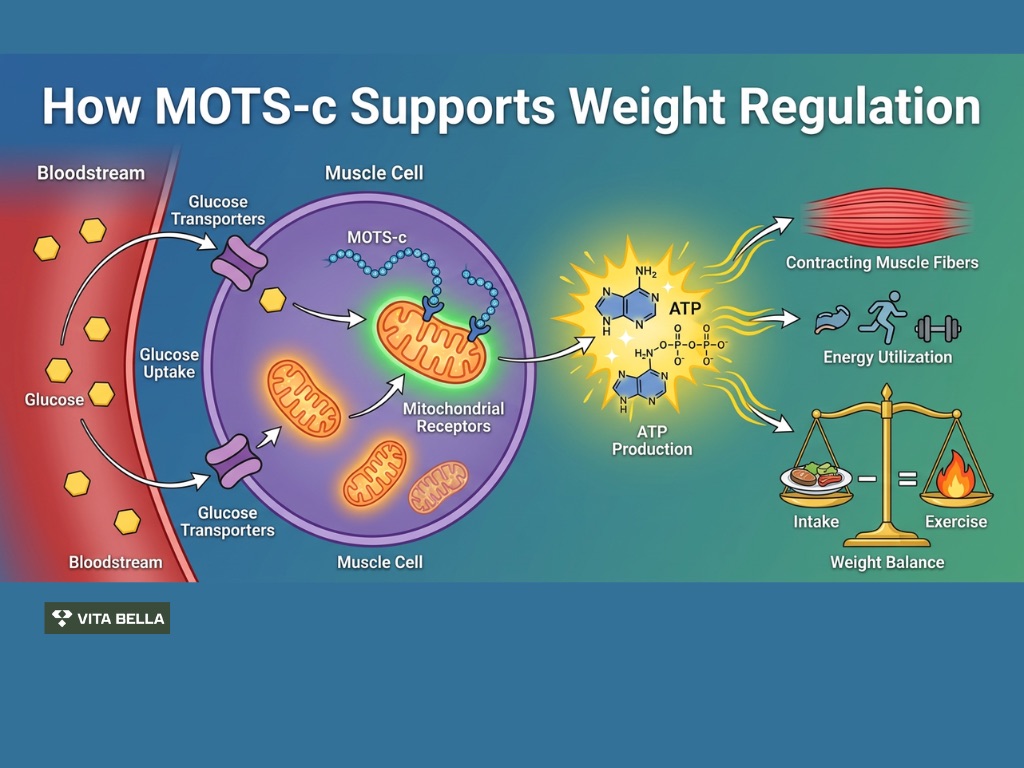
Maintaining a healthy body weight depends on efficient metabolic signaling and energy utilization. MOTS-c contributes to these processes by regulating pathways involved in glucose metabolism and cellular energy balance. These mechanisms highlight the peptide’s potential role in supporting metabolic stability and energy efficiency. Several metabolic mechanisms help explain how this peptide may influence weight regulation.
1- Supporting Glucose Metabolism
Glucose metabolism is a central factor in metabolic balance because it determines how efficiently the body converts nutrients into energy. MOTS-c influences pathways that regulate glucose uptake in skeletal muscle and other tissues. MOTS-c1 levels are associated with metabolic health indicators related to glucose metabolism and insulin sensitivity. Because skeletal muscle accounts for a large proportion of glucose uptake in the body, this signaling pathway plays a critical role in maintaining metabolic stability.
2- Enhancing Metabolic Adaptation
Another important function of MOTS-c is to help cells adapt to metabolic stress. When metabolic demand increases, the body must adjust its energy production to maintain metabolic balance. Research3 describes MOTS-c as a metabolic regulator that influences nuclear gene expression related to energy metabolism, allowing cells to respond efficiently to metabolic challenges. Through this regulatory function, MOTS-c may support metabolic adaptation by:
Improving metabolic flexibility
Supporting efficient energy utilization
Coordinating mitochondrial signaling pathways
How Does MOTS-c Impact Physical Activity?
Exercise significantly influences metabolic signaling pathways. Interestingly, scientists have identified MOTS-c as a mitochondrial peptide involved in metabolic responses associated with physical activity. Research4 indicates that exercise can stimulate metabolic signaling pathways linked with MOTS-c activity, directly regulating adaptive nuclear gene expression following nuclear translocation. During physical activity, the body increases glucose uptake and energy expenditure to support muscle contraction.
How Does MOTS-c Influence Muscle Metabolism?
Skeletal muscle plays a central role in metabolic health because it consumes large amounts of glucose and energy. Efficient muscle metabolism, therefore, contributes significantly to weight regulation and metabolic balance. Human observational studies5 show that higher circulating MOTS-c levels are associated with improved muscle performance indicators, including greater muscle strength and physical performance capacity.
Why is MOTS-c studied as a Biomarker for Metabolic Disorders?
Interest in mitochondrial peptides has grown significantly because these molecules connect cellular energy production with systemic metabolic health. Study6 indicates that circulating MOTS-c levels may serve as a biomarker for metabolic disorders such as obesity and type 2 diabetes, highlighting their importance in metabolic health research. MOTS-c may influence metabolic balance through several mechanisms:
Supporting glucose uptake in skeletal muscle
Regulating insulin signaling pathways
Coordinating mitochondrial energy production
Influencing metabolic gene expression
Shed Pounds & Boost Energy with Vita Bella
You’ve tried countless solutions to manage your weight, but something’s still off. The underlying issue may lie within mitochondrial dysfunction and disrupted metabolic pathways. These imbalances prevent your body from efficiently converting nutrients into energy, leading to weight fluctuations and low energy levels. Without addressing these root causes, traditional weight-loss methods often fall short in delivering lasting results.
Vita Bella offers a breakthrough approach using MOTS-c peptide, a natural signal that enhances glucose metabolism and regulates energy use. Our holistic wellness programs are designed to restore metabolic efficiency, improve energy production, and support weight management. Take the first step toward lasting metabolic health with Vita Bella today.

Frequently asked questions
Yes, human research suggests that the MOTS-c peptide participates in metabolic signaling pathways that influence glucose metabolism and energy utilization. Because these pathways help regulate how the body processes nutrients and maintains energy balance, MOTS-c may contribute to metabolic processes associated with weight regulation and overall metabolic stability.
Yes, studies indicate that MOTS-c functions as a mitochondrial-derived signaling peptide that helps coordinate metabolic pathways involved in energy production and glucose metabolism. By influencing cellular signaling processes related to metabolism, MOTS-c may support metabolic balance and help maintain stable metabolic function in human cells.
Yes, several human observational studies report that circulating MOTS-c levels are associated with metabolic health markers such as insulin sensitivity, glucose regulation, and body weight indicators. These associations suggest that mitochondrial peptides like MOTS-c may reflect metabolic status and play a role in maintaining metabolic homeostasis.
Yes, human research shows that MOTS-c may influence metabolic pathways within skeletal muscle, which is a major site of glucose utilization in the body. Because skeletal muscle plays an essential role in energy metabolism, mitochondrial peptides such as MOTS-c may help support muscle metabolism and cellular energy regulation.
References:
Zheng, Y., Wei, Z., & Wang, T. (2023). MOTS-c: A promising mitochondrial-derived peptide for therapeutic exploitation. Frontiers in Endocrinology, 14, 1120533. https://doi.org/10.3389/fendo.2023.1120533
Du, C., Zhang, C., Wu, W., Liang, Y., Wang, A., Wu, S., Zhao, Y., Hou, L., Ning, Q., & Luo, X. (2018). Circulating MOTS-c levels are decreased in obese male children and adolescents and associated with insulin resistance. Pediatric Diabetes. https://doi.org/10.1111/pedi.12685
Mohtashami, Z., Singh, M. K., Salimiaghdam, N., Ozgul, M., & Kenney, M. C. (2022). MOTS-c, the most recent mitochondrial-derived peptide in human aging and age-related diseases. International Journal of Molecular Sciences, 23(19), 11991. https://doi.org/10.3390/ijms231911991
Reynolds, J. C., Lai, R. W., Woodhead, J. S. T., Joly, J. H., Mitchell, C. J., Cameron-Smith, D., Lu, R., Cohen, P., Graham, N. A., Benayoun, B. A., Merry, T. L., & Lee, C. (2021). MOTS-c is an exercise-induced mitochondrial-encoded regulator of age-dependent physical decline and muscle homeostasis. Nature Communications, 12, 470. https://doi.org/10.1038/s41467-020-20790-0
Domin, R., Pytka, M., Żołyński, M., Niziński, J., Rucinski, M., Guzik, P., Zieliński, J., & Ruchała, M. (2023). MOTS‑c serum concentration positively correlates with lower‑body muscle strength and is not related to maximal oxygen uptake — a preliminary study. International Journal of Molecular Sciences, 24(19), 14951. https://doi.org/10.3390/ijms241914951
Zhou, Q., Yin, S., Lei, X., Tian, Y., Lin, D., Wang, L., & Chen, Q. (2024). The correlation between mitochondrial derived peptide (MDP) and metabolic states: A systematic review and meta‑analysis.Diabetology & Metabolic Syndrome, 16, 200. https://doi.org/10.1186/s13098‑024‑01405‑w