Peptide therapy is the clinical use of short amino acid chains to send targeted signals inside the body. More than 60 peptide-based drugs are in clinical use, with hundreds more in development, per a 2015 review in Drug Discovery Today. The signals support recovery, muscle growth, fat loss, and anti-aging. Because peptide therapy frequently pairs with hormone therapy to address multiple systems at once, licensed providers review your labs before recommending any compound.
What is peptide therapy used for?
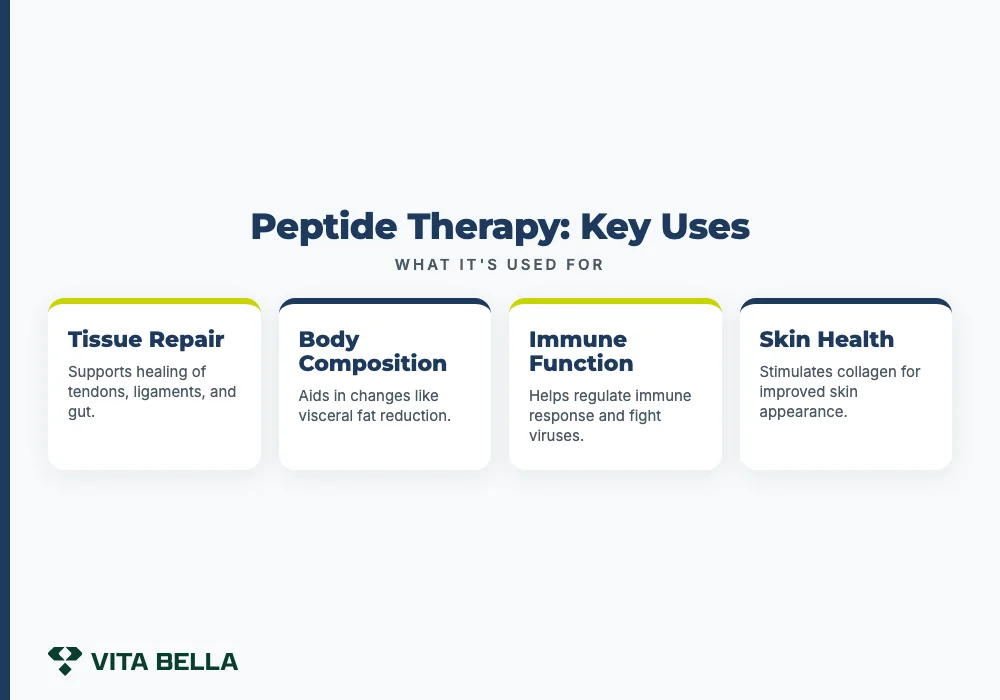
Peptide therapy is used to support tissue repair, body composition change, immune function, and skin health. Providers prescribe it when labs and symptoms reveal specific deficits that targeted signaling can address. It is not a general supplement. It is a provider-supervised protocol matched to your individual biology.
The table below lists the most common compounds and their primary clinical uses.
| Peptide | Primary clinical use | Delivery route |
|---|---|---|
| BPC-157 | Tendon, ligament, and gut repair | Peptide injections or oral |
| CJC-1295 | Growth hormone pulse amplification | Peptide injections |
| Tesamorelin | Visceral fat reduction | Peptide injections |
| Thymosin alpha-1 | Immune regulation and anti-viral response | Peptide injections |
| Cosmeceutical peptides | Skin collagen stimulation | Topical application |
The clinical footprint of this field is expanding beyond performance and longevity. A 2025 review in Cells explored peptide-based approaches for central nervous system repair in neurodegenerative conditions. A separate 2025 paper in Drug Discovery Today positioned peptide therapy as a promising direction for acute kidney injury, identifying compounds capable of interrupting the inflammatory cascade driving organ damage. These are early-stage findings, not current standard-of-care protocols. But they illustrate why researchers across specialties are paying close attention to the same mechanisms that athletes and longevity-focused patients have used for years.
How do peptides differ from hormones?
Peptides and hormones are both chemical messengers, but they operate at different scales. Hormones such as testosterone or cortisol travel through the bloodstream and exert effects across many tissues simultaneously. Peptides bind to highly specific receptors and produce more contained results. Fewer systemic effects. More precision.
Growth hormone is the clearest example. The hormone itself drives broad tissue growth throughout the body. Growth hormone peptides, by contrast, signal the pituitary gland to release growth hormone in a controlled pulse rather than flooding the system. This is why peptide injections can support your body's own hormone production rather than overriding it.
This receptor specificity means dosing requires clinical judgment. A licensed provider determines the dose after labs, balancing signal strength against your tolerance, timing, and full health history. The same compound can behave very differently across two individuals with similar goals but distinct baselines.
Key compounds: BPC-157, growth hormone peptides, and more
BPC-157 benefits for tissue repair
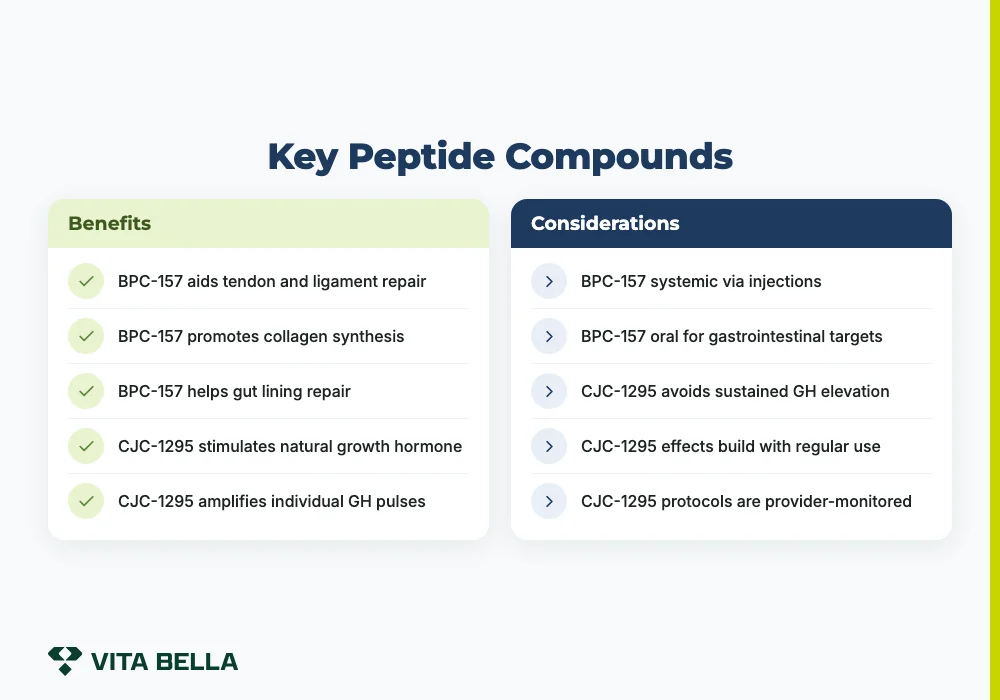
BPC-157 is a body-protective compound originally isolated from a gastric juice protein. Preclinical research has consistently shown that BPC-157 benefits include accelerating tendon and ligament repair by promoting collagen synthesis and new blood vessel formation, as documented in a 2019 review in Current Pharmaceutical Design. Athletes recovering from connective tissue injuries are the most common candidates.
The tissue-repair application extends beyond muscles and joints. The same review noted effects on gut lining repair, making BPC-157 relevant for patients managing inflammatory bowel conditions alongside their performance goals. Peptide injections are the standard delivery route when the goal is systemic. Oral forms are used when the target is gastrointestinal specifically.
Peptides for muscle growth and the CJC-1295 peptide
Peptides for muscle growth work by stimulating the body's natural release of growth hormone. No synthetic hormone. No override. Just an amplified signal sent to an already functioning system.
CJC-1295 is a growth hormone-releasing hormone analog and one of the most studied growth hormone peptides in this category. The CJC-1295 peptide version used in clinical protocols at Vita Bella is without DAC (drug affinity complex), which carries a half-life of roughly 30 minutes and amplifies each individual natural GH pulse rather than sustaining elevated hormone levels across multiple days. That distinction shapes how the compound is monitored and combined with other agents.
Research on the DAC version of CJC-1295 found that prolonged GHRH analog stimulation raised IGF-1 levels significantly, as reported in a 2006 study in the Journal of Clinical Endocrinology and Metabolism. Those findings apply to the long-acting DAC formulation only. The no-DAC mechanism is different: effects accumulate through consistent, regular use as each individual pulse is reinforced rather than prolonged.
In practice, providers typically combine CJC-1295 with a growth hormone-releasing peptide (GHRP) to engage both arms of the GH-release pathway. Together, the compounds improve recovery between training sessions and support a gradual shift toward lean body mass over time.
Peptides for fat loss
Peptides for fat loss act through two primary mechanisms: direct stimulation of fat metabolism and reduction of visceral adiposity. Tesamorelin has demonstrated clinical efficacy for visceral fat reduction in patients with HIV-associated lipodystrophy. Vita Bella providers include it in body composition protocols, with IGF-1 monitoring as a supporting signal.
Growth hormone peptides contribute to fat loss indirectly. Elevated GH improves insulin sensitivity and shifts the body toward fat oxidation during fasted states and exercise. The degree of change depends on your baseline hormone output, dietary patterns, and training intensity. A provider weighs each of those factors before building a peptides-for-fat-loss protocol.
Peptide therapy is not a substitute for nutrition and training. It amplifies the metabolic impact of those inputs for people whose hormonal baseline is limiting what those inputs can achieve on their own.
Anti-aging peptides and skin health
Anti-aging peptides address collagen decline, tissue elasticity loss, and the slowing of cellular repair that accompanies aging. A 2007 study in Dermatologic Therapy found that peptide-infused topical creams improved skin smoothness and firmness versus placebo. The mechanism was structural, these compounds supported the skin's own regenerative activity rather than masking visible signs.
The anti-aging application reaches well beyond the skin. Effective protocols address inflammation, tissue repair capacity, and hormonal support together. No single compound covers all of those targets. Anti-aging peptides produce the strongest results when part of a protocol that considers the full biological picture.
Immune modulation and inflammation control
Chronic low-grade inflammation drives many of the conditions that accelerate biological aging. Certain peptides act directly on the signaling pathways that sustain it. Thymosin alpha-1 is the most studied compound in this category. A review in the Annals of the New York Academy of Sciences found that it regulates T-cell activity and enhances adaptive immune responses, with studied applications in vaccine effectiveness and ongoing immune support.
More recent research extends that picture. A 2021 study in the International Journal of Molecular Sciences reported that ezrin-targeting peptides can inhibit inflammatory signaling pathways relevant to both viral infections and chronic immune activation. These operate through a different mechanism than Thymosin alpha-1. Both point toward the same principle: targeted peptide signaling can calibrate immune responses rather than simply activating or suppressing them.
Immune-modulating peptide therapy is still an emerging area. It is not yet first-line care for most immune conditions. The evidence base is growing, and these compounds increasingly appear in complex wellness protocols where systemic inflammation is a primary target.
What happens before you start peptide therapy
Most articles explain what peptides do. Few cover the process that precedes a single injection. That process matters.
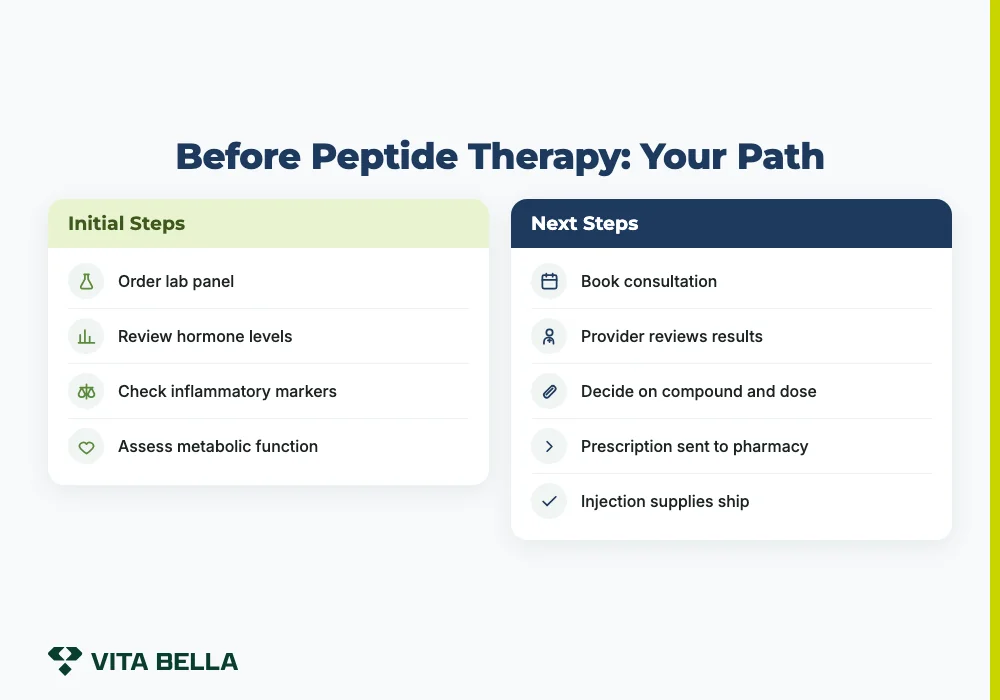
The path starts with labs. A licensed provider orders a panel through Quest Diagnostics that reveals baseline hormone levels, inflammatory markers, and metabolic function. The initial panel typically covers:
- Baseline hormone levels, including testosterone, IGF-1, and thyroid markers, which establish your starting point.
- Inflammatory indicators such as C-reactive protein, which reveal systemic stress that affects compound selection.
- Metabolic markers including fasting glucose and a standard metabolic panel, which show how your body manages energy.
These numbers tell the provider which deficits are real versus within normal variation. If standard lab ranges have left you feeling off, understanding what your results actually reveal about your hormonal and metabolic baseline is a core part of how providers build a starting protocol.
Labs at Vita Bella are ordered and reviewed by the provider and billed separately from membership at most Quest locations. After results come back, you book a 30-to-45-minute consultation. The provider walks through your numbers, connects them to your symptoms and goals, and explains which compounds match your clinical picture. Dosing is decided here: a licensed provider determines the dose after labs, not from a default template or general guideline.
If peptide therapy fits your profile, the prescription goes to an FDA-inspected, state-licensed U.S. compounding pharmacy. Injection supplies ship free and discreetly. Most people become comfortable with subcutaneous injection technique within the first few sessions.
Are peptides safe for long-term use?
Peptides are generally well-tolerated when sourced through regulated compounding pharmacies and supervised by a licensed provider. Because most therapeutic peptides mimic compounds the body already produces, the risk of systemic disruption is lower than with many synthetic interventions. A 2026 primer in The American Journal of Sports Medicine for orthopaedic and sports medicine physicians covered injectable peptide therapy protocols and outlined the safety framework applicable to each major compound class.
Long-term safety depends on the specific compound, the patient's health history, and consistent monitoring. No responsible provider prescribes a peptide without regular follow-up. Quarterly one-on-one reviews allow providers to catch changes in labs or symptoms early and adjust the protocol accordingly.
Common short-term effects include mild injection-site reactions and temporary shifts in appetite or water retention, particularly with growth hormone-related peptides. These typically resolve within days. A provider who observes accumulating side effects will adjust or pause before continuing.
Which peptides are approved for specific clinical indications?
Several peptides carry full clinical approval for specific indications. Tesamorelin passed rigorous trials for visceral fat reduction. Thymosin alpha-1 has been extensively studied for immune modulation, including vaccine enhancement, per the Annals of the New York Academy of Sciences review.
Many compounds used in clinical peptide therapy practice are prescribed through licensed compounding pharmacies pursuant to a valid prescription. Unapproved does not mean unresearched. It means the compound has not completed the approval pathway for a defined commercial indication, not that it lacks a clinical rationale or evidence base.
Purchasing peptides without a prescription from unregulated online sources is a separate and higher-risk category. Contamination, mislabeling, and inconsistent purity are documented problems in that market. Working with a licensed provider and an FDA-inspected pharmacy addresses those risks.
How long does peptide therapy take to work?
The timeline depends on the compound and the goal. Sleep quality and recovery often improve within the first two to four weeks. Visible body composition changes, including fat reduction and muscle definition, typically require eight to twelve weeks of consistent use paired with appropriate nutrition and training.
Meaningful progress in tissue repair, such as supporting a tendon recovery with BPC-157, is often measurable in four to eight weeks. Skin improvements from anti-aging peptides generally appear after eight to twelve weeks of regular use.
Providers build specific checkpoints into every protocol. Reviewing body composition data throughout your protocol gives you and your provider an objective measure of whether the compounds are producing the intended effect. Consistent use and the lifestyle inputs your provider recommends determine how quickly results become measurable.
No outcomes are assured. Every baseline is different.
How providers monitor and adjust peptide protocols
Peptide therapy is not a static prescription. Effective protocols adapt. Providers review labs quarterly, assess symptoms against baseline, and modify compound selection or timing when your physiology calls for an adjustment.
Lab reviews every quarter, symptom check-ins between visits, and protocol changes when your response shifts off-course: this is how provider oversight shapes peptide protocol outcomes in practice. Members at Vita Bella get direct access to a licensed provider, not an automated recommendation engine.
The structure of that monitoring separates supervised peptide therapy from self-directed supplementation. Results tracked across months create a clinical record that informs not only the peptide protocol but the entire wellness program.
Start your peptide therapy evaluation
Getting started at Vita Bella follows a clear sequence: labs through Quest Diagnostics, a one-on-one consultation to review your results, and a protocol recommendation matched to your specific baseline. No prescription without provider review. Real providers, real medicine, and the ability to choose your own provider from a licensed network.
Get Started to take the intake assessment and connect with a licensed provider.
Frequently asked questions
Yes. Certain growth hormone secretagogues support the sleep stages where tissue repair and natural GH release are highest. Many people report deeper, more restorative sleep and faster recovery within the first few weeks of a protocol.
Adults dealing with slow recovery, stubborn body composition changes, energy decline, or early signs of accelerated biological aging are common candidates. A licensed provider uses your labs to determine whether your baseline supports a meaningful clinical response.
The decision begins with labs and reported symptoms. Providers match compound selection to measurable deficits: low growth hormone output, impaired tissue repair, elevated visceral fat, or immune dysregulation. No compound is prescribed on a general recommendation alone.
Yes. The two approaches frequently complement each other. Peptide therapy addresses recovery and tissue repair while hormone optimization maintains the foundational hormonal environment. Providers design these protocols together so the compounds reinforce rather than interfere with one another.
Sources
- Fosgerau K, Hoffmann T. (2015). Peptide therapeutics: current status and future directions. Drug Discovery Today. PubMed
- Brcic L, Brcic I. (2019). The role of BPC-157 in the healing of different tissues. Current Pharmaceutical Design. PubMed
- Teichman SL et al. (2006). Prolonged stimulation of growth hormone and IGF-1 by CJC-1295, a long-acting GHRH analog. Journal of Clinical Endocrinology and Metabolism. PubMed
- Romani L et al. (2015). Thymosin alpha1: an endogenous regulator of immunity, inflammation, and tolerance. Annals of the New York Academy of Sciences. PubMed
- Lupo MP, Cole AL. (2007). Cosmeceutical peptides. Dermatologic Therapy. PubMed
- Mayfield CK et al. (2026). Injectable Peptide Therapy: A Primer for Orthopaedic and Sports Medicine Physicians. The American Journal of Sports Medicine. PubMed
- de Oliveira CAA et al. (2025). Orthobiologics and Peptide Therapy for Central Nervous System Repair in Neurodegenerative Conditions. Cells. PubMed
- Hao H et al. (2025). Peptide therapy: new promising therapeutics for acute kidney injury. Drug Discovery Today. PubMed
- Holms RD et al. (2021). Ezrin Peptide Therapy from HIV to COVID: Inhibition of Inflammation and Amplification of Adaptive Anti-Viral Immunity. International Journal of Molecular Sciences. PubMed