Peptides vs TRT comes down to mechanism, not results alone. TRT replaces testosterone from outside the body; peptide therapy signals the pituitary to produce more of its own. The two approaches target different hormonal axes, which is why a man with confirmed low testosterone and a man with poor sleep and slow recovery despite normal testosterone may need entirely different protocols. Labs clarify which path fits.
TRT vs peptides: what's actually different?
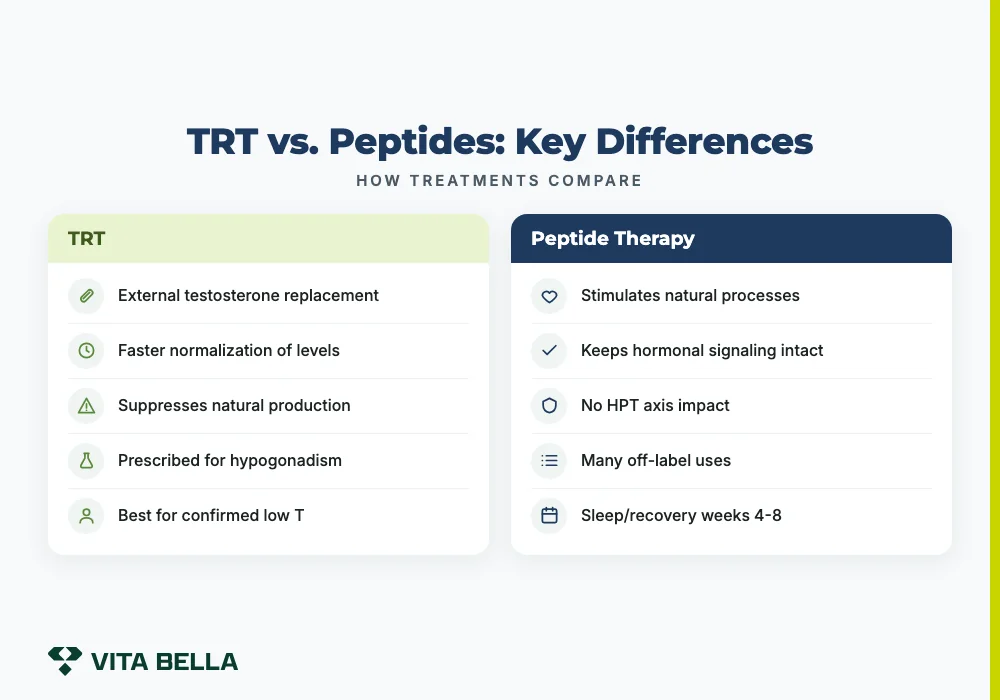
TRT delivers exogenous testosterone directly into the bloodstream, bypassing the hypothalamic-pituitary-testicular (HPT) axis entirely. The body receives the hormone rather than being prompted to produce it. Peptide therapy works differently: compounds like Sermorelin, BPC-157, and PT-141 use amino acid signals to stimulate the pituitary, improve tissue repair, or act on specific receptors without introducing external hormones.
Peptide therapy keeps the body's natural hormonal signaling intact. Vita Bella's hormone optimization with testosterone delivers the hormone directly, which produces faster normalization but suppresses the body's own production in the process.
| TRT | Peptide therapy | TRT + peptides | |
|---|---|---|---|
| Mechanism | External testosterone replacement | Pituitary stimulation (GH axis) | Both axes addressed |
| FDA status | Prescribed indication: hypogonadism | Some approved; many off-label | Protocol-dependent |
| Timeline to results | Energy: weeks 2-4 | Sleep/recovery: weeks 4-8 | Varies by compound |
| Fertility impact | Suppresses spermatogenesis | No HPT axis impact | Managed with provider oversight |
| Cost model | Member wholesale pricing (see Membership) | Assessed at consultation | Combined membership pricing |
| Best-for profile | Confirmed low T, faster onset | GH axis goals, fertility priority | Multi-system deficiency |
What does TRT do well, and where does it fall short?
TRT is the clinical standard for confirmed low testosterone. When bloodwork shows deficient total or free testosterone, exogenous testosterone produces reliable, measurable outcomes. A 2024 evidence synthesis by Cruickshank et al. in Health Technology Assessment confirmed consistent improvements in energy, libido, mood, and lean mass in men treated for hypogonadism. The data is strong.
TRT strengths:
- Rapid testosterone normalization, often within weeks of starting
- Consistent improvements in libido, energy, and muscle mass
- Decades of clinical data across injectable, topical, and pellet delivery formats
- Predictable dosing that providers can adjust based on regular bloodwork
TRT drawbacks:
- Suppresses the HPT axis, reducing the body's own testosterone output
- Reduces or stops sperm production in many men, which is critical for any man considering biological children
- Requires ongoing exogenous testosterone; stopping introduces a withdrawal period
- Estrogen conversion (aromatization) must be managed alongside the protocol
Where peptides vs TRT diverges most: fertility and HPT suppression
The fertility impact is the top decision driver for men in their 30s and early 40s. When mapping peptides vs TRT against goals, this is where the two approaches diverge most sharply.
What does peptide therapy do well, and where does it fall short?
Peptide therapy targets the growth hormone axis, not the testosterone axis. Compounds like Sermorelin, BPC-157, and PT-141 stimulate GH release, improve tissue repair, and support sleep architecture without introducing external hormones. The result is improved recovery, better body composition over time, and sharper cognitive function. Peptides for low testosterone symptoms address the problem correctly when the root cause is GH-axis underperformance rather than testosterone deficiency itself.
Peptide therapy strengths:
- No suppression of the body's own hormone production
- Improved sleep quality, recovery speed, and body composition over time
- PT-141 addresses libido through a mechanism that works independently of testosterone levels
- Fertility remains unaffected
Peptide therapy drawbacks:
- Slower onset than TRT; meaningful body composition changes take months, not weeks
- Most men's health peptide protocols are prescribed off-label through compounding pharmacies
- Less long-term clinical data compared to TRT
- Results vary significantly by compound, dosing, and individual metabolism
What is the regulatory status of peptides?
Some peptides have specific licensed indications; many men's health protocols are prescribed off-label through FDA-inspected, state-licensed U.S. pharmacies under provider supervision. Sermorelin has a documented history of clinical use for growth hormone deficiency, and bremelanotide (PT-141) holds a licensed indication for hypoactive sexual desire disorder in women. The off-label compounding pathway is legally appropriate when a licensed provider supervises the protocol, but it means fewer long-term safety studies than fully approved medications. Understanding this distinction matters when weighing peptides vs TRT from a regulatory standpoint.
Which symptoms point to TRT, and which point to peptides?
Labs are the decision gate. Symptoms overlap more than most men expect, but pattern-matching is a useful first step before bloodwork confirms the direction.
Symptoms that favor TRT:
- Confirmed low total or free testosterone on bloodwork
- Significant libido decline that lifestyle changes have not resolved
- Rapid energy crashes, particularly in the afternoon
- Noticeable muscle loss despite consistent strength training
Symptoms that favor peptide therapy:
- Poor sleep quality despite adequate time in bed
- Slow recovery between workouts with normal testosterone on labs
- Stubborn body fat accumulation with normal T but possibly low IGF-1
- Brain fog and cognitive blunting without clear testosterone deficiency
When trt vs peptides is not an obvious binary, labs clarify which axis needs the most support. Peptides for low testosterone symptoms work best when the actual problem is GH-axis underperformance, not testosterone deficiency itself.
How long before you feel results?
The timelines differ meaningfully, and setting expectations before starting any protocol is worth the conversation with your provider.
TRT results timeline:
- Weeks 2-4: energy and mood improvements often begin
- Weeks 4-6: libido changes become noticeable
- Weeks 6-12: body composition shifts and lean mass gains develop
Peptide therapy results timeline:
- Weeks 4-8: sleep quality and recovery speed improve first
- Weeks 8-16: body composition changes become measurable
- Weeks 12-24: GH axis optimization reaches full effect
TRT wins on speed for testosterone-related symptoms. Peptide therapy is slower but builds changes without HPT suppression. A peptides and testosterone stack under supervision combines both timelines: testosterone normalization in weeks and GH axis optimization over months, without the two working against each other.
What happens to your natural testosterone on TRT?
Exogenous testosterone suppresses the HPT axis. When the body receives testosterone from outside, the hypothalamus reduces LH and FSH output from the pituitary. LH and FSH drop. The testes reduce their own testosterone production and, in most men, slow or stop sperm output.
A 2025 review by Naelitz et al. in Nature Reviews Urology confirmed that TRT significantly impacts spermatogenesis in reproductive-age men, with most experiencing reduced sperm counts during treatment. Recovery after stopping is possible but not certain, and the process can take six to twelve months. This is the sharpest line in the peptides vs TRT comparison for men under 45 who may want biological children. The peptides vs HRT framing matters here: peptides do not act on the HPT axis and carry no equivalent suppression risk.
Can you take peptides and TRT together?
Yes. Many men follow a supervised protocol combining TRT and peptides, and the two therapies address different axes without duplicating effects. TRT handles testosterone normalization; peptides address GH output, sleep quality, and tissue repair simultaneously. They complement each other rather than compete.
A peptides and testosterone stack is a first-class strategy, not a workaround. For men whose labs show both low testosterone and below-optimal IGF-1, starting both under provider oversight addresses more symptom domains than either therapy alone. Providers titrate each component against separate markers: testosterone levels for the TRT portion and IGF-1 for the peptide portion. This approach suits men with multi-axis deficiency on labs, men who want to preserve remaining natural function while addressing the testosterone deficit, and men whose symptoms span both the testosterone and GH domains. Framing the peptides vs TRT question as a protocol-building exercise, rather than a binary either/or, opens these combined options.
What labs do you need before starting?
No provider should prescribe TRT or peptide therapy without a baseline panel. Labs set the protocol. Symptoms confirm direction but cannot replace measurement.
A thorough baseline panel covers:
- Total testosterone: the primary marker for TRT eligibility
- Free testosterone: bioavailable hormone, which can be low even when total T reads in range
- LH and FSH: establish whether low T is primary (testicular) or secondary (pituitary) in origin
- Estradiol (E2): baseline needed to manage aromatization on TRT
- SHBG: high SHBG can make total T appear normal while free T is deficient
- IGF-1: the key GH-axis marker and a primary indicator for peptide therapy candidacy
- Basic metabolic panel: liver, kidney, and glucose baselines before any hormonal protocol
High SHBG is one of the more common reasons men feel symptomatic despite a technically normal total T number. How SHBG affects your actual testosterone availability explains the relationship in detail and shows what a provider looks at beyond the single testosterone line on a lab report.
If labs show borderline testosterone alongside low IGF-1, peptide therapy may be the right first-line approach. Clear testosterone deficiency points more directly to TRT.
Take the 60-second quiz to see which markers match your symptom profile. Get Started
Cost comparison: TRT vs peptides
Vita Bella publishes its medication prices instead of hiding them behind a sales call. For members, testosterone is priced at wholesale — that is the medication price, not the total cost of care, which runs through the membership. Current membership terms and the consultation fee are listed on the Membership page. That transparency stands against the opaque "call for pricing" approach most men's health clinics use, and members get the same wholesale access across 100+ medications, not testosterone alone.
Peptide therapy cost depends on the specific protocol a provider recommends after reviewing labs and goals. Protocols vary by compound, dosing frequency, and duration, so quoting a number without a consultation would not reflect your actual cost. The same wholesale access applies to peptides, which is a meaningful advantage over retail cash-pay clinic pricing. For long-term users, the peptides vs HRT cost comparison often favors this model once the per-unit price difference between wholesale and retail is factored in.
How to choose the right path
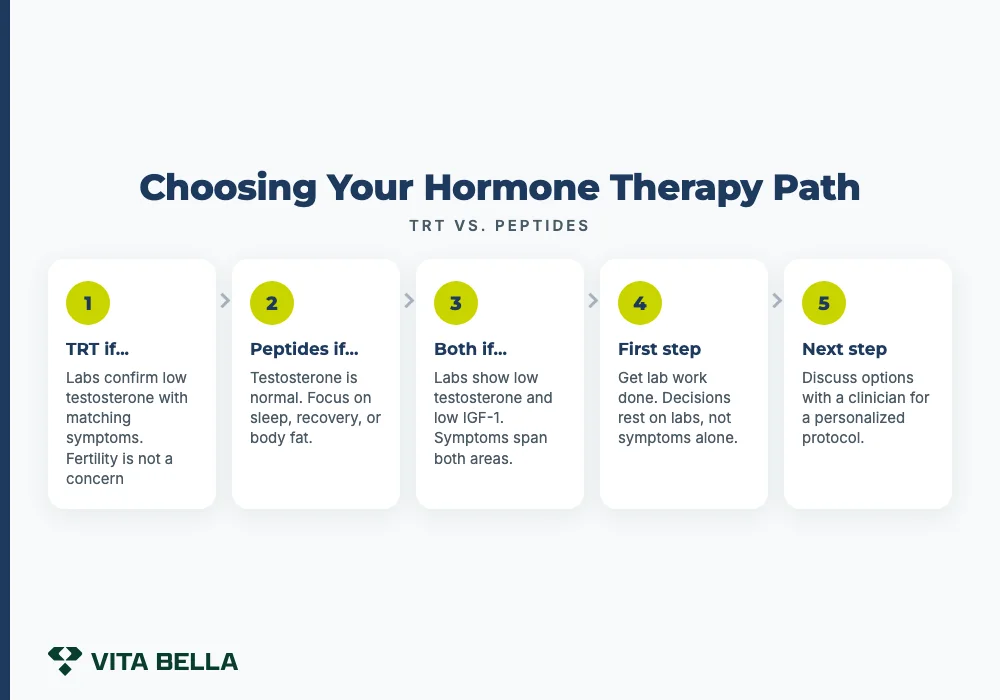
Consider TRT if:
- Labs confirm clinically low total or free testosterone with matching symptoms
- Faster symptom resolution is the priority and fertility is not a current concern
- Primary complaints are libido, energy, and muscle loss consistent with testosterone deficiency
- A provider has reviewed your bloodwork and identified TRT as appropriate for your profile
Consider peptide therapy if:
- Testosterone is in normal or low-normal range and the main issues are sleep, recovery, or body fat
- Preserving natural hormone production is important for fertility or long-term HPT axis health
- IGF-1 is below optimal and a GH-axis protocol makes clinical sense
- You want to support body composition and recovery without introducing external testosterone
Consider both if:
- Labs show deficiency across both axes (low testosterone and low IGF-1)
- Symptoms span testosterone-related and GH-axis domains simultaneously
- A provider assessment identifies concurrent deficiencies worth addressing in a combined protocol
The peptides vs TRT decision rests on what your labs reveal, not on symptoms alone. The nutritional side of the equation also matters alongside any hormonal protocol. Foods that support natural testosterone production covers what diet contributes to hormonal health.
When you're ready to discuss options with a clinician, Vita Bella's hormone therapy programs and complete peptide therapy protocols are the two paths a provider will map to your specific lab results.
Ready to find the right protocol?
Labs and a provider conversation are the real decision gate. Internet research clarifies the options; a 45-minute consultation with your bloodwork in hand makes the actual call. Vita Bella's licensed providers review your results, walk through your goals, and build a protocol around your specific data. You pick your provider from 80+ licensed clinicians across 47 states.
Transform Your Life. You Owe It To Yourself. Get Started
Frequently asked questions
Neither therapy is universally safer; risk depends on your labs, health history, and provider oversight. TRT carries well-documented effects including HPT axis suppression and reduced fertility; peptides prescribed off-label have fewer documented long-term risks but less regulatory history. A provider assessment is the right starting point for both.
Peptides and testosterone target different hormonal pathways, so a direct comparison depends on what you are trying to fix. If clinically low testosterone is the core issue, TRT typically produces faster normalization; if the goals are sleep, recovery, and GH-axis optimization, peptides can outperform TRT in those specific areas. Many men achieve better overall results by combining both under provider supervision.
The main drawbacks are a slower onset compared to TRT, limited long-term data for some compounds, and the fact that most men's health peptide protocols are prescribed off-label rather than for a specific approved indication. Results vary by compound, dosing, and individual response. Provider oversight is essential for any peptide protocol.
There is no single answer. Men with confirmed low testosterone and no current fertility concerns often see faster results with TRT; men who want to preserve natural hormone production or address GH-related goals often do better with peptide therapy. A baseline lab panel and a provider consultation are the right way to determine which path fits your specific results.
Sources
- Cruickshank M et al. (2024). The effects and safety of testosterone replacement therapy for men with hypogonadism: the TestES evidence synthesis and economic evaluation. Health Technology Assessment. PubMed
- Naelitz BD et al. (2025). Testosterone replacement therapy and spermatogenesis in reproductive age men. Nature Reviews Urology. PubMed