





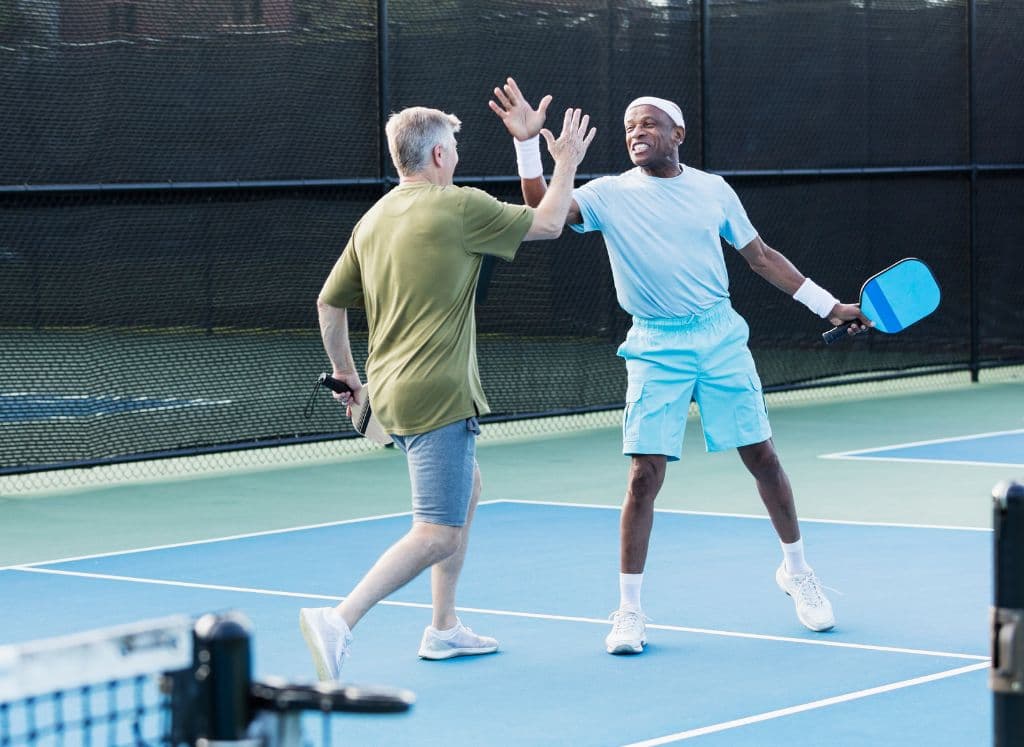



From neighborhood courts to national tournaments, Pickleball isn’t just a pastime; it’s a movement redefining active living across generations. Pickleball 1 is booming among teens to retirees, and with more play comes a sharper focus on smarter recovery to keep players on court, pain-free, and progressing week after week.
Because the sport combines bursts of acceleration with frequent changes of direction and overhead strokes, athletes require evidence-based strategies that accelerate tissue repair, stabilize hormones, and promote high-quality sleep. According to research 7, these key pillars reduce downtime and sustain optimal performance.
Fuel your comeback with Vita Bella Health’s peptide and hormone recovery protocols designed to help pickleball players heal faster, move better, and play stronger. Our personalized programs target the root of fatigue and joint stress, restoring peak performance from the inside out.
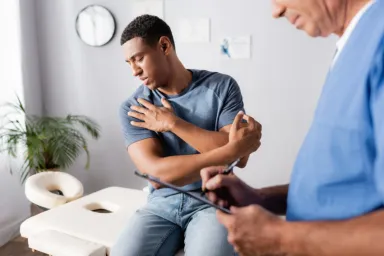
The problem: common injuries (shoulder, knees, elbow, fatigue)
Clinics 1 report rising overuse patterns in pickleball, particularly foot/ankle instability during stops, pivots, and lunges. These findings mirror broader workload stress seen in racket and paddle sports and signal a growing need for structured recovery plans.
Fatigue compounds risk: when neuromuscular control drops, landing mechanics and swing accuracy falter. Even small tendon microtears can escalate into persistent pain if players don’t restore sleep, mobility, and anabolic signaling between sessions.
Peptide Therapy
Peptide therapy uses naturally occurring amino acid chains to signal the body to repair, rejuvenate, and restore optimal function. By enhancing cellular communication and hormone balance, it supports faster recovery, improved energy, and overall vitality from within.
1- PDA instead of BPC injections for joint/tendon repair
Clinical studies 3 explain that rather than leaning on under-studied compounds, many clinicians prioritize clinically characterized peptide strategies that modulate the GH/IGF-1 axis, because these have published human data demonstrating sustained increases in IGF-1. This anabolic signal supports collagen turnover and soft-tissue remodeling relevant to joint and tendon recovery.
In practice, this means emphasizing peptides with documented pharmacokinetics and endocrine effects in people, then pairing them with load-management and mobility work to translate hormonal signaling into durable structural gains.
2- GHRH analogues (Sermorelin/Tesamorelin/Ipamorelin/CJC-1295) and the IGF-1 axis
Long-acting GHRH analog CJC-1295 produced 2–10× GH and ~1.5–3× IGF-1 elevations for days after a single dose in healthy adults, confirming robust, sustained activation of the anabolic axis that athletes leverage for recovery phases.
Moreover, tesamorelin (a GHRH analog) reduced visceral adipose tissue and improved metabolic markers in randomized, placebo-controlled human trials 4 benefits that correlate with higher IGF-1 and can support body-composition management during heavy training or return-to-play blocks.
A subsequent randomized clinical trial 5 extended these findings by showing that tesamorelin reduced visceral fat and favorably influenced liver fat, reinforcing that GHRH-driven endocrine changes translate into meaningful, measurable composition outcomes in humans.
IGF-1 sits downstream of GHRH→GH signaling, elevating endogenous IGF-1 through these analogues creates the biochemical environment for protein synthesis and connective-tissue remodeling that athletes need after intense bouts or repetitive loading.
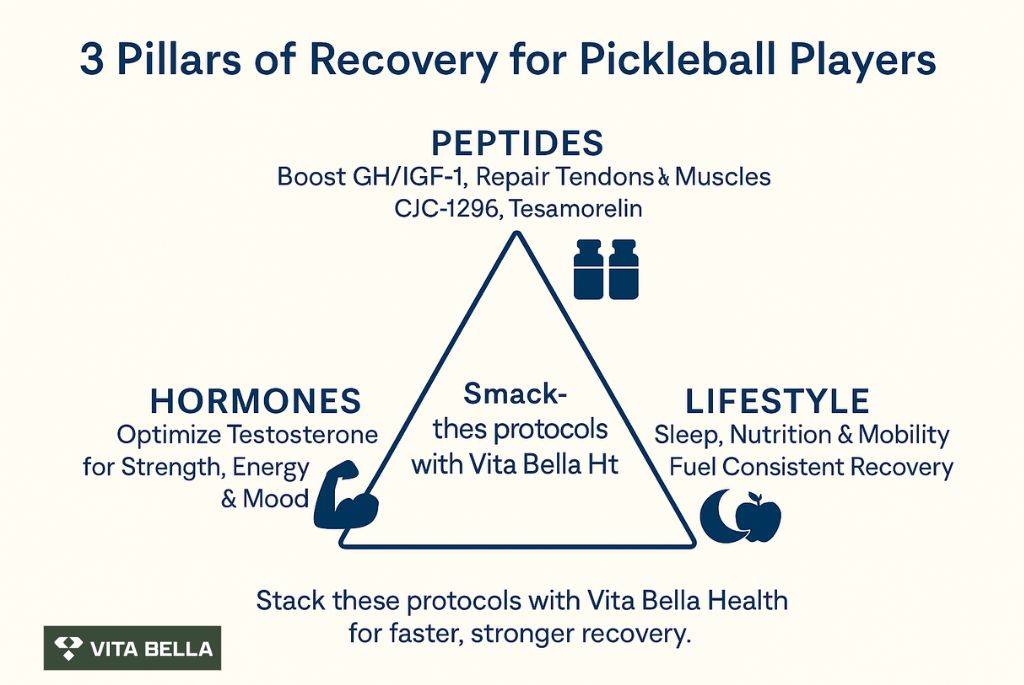
Hormone Optimization: Testosterone for muscle repair, energy, and mood.
Optimizing testosterone within physiologic ranges can meaningfully support recovery: in the Testosterone Trials 6, older men treated for one year improved sexual function and reported better vitality while achieving mid-normal serum levels in an endocrine context that supports training consistency and perceived recovery.
Although those trials 6 targeted older hypogonadal men, the principle is actionable across ages under medical supervision: when testosterone is low, normalization aligns anabolism with workload, helping protect lean mass, stabilize mood, and sustain energy needed for high-frequency play.
When clinicians combine testosterone optimization for deficient individuals with GHRH-based peptides, players often report steadier strength throughout the week, quicker recovery from matches, and fewer late-week drop-offs, all hallmarks of a balanced recovery ecosystem.
Lifestyle Recovery Protocols: Sleep, nutrition, mobility
First, sleep: systematic reviews 2 in athletes show that sleep extension, circadian-friendly schedules, and pre-sleep routines (dark/cool rooms, screen-light reduction) improve recovery indices and next-day performance, making sleep hygiene the most cost-effective “supplement” a pickleball player can adopt.
Second, nutrition: aim for ~1.6–2.2 g/kg/day protein distributed across meals, including a leucine-rich dose within 60–90 minutes post-session; pair with omega-3s and adequate vitamin D and magnesium to support connective-tissue and neuromuscular function through the week.
Third, mobility and tissue care: short daily sessions of dynamic mobility, light eccentric work, and soft-tissue techniques reduce stiffness and help route hormone-driven protein synthesis to the structures you’re actually loading in pickleball shoulders, knees, calves/Achilles, and forearm extensors.
Stacking protocols: peptides + hormones + lifestyle = optimal recovery
Step 1 - Baseline & goals: obtain labs (total/free testosterone, IGF-1) and define court frequency, match duration, and current aches to tailor the protocol to your actual workload.
Step 2 - Peptide core (GHRH analog): Use a clinician-guided 3 GHRH strategy (e.g., CJC-1295 or tesamorelin) to elevate IGF-1 and support anabolism during training and deload weeks, aligning endocrine support with your cycle.
Step 3 - Hormone check: if testosterone is suboptimal, medically supervised optimization can improve energy, mood, and lean-mass maintenance that make recovery protocols “stick” over months rather than weeks.
Step 4 - Lifestyle glue: protect your investment with sleep scheduling, protein timing, and mobility circuits so hormonal signals convert into stronger tendons, more resilient shoulders, and steadier legs late in tournaments.
Step 5 - Monitor & adjust: track soreness, range of motion, and match-to-match energy; repeat labs periodically and adjust peptide timing or loads to keep progress moving without overreaching.
Why this stack works: you’re combining hormonal capacity (testosterone/IGF-1) with behavioral capacity (sleep/nutrition/mobility), turning each match into a stimulus you fully recover from so your next session starts from a higher baseline instead of a deeper hole.
Get Your Recovery Plan Personalized at Vita Bella Health
Every match takes a toll on tight shoulders, aching knees, and endless fatigue. Ready to bounce back faster, play longer, and protect your joints while you climb the ladder? Get your recovery plan personalized at Vita Bella Health. Our clinicians tailor GHRH-based peptide support, responsible hormone optimization, and day-to-day recovery habits to your schedule, goals, and lab profile. It’s not just recovery, it’s renewal. Start your revitalization journey with Vita Bella today.
FAQs
Can peptides really help pickleball players recover faster from injuries?
Yes, clinical studies show that specific peptides, such as GHRH analogs and IGF-1 variants, enhance tissue repair and muscle recovery by stimulating natural growth hormone and collagen synthesis, leading to faster healing and less fatigue.
Is hormone optimization, like testosterone therapy, safe for improving recovery and energy?
Yes, when administered under medical supervision, testosterone replacement within physiological ranges safely supports muscle repair, energy, and mood stability in adults with low levels, as confirmed by The Testosterone Trials published in the New England Journal of Medicine.
Do lifestyle habits like sleep and nutrition still matter if peptides or hormones are used?
Yes, consistent sleep, proper nutrition, and regular mobility training remain essential for maximizing the effectiveness of peptides and hormones. Evidence shows that recovery and performance dramatically improve when biological therapies are combined with these lifestyle foundations.
Should every pickleball player use peptide or hormone therapy for recovery?
No, these therapies are not for everyone. They are most beneficial for players with documented hormonal deficiencies or chronic recovery challenges, and they should always be prescribed and monitored by qualified healthcare professionals.
References:
Kingston, K., & Parker, E. B. (2024). Emerging patterns of foot and ankle injuries in pickleball players: A short report. Foot & Ankle International, 45(11), 1266-1269. https://doi.org/10.1177/10711007241271215
Cunha, L. A., Costa, J. A., Marques, E. A., Brito, J., Lastella, M., & Figueiredo, P. (2023). The impact of sleep interventions on athletic performance: A systematic review. Sports Medicine – Open, 9(1), Article 58. https://doi.org/10.1186/s40798-023-00599-z
Teichman, S. L., Neale, A., Lawrence, B., Gagnon, C., Castaigne, J.-P., & Frohman, L. A. (2006). Prolonged stimulation of growth hormone (GH) and insulin-like growth factor I secretion by CJC-1295, a long-acting analog of GH-releasing hormone, in healthy adults. The Journal of Clinical Endocrinology & Metabolism, 91(3), 799–805. https://doi.org/10.1210/jc.2005-1536
Falutz, J., Allas, S., Blot, K., Potvin, D., Kotler, D., Somero, M., Berger, D., Brown, S., Richmond, G., Fessel, J., Turner, R., & Grinspoon, S. (2007). Metabolic effects of a growth hormone–releasing factor in patients with HIV. The New England Journal of Medicine, 357(23), 2359–2369. https://doi.org/10.1056/NEJMoa072375
Stanley, T. L., Feldpausch, M. N., Oh, J., Branch, K. L., Lee, H., Torriani, M., & Grinspoon, S. K. et al. (2014). Effect of tesamorelin on visceral fat and liver fat in HIV-infected patients with abdominal fat accumulation: A randomized clinical trial. JAMA, 312(4), 380–389. https://doi.org/10.1001/jama.2014.8334
Snyder, P. J., Bhasin, S., Cunningham, G. R., Matsumoto, A. M., Stephens-Shields, A. J., Cauley, J. A., Gill, T. M., et al. (2016). Effects of testosterone treatment in older men [Corrected]. New England Journal of Medicine, 374(7), 611–624. https://doi.org/10.1056/NEJMoa1506119
Kellmann, M., Bertollo, M., Bosquet, L., Brink, M., Coutts, A. J., Duffield, R., Erlacher, D., Halson, S. L., Hecksteden, A., Heidari, J., Kajeniene, A., Meeusen, R., Mujika, I., Robazza, C., Skorski, S., Venter, R., & Beckmann, J. (2018). Recovery and performance in sport: Consensus statement. International Journal of Sports Physiology and Performance, 13(2), 240–245. https://doi.org/10.1123/ijspp.2017-0759