Testosterone boosting foods supply the zinc, healthy fats, and antioxidants that hormone production depends on, as confirmed in a 2025 systematic review by Rojas-Zambrano et al. (Cureus). Low testosterone has been linked to metabolic disruption and reduced quality of life in men (Saad and Gooren, J Steroid Biochem Mol Biol, 2009), which is why dietary choices matter. Oysters, pomegranate, eggs, lean beef, avocados, spinach, garlic, nuts, and ginger each carry peer-reviewed evidence for natural testosterone support. No food replaces clinical treatment, but your daily plate is a real lever.
What foods naturally boost testosterone levels?
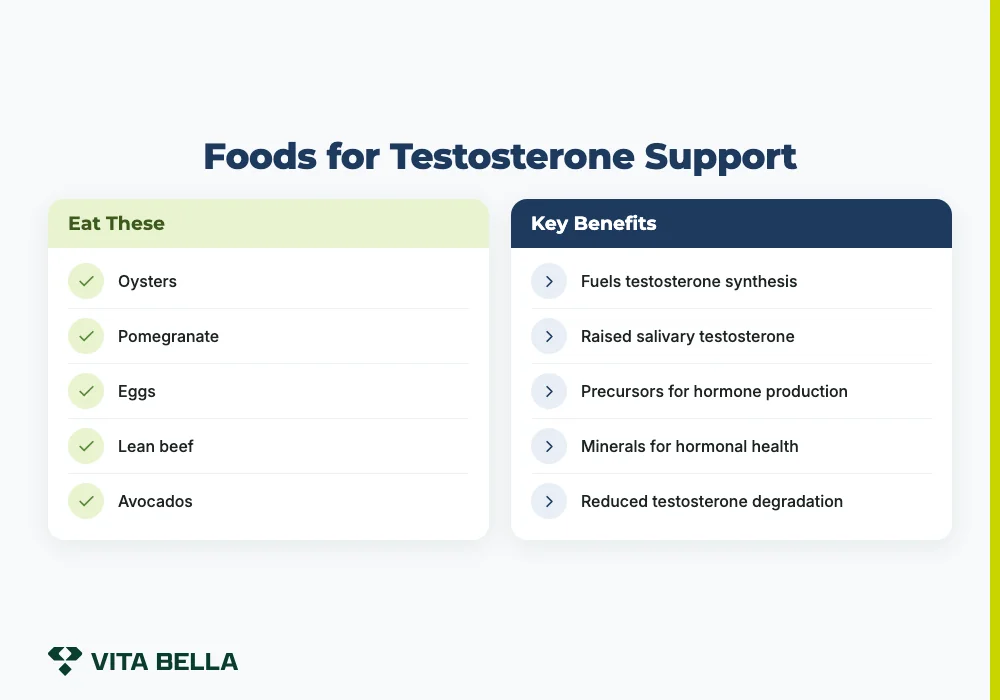
Nine foods carry the strongest research backing for natural testosterone support. Each works through a distinct mechanism: some deliver zinc critical for testosterone synthesis, others supply the healthy fats the body converts into hormones, and others reduce oxidative stress in the Leydig cells where testosterone is produced.
| Food | Key nutrient | Documented effect |
|---|---|---|
| Oysters | Zinc (673% RDA per serving) | Fuels testosterone synthesis; peptides may stimulate secretion |
| Pomegranate | Polyphenols | Raised salivary testosterone ~24% in 1-2 weeks (Al-Dujaili & Smail, 2012) |
| Eggs | Protein, cholesterol, vitamin D, selenium | Precursors and cofactors for hormone production |
| Lean beef | Zinc (44% DV per 100 g), vitamin D, protein | Core minerals for reproductive and hormonal health |
| Avocados | Boron, monounsaturated fats | Boron linked to reduced testosterone degradation |
| Spinach | Magnesium | Normalized testosterone in obesity model; repaired testicular tissue |
| Garlic | Zinc, selenium, antioxidants | Raised LH; preserved testicular integrity in animal studies |
| Nuts | Zinc, healthy fats | High nutrient density for gonadal health |
| Ginger | Antioxidants | Raised LH and improved testicular blood flow in preclinical models |
Oysters and testosterone: the zinc connection
Oysters are the single richest dietary zinc source, delivering roughly 673% of the recommended daily amount from just a few pieces, per a systematic review by Te et al. (J Trace Elem Med Biol, 2023). Zinc is essential for testosterone synthesis and reproductive function; deficiency measurably impairs hormone production. Research on oyster bioactives shows that oyster peptides carry strong antioxidant properties and may stimulate testosterone secretion directly (Hoang et al., Frontiers in Marine Science, 2022). Their omega-3 fatty acids support circulation as an added benefit.
Pomegranate
Daily pomegranate juice raised salivary testosterone by around 24% after one to two weeks of intake in a study by Al-Dujaili and Smail (Endocrine Abstracts, 2012). Mood improved and blood pressure fell in the same cohort. The fruit's polyphenols combat oxidative stress in endocrine tissue and have shown protective effects on reproductive function in animal research (Ammar et al., Prostate, 2015).
Ginger
In preclinical models, ginger enhanced testosterone by raising luteinizing hormone, improving testicular blood flow, and reducing oxidative damage (Banihani, Biomolecules, 2018). Human data remain limited. The mechanistic evidence is consistent across multiple animal studies.
Eggs
Whole eggs supply protein, cholesterol, vitamin D, and selenium, all precursors or cofactors in testosterone synthesis. Santos et al. (Int J Sport Nutr Exerc Metab, 2021) found that selenium in eggs may enhance testosterone production beyond its structural role as a hormone precursor.
Lean beef
A 100-gram serving of lean beef delivers roughly 4.8 mg of zinc (44% of daily value), about 2.1 mcg of vitamin D, and approximately 26 g of protein, per data from Maldonado-Cárceles et al. (British Journal of Nutrition, 2019). Zinc and vitamin D in lean beef support testosterone and reproductive health directly. Consumed in moderation as part of a testosterone diet plan, it is a practical androgen increasing food.
Avocados
Avocados supply monounsaturated fats, magnesium, and boron, a trace mineral that may reduce testosterone degradation and raise free testosterone. A 2023 review by Cuschieri et al. (Food Materials Research) documented notable effects on hormonal physiology, including improved insulin sensitivity and positive LH and FSH responses in men. Pizzorno (Integrative Medicine, 2015) further links boron to reduced inflammation and better hormone metabolism.
Spinach
Spinach and other dark leafy greens supply magnesium, which aids testosterone production by reducing oxidative stress. A 2017 study (Iqbal et al., Advances in Basic Medical Sciences) found that four weeks of spinach extract normalized testosterone levels and repaired testicular tissue in an obesity-induced model. The antioxidant load in spinach appears to counteract obesity-driven reproductive dysfunction in males.
Nuts
Nuts are reliable zinc rich foods for men, combining zinc with healthy fats and minerals critical for gonadal health. A clinical review by Nazari et al. (Int J Nutr Sci, 2024) identifies high nutrient density as the practical factor that makes nuts a consistent part of any low testosterone diet correction strategy.
Garlic
Garlic contains zinc, selenium, and antioxidants that protect hormone-producing tissue. A Nigerian study (Memudu et al., Asian Pacific Journal of Tropical Biomedicine, 2015) found that garlic extract boosted testosterone significantly and preserved testicular integrity in rats, attributing the effect to its zinc and selenium content. Human data are limited, but the mechanism is well-characterized in animal models.
How much zinc do you need to support testosterone?
The clearest benchmarks come from the foods themselves. Oysters deliver 673% of the recommended daily amount per serving; 100 g of lean beef covers 44%. Zinc deficiency blocks testosterone synthesis directly, making consistent daily intake from whole food sources the practical goal. Rotating oysters, beef, nuts, and garlic across the week provides reliable zinc coverage without relying on any single source.
What you eat is a starting point. What your bloodstream actually absorbs is what counts. Tracking key hormone and mineral markers before and after dietary changes is the most direct way to confirm whether your testosterone diet plan is moving the needle.
What foods should men avoid for healthy testosterone?
Alcohol is the most clearly documented dietary threat. Reducing intake protects liver function and cuts the conversion of testosterone to estrogen. Very low-fat diets are equally relevant: testosterone is synthesized from cholesterol, and removing the healthy fats in avocados, nuts, and eggs cuts out core hormone-building material.
A diet dominated by processed foods, excess alcohol, or near-zero fat creates exactly the nutrient gaps that drive low testosterone. Removing those patterns delivers as much benefit as adding androgen increasing foods to the plate.
How quickly do testosterone boosting foods work?
Pomegranate is the only food in this review with direct timeline data: salivary testosterone rose 24% after one to two weeks of daily juice intake (Al-Dujaili and Smail, 2012). Fast. For other testosterone boosting foods, speed depends on which deficiency is being corrected. Zinc-related suppression can respond within weeks of consistent intake from zinc-dense sources. Broader dietary pattern changes show effects over months, not days.
Can diet alone fix low testosterone?
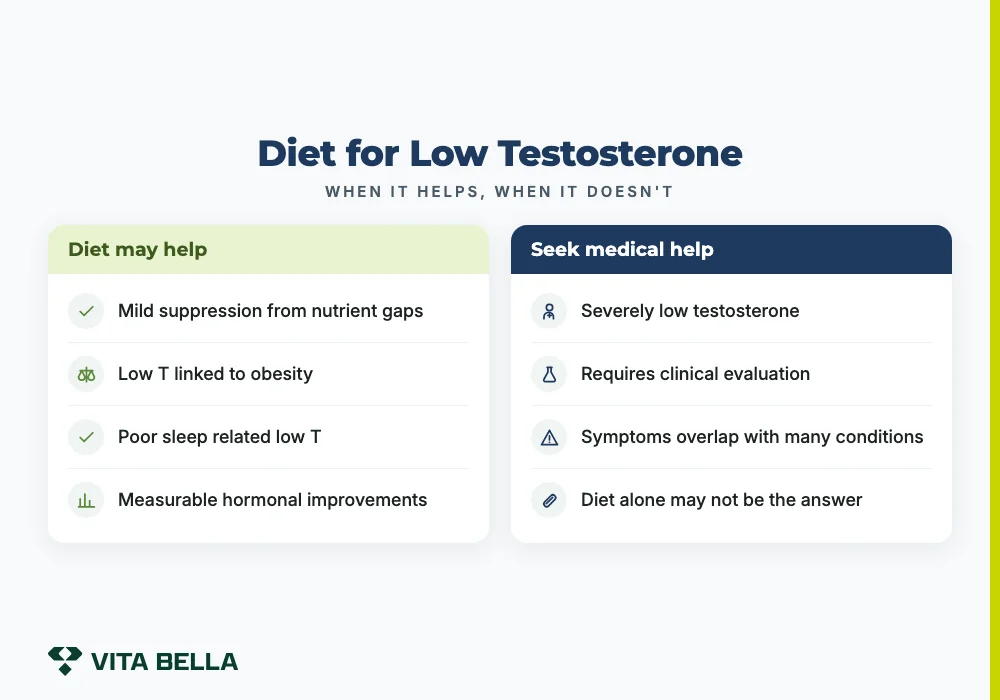
For mild suppression driven by nutrient gaps, obesity, or poor sleep, a diet rich in foods that increase testosterone produces measurable hormonal improvements. Severe cases are different. Severely low testosterone is unlikely to normalize through dietary changes alone and requires clinical evaluation.
Common signs that levels may be low include reduced sex drive, persistent fatigue, mood instability, muscle loss, increased body fat, and difficulty concentrating. These symptoms overlap with many conditions, so they are a reason to test, not a self-diagnosis.
Lab results often clarify what diet changes cannot. Many men find their numbers sit in the "normal" range while symptoms persist. The difference between a "normal" and an optimal hormone panel is worth discussing with a provider before concluding that food alone is the answer.
Lifestyle habits that multiply dietary gains
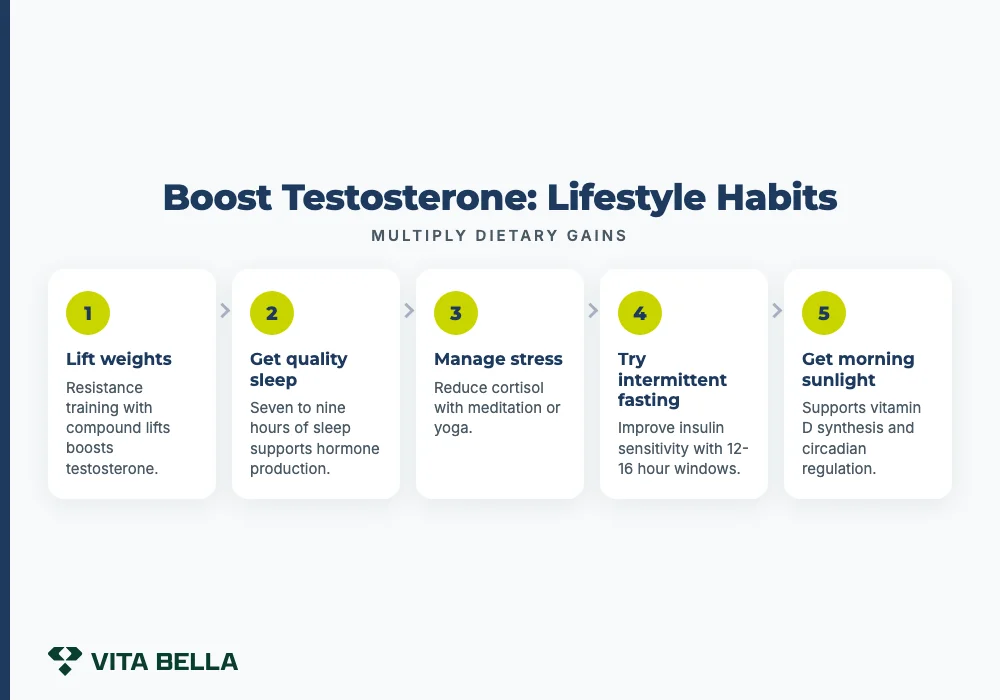
Testosterone boosting foods work best inside a broader routine that supports hormone output at every level.
- Resistance training with compound lifts such as squats and deadlifts triggers acute testosterone spikes and improves long-term hormonal balance through increased muscle mass and better nutrient uptake in tissue.
- Quality sleep of seven to nine hours is necessary because testosterone production peaks during deep sleep phases, and poor sleep can reduce levels by up to 15%.
- Stress management through meditation, deep breathing, or yoga reduces chronic cortisol elevation, which suppresses testosterone when sustained over time.
- Intermittent fasting windows of 12 to 16 hours improve insulin sensitivity and sharpen the metabolic effect of a natural testosterone support diet.
- Morning sunlight exposure supports circadian regulation and vitamin D synthesis. Vitamin D testosterone levels are linked directly through the hormone production pathway, making consistent sunlight a low-cost addition to any androgen increasing foods strategy.
- Limiting alcohol intake protects liver function and reduces the testosterone-to-estrogen conversion that alcohol accelerates.
Take control of your hormone health
A consistent testosterone diet plan built on these nine foods addresses the core nutrient requirements for androgen production. That is a real foundation. Diet alone, however, cannot measure or adjust your hormone levels.
Get Started with the Vita Bella 60-second quiz to find out where your hormone baseline stands and whether a provider-led testosterone program fits your goals. Real providers. Real medicine. Honest prices.
Transform Your Life. You Owe It To Yourself. Get Started
Frequently asked questions
Common signs include reduced sex drive, persistent fatigue, mood instability, muscle loss, increased body fat, difficulty concentrating, and thinning hair. These symptoms overlap with other conditions, so a provider evaluation is the reliable way to confirm testosterone as the underlying cause.
Pomegranate has the strongest research backing: a study by Al-Dujaili and Smail (2012) showed a 24% rise in salivary testosterone after one to two weeks of daily juice. Most other fruits contribute polyphenol antioxidants that protect hormone-producing Leydig cells from oxidative damage, supporting testosterone production indirectly.
Building meals around testosterone boosting foods such as oysters, lean beef, eggs, spinach, and avocados covers the core nutrient requirements for androgen production: zinc, healthy fats, magnesium, and antioxidants. Pairing this with resistance training, adequate sleep, and minimal alcohol produces the strongest combined effect.
Yes. Vitamin D acts as a direct cofactor in testosterone synthesis, and deficiency is associated with lower testosterone levels, per review literature cited in this article. Eggs, lean beef, and regular sunlight exposure all supply or stimulate vitamin D, making them consistent parts of any low testosterone diet correction plan.
Sources
- Rojas-Zambrano et al. (2025). Systematic review — Cureus — source
- Low testosterone and metabolic health — ScienceDirect — source
- Zinc content of oysters — Journal of Trace Elements in Medicine and Biology — source
- Oyster bioactives and reproductive function — Frontiers in Marine Science — source
- Pomegranate juice and salivary testosterone — Endocrine Abstracts — source
- Pomegranate polyphenols and reproductive function — PubMed — source
- Ammar et al. (2015). Prostate — PubMed — source
- Santos et al. — International Journal of Sport Nutrition and Exercise Metabolism — source
- Maldonado-Cárceles et al. — British Journal of Nutrition — source
- Boron and testosterone metabolism — PubMed — source
- Cuschieri et al. (2023) — Food Materials Research — source
- Pizzorno (2015). Integrative Medicine — PMC — source
- Magnesium and testosterone, 2017 study — Annals of Basic Medical Sciences — source
- Nutrition and gonadal health, clinical review — International Journal of Nutrition Sciences — source
- Garlic and hormone-producing tissue — ScienceDirect — source