Tesamorelin dosage is not a fixed number you apply to yourself. A licensed provider determines the dose after reviewing your labs and body composition goals; an IGF-1 reading, when you have one, adds a useful baseline. This peptide carries U.S. regulatory approval for reducing visceral fat in HIV-associated lipodystrophy, backed by multiple randomized controlled trials, and getting a personalized protocol starts with your lab results, not a chart someone wrote online.
Understanding what actually shapes the tesamorelin dosage decision helps you walk into your first provider visit prepared.
What is tesamorelin?
Tesamorelin is a synthetic 44-amino-acid analogue of Growth Hormone-Releasing Hormone (GHRH). It binds to GHRH receptors in the anterior pituitary, triggering pulsatile GH release. That pulsatile pattern matters: it mirrors the body's natural GH secretion rhythm, which differs from the flat pharmacokinetic curve of direct GH injection.
Rising GH then signals the liver and peripheral tissues to produce insulin-like growth factor-1 (IGF-1), which drives lipolysis and supports lean tissue. The NIH LiverTox database documents tesamorelin's approved indication for adults with HIV who develop lipodystrophy from antiretroviral therapy. Multiple randomized controlled trials back that indication. Unlike most peptides used off-label, the evidence base here is substantial and peer-reviewed.
What is the recommended tesamorelin dosage for beginners?
A licensed provider determines the dose after reviewing your labs. No universal starting point exists independent of your biology.
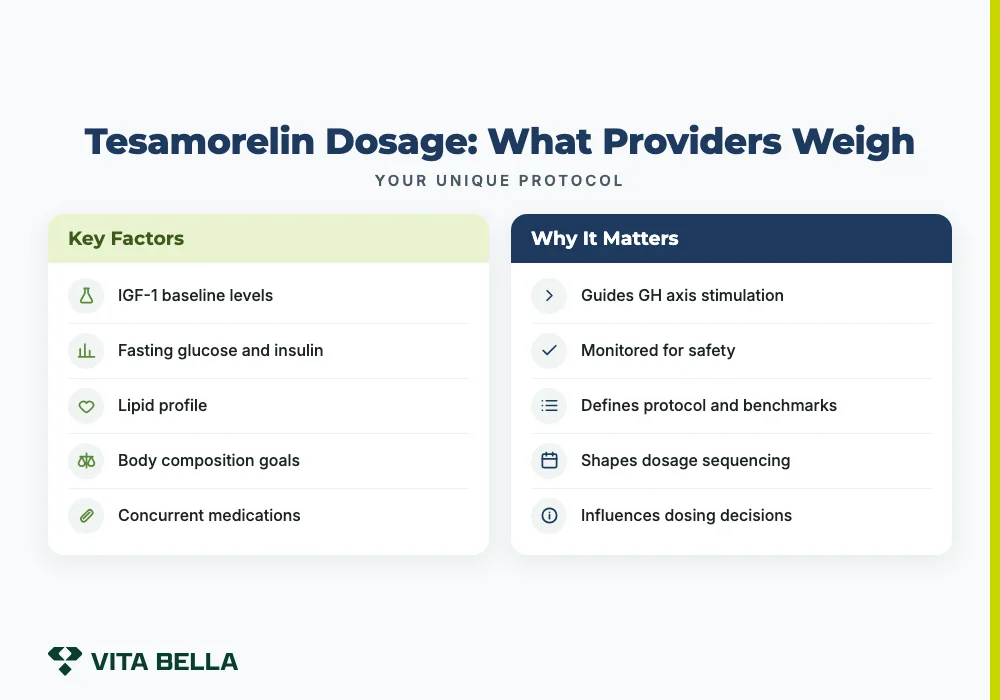
The right tesamorelin dosage protocol depends on your fasting glucose, lipid markers, waist circumference, and full health history. An IGF-1 baseline is good to have when available — it makes later comparisons more precise — but it is not a requirement to begin. What beginners actually need is a clear picture of what a provider weighs before finalizing anything:
- IGF-1 baseline (optional, but useful). A pre-treatment IGF-1, when you have one on file, shows where your GH axis started and makes follow-up comparisons more accurate.
- Fasting glucose and insulin sensitivity. Research published in PLOS ONE (Clemmons et al., 2017) confirmed tesamorelin does not significantly alter glucose metabolism even in patients with type 2 diabetes, but routine glucose monitoring remains standard during treatment.
- Lipid profile. Tesamorelin has been associated with reductions in triglycerides and total cholesterol (Stanley et al., 2019, The Lancet HIV). Baseline lipids define both protocol selection and the benchmarks providers use to measure response over time.
- Body composition goals. Visceral fat reduction, lean mass preservation, and metabolic health improvements carry different response timelines. Your goal mix shapes how a provider sequences the tesamorelin dosage from the start.
- Concurrent medications. Antiretroviral drugs, insulin, and glucocorticoids interact with GH axis activity and can influence dosing decisions and the interpretation of IGF-1 trends.
- Waist circumference. Providers track this regularly alongside imaging data as a practical proxy for visceral fat changes between formal measurement intervals.
Reassessment follows at defined intervals. Updated labs determine whether the tesamorelin dosage needs adjustment. Data drives the decision, not a predetermined schedule.
How much tesamorelin should I take daily?
The dose is calibrated to bring your IGF-1 into the optimal range for your age and goals. That number varies by individual. No single dose applies across patients.
Tesamorelin is delivered via subcutaneous injection in the abdomen. Rotate injection sites each time to reduce irritation and tissue damage. Avoid the navel, scar tissue, and bruised areas. Sterile technique matters. Your provider walks through the injection protocol in detail at the initial visit.
Monitoring is built into the tesamorelin dosage protocol from the start. IGF-1, fasting glucose, lipids, and waist circumference are reviewed at follow-up labs. If IGF-1 rises above the age-appropriate optimal range, the provider trims the dose. If response is muted, the protocol gets reconsidered.
What does tesamorelin do for belly fat?
Tesamorelin targets visceral adipose tissue directly. This is fat stored around internal organs, not the softer subcutaneous layer under the skin. Visceral fat is associated with elevated cardiovascular risk, insulin resistance, and elevated triglycerides. It resists diet and training far more stubbornly than subcutaneous fat does.
Clinical trials in people with HIV-associated lipodystrophy showed approximately 15-18% reductions in VAT after 26 to 52 weeks, as documented in the NIH LiverTox database. A 2021 study in AIDS (Lake et al.) found that tesamorelin belly fat reduction goes beyond volume. Treated patients showed improved fat quality: increased fat density, reflecting smaller and metabolically healthier adipocytes in both visceral and subcutaneous compartments.
Two 2026 meta-analyses add further evidence. Ditta et al. in the Journal of the International Association of Providers of AIDS Care confirmed significant VAT reductions across randomized trials in people living with HIV. Badran et al. in Obesity Research and Clinical Practice documented improvements in hepatic fat content alongside visceral fat changes, showing metabolic benefits extend to the liver.
Subcutaneous fat is largely unaffected. That selectivity matters: tesamorelin targets the dangerous visceral deposit without disrupting the less metabolically problematic subcutaneous layer. Tracking body composition rather than total weight is the only way to see this shift clearly during treatment.
Tesamorelin for men: weight loss and muscle growth
Tesamorelin for men addresses a pattern that training and caloric management rarely fix alone: visceral fat accumulation as GH output declines with age. The GH axis pulls back. Fat storage shifts toward the abdominal core. Tesamorelin works by restoring pulsatile GH release through GHRH receptors, partially addressing that progression.
Tesamorelin weight loss is better described as fat redistribution. Clinical trials showed preserved and increased lean body mass alongside reduced waist circumference. The scale may shift modestly. The ratio of muscle to visceral fat improves in ways that matter for long-term metabolic health.
Tesamorelin muscle growth is a secondary benefit of the IGF-1 elevation downstream of GH stimulation. IGF-1 supports protein synthesis, muscle fiber repair, and energy substrate use during recovery. A 2020 review in Translational Andrology and Urology (Sinha et al.) found that GHRH analogues improve body composition in hypogonadal men beyond what androgen receptor pathways achieve alone.
For men where GH decline overlaps with broader hormonal shifts, the lab picture before treatment tells you what is actually driving fat accumulation. Reviewing what your labs reveal before starting tesamorelin treatment often changes the conversation about which protocol fits best.
Can you stack tesamorelin with ipamorelin?
Yes. The tesamorelin ipamorelin stack is among the most common combinations in clinical peptide practice. Tesamorelin activates GHRH receptors. Ipamorelin activates ghrelin receptors. Two pathways, one amplified GH signal.
That difference is clinically meaningful. Ipamorelin drives GH release from the ghrelin axis without significantly elevating cortisol or prolactin, making it a cleaner signal than older GHRP compounds. Combined with tesamorelin's GHRH-receptor stimulation, the result is additive rather than redundant.
A 2020 review in Translational Andrology and Urology (Sinha et al.) reported that pairing GHRH analogues with ghrelin-axis secretagogues increases GH levels and improves body composition without significant adverse effects. In practice, the tesamorelin ipamorelin stack targets visceral fat more aggressively than either peptide alone while also supporting recovery and sleep quality through the combined GH rise.
Your provider determines whether the combination fits your IGF-1 target and health status before prescribing. The stack is not automatically part of a beginner's tesamorelin dosage plan. If you want context before your consultation, understanding what a multi-peptide program actually involves is a useful starting point.
Can I take tesamorelin and sermorelin together?
Yes. The tesamorelin sermorelin stack combines two GHRH analogues with different clinical profiles. Tesamorelin concentrates specifically on visceral adiposity. Sermorelin stimulates endogenous GH secretion with a shorter half-life and a broader metabolic focus, contributing to energy, skin elasticity, and muscle recovery over time.
Together, the combination provides layered support. Tesamorelin handles acute visceral fat reduction. Sermorelin maintains GH axis activity over a longer treatment arc. The tesamorelin sermorelin stack is not a rigid preset; providers tailor it to each patient's IGF-1 response, lab trends, and where they are in the treatment timeline.
Sermorelin's role becomes more prominent during maintenance phases, once the initial tesamorelin dosage has produced meaningful VAT reduction and the goal shifts toward sustaining GH axis health long-term. That sequencing follows lab data, not a fixed schedule.
Monitoring during tesamorelin treatment
Monitoring is not a formality. It is how tesamorelin dosage stays accurate over time.
Follow-up reviews look at how you feel and function first: energy through the day, sleep quality, recovery after activity, and how your waist measurements trend tell the provider more about progress than any single number. Labs — fasting glucose, a lipid panel, and IGF-1 when a baseline was drawn — add context to that picture. In practice, GH secretagogues shift IGF-1 modestly, so the marker is a supporting signal rather than the goal itself.
Fasting glucose is tracked at each interval. The evidence from Clemmons et al. (2017) shows a favorable glucose profile even in metabolically compromised patients, but routine monitoring remains part of sound protocol management. A 2014 randomized clinical trial in JAMA (Stanley et al.) documented significant reductions in both visceral fat and liver fat in HIV patients with abdominal fat accumulation, with effects tracked at defined intervals. That study design reflects how monitoring is built into evidence-based tesamorelin dosage protocols.
If the response looks too strong or too weak — in how you feel or in the labs — the provider adjusts. If a concurrent factor is blunting the response, the provider identifies it. That feedback loop between your experience, your labs, and your protocol is where outcomes are actually determined.
Ready to find out what your protocol looks like?
A personalized tesamorelin dosage protocol starts with labs, not guesswork. Vita Bella's licensed providers review your complete health profile before any protocol is written. Get Started and connect with a provider who evaluates your goals against your actual numbers.
Frequently asked questions
Tesamorelin dosage is determined by a licensed provider after reviewing your labs, including IGF-1, fasting glucose, and lipid markers. There is no fixed dose that applies to all patients. Your provider calibrates the protocol to bring your GH axis into the target range based on your individual results.
Tesamorelin reduces visceral adipose tissue by stimulating GH release through GHRH receptors in the pituitary. Clinical trials showed approximately 15-18% reductions in VAT after 26 to 52 weeks. It also improves fat quality by increasing adipocyte density, reflecting healthier fat composition alongside the volume reduction.
Yes. The tesamorelin ipamorelin stack uses two peptides working through different receptor pathways to amplify GH output. A provider determines whether the combination fits your IGF-1 target, health status, and goals before prescribing.
Tesamorelin supports fat redistribution and lean mass preservation by restoring pulsatile GH release. The downstream IGF-1 rise supports protein synthesis and recovery, which is particularly relevant for men who are also training. A provider reviews labs and goals to determine whether tesamorelin alone or a combination protocol is appropriate.
Yes, the tesamorelin sermorelin stack is used when targeted visceral fat reduction and longer-term GH axis support are both treatment goals. Tesamorelin addresses visceral fat; sermorelin maintains GH production over a longer period. Providers use lab data and response trends to tailor the combination for each patient.
Sources
- U.S. National Library of Medicine. (2018). Tesamorelin. In LiverTox: Clinical and Research Information on Drug-Induced Liver Injury. National Institute of Diabetes and Digestive and Kidney Diseases. PubMed
- Lake JE et al. (2021). Tesamorelin improves fat quality independent of changes in fat quantity. AIDS, 35(9), 1395-1402. PubMed
- Stanley TL et al. (2019). Effects of tesamorelin on non-alcoholic fatty liver disease in HIV: A randomised, double-blind, multicentre trial. The Lancet HIV, 6(12), e821-e830. PubMed30338-8)
- Clemmons DR, Miller S, Mamputu JC. (2017). Safety and metabolic effects of tesamorelin, a growth hormone-releasing factor analogue, in patients with type 2 diabetes: A randomized, placebo-controlled trial. PLOS ONE, 12(6), e0179538. PubMed
- Stanley TL et al. (2014). Effect of tesamorelin on visceral fat and liver fat in HIV-infected patients with abdominal fat accumulation: A randomized clinical trial. JAMA, 312(4), 380-389. PubMed
- Sinha DK et al. (2020). Beyond the androgen receptor: The role of growth hormone secretagogues in the modern management of body composition in hypogonadal males. Translational Andrology and Urology, 9(Suppl 2), S149-S159. PubMed
- Ditta AM et al. (2026). Efficacy and Safety of Tesamorelin in People Living With HIV (PLWH) With Lipodystrophy: A Systematic Review and Meta-Analysis. Journal of the International Association of Providers of AIDS Care. PubMed
- Badran AS et al. (2026). Body composition, hepatic fat, metabolic, and safety outcomes of Tesamorelin, a GHRH analogue, in HIV-associated lipodystrophy: A meta-analysis of randomized controlled trials. Obesity Research and Clinical Practice. PubMed