
Anavar dosage is not a fixed number. A licensed provider determines the appropriate oxandrolone protocol only after reviewing lab work and a complete health history. No universal anavar dosage exists because the right approach depends on your specific condition, hormone levels, liver function, and current medications. This article explains the evaluation process providers use, the approved medical indications, and what ongoing monitoring looks like through a program like Vita Bella's individualized hormone therapy program.
What is oxandrolone, and when is it prescribed?
Oxandrolone, commonly known by the brand name Anavar, is a Schedule III controlled substance available only by prescription in the United States. The FDA has approved it for specific medical indications. A licensed provider determines both eligibility and the oxandrolone dosage based on individual lab results and a thorough health history.
The clinical context matters. Supervised short-term use for approved indications differs from any non-medical application. The provider determines whether a patient qualifies and sets the anavar dosage. The patient does not.
Approved clinical indications for oxandrolone:
- Injury recovery support, particularly for patients recovering from significant tissue damage
- Muscle wasting associated with chronic illness or post-surgical recovery
- Post-surgical weight restoration for patients who have lost significant lean tissue
- Wound healing support in clinical settings
- Bone pain associated with osteoporosis
What are the approved medical uses of oxandrolone?
The strongest clinical evidence for oxandrolone covers burn recovery and muscle-wasting conditions. A 2025 systematic review by Lou et al. in World Journal of Emergency Surgery and a 2020 meta-analysis by Ring et al. in Journal of Burn Care and Research found that supervised oxandrolone protocols in appropriate burn patients supported lean mass preservation. A 2016 systematic review by Li et al. in Burns reached similar conclusions for patients with severe burns.
These findings apply to short, supervised protocols in specific populations. The research does not address applications outside these approved clinical indications. Providers use this evidence when evaluating whether a patient's indication aligns with the clinical record.
The distinction matters for anyone researching anavar dosage. Unlike anavar dosage figures that circulate in non-clinical sources, what the clinical literature documents is what short supervised protocols achieve for specific medical needs. That is the only legally appropriate frame for prescribing this compound in the United States.
Side effects and warning signs
Every anavar dosage protocol begins with a review of the documented side-effect profile against the patient's baseline labs and overall health picture. This review is not optional. It is part of every clinical intake.
Patients are counseled on what to monitor during a supervised course. Early recognition and reporting allows the provider to adjust before minor changes become significant problems.
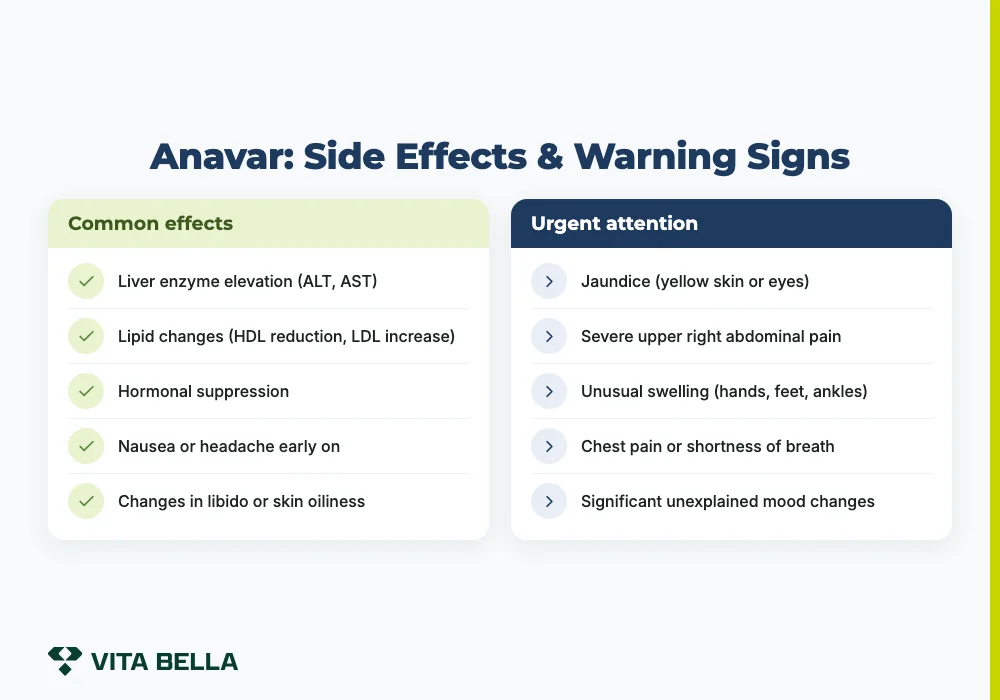
Common side effects
These effects are discussed before any prescription is written. Knowing what to watch for is a core part of supervised use, and reporting early changes is how the monitoring structure works.
Common side effects of oxandrolone:
- Liver enzyme elevation, particularly ALT and AST
- Lipid changes, including HDL reduction and LDL increase
- Hormonal suppression, which is one reason testosterone co-prescription is often part of the protocol
- Nausea and headache in some patients during early use
- Changes in libido
- Skin changes, including increased oiliness
Warning signs that require immediate attention
Some effects require contacting a provider the same day. Not waiting for the next scheduled check-in. A patient in a supervised protocol knows this list before the course begins.
Warning signs requiring immediate provider contact:
- Jaundice or yellowing of the skin or eyes, which signals significant liver stress
- Severe abdominal pain, particularly in the upper right quadrant
- Unusual swelling in the hands, feet, or ankles
- Cardiovascular symptoms, including chest pain or shortness of breath
- Significant unexplained mood changes or psychological disturbances
What happens if you miss a dose?
If a scheduled dose is missed, take it as soon as you remember, unless the next dose is close. In that case, skip the missed dose and continue with the normal schedule without doubling up.
Consistent anavar daily dosage timing matters within a short supervised course. Gaps in administration affect compound levels. A patient unsure whether to adjust should contact their provider rather than making that decision independently, since self-adjustment during a supervised protocol undermines the monitoring structure the provider has set up.
When is oxandrolone prescribed alongside testosterone?
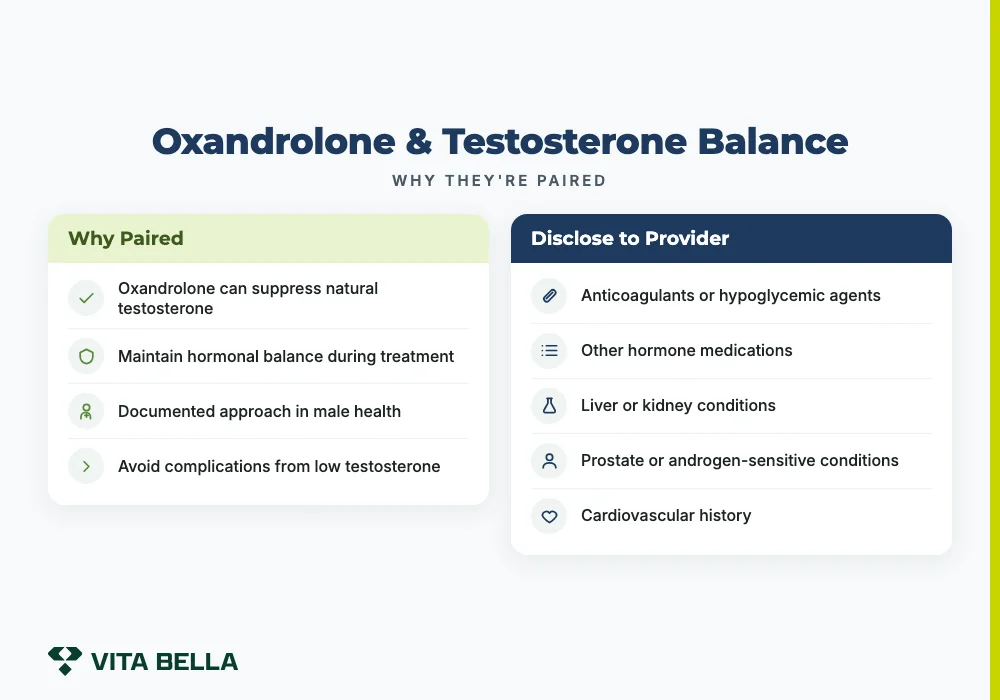
Oxandrolone can suppress the body's natural testosterone production, even during a short course. Providers frequently prescribe exogenous testosterone alongside it to maintain hormonal balance throughout the protocol. Wu et al. (2016) in Current Urology Reports reviewed this pairing as a documented approach in supervised male health management.
Allowing testosterone levels to fall during an oxandrolone course introduces its own complications. Addressing both variables from the start avoids that outcome. Patients working through Vita Bella receive a protocol where both components are set by a licensed provider who uses a physician-supervised testosterone protocol to maintain hormonal balance throughout.
Before starting oxandrolone, patients should disclose the following to their provider:
- Anticoagulants, including warfarin, because oxandrolone can potentiate anticoagulant effects
- Oral hypoglycemic agents, which may need dose adjustment under provider guidance
- Other current hormone medications, including any testosterone or estrogen-related prescriptions
- Liver or kidney conditions that may affect metabolic clearance
- Prostate history or androgen-sensitive conditions
- Cardiovascular history, including hypertension or prior cardiac events
If you're exploring oxandrolone as part of a supervised injury and recovery plan, Get Started to connect with a licensed Vita Bella provider.
How supervised telehealth handles oxandrolone prescribing
Most discussions of how to take anavar, and many online searches for anavar protocol dosage, stop at the compound itself and offer no view of what a supervised prescribing pathway looks like from intake to quarterly check-in. That gap is worth addressing directly.
At Vita Bella, labs are ordered through Quest Diagnostics and billed separately. Results are reviewed by a licensed provider before the 45-minute initial consultation begins. By the time the consultation starts, the provider has already reviewed the markers.
The session focuses on interpreting results, confirming the indication, and either setting a protocol or determining that the patient is not a candidate. Anavar dosage guidance, including the best time to take anavar and specific timing instructions, is part of the written protocol delivered after that consultation. It is set for the individual patient's indication and concurrent medications, not adapted from a general reference.
Quarterly provider check-ins are built into the membership structure. Labs are reviewed again at each check-in, and the oxandrolone dosage or concurrent protocol components are adjusted if markers indicate a change is warranted. Vita Bella providers are licensed across 47 states, and patients choose their own provider from the start.
Who is not a candidate for oxandrolone therapy:
- Patients with active liver disease or significantly elevated baseline liver enzymes
- Patients with certain cardiovascular conditions that contraindicate anabolic agent use
- Pregnant or breastfeeding patients
- Patients with a history of prostate cancer or androgen-sensitive conditions
- Patients currently on incompatible medications, including certain anticoagulants and specific oral hypoglycemic agents
For a closer look at how lab results inform clinical decisions, the guide to essential lab testing for hormones and peptides covers which markers providers review most carefully. If your labs read as normal but symptoms persist, when normal labs still leave you feeling suboptimal explains why that gap exists and what providers look for beyond standard reference ranges.
Ready to talk to a provider about your recovery plan?
The evaluation starts with a short quiz, moves to labs through Quest Diagnostics, then to a 45-minute provider consultation that reviews your results and determines whether oxandrolone is appropriate for your indication. Vita Bella providers are licensed across 47 states and you choose your own provider. Real providers. Real medicine. Honest prices. Get Started to connect with a licensed provider who reviews your labs before setting any protocol.
Frequently asked questions
A licensed provider answers this question only after reviewing your labs and health history. No universally safe answer exists before that evaluation. The provider determines the appropriate protocol based on your specific indication, lab results, and concurrent medications.
A licensed provider reviews lab results, including liver function, lipid panel, and testosterone baseline, along with a complete health history before determining whether oxandrolone is appropriate and how the protocol should be structured. No specific anavar dosage is set before that evaluation is complete. Individual variation in metabolic and hormonal markers is what makes the full intake necessary.
The best time to take anavar each day is part of the written protocol your provider delivers after the initial consultation, based on your specific indication, course duration, and concurrent medications. Your provider gives explicit timing instructions at the time of prescribing. Following that schedule consistently is part of what keeps the supervised course on track.
Supervised oxandrolone courses are typically short, generally no longer than eight weeks, to minimize the risk of side effects and allow adequate monitoring between provider check-ins. Longer courses increase the likelihood of liver enzyme changes and lipid shifts. A provider determines the appropriate duration based on the patient's indication and how their markers respond.
Patients with active liver disease, certain cardiovascular conditions, prostate or androgen-sensitive conditions, or those on incompatible medications are typically not candidates. A provider determines eligibility based on labs and a complete health history. These exclusions exist because the risks in those populations outweigh the potential benefits of a short supervised course.
Sources
- Lou J et al. (2025). Oxandrolone for burn patients: a systematic review and updated meta-analysis of randomized controlled trials from 2005 to 2025. World Journal of Emergency Surgery. PubMed
- Ring J et al. (2020). Oxandrolone in the Treatment of Burn Injuries: A Systematic Review and Meta-analysis. Journal of Burn Care and Research. PubMed
- Li H et al. (2016). The efficacy and safety of oxandrolone treatment for patients with severe burns: A systematic review and meta-analysis. Burns. PubMed
- Wu C et al. (2016). Novel Uses for the Anabolic Androgenic Steroids Nandrolone and Oxandrolone in the Management of Male Health. Current Urology Reports. PubMed