
On a testosterone treatment program, providers aim for ideal testosterone levels on TRT in the 400–700 ng/dL range measured at trough, within the mid-to-upper physiologic zone, per Endocrine Society and AUA guidelines. That range is not a fixed target. The right value for any individual depends on symptom response, delivery method, and free testosterone status.
What "ideal" means on TRT: not just a lab reference range
The word "ideal" carries real weight here. On therapy, providers calibrate to a functional zone within the physiologic range, not to the midpoint of a population chart.
Most labs report testosterone against a broad reference range of 300–1,000 ng/dL. That range was built to describe what a statistically typical population looks like, not to define a treatment target. A man at 310 ng/dL is technically "within range" on paper and symptomatic in practice. The distinction matters.
Understanding why population reference values and guideline-referenced treatment targets differ also explains why two men on identical protocols can have meaningfully different symptom outcomes. Reaching a number inside the reference band does not confirm that therapy is calibrated correctly. When "Normal" Labs Still Leave You Feeling Suboptimal explores exactly this gap in depth.
Why the lab reference range is not your treatment target
The reference range of 300–1,000 ng/dL comes from measuring testosterone across a large, diverse population spanning age groups and health statuses. It answers "what is common?" not "what is optimal for a treated patient?" Those are different questions with different answers.
The 2018 Endocrine Society clinical practice guideline, authored by Bhasin et al., frames the treatment goal as restoring testosterone to the physiologic range typical of healthy young men, roughly the mid-to-upper segment of the reference band. Providers use guideline-referenced targets, not the statistical floor of the reference range, as their aim point after reviewing labs.
What is the ideal testosterone level for men on TRT?
For most men, that works out to keeping the trough reading between roughly 400 and 700 ng/dL — the mid-to-upper stretch of the normal physiologic zone that Endocrine Society and AUA guidance points to. Trough is the lowest point in the dosing cycle, measured just before the next scheduled administration.
Testing at trough captures the floor of the treatment range. A result drawn at peak rather than trough will read considerably higher and does not reflect where the patient spends most of the cycle. That distinction matters when a provider uses lab results to decide whether a dose calibration is warranted. A licensed provider determines the appropriate dose after labs, not based on symptoms alone.
The 2024 review by Heidelbaugh et al. in American Family Physician confirms that the therapeutic goal for men is to normalize total testosterone to the mid-normal physiologic range, with individualized adjustments based on clinical response and repeat labs. Dose decisions happen at quarterly provider check-ins after reviewing trough results, not after a single draw at an arbitrary point in the cycle.
This calibration also depends on how the patient metabolizes testosterone. Some men convert a higher proportion to estradiol via aromatization; others have naturally slower clearance rates that sustain higher trough levels from a given dose. Both factors influence where within the 400–700 ng/dL range a provider aims for each individual.
Why there's a range, not a single number
Androgen receptor sensitivity varies between individuals. Two men with identical trt testosterone levels can have very different symptom profiles. One at 520 ng/dL feels fully restored; another at the same reading still reports fatigue and low libido because his free testosterone is suppressed by elevated SHBG. The number alone does not tell the full story.
Providers calibrate within the 400–700 ng/dL zone based on actual symptom response between lab draws, not by targeting the midpoint of the range. The optimal testosterone level for men on therapy is the value that resolves symptoms while keeping hematocrit, PSA, and cardiovascular markers stable. This is why what is optimal testosterone level for men has no universal answer: the right number is a clinical determination made over multiple quarterly reviews.
What discussions about ideal testosterone levels on TRT often get wrong
Men searching "ideal testosterone levels on TRT reddit" frequently encounter posts reporting trough values, peak values, and mid-cycle draws under the same label, making direct comparison unreliable. Ideal testosterone levels on TRT are only interpretable when draw timing is specified and consistent.
What should free testosterone be on TRT?
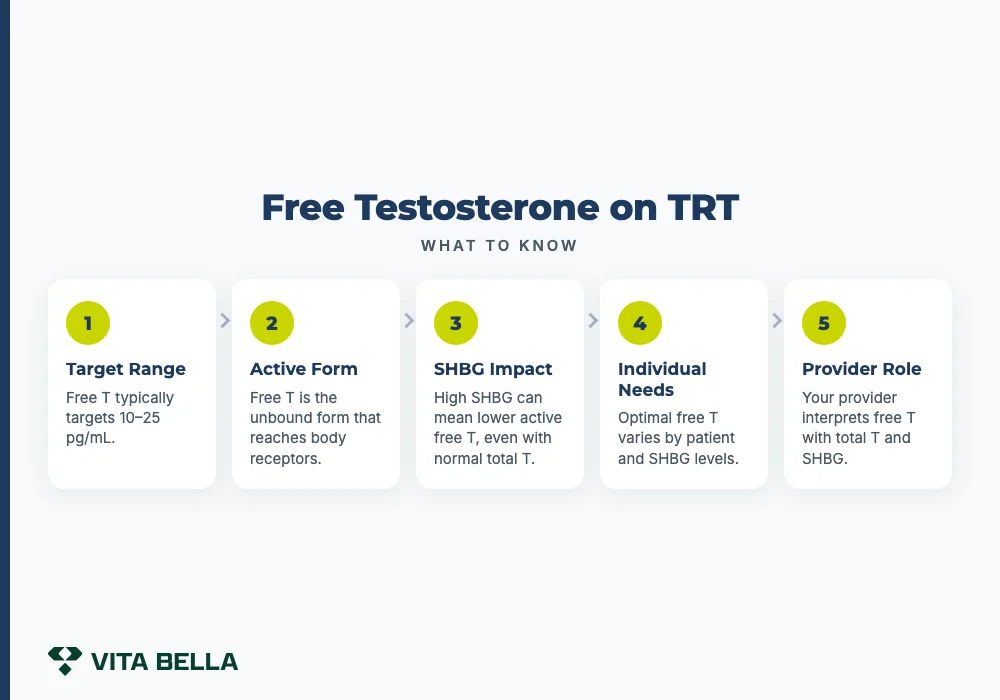
Free testosterone on TRT typically targets 10–25 pg/mL, though reference intervals vary by assay method and are shaped by each patient's sex hormone-binding globulin (SHBG) level. When total T reads within target but symptoms persist, free testosterone is often the more clinically meaningful number.
Only a small fraction of circulating testosterone is unbound. Most is bound to SHBG and albumin, which renders it inactive at the tissue level. Free testosterone is the unbound fraction that reaches androgen receptors in muscle, brain, and bone. Low free T explains the "normal labs, still feel terrible" experience that many men on therapy encounter before their protocol is recalibrated.
Understanding what is optimal free testosterone level for any individual requires knowing their SHBG. Ideal free testosterone levels on TRT are not identical for every patient because free T reference intervals also vary depending on whether the lab uses direct immunoassay or equilibrium dialysis. A licensed provider interprets free T alongside total T and SHBG, not as a standalone value.
How SHBG changes what your total T number actually means
Sex hormone-binding globulin binds testosterone tightly and renders it inactive at the tissue level. High SHBG can leave a patient at 550 ng/dL total testosterone, well within the trt testosterone levels target zone, yet significantly deficient in bioavailable free testosterone.
This is the mechanism most lab reports skip over. A man with high SHBG needs a higher total T to achieve the same free T as someone with average binding protein levels. Providers account for SHBG when setting targets, which is why two patients on similar protocols can have different total T goals. If total T is on target but symptoms remain, SHBG is where the review starts. For a detailed look at how binding proteins distort the total T picture, Sex Hormone-Binding Globulin: Why Total Testosterone Is Not Enough covers the mechanism fully.
| Men (population reference) | Men on TRT (provider target) | Women (population reference) | Women on TRT (provider target) | |
|---|---|---|---|---|
| Total testosterone | 300–1,000 ng/dL | 400–700 ng/dL at trough | 15–70 ng/dL | 15–70 ng/dL |
| Free testosterone | 5–21 pg/mL (varies by assay) | 10–25 pg/mL | 0.3–1.9 pg/mL (varies by assay) | Low end of physiologic premenopausal range |
| Key modifier | Baseline SHBG | SHBG influences free T target | Baseline SHBG | SHBG influences free T target |
All targets are set by a licensed provider after reviewing labs, not self-adjusted. Reference intervals vary by assay method and laboratory.
Ideal testosterone levels for women on TRT
Women undergoing testosterone therapy are treated at substantially lower targets, typically 15–70 ng/dL for total testosterone, guided by symptom relief rather than male reference ranges. Dosing and monitoring protocols differ significantly from male TRT.
The 2023 consensus statement by Parish et al. in Menopause notes that postmenopausal women receiving testosterone for hypoactive sexual desire disorder are dosed to restore levels to the physiologic premenopausal range. Free testosterone is monitored alongside total T, and labs are drawn before therapy begins and at regular intervals to confirm levels remain within a physiologically appropriate zone.
Women's programs require provider-led lab review at every stage. Applying male TRT targets to women carries a risk of supraphysiologic exposure that affects voice, skin texture, and cardiovascular markers. Women's hormone therapy at Vita Bella includes licensed provider oversight of both total and free testosterone alongside other relevant hormone markers.
Testosterone levels by age: reference chart
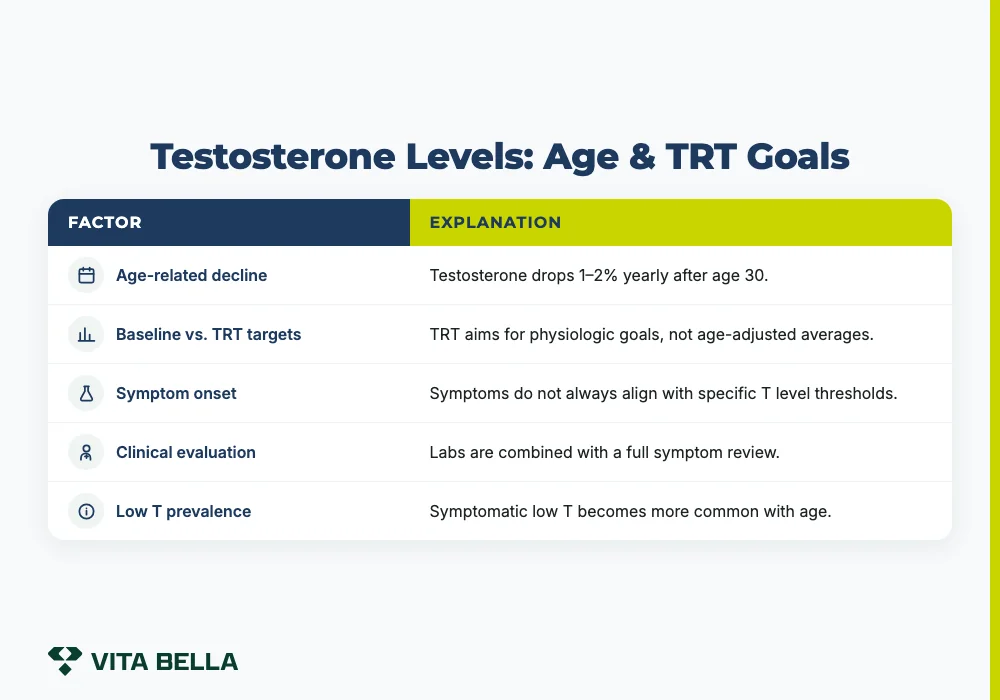
Testosterone production declines roughly 1–2% per year after age 30. Knowing where age-adjusted baseline values sit helps interpret pre-treatment labs and explains why TRT targets for a 55-year-old differ from population norms for that age bracket.
| Age range | Men (total T, ng/dL) | Women (total T, ng/dL) |
|---|---|---|
| 20–29 | 400–1,080 | 8–60 |
| 30–39 | 350–1,000 | 8–55 |
| 40–49 | 300–890 | 7–50 |
| 50–59 | 250–820 | 6–45 |
| 60–69 | 200–740 | 5–40 |
| 70+ | 150–670 | 4–36 |
Reference ranges from Heidelbaugh et al. (2024), American Family Physician. TRT targets for men (400–700 ng/dL at trough) differ from these age-adjusted population baselines. These values describe untreated populations; provider-set TRT targets reflect guideline-referenced physiologic goals, not age-adjusted medians.
These numbers decline predictably with age, but symptom onset does not align neatly with any threshold. A testosterone levels by age chart like the one above illustrates why providers set ideal testosterone levels on TRT against guideline-referenced physiologic goals rather than the age-adjusted median for a given decade. A man at 310 ng/dL at age 45 sits above the floor for his decade yet may have frank symptoms of hypogonadism. That is why clinical evaluation combines labs with a full symptom review. The number is context, not a standalone decision.
The decline in production also explains why symptomatic low T becomes more common with each decade. By the 50s, a man's average total T may sit at the lower half of what it was in his 20s, often crossing into the symptomatic range even before reaching the 300 ng/dL threshold most guidelines use as a diagnostic floor. That is why an age-matched perspective on pre-treatment labs matters when a provider evaluates candidacy.
When should testosterone levels be tested on TRT?
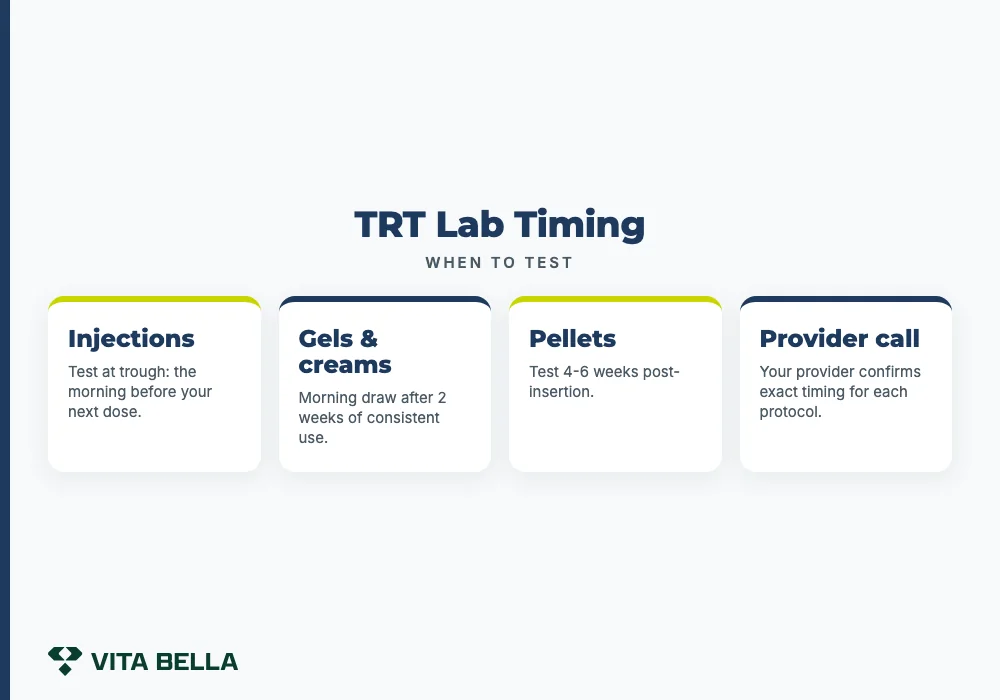
The correct draw window depends on delivery method: for injections, test at trough on the morning before the next dose; for daily gels and creams, test in the morning after at least two weeks of consistent daily use. Testing outside this window is the most common source of misleading TRT lab results.
A patient on weekly injections who tests on day two post-injection captures a near-peak reading, not a trough. That inflated result can prompt an unnecessary protocol reduction. Drawing at the correct trough window gives the provider the actual floor of the treatment range and the data needed to calibrate accurately.
Lab timing by delivery method:
- Weekly injections: draw at trough, morning before the next scheduled dose
- Biweekly injections: draw on day 7 of the 14-day cycle, at the midpoint trough
- Daily gels and creams: draw in the morning after at least two weeks of consistent daily use
- Patches: draw at steady state after two weeks of daily application
- Pellets: draw four to six weeks post-insertion, when absorption has stabilized
A licensed provider confirms the exact timing for each protocol at enrollment and revisits it at every quarterly check-in.
The 2024 Cruickshank et al. evidence synthesis in Health Technology Assessment underscores that consistent monitoring protocols, including standardized draw timing, are necessary for meaningful treatment evaluation. One draw at the wrong point in the cycle can mischaracterize an otherwise well-calibrated protocol.
For a broader overview of which labs matter alongside testosterone, Essential Lab Testing for Peptide and Hormones: Markers to Track walks through the full panel a provider typically reviews.
A licensed Vita Bella provider reviews your lab results at every quarterly check-in and adjusts your protocol when levels drift from target. The TRT check-in program includes quarterly 1:1 reviews and lab oversight through Quest Diagnostics. Get Started to connect with a provider and schedule your baseline labs.
What if your levels go too high on TRT?
Supraphysiologic testosterone, levels that exceed the upper physiologic reference range, is associated with elevated hematocrit, cardiovascular marker changes, mood shifts, and sleep disruption. Staying within the 400–700 ng/dL trough target avoids these risks.
The 2024 Cruickshank et al. systematic review found that elevated hematocrit is one of the most consistently reported adverse effects of TRT when levels run above the therapeutic target. Polycythemia increases blood viscosity. This carries cardiovascular implications that require active provider-led monitoring and a clinical response, not self-adjustment.
Protocol changes when levels overshoot the target are a clinical decision. A licensed provider adjusts delivery method, injection frequency, or dose based on labs. Patients who observe concerning signs contact their provider before the next scheduled check-in.
Signs that warrant a provider review:
- If hematocrit rises above 54%, discuss this with your provider before the next scheduled draw
- If you experience persistent mood changes or unexplained irritability, your provider reviews this at your next check-in
- If sleep disruption or new-onset snoring develops, your provider assesses this in the context of current levels
- If new skin changes consistent with androgen excess appear, your provider reviews this at your next check-in
- If blood pressure rises above your established baseline, your provider reviews this at your next check-in
What if your testosterone levels aren't increasing on TRT?
When total testosterone remains below target after six to twelve weeks of consistent treatment, the most common explanation is draw timing error, followed by absorption differences by delivery method and site, elevated SHBG, and individual metabolism variation. Each of these is reviewable at a provider check-in.
Draw timing is the first thing to rule out. A man testing near peak rather than trough sees an elevated result that does not reflect the trough floor. That reading can mask a genuine response and delay appropriate calibration. Confirming correct draw timing costs nothing and addresses the most frequent confound.
When timing is confirmed correct and ideal testosterone levels on TRT remain below the 400–700 ng/dL target, the next review points are absorption, SHBG, and underlying thyroid or adrenal factors. A licensed provider works through each of these at the quarterly check-in.
Reasons levels may not be responding as expected:
- Draw timing error (most common): your provider confirms the correct draw window at your next check-in
- Site or method absorption differences: your provider reviews delivery method and site rotation at your next check-in
- Elevated SHBG compressing bioavailable testosterone: your provider reassesses the free T target in context
- Underlying thyroid or adrenal factors: your provider orders additional labs as needed
- Dose calibration needed based on updated trough labs: your provider adjusts the protocol at the quarterly review
Tracking progress beyond the number
Lab values confirm direction. Symptoms are the daily signal between draws. Both matter, and they do not always move in sync.
Energy and libido typically begin improving at weeks four to eight of therapy. Body composition and recovery show measurable change at weeks eight to twelve and beyond. Strength adaptations take longer still. This timeline reflects the range reported in the Heidelbaugh et al. (2024) review in American Family Physician; individual variation is real and expected.
Libido and sleep quality are typically the earliest reported changes. Energy and mood follow. Body composition changes require a longer window because they depend on muscle protein synthesis rates, fat cell metabolism, and training stimulus, all of which respond to normalized testosterone on a slower biological timeline. Patients who expect rapid body recomposition at week two may question a protocol that is actually working correctly.
The quarterly check-in model at Vita Bella is built around this timeline. A provider reviews labs at the three-month mark, not simply to confirm a number, but to compare it against the symptom changes the patient has tracked between visits. That combination of data drives meaningful protocol decisions.
What to review at a quarterly provider check-in:
- Total testosterone at trough: confirm the value sits within the 400–700 ng/dL target zone
- Free testosterone: review this particularly when total T is on target but symptoms have not fully resolved
- Hematocrit: flag this if it is trending toward the clinical review threshold
- SHBG: interpret alongside free T to assess the bioavailable hormone fraction
- Symptom log: track energy, libido, sleep, and recovery against the pre-treatment baseline
- Protocol adjustment: discuss with the licensed provider based on all of the above
This is where quarterly provider-led monitoring adds clinical value that self-directed testing cannot replicate. A single lab draw without a symptom review and protocol discussion is incomplete data.
Ready to find out where your levels stand?
A licensed Vita Bella provider orders baseline labs through Quest Diagnostics, reviews the results, and builds a protocol around guideline-referenced targets rather than a population average. Quarterly 1:1 check-ins keep ideal testosterone levels on TRT calibrated as the body responds to treatment. For anyone ready to know their numbers and what they mean, the next step is a provider-led evaluation. Provider-supported programs include 1:1 provider care every quarter, free injection supplies, and discreet shipping from FDA-inspected, state-licensed U.S. pharmacies.
Frequently asked questions
Most providers target 400–700 ng/dL at trough for men on TRT, based on Endocrine Society and AUA guidance, though the right value within that range depends on individual symptom response and free testosterone status. A single number is not the goal; a licensed provider calibrates the protocol over multiple quarterly draws.
Free testosterone on TRT typically targets 10–25 pg/mL, though reference intervals vary by assay and are affected by each patient's SHBG level. When SHBG is elevated, free T is often the more clinically relevant marker, even when total T reads within range.
Levels above the physiologic reference range are associated with elevated hematocrit, mood changes, and cardiovascular risk, not improved outcomes. The goal of TRT is to restore physiologic testosterone, not to maximize it, and a licensed provider adjusts the protocol when levels exceed the target zone.
Timing depends on delivery method: for injections, test at trough on the morning before the next dose; for gels and creams, test in the morning after at least two weeks of consistent daily use. Testing at the wrong point in the cycle is the most common reason for misleading results.
Most guidelines use a total testosterone below 300 ng/dL combined with clinical symptoms as the threshold for evaluating TRT candidacy. A licensed provider confirms eligibility after reviewing labs and medical history; the number alone is not sufficient for a treatment decision.
Sources
- Cruickshank M et al. (2024). The effects and safety of testosterone replacement therapy for men with hypogonadism: the TestES evidence synthesis and economic evaluation. Health Technology Assessment. PubMed
- Parish SJ et al. (2023). Testosterone use for hypoactive sexual desire disorder in postmenopausal women. Menopause. PubMed
- Heidelbaugh JJ et al. (2024). Testosterone Replacement Therapy for Male Hypogonadism. American Family Physician. PubMed
- Bhasin S et al. (2018). Testosterone Therapy in Men With Hypogonadism: An Endocrine Society Clinical Practice Guideline. Journal of Clinical Endocrinology and Metabolism. PubMed