
TRT for women is an off-label testosterone therapy prescribed after blood work confirms clinically low testosterone. Testosterone supports energy, muscle tone, bone density, mood stability, and sexual function throughout a woman's life, with levels that naturally decline with age and across hormonal transitions like perimenopause and menopause. When levels fall and consistent symptoms develop, testosterone replacement therapy becomes one clinical option a provider considers alongside a full hormone panel. Vita Bella's testosterone and hormone care program connects patients with licensed providers across 47 states who order labs first and determine the right protocol for each individual.
What Does TRT Do for Women? Testosterone's Role in the Body
Testosterone is produced in the ovaries and adrenal glands throughout a woman's life. It works alongside estrogen and progesterone, and all three hormones regulate interconnected systems. Levels follow a declining arc through the thirties and forties before falling more sharply through perimenopause and menopause.
The 2019 Global Consensus Position Statement on the Use of Testosterone Therapy for Women, published in the Journal of Clinical Endocrinology and Metabolism, documented testosterone's established roles in female physiology: sexual function, bone density, muscle maintenance, energy metabolism, and mood regulation. When testosterone falls below a woman's functional threshold, these systems can underperform in ways that estrogen replacement alone often does not address.
Symptoms of low testosterone in women
When testosterone falls below a woman's functional range, several symptoms tend to appear together. A provider evaluates the full symptom picture alongside lab values, never symptoms in isolation.
Common indicators a provider may assess include:
- Fatigue persists despite adequate sleep and does not resolve with rest.
- Libido drops noticeably, often with reduced interest in sexual activity.
- Building or maintaining muscle becomes difficult despite regular exercise.
- Brain fog and memory lapses affect focus and daily mental performance.
- Mood dips or irritability appear without an obvious psychological cause.
- Sleep quality declines, particularly through frequent mid-night waking.
- Bone density decreases, which providers may note on imaging or in lab results.
No single symptom confirms low testosterone. Labs decide.
Can Women Take TRT? Candidacy and Clinical Criteria
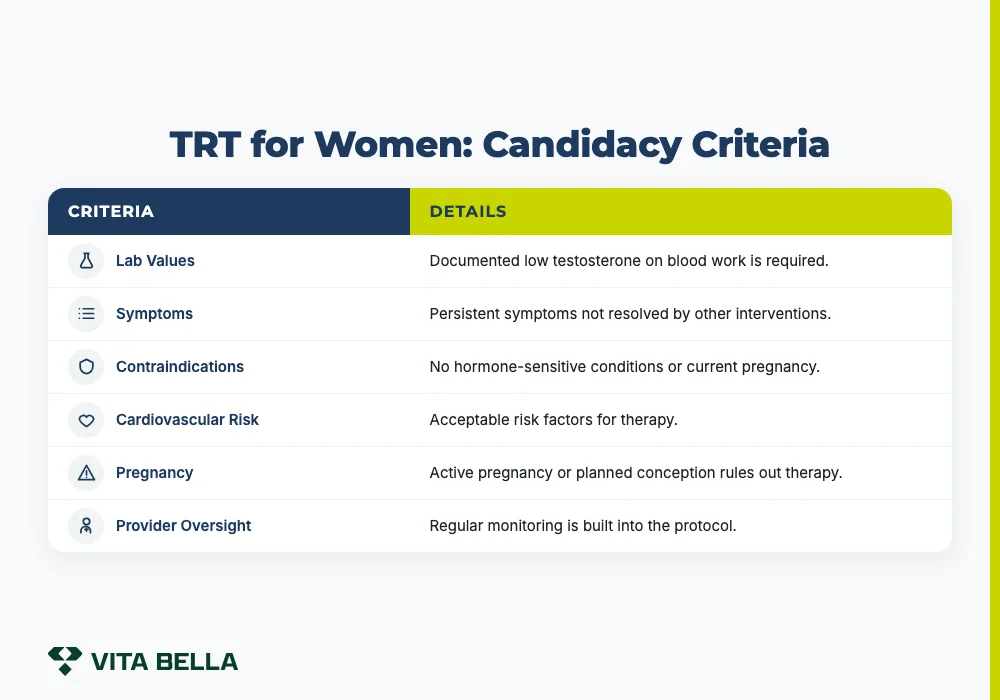
Yes. A licensed provider can prescribe TRT for women when documented low testosterone on blood work aligns with consistent symptoms. Candidacy is not based on a symptom checklist alone. It requires confirmed lab values, a full clinical review, and an assessment of contraindications.
No testosterone product carries specific regulatory approval for women. Providers prescribe compounded formulations under established clinical guidance, including the 2019 Global Consensus Position Statement, which reviewed the evidence base for testosterone replacement for women and outlined the appropriate clinical criteria. The off-label status of trt women pursue means provider oversight and regular monitoring are built into every well-run protocol.
Who is a candidate, and who isn't?
A provider typically evaluates the following when assessing candidacy for trt therapy for women:
Indicators that may support a prescription:
- Documented low total or free testosterone on blood work confirms the clinical picture.
- Persistent symptoms such as fatigue, low libido, or cognitive changes have not resolved with other interventions.
- No contraindications are present, including hormone-sensitive conditions or current pregnancy.
- Cardiovascular risk factors fall within the range a provider considers acceptable for therapy.
Situations where providers generally do not prescribe testosterone:
- Active pregnancy or planned conception rules out testosterone therapy.
- Hormone-sensitive cancer history may disqualify a patient depending on clinical context.
- Uncontrolled medical conditions that affect hormone metabolism complicate the risk-benefit assessment.
- Testosterone levels already within or above the normal female range indicate no deficiency is present.
This is provider-determined, not self-diagnosed.
Perimenopausal, menopausal, and younger women: who fits where?
Providers evaluate testosterone across all three life stages. Whether women can take trt applies before menopause too, not only after it.
Perimenopausal women often experience the earliest declines, and testosterone can begin falling before estrogen shifts become pronounced. Some women in their mid-to-late thirties or forties arrive at a consultation with documented low T and a full symptom profile that predates any menopause diagnosis. Postmenopausal women represent the most-studied group, with the strongest clinical evidence base supporting testosterone therapy when candidacy criteria are met. Premenopausal women with documented low testosterone are a smaller clinical population, and a provider assesses each case on lab values and symptom history rather than life stage alone.
How Is TRT for Women Given? Delivery Methods Compared
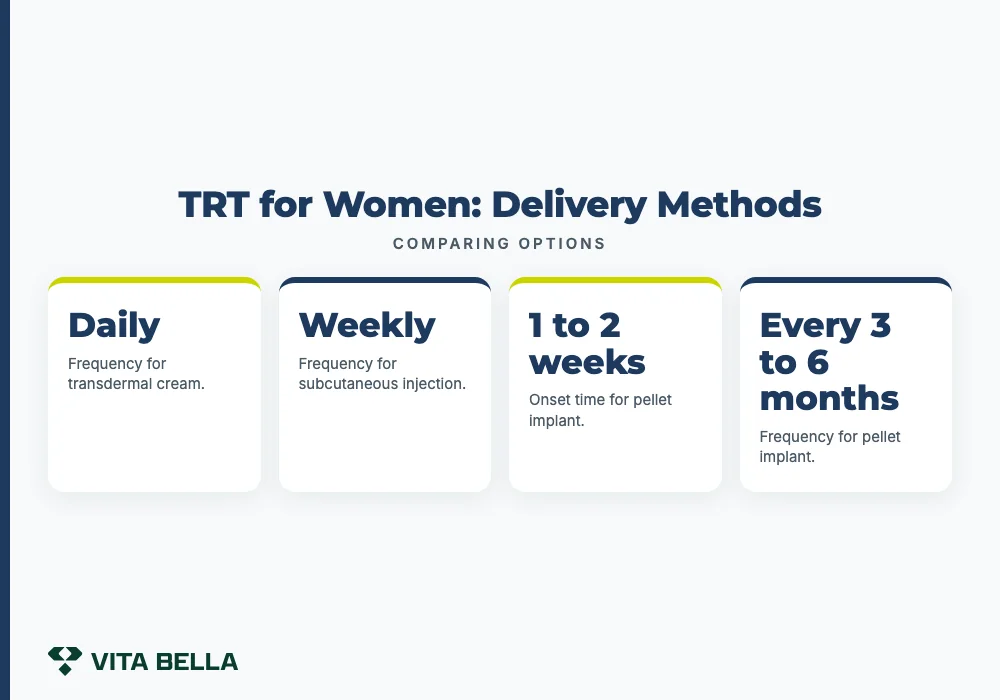
There are several delivery methods for trt for women, and a provider selects the appropriate form based on labs, lifestyle, and clinical factors. A licensed provider determines the dosing after reviewing lab results, calibrating to female physiological ranges, which are substantially lower than male protocols. The 2022 paper by Figueiredo et al. in the Journal of Clinical Endocrinology and Metabolism identified subcutaneous injection as a safe, practical, and clinically reasonable delivery option when properly supervised.
| Delivery Form | Onset | Frequency | Pros | Cons |
|---|---|---|---|---|
| Transdermal cream | Within days | Daily | Easy to titrate | Transfer risk to skin contact |
| Subcutaneous injection | Within days | Weekly or biweekly | Precise, consistent dosing | Requires self-injection |
| Pellet implant | 1 to 2 weeks | Every 3 to 6 months | No daily administration | Dose adjustment difficult once placed |
| Transdermal patch | Within days | Daily or every 2 days | Consistent absorption | Skin irritation common |
The right form depends on the patient's lifestyle, tolerance, and provider recommendation. No single method is universally superior for every woman.
What to expect: a realistic timeline for TRT results in women
Initial changes may appear within the first several weeks of consistent therapy. More substantial shifts in energy, body composition, and libido tend to build over the first few months.
Energy and mood often shift first. Women frequently report improved mental clarity and a reduction in the persistent fatigue that drove them to seek evaluation. Libido changes tend to emerge next. Muscle tone and body composition changes take longer; the process is gradual and depends on consistency of therapy alongside physical activity. Bone density outcomes require imaging over a year or more to detect.
Individual response varies. A provider tracks progress through follow-up labs and quarterly provider check-ins, adjusting the approach based on lab values and reported experience.
What are the side effects of testosterone therapy in women?
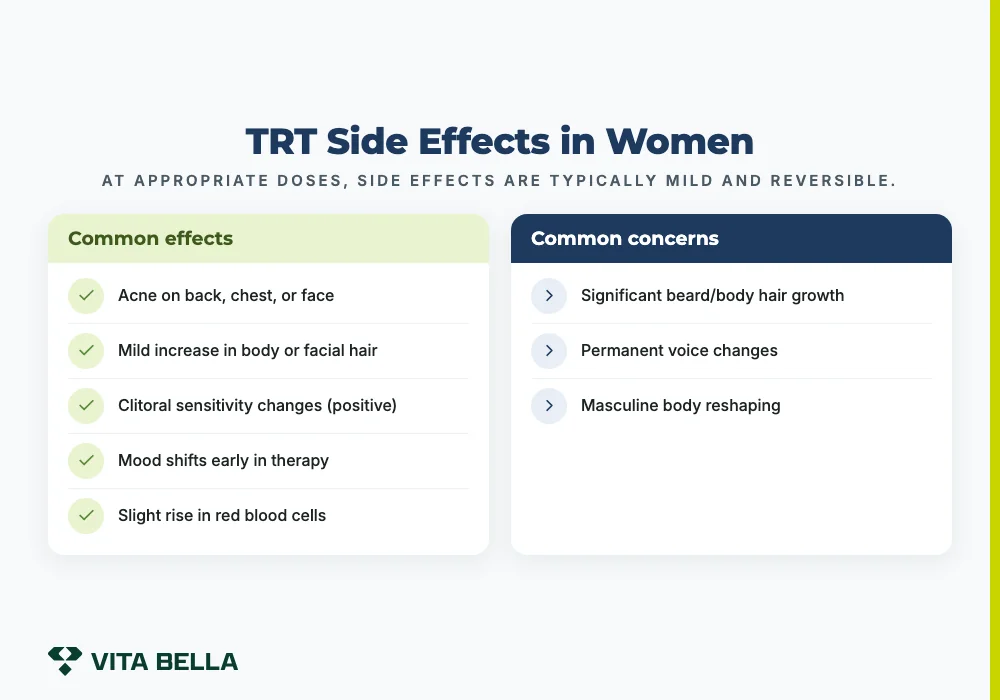
At doses calibrated to female physiological ranges, most women tolerate trt for women well. Side effects become more common when dosing exceeds that range. The 2019 Global Consensus Position Statement documented that side effects at physiological doses are typically mild and reversible when caught early through monitoring.
Common side effects at appropriate doses:
- Acne appears, particularly on the back, chest, or face.
- Body or facial hair increases mildly.
- Clitoral sensitivity changes, an effect most patients view positively.
- Mood shifts occur, especially early while hormone levels stabilize.
- Red blood cell counts may rise slightly, which a provider monitors through CBC.
Common concerns about masculinization, addressed:
- "Testosterone will cause significant beard or body hair growth." Hair changes at physiological doses are mild; pronounced growth is a supraphysiologic effect.
- "My voice will change permanently." Voice changes are associated with doses well above the female physiological range and are uncommon under close monitoring.
- "TRT will reshape my body masculinely." Physical changes are dose-dependent; physiological dosing supports muscle maintenance without altering body composition dramatically.
Is testosterone therapy safe? What the research says
The 2019 Global Consensus Position Statement on the Use of Testosterone Therapy for Women was endorsed by major international endocrinology and gynecology societies. It concluded that testosterone therapy at physiological doses carries an acceptable safety profile for appropriate candidates with proper monitoring.
Most long-term cardiovascular and thromboembolic data in the published literature comes from male populations. A 2024 systematic review in Expert Opinion on Drug Safety (Corona et al.) and a 2024 meta-analysis in Asian Journal of Andrology (Cannarella et al.) assessed these risks in men on testosterone therapy. These findings do not translate directly to women, whose baseline hormone environments differ substantially. Lab monitoring before and during therapy is the central safety mechanism, and provider oversight is the framework within which trt therapy for women is practiced responsibly.
Labs and monitoring: what to expect before and during TRT
Before a provider prescribes testosterone therapy, labs are ordered first. The results determine whether testosterone replacement for women is clinically indicated and what approach makes sense.
Markers a provider typically reviews before starting therapy include total and free testosterone, estradiol, and CBC, among other metabolic markers. Understanding the difference between total and free testosterone matters here; the article on sex hormone-binding globulin and why total testosterone can be misleading explains why free testosterone often tells a more complete story. Labs are ordered through Quest Diagnostics and billed separately from the membership fee.
After therapy begins, monitoring continues on a regular cadence. The article on what "normal" lab ranges miss in clinical practice is useful context for understanding why a result within standard reference range is not automatically optimal for that individual. Follow-up labs track hormone levels and flag changes that warrant protocol adjustments. Quarterly provider check-ins are built into the program structure so that lab trends, symptom reports, and protocol decisions are reviewed together.
How to get TRT as a woman today
Telehealth removes the specialist-referral barrier that has historically made testosterone therapy for women hard to access. The path at Vita Bella is direct: labs are ordered first through Quest Diagnostics, then a licensed provider reviews the results and determines whether trt therapy is appropriate for that individual's clinical picture. The patient selects their own provider from a licensed network across 47 states.
The program includes quarterly provider check-ins, free injection supplies, and discreet shipping from FDA-inspected U.S. pharmacies. Medications are billed at wholesale pricing, separately from the membership fee. For full program and pricing details, visit the Vita Bella Performance Membership page.
Learn how Vita Bella's hormone therapy program works
Ready to find out if testosterone therapy is right for you?
Labs and a provider consultation are where the answer comes from, not a symptom checklist. Provider-supported programs. Discreet shipping from FDA-inspected U.S. pharmacies. Quarterly provider check-ins. Free injection supplies.
Transform Your Life. You Owe It To Yourself.
Frequently asked questions
TRT for women is an off-label testosterone therapy a licensed provider may prescribe to address clinically low testosterone levels confirmed by blood work. No testosterone product carries specific regulatory approval for women; providers prescribe compounded formulations when clinical criteria are met.
Yes. Testosterone levels can fall in women before menopause, including during perimenopause and in some premenopausal women. A provider evaluates low testosterone based on lab results and symptom history, not life stage alone.
Most women notice early changes within the first several weeks of consistent therapy, with fuller effects on energy, libido, and body composition building over several months. Individual response varies, and a provider tracks progress through follow-up labs and quarterly check-ins.
At doses calibrated to female physiological ranges, common side effects include acne, mild increases in body or facial hair, and mood changes. Virilizing effects such as voice changes are associated with supraphysiologic dosing and are uncommon when a provider monitors levels closely.
The primary difference involves the target physiological range and the trt dose for women compared to male protocols. Women's baseline testosterone levels are much lower than men's, so a provider-prescribed protocol for women is calibrated to that range. Labs determine the appropriate approach for each individual.
Sources
- Davis SR et al. (2019). Global Consensus Position Statement on the Use of Testosterone Therapy for Women. Journal of Clinical Endocrinology and Metabolism. PubMed
- Figueiredo MG et al. (2022). Testosterone Therapy With Subcutaneous Injections: A Safe, Practical, and Reasonable Option. Journal of Clinical Endocrinology and Metabolism. PubMed
- Cannarella R et al. (2024). Testosterone replacement therapy and vascular thromboembolic events: a systematic review and meta-analysis. Asian Journal of Andrology. PubMed
- Corona G et al. (2024). Cardiovascular safety of testosterone replacement therapy in men: an updated systematic review and meta-analysis. Expert Opinion on Drug Safety. PubMed