











Millions of people struggle with weight gain, fatigue, and depression while being told their thyroid is “normal.” Yet the standard thyroid test, TSH, fails to capture the complete picture of thyroid metabolism. Although TSH reflects pituitary signaling, it does not measure how much active thyroid hormone the body actually uses. It has been shown that many symptomatic patients have normal TSH levels but impaired thyroid function at the tissue level.
Tired of being told your labs are fine when your body says otherwise? A normal TSH doesn’t rule out thyroid dysfunction, far from it. At Vita Bella, we look deeper to identify hidden hormonal imbalances and nutrient gaps. You deserve real solutions, not outdated diagnostics. You deserve to feel like yourself again. Start your path to better metabolism and a clearer mood today.
Why Relying Only on TSH Leads to Misdiagnosis?
Primary care providers typically order only TSH because guidelines frame it as the “gold standard” for screening. However, TSH has an extensive reference range, often from 0.4 to 4.5 mIU/L, which means a patient can be symptomatic yet still fall within this wide interval. It has been shown that individuals in the higher-normal TSH range have slower metabolism, higher body weight, and more fatigue compared with those in the lower range.
Relying solely on TSH for thyroid screening can miss subtle hormone imbalances because TSH reflects pituitary feedback rather than actual tissue-level thyroid hormone activity. In a longitudinal cohort study 1, the overlap between normal and subclinical hypothyroid patients was 92.6% for total T4 but only 9.0% for TSH, indicating TSH alone may fail to detect clinically relevant thyroid dysfunction.
Testing only TSH also misses problems with thyroid hormone conversion, cellular resistance, and early autoimmune activity. According to a study 2, intracellular conversion of T4 to T3 at the cellular level may not be reflected in the T3 level in the blood; a normal TSH in the majority of patients implies an appropriate T4 dosage.
The “Normal” TSH Trap: How Labs Miss Low Free T3 and Free T4?
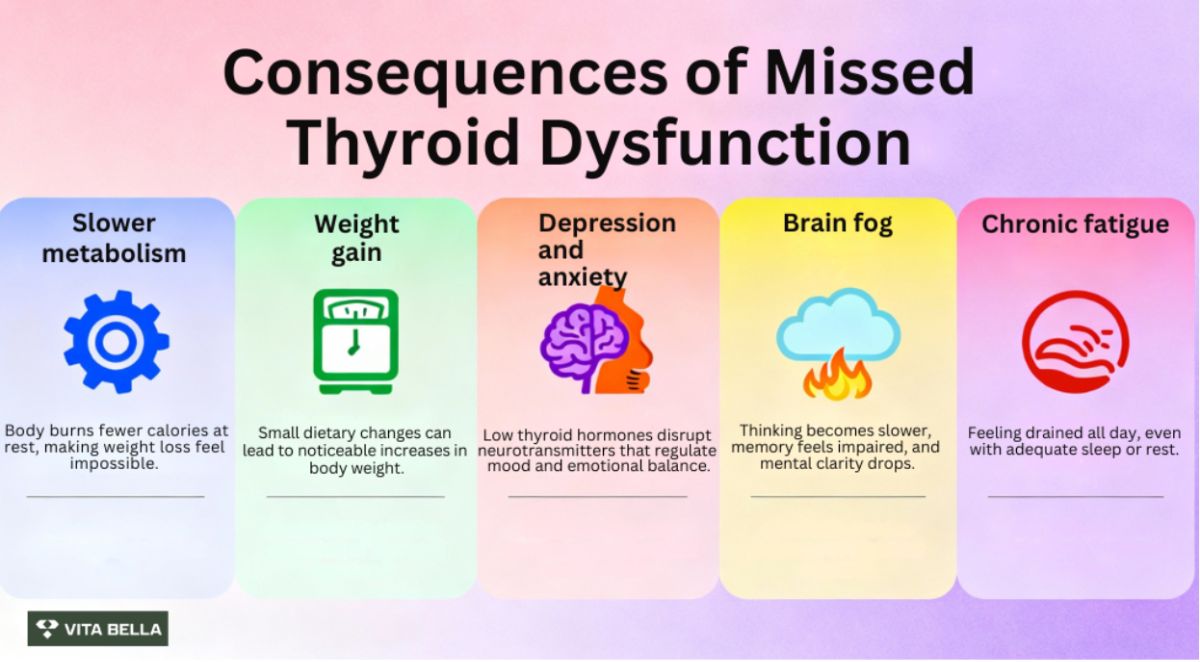
Many patients have normal TSH but low Free T3, low Free T4, or both. This condition, sometimes called euthyroid sick syndrome or low T3 syndrome, is linked to fatigue, weight gain, depression, and impaired cognitive function. Low T3 levels, even within a normal TSH range, are associated with metabolic slowdown and poorer quality of life scores.
Additionally, biological individuality matters. A TSH of 3.5 mIU/L may be “normal” on paper, but dysfunctional for someone whose optimal levels sit closer to 1.0. Broad reference ranges create an illusion of health, leaving patients suffering from undiagnosed hypothyroidism-like symptoms despite normal lab numbers.
Could Biotin Be Silently Sabotaging Your Thyroid Lab Results?
Biotin, a common ingredient in hair, skin, and nail supplements, can distort thyroid bloodwork by interfering with immunoassays. It's interesting to note that biotin has been shown to interfere with several immunoassay platforms. Because the test signal is closely correlated with TSH concentration, excess biotin in TSH sandwich assays dislodged biotinylated antibody-antigen complexes from streptavidin-coated microparticles, producing falsely low TSH levels.
On the other hand, because the signal is inversely proportional to hormone concentrations, excess biotin led to an overestimation of both FT4 and FT3 in competitive tests. According to research 3, normal dietary consumption of biotin is not predicted to cause biotin interference in immunoassays; reported interfering levels range from 1.5 to 300 mg/d can falsely lower TSH and falsely raise Free T4 and Free T3, making a hypothyroid patient appear normal or even hyperthyroid.
Can Nutrient Deficiencies Interfere With T4 to T3 Conversion?
Even when the thyroid gland produces enough T4, the body may fail to convert it to the active hormone T3. This conversion happens mainly in the liver and requires key nutrients. Deficiencies can mimic hypothyroidism again, with a completely normal TSH. When these nutrients are insufficient, thyroid activation slows, leading to reduced energy, sluggish metabolism, and persistent hypothyroid symptoms even when TSH appears normal. The following are the nutrients essential for T3 Production.
Selenium: required for deiodinase enzymes that convert T4 into T3
Zinc: supports hormone receptor expression
Iron: needed for thyroid peroxidase and hormone synthesis
Vitamin D: supports thyroid autoimmunity regulation
Magnesium: involved in hormone receptor activation
A human trial 4 found that selenium supplementation significantly improved Free T3/T4 ratios and reduced thyroid symptoms in individuals with impaired conversion. These nutrients are often depleted in people experiencing chronic stress, restrictive dieting, gut issues, or poor liver function, making low T3 more common than most clinicians acknowledge.
Can Hashimoto’s Hide Behind a Normal TSH Reading?
Many people with Hashimoto’s thyroiditis have normal TSH in the early stages. The most frequent cause of hypothyroidism in the US is Hashimoto thyroiditis. The claimed incidence, as per study 5, among white women is between 1% and 2%, with a 5–10 times preference over males. The pathophysiology and etiology of Hashimoto thyroiditis remain unclear. Furthermore, nothing is known about how Hashimoto's disease progresses from euthyroid to hypothyroid.
Disease progression from euthyroid to hypothyroid, at least in youngsters, has been proposed as Hashimoto thyroiditis. It has been shown that people with positive thyroid antibodies and normal TSH often report depression, fatigue, weight gain, and brain fog years before TSH rises. This is why Hashimoto’s is frequently missed: doctors wait for the thyroid to be damaged enough for TSH to respond. Testing only TSH ignores autoimmune inflammation that is already impairing thyroid tissue.
What the Full Thyroid Panel Should Include?
A complete thyroid evaluation should include more than TSH. Patients with normal TSH but abnormal Free T3 or positive antibodies often benefit from earlier intervention, lifestyle support, and nutrient optimization, reducing the risk of long-term metabolic and psychological decline. To capture hidden dysfunction, the following markers are essential:
TSH
Free T3
Free T4
Reverse T3 (optional but helpful)
TPO antibodies
Thyroglobulin antibodies (TgAb)
Don't Let Misdiagnosis Hold You Back: Get a Fresh Perspective with Vita Bella
Do your symptoms keep getting dismissed despite feeling worse? TSH-only testing leaves countless people untreated and misunderstood. Hidden Hashimoto’s and low T3 levels often remain undiagnosed for years. This silent dysfunction affects your metabolism, mood, and daily energy. You deserve more than reassurance; you deserve answers grounded in real thyroid science.
Vita Bella gives you honest answers, not rushed explanations. We identify hidden thyroid issues with advanced, targeted testing. Our approach supports cellular thyroid function for lasting results. Reclaim your energy and health with Vita Bella by your side. Let us guide you toward a future where your lab work finally matches the way you feel.
FAQs
Can you have thyroid symptoms even if your TSH is normal?
Yes, many people experience fatigue, weight gain, depression, and brain fog despite having a “normal” TSH level. This happens because TSH measures only pituitary activity, not active thyroid hormone levels. Low Free T3, low Free T4, nutrient deficiencies, early Hashimoto’s, and poor T4-to-T3 conversion can all cause symptoms long before TSH becomes abnormal.
Is TSH alone an unreliable test for diagnosing thyroid problems?
Yes, TSH alone often misses hidden thyroid dysfunction because its reference range is extensive and does not reflect tissue-level thyroid activity. Patients may have normal TSH but low Free T3, low Free T4, or elevated antibodies. Without a full panel, many cases of early hypothyroidism and autoimmune thyroid disease remain undiagnosed for years.
Can nutrient deficiencies affect thyroid hormone conversion?
Yes, key nutrients like selenium, zinc, iron, magnesium, and vitamin D are essential for converting T4 into the active hormone T3. When these nutrients are deficient, thyroid hormone activation slows, leading to fatigue, weight gain, and mood changes, even with normal TSH. Supporting these nutrients is often critical for optimal thyroid function and metabolic health.
Can Hashimoto’s be present even when TSH is normal?
Yes, Hashimoto’s thyroiditis, the most common cause of hypothyroidism, can remain active for years before TSH rises. Many individuals develop antibodies (TPO and TgAb) while maintaining normal TSH, yet still experience symptoms like depression, weight gain, and low energy. Without antibody testing, this early autoimmune activity is often missed or mistaken for unrelated conditions.
References:
Andersen, L. S., Karmishholt, J., Bruun, N. H., Riis, J., Noahsen, P., Westergaard, L., & Andersen, S. L. (2022). Interpretation of TSH and T4 for diagnosing minor alterations in thyroid function: A comparative analysis of two separate longitudinal cohorts. Thyroid Research, 15(1), Article 19. https://doi.org/10.1186/s13044-022-00137-1
Garber, J. R., Cobin, R. H., Gharib, H., Hennessey, J. V., Klein, I., Mechanick, J. I., Pessah-Pollack, R., Singer, P. A., & Woeber, K. A. (2012). Clinical practice guidelines for hypothyroidism in adults: Cosponsored by the American Association of Clinical Endocrinologists and the American Thyroid Association. Thyroid, 22(12), 1200-1235. https://doi.org/10.1089/thy.2012.0205
Favresse, J., Burlacu, M.-C., Maiter, D., & Gruson, D. (2018). Interferences with thyroid function immunoassays: Clinical implications and detection algorithm. Endocrine Reviews, 39(5), 830-850. https://doi.org/10.1210/er.2018-00119
Bano, I., Hassan, M. F., & Kieliszek, M. (2025). A comprehensive review of selenium as a key regulator in thyroid health. Biological Trace Element Research. https://doi.org/10.1007/s12011-025-04653-7
Staii, A., Mirocha, S., Todorova-Koteva, K., Glinberg, S., & Jaume, J. C. (2010). Hashimoto thyroiditis is more frequent than expected when diagnosed by cytology which uncovers a pre-clinical state. Thyroid Research, 3(1), Article 11. https://doi.org/10.1186/1756-6614-3-11