









Sleep and weight loss might seem unrelated at first glance, but the connection between the two is incredibly strong. One crucial factor is growth hormone (GH), which plays a key role in regulating fat metabolism, muscle development, and overall body composition. However, the timing and quality of your sleep are essential for maximizing the benefits of GH and preventing unwanted weight gain.
Ready to transform your health from the inside out? At Vita Bella, we believe in the power of deep sleep and Growth Hormone (GH) to help you achieve effortless weight loss. Through this blog, we explore how optimizing your sleep patterns can naturally enhance GH release, boost metabolism, and support your weight‑management goals. Take the first step toward a healthier, slimmer you today and consider exploring Vita Bella’s Sermorelin therapy for a scientifically backed boost.
What is the Role of Growth Hormone in Sleep and Weight Management?
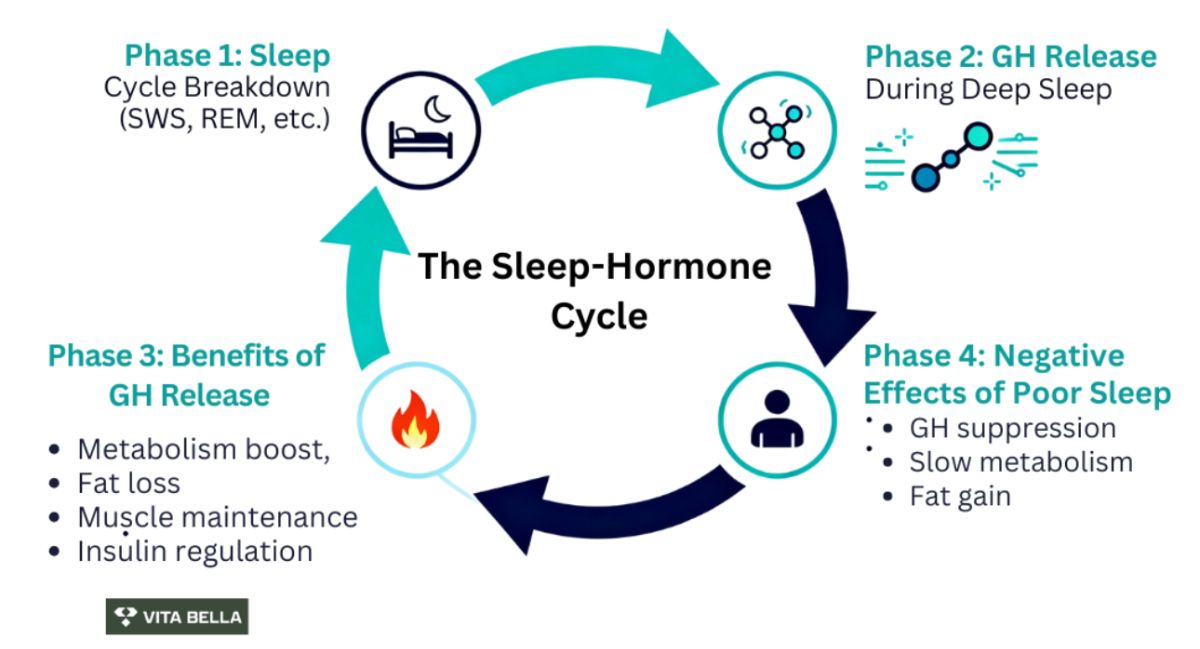
GH is often called the “sleep hormone” because it is primarily released during deep sleep. This release occurs in bursts during the first few hours of the sleep cycle, especially during slow‑wave sleep (SWS), the deepest phase of sleep. A study 1 shows that in adults, the most reproducible GH secretory pulse occurs shortly after sleep onset, coinciding with the first phase of SWS. The quantity of GH released during these pulses corresponds with the contemporaneous amount of SWS in males, and around 70% of GH pulses during sleep coincide with SWS.
Studies 2 show that deep SWS-related GH pulses represent a significant proportion of 24‑hour GH output in young men, especially SWS after sleep onset accounts for a substantial burst of GH secretion. According to a review 3, GH influences lipolysis (fat breakdown), promotes lean mass over fat mass, and supports maintenance of muscle and bone mass. This nocturnal GH release promotes healthy body composition when sleep is of high quality. Thus, deep sleep when GH is naturally secreted supports favorable fat metabolism and helps maintain or improve body composition.
What Are the Consequences of Poor Sleep on Insulin Resistance and Weight Gain?
Poor sleep habits, insufficient sleep duration, irregular sleep patterns, or poor sleep quality can blunt GH secretion, disrupt metabolic regulation, and contribute to weight gain. For instance, sleep restriction disrupts GH secretion patterns and alters other hormonal signals. Furthermore, restricted or disturbed sleep impairs glucose metabolism and insulin sensitivity.
According to research 4, even a single night of partial sleep deprivation (sleep reduced to ~4 hours) in healthy adults resulted in a roughly 25% decrease in peripheral insulin sensitivity during a hyperinsulinemic-euglycemic clamp. More severe restriction of sleep duration to 4 h per night during multiple subsequent nights resulted in decreased glucose tolerance. Total sleep deprivation also reduced glucose tolerance.
Longer‑term patterns of short sleep are consistently associated with increased risk of obesity, metabolic syndrome, and type 2 diabetes. Epidemiological and experimental evidence 5 links chronic partial sleep loss to weight gain, insulin resistance, dysregulation of appetite hormones (like leptin and ghrelin), and reduced energy expenditure, all factors that contribute to fat accumulation. In short, chronic insufficient or poor-quality sleep can undermine GH‑mediated metabolic benefits and promote fat retention and metabolic dysfunction.
Why Some Sleep Aids (and Poor Sleep Hygiene) Can Backfire?
Because many people struggle with insomnia or delayed sleep onset, they sometimes resort to sleep aids or poor sleep habits. But while these measures may help initiate sleep, they don’t guarantee the deep SWS required for GH release. Sleep architecture really matters: disturbances or reductions in SWS, even if total sleep time is preserved, can blunt GH secretion.
Moreover, chronic sleep loss and disrupted sleep stages are associated with hormonal dysregulation, impaired glucose metabolism, changes in appetite, and weight gain, none of which support healthy fat metabolism. Thus, using sedatives or sleep aids that compromise normal sleep architecture, even if they help you fall asleep, may impair GH-related metabolic benefits and undermine efforts for healthy weight management.
How Can We Enhance Deep Sleep and Growth Hormone Release? What Does the Evidence Tell Us?
There is interest in whether enhancing SWS boosts GH secretion and supports metabolic health. Some studies using sleep‑phase enhancers have reported that increasing SWS can elevate GH release. For example, in a controlled human study 6, a reliable stimulant of slow‑wave sleep (gamma-hydroxybutyrate, GHB) significantly increased sleep-related GH secretion.
Moreover, recent research 7 has begun exploring pharmacological or behavioural interventions to enhance deep sleep and, by extension, optimize GH release as a strategy for metabolic regulation and weight management. For instance, a 2022 study reported that pharmacological enhancement of SWS produced GH levels comparable to those of the normal nocturnal peak.
How Does Sermorelin Enhance Growth Hormone Release During Sleep and Support Metabolism?
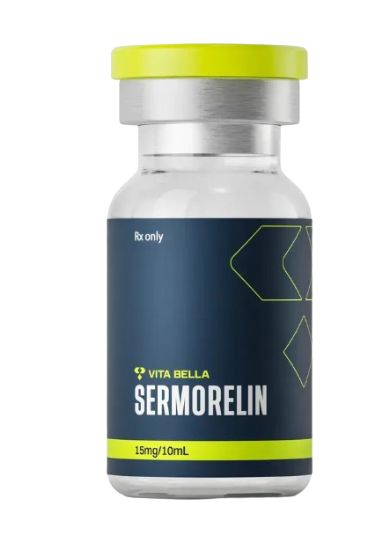
Sermorelin, a synthetic analogue of growth‑hormone‑releasing hormone (GHRH), stimulates your pituitary gland to secrete natural Growth‑Hormone (GH) in a more physiologic, pulsatile pattern rather than a constant flood. In a long-term human trial 8 in older adults (ages 55–71), nightly administration of a GHRH‑analog (sermorelin) significantly increased integrated nocturnal GH secretion. It raised circulating IGF‑1 (insulin‑like growth factor‑1) levels over 16 weeks.
Because GH release is tightly tied to deep slow‑wave sleep (SWS), using a GHRH analogue like sermorelin may help restore more natural nocturnal GH rhythms, which theoretically supports better sleep‑linked GH release, improved metabolism, and maintenance of lean body mass. Sermorelin increases endogenous hGH by stimulating the pituitary gland; it has certain physiological and clinical advantages over hGH.
Fix Your Sleep, Shed the Pounds, Ultimate Sleep‑Optimization Guide by Vita Bella
Do you feel like your weight loss progress has stalled? The root cause might be poor sleep. When you don’t get enough deep sleep, your body struggles to produce sufficient Growth Hormone (GH), which is essential for fat burning and muscle preservation. This leads to weight gain and metabolic slowdown. Lack of GH can also result in increased cravings and a slower recovery process, making it even harder to lose weight.
Vita Bella offers solutions to optimize sleep and boost GH production naturally, including Sermorelin. This GHRH analogue helps restore natural GH levels, improve sleep quality, and enhance metabolism. Sermorelin promotes a more natural release of GH during deep sleep, supporting fat loss and improved body composition. Begin your weight-loss journey with Vita Bella and experience the benefits of Sermorelin today as we guide you toward achieving your fitness goals effortlessly.
FAQs
Can improving my sleep quality help with weight loss?
Yes, improving your sleep quality can significantly help with weight loss. Growth Hormone (GH) is released during deep sleep, and its optimal secretion aids fat metabolism and muscle preservation. Poor sleep disrupts GH release, making weight management harder. Prioritizing sleep helps regulate metabolic functions, supporting weight loss efforts.
Does Growth Hormone (GH) directly affect body composition?
Yes, GH plays a key role in body composition. It promotes fat breakdown (lipolysis) and supports the development of lean muscle mass. Higher GH levels lead to a better balance of fat and muscle, aiding in weight management and overall metabolic health. Consistent deep sleep is crucial for GH secretion. Additionally, GH helps regulate insulin sensitivity, further enhancing fat metabolism and reducing the risk of fat accumulation.
Can Sermorelin help improve sleep and boost Growth Hormone secretion?
Yes, Sermorelin, a synthetic GHRH analogue, stimulates the pituitary gland to release GH in a natural, pulsatile manner. This, in turn, improves sleep quality and supports GH production during sleep. It can help with body composition, fat metabolism, and muscle maintenance, especially in individuals with declining GH levels as they age. Additionally, it has been shown to increase IGF‑1 levels, which further promotes fat loss and muscle growth.
Are sleep aids like alcohol or THC effective for improving sleep quality?
No, sleep aids like alcohol or THC can help you fall asleep but disrupt the quality of your sleep, particularly deep sleep (SWS). Since GH is primarily released during deep sleep, these substances can impair GH secretion, making them counterproductive for weight management and metabolic health in the long term. Over time, this disruption can also lead to decreased insulin sensitivity, further hindering fat metabolism.
References:
Keshel, T. E., & Coker, R. H. (2015). Exercise Training and Insulin Resistance: A Current Review. Journal of Obesity & Weight Loss Therapy, 5(Suppl 5). https://doi.org/10.4172/2165-7904.S5-003
Obál, F. Jr & Krueger, J. M. (2004). GHRH and sleep. Sleep Medicine Reviews, 8(5), 367–377. https://doi.org/10.1016/j.smrv.2004.03.005
Caputo, M., Pigni, S., Agosti, E., Daffara, T., Ferrero, A., Filigheddu, N., & Prodam, F. (2021). Regulation of GH and GH Signaling by Nutrients. Cells, 10(6), 1376. https://doi.org/10.3390/cells10061376
Donga, E., van Dijk, M., van Dijk, J. G., Biermasz, N. R., Lammers, G.-J., van Kralingen, K. W., Corssmit, E. P. M., & Romijn, J. A. (2010). A single night of partial sleep deprivation induces insulin resistance in multiple metabolic pathways in healthy subjects. Journal of Clinical Endocrinology & Metabolism, 95(6), 2963–2968. https://doi.org/10.1210/jc.2009-2430
Knutson, K. L., & Van Cauter, E. (2008). Associations between sleep loss and increased risk of obesity and diabetes. Annals of the New York Academy of Sciences, 1129, 287–304. https://doi.org/10.1196/annals.1417.033
Van Cauter, E., Plat, L., Scharf, M. B., Leproult, R., Cespedes, S., L’Hermite‑Balériaux, M., & Copinschi, G. (1997). Simultaneous stimulation of slow‑wave sleep and growth hormone secretion by gamma‑hydroxybutyrate in normal young men. Journal of Clinical Investigation, 100(3), 745–753. https://doi.org/10.1172/JCI119587
Besedovsky, L., Cordi, M., Wißlicen, L., Martínez‑Albert, E., Born, J., & Rasch, B. (2022). Hypnotic enhancement of slow‑wave sleep increases sleep‑associated hormone secretion and reduces sympathetic predominance in healthy humans. Communications Biology, 5, Article 747. https://doi.org/10.1038/s42003-022-03643-y
Khorram, O., Laughlin, G. A., & Yen, S. S. C. (1997). Endocrine and metabolic effects of long‑term administration of [Nle^27]Growth Hormone‑Releasing Hormone‑(1–29)-NH₂ in age-advanced men and women. The Journal of Clinical Endocrinology & Metabolism, 82(5), 1472–1479. https://doi.org/10.1210/jcem.82.5.3943