

Tretinoin has earned a strong reputation among dermatologists and patients because controlled human studies consistently demonstrate its ability to improve multiple visible signs of skin aging and acne. Its popularity has risen with greater public awareness of its long track record, the availability of customized formulations, and the cumulative changes in texture and clarity that occur with steady use. Social and professional conversations have further highlighted it as one of the most researched topical agents for sustained skin improvement.
How Tretinoin Interacts With Skin Cells
Tretinoin is a prescription-strength form of retinoic acid, a vitamin A derivative. Once applied to the skin, it enters cells and binds to nuclear retinoic acid receptors, especially RAR-γ, which is prominent in the epidermis. This binding modifies gene expression, producing several coordinated effects: epidermal cells turn over more rapidly (old surface layers shed and new cells rise from below), keratinocyte maturation and adhesion normalize (reducing the clumping that clogs pores), fibroblasts in the dermis increase production of collagen types I and III, and enzymes that degrade collagen after sun exposure (matrix metalloproteinases) are suppressed. Melanin distribution also shifts over time, contributing to more even tone. These cellular shifts develop gradually; noticeable improvements in texture, clarity, and firmness typically appear after consistent use over weeks to months.
How Cellular Changes Produce Visible Benefits
Faster epidermal turnover and better-organized surface layers translate to smoother texture and reduced roughness. Pores look smaller because normalized keratinization prevents buildup of debris that enlarges openings. Acne lesions decrease as microcomedones form less readily and inflammation lessens. For photoaged skin, human trials document reductions in fine wrinkles and improved firmness because new collagen deposition in the dermis restores structural support lost to ultraviolet damage. Mottled pigmentation often fades as cell turnover accelerates removal of pigmented cells and melanin production is modulated. Biopsy studies confirm increased procollagen and lower collagen-degrading enzyme activity after months of treatment. These outcomes apply across skin types and genders, though response speed and intensity vary with age, prior sun exposure, skin thickness, and adherence.
Practical Points for Use
Initial dryness, redness, or flaking is common while skin adapts to accelerated turnover; this phase usually improves within several weeks when paired with gentle moisturizing and gradual introduction (for example, starting a few nights weekly). Daily broad-spectrum sunscreen is essential because tretinoin can heighten sun sensitivity. Strength and frequency are individualized—lower concentrations or compounded preparations can maintain efficacy with better tolerance. Dermatologists adjust regimens based on skin response and goals.
VitaBella’s Luna Skin Cream
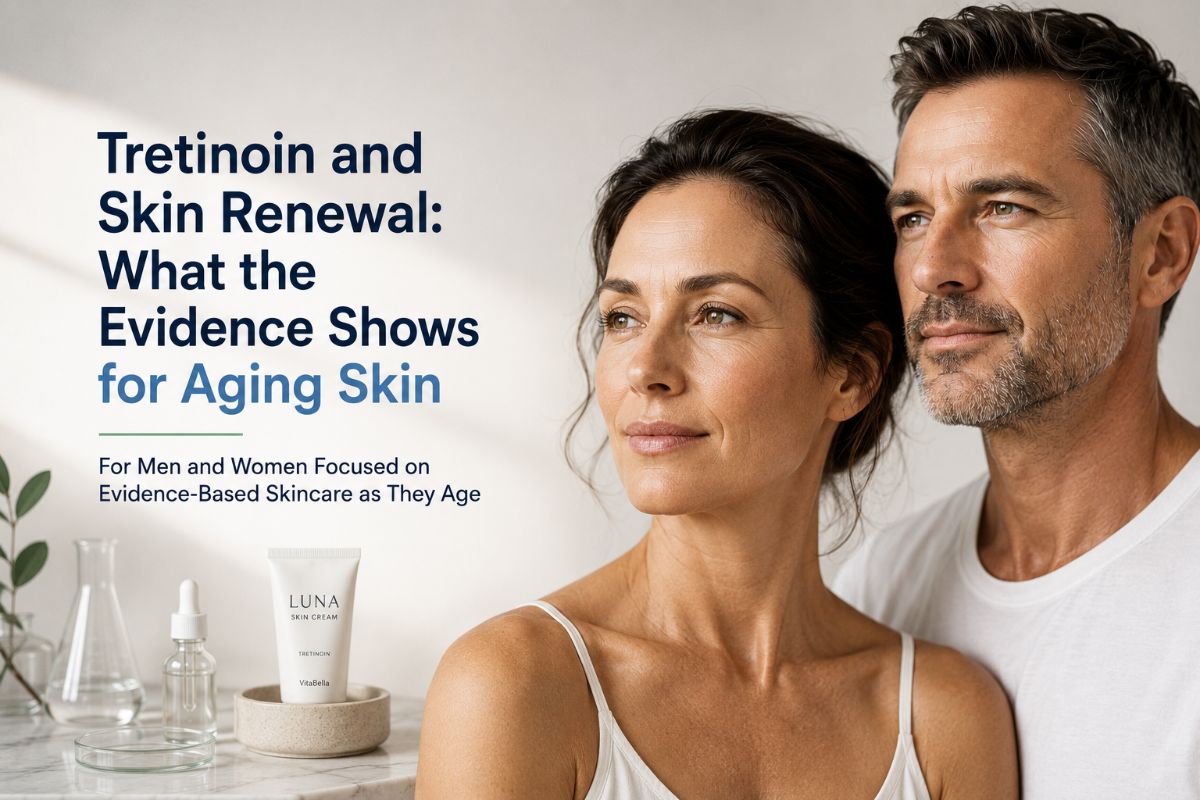
VitaBella’s Luna Skin Cream was formulated by a dermatologist and contains tretinoin as a core active ingredient. This provides access to a compounded formulation designed for both evidence-based strength and practical tolerability. Find out more about Luna Skin Cream at Vita Bella.
When hormonal patterns influence skin changes or when peptide options for repair and recovery are under consideration, coordinated guidance through Vita Bella can help integrate topical care with broader hormone or peptide protocols under professional supervision.
References
Weiss JS, Ellis CN, Headington JT, et al. Topical tretinoin improves photoaged skin. A double-blind vehicle-controlled study. JAMA. 1988;259(4):527-532. doi:10.1001/jama.1988.03720040019019.
Griffiths CE, Kang S, Ellis CN, et al. Two concentrations of topical tretinoin (retinoic acid) cause similar improvement of photoaging but different degrees of irritation. A double-blind, vehicle-controlled comparison of 0.1% and 0.025% tretinoin creams. Arch Dermatol. 1995;131(9):1037-1044.
Kang S, Fisher GJ, Voorhees JJ. Photoaging: pathogenesis, prevention, and treatment. Clin Geriatr Med. 2001;17(4):643-659.
Eichenfield LF, Krakowski AC, Piggott C, et al. Evidence-based recommendations for the diagnosis and treatment of pediatric acne. Pediatrics. 2013;131 Suppl 3:S163-S186.
Chien AL, Qi J, Rainer B, et al. Treatment of photoaged skin with topical tretinoin increases epidermal thickness and decreases matrix metalloproteinase expression. J Invest Dermatol. 2019;139(5):1081-1088. doi:10.1016/j.jid.2018.11.021.
Recent systematic reviews and mechanistic studies continue to position tretinoin as a first-line topical agent for acne and photoaging with reproducible RCT support for texture, pigmentation, and wrinkle outcomes.