
When does testosterone peak? In men, the lifetime high comes in late adolescence: a 2014 normative model by Kelsey et al. in PLoS One, built from 13 studies, places the average peak of total testosterone at about age 19. Each day, levels are also highest in the early morning, which is why the Endocrine Society guideline (Bhasin et al., 2018) recommends a fasting morning blood draw. Both timings matter to anyone evaluating their hormone levels, and they are why Vita Bella's hormone assessment program starts with morning labs reviewed by a licensed provider.
At what age does testosterone peak in men?
When does male testosterone peak? On average, at about age 19. The 2014 normative model by Kelsey et al. in PLoS One places the peak of total testosterone in late adolescence, with a wide range of normal values around that average.
Before that peak, testosterone climbs sharply through puberty, driven by the hypothalamic-pituitary-gonadal (HPG) axis. Peak testosterone age is a population average, not a personal date. In Kelsey's model, average total testosterone drifts lower between that late-teens peak and age 40.
Studies differ on how steep the later decline is. A 2024 review by Cheng et al. in Reproductive Biology and Endocrinology reports that serum testosterone in men begins to decline gradually from about age 35, and cites data showing total testosterone falling about 0.4% per year and free testosterone about 1.3% per year in men aged 40 to 70.
Kelsey's model, by contrast, finds no further fall in average total testosterone after age 40, only a wider spread between individual men. Asking "when does a man's testosterone peak?" gives useful context, but only properly timed labs show where an individual's levels stand.
The lifetime testosterone arc at a glance
Testosterone output rises quickly through the teenage years, reaches its highest average concentration in late adolescence, then drifts lower, with wider differences between individual men in later decades. The broad arc looks like this:
- Puberty: Testosterone surges dramatically, driving muscle development, bone growth, and secondary sex characteristics.
- Peak years (late teens): Average total testosterone reaches its lifetime high, at about age 19 in Kelsey's model. If you are asking "when do testosterone levels peak?", this is the window.
- Early adulthood to 30s: Average levels drift down from the peak, and Cheng et al. (2024) place the start of a gradual age-related decline at about age 35.
- 40s and 50s: Cheng et al. cite a continued gradual decline, with free testosterone falling faster than total testosterone. Sex hormone-binding globulin (SHBG) also tends to rise with age, which is one reason free testosterone can fall faster. Kelsey's model shows mainly a widening spread between individual men.
- 60 and beyond: Individual variation remains wide, and health history and lifestyle factors may shape where a given man's levels fall.
For decade-specific reference numbers, the testosterone levels by age chart from the Vita Bella education center provides a more granular breakdown than a brief overview can capture.
(Kelsey et al., 2014; Cheng et al., 2024)
Does testosterone peak at the same age for every man?
No. The age when men's testosterone peaks is not a fixed date on a shared timeline. Genetics influence the timing, as do body composition, chronic illness, and medications that affect the HPG axis.
A man carrying high visceral body fat may start his decline earlier because adipose tissue converts testosterone to estrogen via the enzyme aromatase. Someone with a favorable genetic profile may sustain elevated levels well into his 30s.
The population average answers "when does your testosterone peak?" only on a statistical basis. Your own timing may be earlier or later, which is why individual lab testing matters more than a generalized curve.
What time of day is testosterone highest?
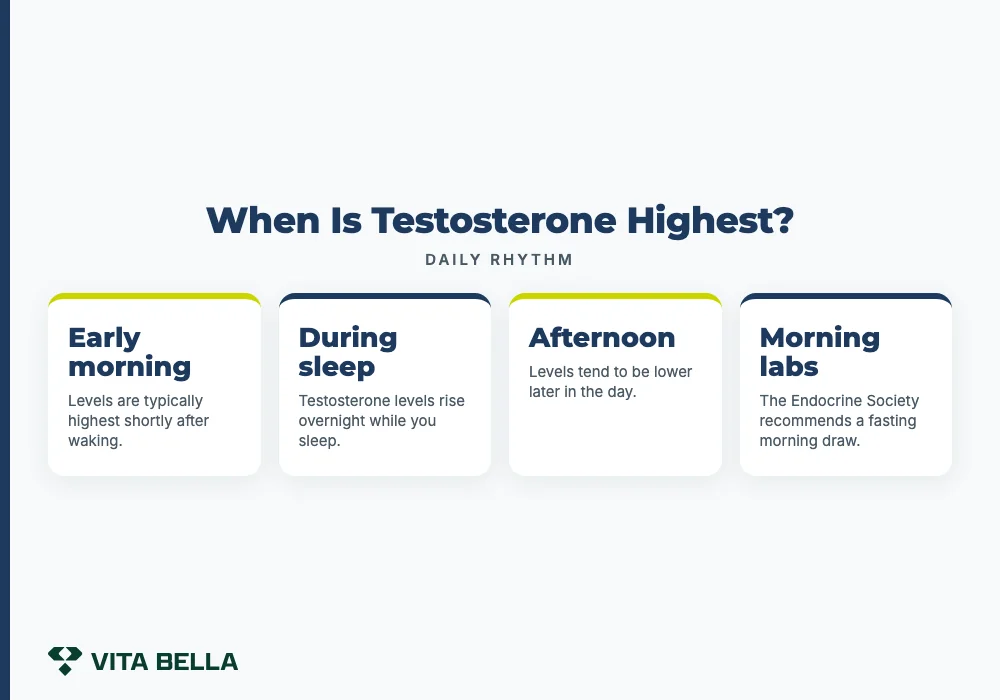
When is testosterone highest? In most men, in the early morning. Testosterone follows a daily rhythm: levels rise during overnight sleep and are typically highest shortly after waking. Later in the day, levels tend to be lower than the morning reading, which is why the 2018 Endocrine Society clinical practice guideline by Bhasin et al. recommends a morning measurement.
This daily swing matters clinically. A result drawn in the afternoon may not reflect a man's true baseline, which is why "what time of day is testosterone highest?" is a scheduling question as much as a biology one.
Why is testosterone highest in the morning?
The HPG axis follows the body's internal clock. The hypothalamus releases pulses of gonadotropin-releasing hormone (GnRH), which signal the pituitary to release luteinizing hormone (LH), which in turn prompts the testes to produce testosterone. Testosterone levels rise during sleep, which is why the early-morning concentration is typically the highest of the day.
Chronic sleep disruption may blunt this overnight rise. That link between sleep quality and testosterone is one reason providers ask about sleep during a hormone evaluation.
Why do providers order testosterone labs in the morning?
A blood draw later in the day may return a value that understates the true baseline, which can misguide clinical decisions. Both the Endocrine Society clinical practice guideline (Bhasin et al., 2018) and the American Urological Association guideline (Mulhall et al., 2018) recommend measuring testosterone in the morning and confirming a low result with a repeat test.
Timing is not the only variable. A few practical prep steps help the draw reflect your usual baseline:
- Arrive for the blood draw before 10 a.m., the timing Vita Bella's testing pathway uses.
- Follow your provider's fasting instructions; the Endocrine Society guideline recommends a fasting morning sample.
- Skip intense exercise right before the draw unless your provider advises otherwise.
- Stay well hydrated the night before and the morning of.
- Bring a current medication list so the provider can flag anything that might affect the result.
A note on testosterone in women
The figures above answer "when does testosterone peak?" for men only. Women produce testosterone too, at much lower concentrations than men, so women's results are read against female reference ranges. Testosterone in women contributes to libido, energy, mood, and bone health, and a provider interprets those results separately from men's.
Why injection peaks are a different question
For a man on injections, the answer to "when does testosterone peak?" is a separate clinical question from either the lifetime peak or the daily morning high. It depends on the ester used, the injection frequency, and individual metabolism rather than on age or the time of day, and a licensed provider determines the schedule after reviewing labs. For how injection timing shapes hormone concentrations across a protocol, see testosterone injection timing and frequency explained.
What can affect how high testosterone peaks?
Peak testosterone levels are shaped by genetics, but several modifiable factors may also affect where your levels fall over time. A provider typically reviews these factors as part of an initial hormone assessment:
- Sleep duration and quality: Testosterone rises during overnight sleep, so chronic sleep restriction may lower morning readings.
- Visceral body fat: Abdominal adipose tissue converts some testosterone to estrogen via aromatase, which may pull circulating levels lower.
- Exercise: Regular exercise, including strength training, may support testosterone levels; a 2024 review by Cheng et al. notes that exercise has been shown to improve testosterone levels, especially in older individuals.
- Dietary protein intake: A 2023 review by Whittaker in Nutrition and Health concluded that moderate and high protein intakes do not appear to lower testosterone, while only very high intakes appear to decrease it.
- Chronic stress load: Sustained stress and elevated cortisol may suppress HPG axis signaling; how chronic stress affects testosterone covers the mechanism.
None of these factors address age-related decline on their own. They may influence how quickly levels fall and how far they drop from the personal peak.
(Exercise: Cheng et al., 2024; protein: Whittaker, 2023)
After the peak: why labs decide
Changes in energy, libido, recovery, or body composition after the peak years are easy to blame on aging, overwork, or poor sleep, and they overlap with many other conditions. The answer to "when does testosterone peak" gives context, but labs settle the question, not a symptom count.
Heidelbaugh et al. (2024) in American Family Physician define testosterone deficiency as persistently low serum testosterone in the setting of symptoms consistent with deficiency, so both have to be present. The causes and early signs of that decline are covered in signs and causes of testosterone decline in men. If these changes sound familiar, Vita Bella's lab-first testosterone evaluation pathway connects you with a licensed provider who reviews morning labs before any protocol discussion begins.
(Heidelbaugh et al., 2024)
How lab testing confirms where your levels stand
Knowing when testosterone peaks in general is useful context. Knowing your specific number today is what drives clinical decisions. A morning blood draw through Quest Diagnostics, ordered by a licensed Vita Bella provider, gives you the actual data.
The provider decides which markers to order, and the Endocrine Society guideline starts with a fasting morning total testosterone. Vita Bella's essential panel covers total and free testosterone, estradiol, SHBG, and thyroid markers, read alongside your symptoms.
Labs are ordered and reviewed by the provider and billed separately from the membership fee. Results are then reviewed during a 45-minute initial provider consult that covers your numbers alongside your full health history. Whether a protocol is appropriate, and what form it takes, is the provider's determination based on that complete clinical picture.
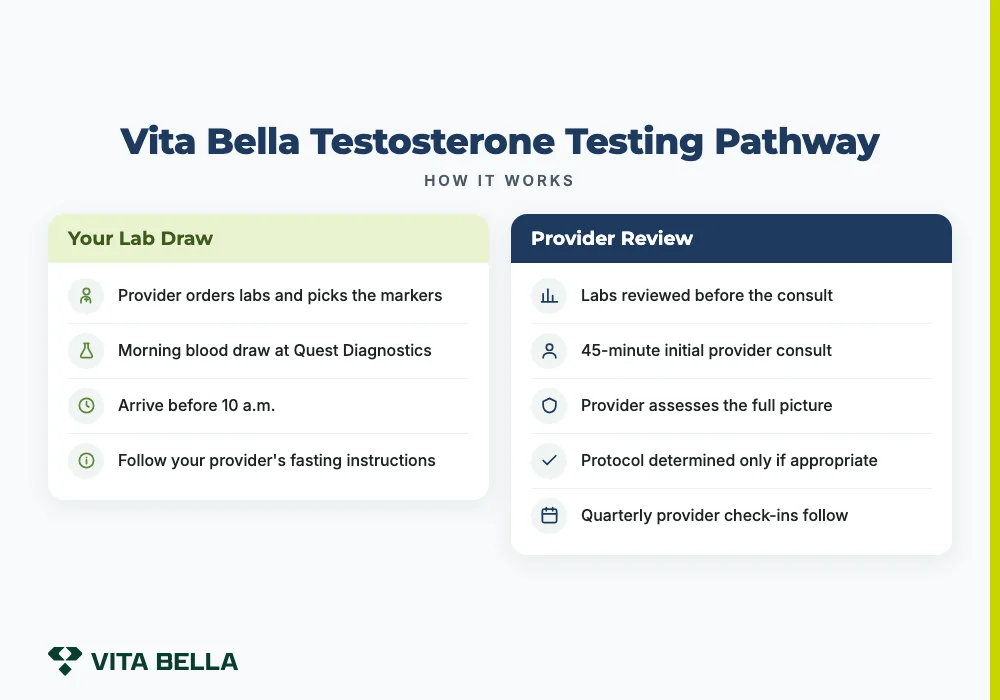
Here is what the Vita Bella testing pathway looks like in practice:
- The provider places the lab order and decides which markers to include.
- Schedule a morning blood draw at Quest Diagnostics, arriving before 10 a.m.
- Labs are reviewed before the consult so the 45-minute visit focuses on clinical context.
- The provider assesses the full picture: numbers, symptoms, health history, and lifestyle.
- If a protocol is appropriate, the provider determines the details after reviewing labs.
- Quarterly provider check-ins follow once a protocol begins.
For anyone whose lab results fall within a broad reference range but who still does not feel right, the difference between normal and optimal lab values explains how providers read results alongside symptoms and history.
(Bhasin et al., 2018; Heidelbaugh et al., 2024)
Ready to find out where your levels stand?
Knowing the answer to "when does testosterone peak?" gives you the full arc. Knowing your actual number today gives you something to act on. Vita Bella's provider-led testosterone program pairs a morning Quest Diagnostics draw with a 45-minute licensed provider review, so the clinical picture is complete before any protocol conversation begins. With the Performance Membership, you get quarterly provider check-ins, and members get wholesale pricing on medications, billed separately from the membership fee.
Frequently asked questions
Testosterone typically peaks in late adolescence, and a 2014 normative model by Kelsey et al. places the average peak of total testosterone at about age 19. Individual timing varies based on genetics, health history, and body composition. A 2024 review by Cheng et al. reports that levels begin to decline gradually from about age 35.
Testosterone follows a daily rhythm and is typically highest in the early morning. A later blood draw may read lower than a true baseline, which can affect clinical decisions. Both the Endocrine Society and AUA guidelines recommend morning testing, with a repeat test to confirm a low result.
No. The general pattern, a rise through puberty and a peak in late adolescence followed by gradual decline, holds broadly, but timing shifts with genetics, overall health, and medications. Some men maintain higher levels well into their 30s; others notice changes earlier.
Testosterone is generally highest in the early morning, after overnight sleep. Levels tend to fall through the day and are typically lower in the afternoon and evening.
Sleep quality, body composition, and physical activity are among the factors linked to testosterone levels in men. Chronic sleep deprivation and excess visceral fat are associated with lower levels. A provider reviews these factors as part of the full clinical picture before making any treatment recommendation.
Sources
- Whittaker J (2023). High-protein diets and testosterone. Nutrition and health. PubMed
- Bhasin S et al. (2018). Testosterone Therapy in Men With Hypogonadism: An Endocrine Society Clinical Practice Guideline. The Journal of clinical endocrinology and metabolism. PubMed
- Mulhall JP et al. (2018). Evaluation and Management of Testosterone Deficiency: AUA Guideline. The Journal of urology. PubMed
- Cheng H et al. (2024). Age-related testosterone decline: mechanisms and intervention strategies. Reproductive biology and endocrinology. PubMed
- Heidelbaugh JJ et al. (2024). Testosterone Replacement Therapy for Male Hypogonadism. American family physician. PubMed
- Kelsey TW et al. (2014). A validated age-related normative model for male total testosterone shows increasing variance but no decline after age 40 years. PLoS One. PubMed