



Lab testing helps to show how your body responds to treatment over time. Key biomarkers can detect changes before you notice symptoms. This allows your provider to make timely adjustments. Regular testing also helps track progress, improve results, and support a treatment plan that fits your needs.
At Vita Bella, we pair personalized peptide and hormone plans with regular lab testing. We track key markers such as IGF-1, hormone levels, inflammation markers, and metabolic health markers. These results help us follow your progress over time. They also help guide treatment changes when needed. Most importantly, this approach supports safer care and helps keep your treatment goals on track.
What Lab Markers Should You Track During Peptide and Hormone Therapy?
The right lab tests help show how your body responds to peptide and hormone therapy. They do more than measure progress. They also help your provider check your health throughout treatment. These tests can reveal small changes before symptoms appear. As a result, your provider can adjust your plan sooner and help you stay on track.
Each group of lab markers serves a different purpose. IGF-1 helps show how your body responds to therapies that affect growth hormone activity. Hormone tests measure levels such as testosterone, cortisol, estradiol, and thyroid hormones. Blood sugar tests- including glucose, insulin, and HbA1c, help track metabolic health. Inflammation tests such as c-reactive protein or sedimentation rate can show whether hidden inflammation may be inhibiting your results of therapy.
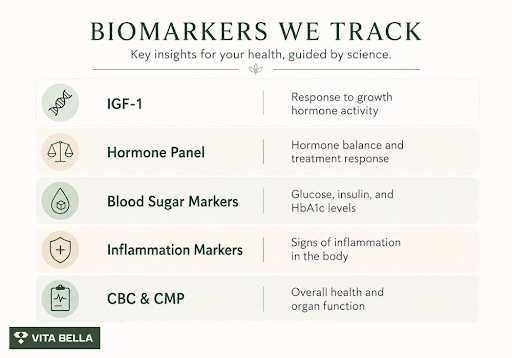
These markers work together to give a fuller view of your health. Looking at one test alone may not tell the whole story. However, reviewing several markers at the same time can help your provider spot patterns and make better decisions.
A 2024 review in Frontiers in Endocrinology [1] reported that IGF-1 remains the marker that best reflects growth hormone activity. Because IGF-1 levels remain more stable than growth hormone levels, they offer a clearer view of long-term treatment effects. A review of Endocrine Connections [2] reported that IGF-1 monitoring helps assess growth hormone status and provides a safety reference to help avoid overdosing during long-term therapy.
How Hormone Panels and Metabolic Markers Help Optimize Treatment Results
Hormone panels and metabolic markers help show how your body responds to treatment. These tests check hormone levels, blood sugar, and general health. This gives your provider useful information so they can adjust your plan when needed and help keep your treatment on track.
To get a clear view of your health, providers often check several lab markers during treatment:
Total and free testosterone helps show how your total and active hormones levels are changing with therapy.
Estradiol, progesterone, and DHEA-S help measure hormone balance and precursors.
Cortisol testing can show how your body handles stress and recovery.
Thyroid tests, such as TSH, Free T3, and Free T4, help track metabolic function.
Fasting glucose, fasting insulin, and HbA1c help measure blood sugar control.
A comprehensive metabolic panel (CMP) helps check liver health, kidney health, and electrolyte balances.
Each test provides a different piece of information. Looking at several markers at the same time can reveal trends that one test alone may miss. This helps your provider understand how your body is changing and whether your treatment plan is working as expected.
Research shows a close link between hormone health and blood sugar control. In the study in the Journal of Postgraduate Medicine [3], researchers found that testosterone therapy improved blood sugar handling, lowered body fat, and increased lean body mass. These findings show that changes in hormone levels can affect many areas of health. Therefore, checking both hormone and metabolic markers can provide a better view of your progress and body function.
Why Should Inflammatory Markers Be Included in Peptide Monitoring Programs?
Inflammatory markers are our body’s alarm system. They can reveal imbalances before symptoms arise and can cause issues preventing normal function. These bio-markers provide information about recovery, energy, heart health, and body function.
Common Tests That Measure Inflammation
Several lab tests help measure inflammation in the body. C-reactive protein (CRP) is one of the most common. High-sensitivity CRP (hs-CRP) can find lower levels of inflammation. Erythrocyte sedimentation rate (ESR) is another widely used test. Some providers also use cytokine panels. These tests can provide more details about immune activity and the body's response to stress and illness.
Why Inflammation Matters for Long-Term Health
Inflammation can affect many areas of health. It may influence recovery, energy levels, blood sugar control, and heart function. When inflammation lasts for a long time, it can make it harder for the body to work at its best.
Research shows that long-term inflammation can affect many body systems. Research in the International Journal of Molecular Sciences [4] found links between chronic inflammation and problems involving the heart, metabolism, kidneys, and immune system. These findings show how wide the effects of inflammation can be.
How Does Regular Lab Testing Improve Long-Term Peptide and Hormone Therapy Success?
Regular lab testing helps show how your body is responding to treatment and helps to build a clear picture of your health over time. Small changes in lab results can reveal important patterns. These patterns may not be obvious from symptoms alone. By reviewing results on a regular basis, providers can check your progress, review dosing, and watch for potential concerns. This helps support safer treatment and more stable results over the long term.
Research supports the value of regular testing during hormone therapy. The Journal of Clinical Endocrinology and Metabolism [5] recommends ongoing monitoring during treatment. The guideline advises providers to review symptoms, check for side effects, and measure key blood markers. These recommendations show that regular testing can help track progress, support safety, and guide treatment decisions throughout care.
Take Control of Your Progress With Expert-Guided Peptide and Hormone Monitoring
You may feel frustrated when your results do not match your expectations. Changes in energy, recovery, body composition, or body function can be difficult to interpret on your own. Without regular testing, it can be hard to know whether your treatment plan is working as intended or if important health markers are changing over time.
At Vita Bella, we help remove the guesswork from your treatment journey. We use personalized peptide and hormone protocols along with ongoing monitoring of key markers such as IGF-1, hormone panels, inflammatory markers, and metabolic health indicators. This approach helps us track your progress, support safer treatment decisions, and keep your plan aligned with your goals. Contact us today to learn how expert monitoring can support your long-term success.
Frequently asked questions
The right testing schedule depends on your treatment plan and health goals. Many providers order tests before treatment starts and repeat them during care. Regular testing helps track changes over time. It also gives your provider useful information. This helps ensure your treatment stays on the right path.
Baseline tests show where your health stands before treatment begins. They measure key markers such as hormone levels and blood sugar. Later results can then be compared with these starting values. This makes it easier to see changes over time. It also helps providers make better treatment decisions.
An out-of-range result does not always mean something is wrong. Many factors can affect lab values. Your provider will review the result along with your symptoms and health history. They may order more tests or adjust your plan. The goal is to understand the cause and decide on the next step.
No. Symptoms tell only part of the story. Some health changes may not cause clear symptoms at first. Hormone levels, blood sugar, and inflammation can change quietly. Lab tests provide clear data about what is happening inside your body. Together, symptoms and lab results give a better picture of your health.
One test shows what is happening on a single day. A series of tests shows how your body changes over time. These patterns can reveal progress or new concerns. They can also help your provider decide if treatment changes are needed. This makes long-term monitoring more useful than one test alone.