



What if a small peptide could unlock your body’s full energy potential? The MOTS-c peptide, a mitochondrial signal, plays a crucial role in optimizing metabolism and driving peak cellular performance. Mitochondria are known for powering our cells, but their role in regulating cellular performance goes beyond energy production. MOTS-c peptide, a mitochondrial-derived molecule, can optimize glucose metabolism, enhance energy utilization, and maintain metabolic balance.
Maintaining optimal energy levels and metabolic balance is essential for overall well-being. The key to unlocking this balance may lie in a mitochondrial-derived peptide called MOTS-c. At Vita Bella, we integrate advanced metabolic solutions, focusing on restoring mitochondrial efficiency and promoting sustained cellular performance. Learn how the MOTS-c peptide can help your body harness energy more effectively
What Exactly Is MOTS‑c and Why Does It Matter?
MOTS‑c is a small but mighty peptide produced in the mitochondria, crucial for regulating how cells generate and use energy. Human studies1 highlight its influence on metabolic functions, insulin sensitivity, and overall cellular performance, making it an essential molecule for energy efficiency and metabolic health. It also increases glucose clearance, lactate levels in culture media, and intracellular glucose levels.
It has also been shown in human research2 that circulating MOTS-c levels are associated with metabolic markers such as insulin sensitivity, glucose regulation, and muscle function, pointing to its significant role in optimizing energy balance and weight regulation. In individuals with metabolic disorders like obesity or diabetes, MOTS-c levels tend to be lower, suggesting a potential therapeutic role for this peptide in improving metabolic health.
How Can MOTS-c Unlock the Path to Peak Cellular Energy?
MOTS-c plays a key role in enhancing this process by improving glucose uptake and boosting mitochondrial efficiency. Efficient cellular energy production is essential for maintaining good health. As a result, it helps to keep the body energized and metabolically balanced.
According to Study3, activated MOTS-c primarily targets the Folate-AICAR-AMPK pathway, which is crucial in regulating several vital functions, including energy metabolism and improved insulin sensitivity. And activation of brown adipose tissue and enhanced exercise performance.
How Can MOTS-c Boost Energy Metabolism and Enhance Performance?
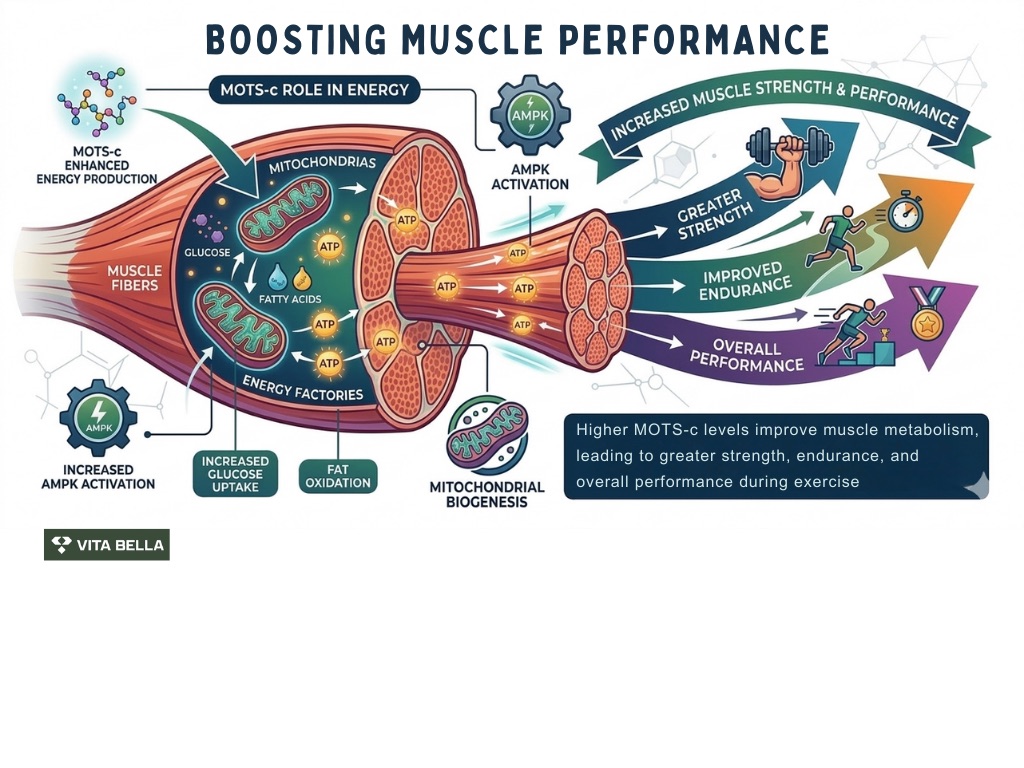
Glucose metabolism is central to energy production, and MOTS-c plays a crucial role in regulating glucose uptake into muscle cells. This ensures efficient energy use and supports physical performance. Research4 shows that MOTS-c significantly enhances physical performance, regulates skeletal muscle metabolism, and improves the body’s ability to adapt to metabolic stress. Moreover, exercise has been found to stimulate the expression of mitochondrial-encoded regulatory peptides, including MOTS-c, which further supports metabolic adaptation.
Such actions make MOTS-c an essential player in optimizing cellular energy use and overall metabolic function, supporting both long-term health and physical performance. By enhancing glucose utilization and improving mitochondrial efficiency, MOTS-c helps the body respond better to metabolic stress. Its influence on insulin sensitivity and fat metabolism also contributes to weight management and enhanced performance during physical activity, making it a valuable factor for both athletic performance and general health.
How MOTS‑c Influences Metabolic Flexibility for Peak Performance?
Metabolic flexibility allows the body to switch between energy sources effectively. MOTS‑c supports this ability, helping cells adapt to increased metabolic demands, whether during exercise or rest. This makes it a key player in sustaining energy levels and supporting peak performance. MOTS-c expression levels increase in skeletal muscles, systemic circulation, and the hypothalamus upon exercise.
Research5 shows that systemic MOTS-c administration increases exercise performance by boosting skeletal muscle stress responses and by enhancing metabolic adaptation to exercise. Exogenous MOTS-c also stimulates thermogenesis in subcutaneous white adipose tissues, thereby enhancing energy expenditure and contributing to the anti-obesity effects of exercise training. In addition to skeletal muscle, exercise training causes beneficial adaptations to multiple organs, including adipose tissues.
How MOTS‑c Boosts Muscle Metabolism and Performance?
Muscle tissue is a primary site for glucose metabolism. Higher MOTS‑c levels are linked with improved muscle performance, strength, and energy efficiency, supporting not only physical activity but also overall metabolic health. According to research6, a higher MOTS-c concentration was also positively correlated with muscle mass and BMI, but not with FAT%. MOTS-c concentrations were positively correlated with both muscle mass and muscle strength/power indices.
Power Up Your Day with MOTS-c's Lasting Fuel for Peak Performance by Vita Bella
Persistent fatigue and metabolic imbalance can be frustrating, even with a healthy diet and regular exercise. The real issue may be rooted in mitochondrial dysfunction and disrupted metabolic pathways. These inefficiencies can prevent the body from using energy optimally, leading to low stamina and poor physical performance. Without addressing these underlying issues, traditional methods often fail to produce lasting results.
Vita Bella provides cutting-edge solutions with MOTS-c peptide, focusing on mitochondrial efficiency and metabolic optimization. Through tailored programs, we help you restore energy balance and achieve sustained peak performance. Begin your transformation with Vita Bella’s expert care today. Begin your transformation with Vita Bella’s expert care today.
Frequently asked questions
Yes, MOTS-c peptide helps optimize the body’s ability to process glucose and produce energy. It enhances mitochondrial function, which plays a key role in cellular energy production. By improving energy efficiency and metabolic balance, MOTS-c supports the body’s ability to perform at its peak, leading to better overall metabolic performance.
Yes, MOTS-c regulates glucose metabolism and insulin sensitivity, both of which are crucial for weight management. By improving how the body processes nutrients and balances energy, MOTS-c helps control weight more effectively. Its influence on metabolic pathways makes it a key player in maintaining a stable metabolic rate and healthy weight.
Yes, MOTS-c plays a significant role in muscle metabolism by enhancing glucose uptake and energy production in muscle cells. This peptide helps increase muscle strength and endurance, improving overall muscle performance. By supporting efficient energy utilization, MOTS-c contributes to better muscle function during physical activity and exercise.
Yes, MOTS-c levels are often lower in individuals with metabolic disorders such as obesity and type 2 diabetes. This peptide can serve as a valuable biomarker to assess metabolic health, providing insights into how well the body is managing energy. Its levels can help identify metabolic imbalances and the risk for metabolic diseases.
References:
Mohtashami, Z., Singh, M. K., Salimiaghdam, N., Ozgul, M., & Kenney, M. C. (2022). MOTS‑c, the most recent mitochondrial‑derived peptide in human aging and age‑related diseases. International Journal of Molecular Sciences, 23(19), 11991. https://doi.org/10.3390/ijms231911991
Du, C., Zhang, C., Wu, W., Liang, Y., Wang, A., Wu, S., Zhao, Y., Hou, L., Ning, Q., & Luo, X. (2018). Circulating MOTS‑c levels are decreased in obese male children and adolescents and associated with insulin resistance. Pediatric Diabetes, 19(5), 755–763. https://doi.org/10.1111/pedi.12685
Wan, W., Li, Y., Zhang, L., Rong, X., & Wang, J. (2023). Mitochondria‑derived peptide MOTS‑c: Effects and mechanisms related to stress, metabolism, and aging. Journal of Translational Medicine, 21(1), 36. https://doi.org/10.1186/s12967‑023‑03885‑2
Reynolds, J. C., Lai, R. W., Woodhead, J. S. T., Joly, J. H., Mitchell, C. J., Cameron‑Smith, D., Lu, R., Cohen, P., Graham, N. A., Benayoun, B. A., Merry, T. L., & Lee, C. (2021). MOTS‑c is an exercise‑induced mitochondrial‑encoded regulator of age‑dependent physical decline and muscle homeostasis. Nature Communications, 12, 470. https://doi.org/10.1038/s41467‑020‑20790‑0
Yoon, T. K., & Lee, C. H. (2022). Exercise, mitohormesis, and mitochondrial ORF of the 12S rRNA type‑C (MOTS‑c). Journal of Exercise & Nutrition/Biochemistry, 26(2), 67–76. [Note: Journal details adapted based on PMC entry—confirm exact journal name and volume from the PDF if available]. https://www.ncbi.nlm.nih.gov/pmc/articles/PMC9171157/
Domin, R., Pytka, M., Żołyński, M., Niziński, J., Ruciński, M., Guzik, P., Zieliński, J., & Ruchała, M. (2023). MOTS‑c serum concentration positively correlates with lower‑body muscle strength and is not related to maximal oxygen uptake — a preliminary study. International Journal of Molecular Sciences, 24(19), 14951. https://doi.org/10.3390/ijms241914951