










Imagine healing faster, recovering stronger, and feeling better than ever. Pentadeca-Arginate (PDA) is a revolutionary peptide that accelerates recovery, derived from the same 15 amino acids as BPC 157, but with an enhanced arginate salt for greater stability. The improved PDA dosage offers more consistent and effective therapeutic results. This advanced formulation ensures reliable PDA dosage throughout your treatment cycle, optimising recovery and performance.
Therefore, you must approach the subject carefully, focusing on mechanistic evidence, delivery form, and safety rather than relying on fixed milligram numbers. Your recovery deserves precision, not guesswork. Vita Bella’s Pentadeca Arginate (PDA) dosage insights combine science and safety to help you heal smarter. Learn how the right amount can optimise repair, energy, and performance from the inside out.
Why Does Dosage Matter for Peptides and PDA?
The amount you take matters because peptides like PDA 2 depend heavily on their route of administration, formulation stability, absorption, and tissue distribution. Injections are used to deliver a significant amount of authorised peptides, many at weekly dosages of 1 mg or less.
The cost of argument is untenable for the majority of candidates that may be evaluated for conversion to the oral route, assuming oral bioavailability of around 1% with current FDA-approved formulations in comparison to injections of the same peptide.
What Do the Preclinical and Formulation Science Tell Us?
Preclinical studies 1 reveal that PDA-related peptides (such as BPC-157) show effects, especially in tissues with limited vascularisation, such as tendons and myotendinous junctions, encourage angiogenesis, fibroblast activity, and neuromuscular stability. Despite strong preclinical evidence, there is very little human data available.
Human usage of BPC-157 for intra-articular knee pain, interstitial cystitis, and intravenous safety/pharmacokinetics has only been investigated in three pilot trials. Moreover, drug-delivery research 3 shows that the oral route for peptides faces significant barriers: enzymatic breakdown, poor permeability, and first-pass metabolism, all of which demand higher or specially formulated doses to achieve the desired effect.
What would be the estimated dosage for PDA?
Research 4 shows that if oral bioavailability is ~1% compared to injection, then an oral dose would need to be significantly higher to match systemic exposure. Some protocols suggest starting with 200–250 mcg daily, increasing to 300–500 mcg daily for more significant injuries, administered via subcutaneous or intramuscular injections.
Study 1 shows that after linear pharmacokinetics, BPC-157 was shown to have a half-life of less than 30 minutes following the administration of a single and repeated intramuscular and intravenous dosage. Using high-resolution liquid chromatography mass spectrometry, the study also explains that BPC-157 metabolites were stable and detectable in urine for four days, with a limit of detection of 0.1 ng/mL. If using PDA experimentally:
The injection route might require lower milligram or microgram doses because of higher direct exposure and potency.
The oral route may need a higher dosage or an advanced formulation and should be viewed as ‘maintenance’ rather than acute repair.
What are the formulation and timing considerations for PDA?
The effectiveness of Pentadeca Arginate (PDA) depends significantly on its formulation and dosing schedule. Advanced delivery methods, such as enteric-coated oral capsules or sterile injectable solutions, help improve stability and absorption. Timing doses around physical activity or recovery phases enhances peptide utilisation, supporting faster healing and muscle repair.
When discussing dosage, formulation and timing matter just as much as the number:
Study 5 shows that oral capsules may need enteric coatings, permeation enhancers, or lipid carriers to optimize absorption; without these, the expected effect may be minimal.
Injection routes benefit from strict sterile technique, site rotation, and consistent scheduling (e.g., every other day) to maintain tissue exposure.
Because PDA (and analogs) likely target angiogenesis and endothelial repair, timing relative to physical therapy or recovery phases can enhance the effect.
What are the safety dosages and monitoring for PDA?
While exact human dosages for Pentadeca Arginate (PDA) are not yet established, safety reviews of related peptides like BPC-157 show favorable tolerance at controlled doses. Users should start conservatively, monitor for local or systemic reactions, and always use medically supervised protocols to ensure optimal results and safety.
Start at the lowest feasible dose, especially with injection.
Monitor for local injection reactions, systemic symptoms, or unexpected responses.
Use in conjunction with physical rehabilitation, nutrition, and lifestyle support, not as a standalone “magic dose”.
How to Decide Your Route and Range for PDA?
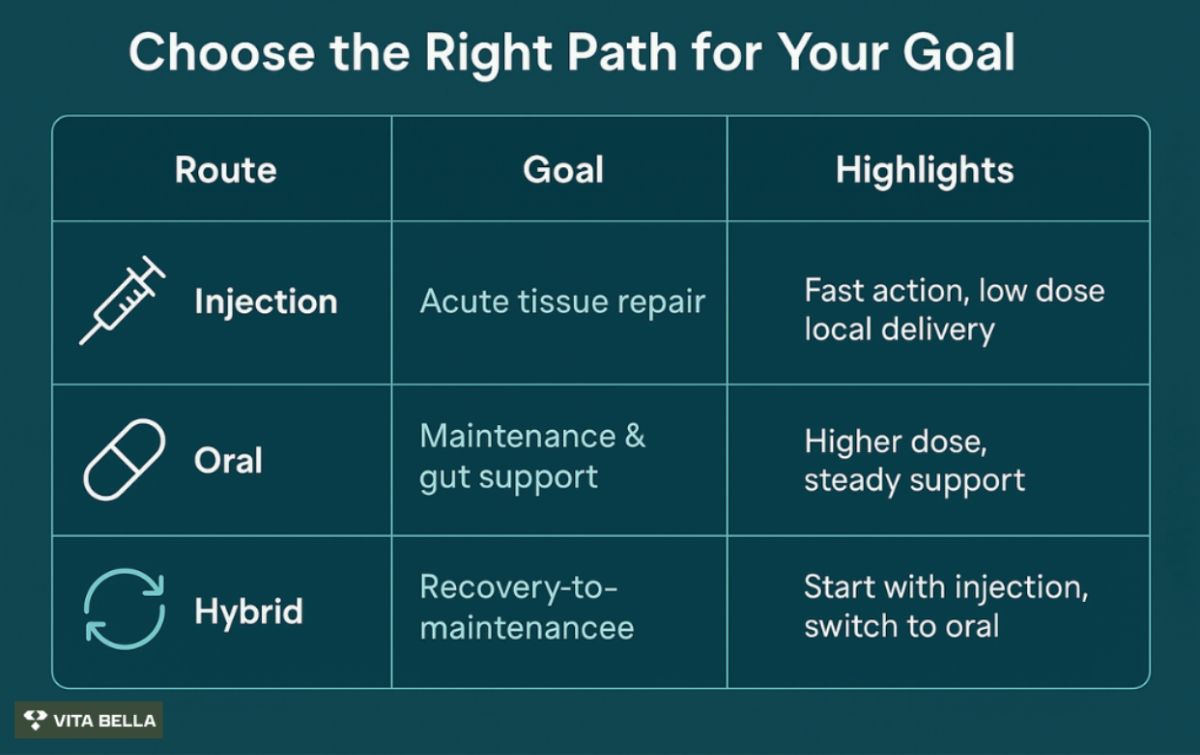
Choosing the correct route for Pentadeca Arginate (PDA) depends on your recovery goals. Injections offer faster, targeted results ideal for acute injuries, while oral forms provide convenient, steady support for long-term maintenance.
Goal: Acute tissue repair (e.g., tendon injury, post-surgery). Choose the injection route for lower dose, higher exposure, faster effect.
Goal: Long-term maintenance (joint health, gut barrier support). Choose the oral route for higher doses or enhanced formulation, and more convenience.
Hybrid approach: Use injection during the acute phase, switch to oral for maintenance.
Stop Guessing, Start Optimising Dosage with Vita Bella
Finding the correct dosage can feel overwhelming: too little, and results are slow; too much, and progress feels uncertain. With Vita Bella’s Pentadeca Arginate (PDA), every dose is guided by science and crafted for your body’s natural rhythm so you recover smarter, stronger, and faster.
Experience precision in every drop as your body restores balance, strength, and energy from within. With Vita Bella’s Pentadeca Arginate (PDA), dosing becomes more than a routine; it becomes your personalised path to sustainable healing and peak performance.
FAQs
Is there a standard recommended dosage for Pentadeca Arginate (PDA)?
No, currently, there isn’t an officially established dosage for PDA in human studies; however, preclinical and formulation research guide absorption, stability, and safe ranges. Until human clinical data are published, users should follow expert recommendations and prioritize professionally supervised dosing.
Can taking too much PDA reduce its effectiveness?
Yes, like most bioactive peptides, exceeding an optimal range can overwhelm receptor pathways, reducing the body’s natural response. Controlled, consistent dosing supports cellular repair and balance more effectively. It’s best to follow evidence-informed, physician-guided protocols rather than increasing doses for faster results.
Does the dosage differ between oral and injectable PDA?
Yes, oral forms face digestive enzyme breakdown, resulting in lower absorption, while injections deliver higher bioavailability and faster action. Because of this, oral PDA generally requires higher doses or advanced formulations. Each route has unique dosage strategies tailored to its delivery efficiency.
Should PDA be taken daily for the best results?
Yes, consistency matters more than quantity. Regular dosing allows peptide levels to stabilise in the body, supporting ongoing tissue recovery and repair. Whether taken daily or on alternating schedules, following a structured plan helps optimize absorption, muscle regeneration, and long-term benefits.
References:
Vasireddi, N., Hahamyan, H. A., Salata, M. J., Karns, M., Calcei, J. G., Voos, J. E., & Apostolakos, J. M. (2025). Emerging use of BPC-157 in orthopaedic sports medicine: A systematic review. HSS Journal. https://doi.org/10.1177/15563316251355551
Brayden, D. J. (2023, March 1). An update on oral administration of peptides to achieve systemic delivery. American Pharmaceutical Review. Retrieved from https://www.americanpharmaceuticalreview.com/Featured-Articles/595225-An-Update-on-Oral-Administration-of-Peptides-to-Achieve-Systemic-Delivery
Nicze, M., Borówka, M., Dec, A., Niemiec, A., Bułdak, Ł., & Okopień, B. (2024). The current and promising oral delivery methods for protein- and peptide-based drugs. International Journal of Molecular Sciences, 25(2), 815. https://doi.org/10.3390/ijms25020815
Brayden, D. J., Hill, T. A., Fairlie, D. P., Maher, S., & Mrsny, R. J. (2020). Systemic delivery of peptides by the oral route: Formulation and medicinal chemistry approaches. Advanced Drug Delivery Reviews, 157, 2–36. https://doi.org/10.1016/j.addr.2020.05.007
Patil, S., Gupta, K., Pandit, A., Desai, B., Gschliesser, S., Dandekar, P., & Jain, R. (2021). Oral delivery of peptide formulations and their cellular evaluation. International Journal of Peptide Research and Therapeutics, 27(4), 2831–2844. https://doi.org/10.1007/s10989-021-10293-x
QUICK SUMMARY:
Here are the key points about Pentadeca Arginate (PDA) dosage, keeping it casual:
PDA is the upgraded version of BPC 157: It's a "revolutionary peptide" for speeding up recovery, with better stability thanks to an enhanced arginate salt.
Don't just focus on the number (mg/mcg): When figuring out your dose, you need to look at how it works, how you take it (injection vs. oral), and safety, not just a fixed number.
Dose is super important for peptides: How much you take matters because it affects how well the peptide gets absorbed and where it goes in your body.
Science is limited right now: While early studies on similar peptides (like BPC-157) show it helps heal tissues like tendons and muscles, there's very little data on human PDA dosage.
Oral vs. Injection Dosing is Different:
Injections give you way more bang for your buck (higher bioavailability), so you need a much smaller dose.
Oral forms have a tough journey through your gut (enzymes break it down), so absorption is low (maybe only 1%). This means you need a much higher dose or a special formula (like enteric-coated capsules).
Estimated Injection Doses (based on similar protocols): Start with 200–250 mcg daily, and maybe bump it up to 300–500 mcg daily for bigger injuries (via subcutaneous or intramuscular injection).
Oral is more for "maintenance": Think of the oral route as a way to keep things steady, not for fast, acute repair.
Formulation and Timing are Key:
Advanced delivery methods (like special capsules or sterile injectables) are crucial for it to work.
Timing your dose around exercise or recovery can boost the effect.
Play it Safe: No official human dosage exists yet. Start with the lowest possible dose, especially with injections. Keep an eye out for any bad reactions. Always use it with good nutrition and physical therapy, not as a shortcut.
Pick Your Route Based on Your Goal:
Acute Injury/Post-Surgery: Go for the injection (faster, more targeted results).
Long-term Maintenance (e.g., gut health): Go for the oral route (easier, steady support).
Hybrid: Inject when you're hurt, then switch to oral for long-term health.
Consistency is Better Than Quantity: Taking PDA regularly helps stabilize the peptide in your body, which supports ongoing healing better than taking a huge dose once in a while.