










If your drive is fading and mental clarity feels out of reach, the issue may not be psychological it may be hormonal. Testosterone is often thought of only as the “male hormone,” but in reality, it acts as a powerful neuromodulator impacting mood, drive, cognition, and resilience. Emerging evidence links low testosterone to depression, anxiety, diminished motivation, and reduced mental clarity in men.
Feeling mentally drained, unmotivated, or not quite like yourself lately? These could be signs of more than just stress; they may signal a hormonal imbalance. At Vita Bella, we understand how testosterone impacts not only your body but also your mind and motivation. Through science-backed, personalized testosterone therapy, we help men restore balance, rebuild confidence, and rediscover their drive for life.
What is the Brain-Hormone Connection?
Testosterone functions as a neuroactive steroid, modulating neurotransmitter systems including GABA, serotonin, and dopamine, and supporting neuroplasticity. In this capacity, testosterone helps regulate mood, reward signaling, stress response, and cognitive flexibility.
According to research 1, when testosterone declines, these systems can be impaired, leading to reduced dopaminergic drive, altered mood regulation, and weakened cognitive resilience. In short, drops in testosterone may “unplug” key pathways that sustain motivation and mental stability.
Understanding this hormone–mind connection is crucial. In men with clinically low testosterone, restoring hormonal balance can improve not just physical health, but mental wellness and purpose.
What is the evidence Linking Low Testosterone to Depression and Mood Disorders?
Cross-sectional and longitudinal human studies 2 show that men with lower testosterone levels more often report depressive symptoms, low mood, and fatigue. For example, a JAMA Psychiatry meta-analysis of 27 randomized, placebo-controlled trials demonstrated that testosterone treatment significantly reduced depressive symptoms especially in hypogonadal men receiving higher doses.
More recently, in the TRAVERSE trial 3, hypogonadal men treated with testosterone reported modest but statistically significant improvements in mood and energy compared to placebo (though effects on cognition and sleep were less clear). These data suggest that addressing low testosterone can yield real mood benefits in men who carry both hormonal deficiency and mood symptoms.
What is the relationship of Testosterone with Motivation, Drive and Cognitive Effects?
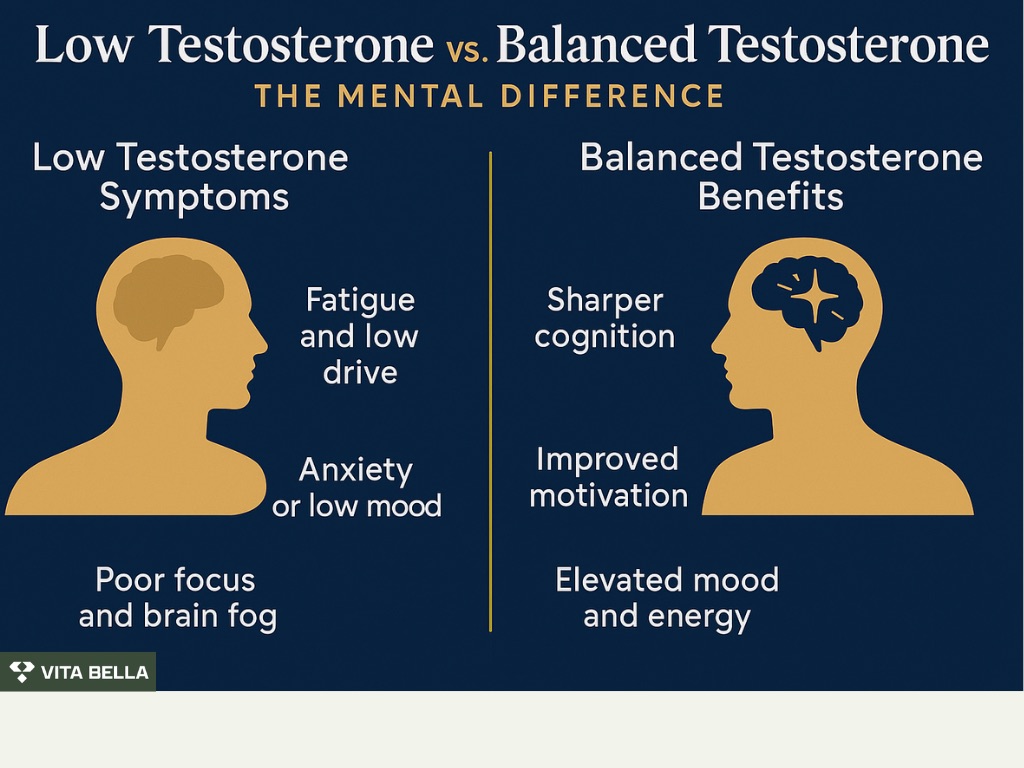
Men with low testosterone often describe a creeping lack of drive, fatigue, “brain fog,” and low intrinsic motivation to pursue tasks. These symptoms lie in the interface between endocrine and psychiatric domains.
In clinical settings 2, testosterone therapy has been associated with enhanced mental clarity, elevated motivation, and reduced depressive symptoms in men with documented deficiencies. Indeed, some of the strongest mood gains occur not in severely depressed men, but in those whose mood lies in the subclinical-to-moderate spectrum. Thus, for men over 35, restoring testosterone may help reignite both thought and action.
Who’s at Risk of Low Testosterone and Mental Health?
Men in mid-life, particularly those with obesity, insulin resistance, metabolic syndrome, or sedentary lifestyles, are more likely to experience low testosterone accompanied by mood complaints. Low testosterone often goes undetected because many men and even clinicians fail to link emotional symptoms with hormonal status.
Interestingly, some research 4 evidence suggests men with atypical depression (e.g. mood reactivity, weight gain, low energy) may more often exhibit lower testosterone than those with melancholic depression. In that pattern, mood problems may partly arise from endocrine imbalance rather than conventional psychiatric causes.
Does Testosterone Therapy Improve Mood & Motivation?
Clinical trial data 3 support that TRT leads to measurable improvements in mood and energy among men with low testosterone. In the TRAVERSE trial, for example, testosterone therapy vs placebo gave modest but statistically significant gains in mood and energy domains over 6–24 months.
However, results vary. Some men manifest larger gains in motivation than in sleep, cognition, or mood; others see only subtle mood benefits. Therefore, TRT should be treated as one leg of a holistic approach, complementing psychotherapy, exercise, and stress management rather than replacing them.
Are There Any Safety Concerns with Low Testosterone Treatment?
Though mood benefit is promising, psychiatric side effects are possible, especially in men with unstable mood disorders or bipolar tendencies. Some case reports 5 link testosterone use to mood destabilization or irritability, though large-scale data remain limited.
That’s why psychological screening, mood history evaluation, and ongoing mental health monitoring must accompany any TRT protocol. Clinicians should regularly check hormones, hematocrit, estradiol, and mental health scales to gauge both efficacy and safety, adjusting course as needed.
What are the Strategies to Support Mental Health Alongside Testosterone?
Supporting mental health alongside testosterone therapy involves more than just restoring hormone levels. Regular exercise, quality sleep, balanced nutrition, and stress management all enhance mood and motivation.
Lifestyle supports: Resistance exercise, restful sleep (7–9 hours), social connection, and stress reduction techniques amplify mood and hormonal balance.
Nutrition & micronutrients: Adequate vitamin D, omega-3s, magnesium, and zinc support neural health and hormonal function.
Psychotherapy or counseling: For low mood or motivation, talk therapy or cognitive-behavioral techniques help rewire thought patterns and behavioral activation.
Integrated care model: Combining TRT with behavioral supports creates synergy, hormonal restoration unlocks energy, while therapy and actions anchor mood gains.
Transform Your Mind with Vita Bella - Unstoppable Strength Guaranteed
Feeling stressed, unfocused, or emotionally flat isn’t just part of aging; it’s a sign your hormones may be out of sync. Vita Bella’s tailored TRT programs are designed to restore optimal testosterone levels, helping you think clearly, feel stronger, and stay motivated every day.
With personalized medical care, advanced diagnostics, and ongoing support, we help you take back control of your mood, focus, and confidence. It’s not just about balancing hormones; it’s about rediscovering your drive, purpose, and mental clarity. Start your transformation with Vita Bella and experience what it truly means to feel like yourself again.
FAQs
Can low testosterone really affect mental health and motivation?
Yes, research shows that testosterone directly influences neurotransmitters such as dopamine and serotonin, which regulate motivation, mood, and focus. When levels drop, men often experience low energy, reduced drive, and depressive symptoms issues that can improve significantly once testosterone balance is restored under medical supervision.
Does testosterone replacement therapy (TRT) improve mood and mental clarity?
Yes, multiple human studies demonstrate that TRT enhances mood, energy, and cognitive performance in men with low testosterone. While results vary, many report reduced anxiety, sharper focus, and increased motivation after several months of treatment when therapy is properly monitored by a qualified physician.
Is testosterone therapy safe for mental health when prescribed by a doctor?
Yes, when prescribed responsibly, TRT is both safe and effective for improving mood and mental health. Regular medical monitoring ensures hormone levels remain within healthy ranges, preventing complications and promoting emotional stability while enhancing mental drive and overall energy in men over 35.
Can lifestyle changes help support mental health along with testosterone therapy?
Yes, Lifestyle habits like strength training, balanced nutrition, proper sleep, and stress management naturally support both testosterone levels and brain health. When combined with TRT, these strategies create a powerful foundation for lasting motivation, mental clarity, and emotional balance.
References:
Walther, A., & Ehlert, U. (2022). The antidepressant effect of testosterone: An effect of neuroplasticity? World Journal of Biological Psychiatry, 23(7), 497–512. https://doi.org/10.1080/15622975.2021.1907712
Walther, A., Breidenstein, J., & Miller, R. (2019). Association of testosterone treatment with alleviation of depressive symptoms in men: A systematic review and meta-analysis. JAMA Psychiatry, 76(1), 31–40. https://doi.org/10.1001/jamapsychiatry.2018.2734
Bhasin, S., Cunningham, G. R., Hay, C. J., Khera, M., Matsumoto, A. M., Snyder, P. J., & Ellenberg, S. S. (2024). Depressive syndromes in men with hypogonadism in the TRAVERSE trial: Response to testosterone-replacement therapy. The Journal of Clinical Endocrinology & Metabolism, 109(4), 1091–1102. https://doi.org/10.1210/clinem/dgae017
Jensen, K. H. R., Paulson, M., Gregersen, M., Jessen, G., Miskowiak, K. W., & Köhler-Forsberg, O. (2024). Psychoneuroendocrine profiles of unmedicated men with major depressive disorder and associations to treatment effects and sexual side-effects. Psychoneuroendocrinology, 163, 106324. https://doi.org/10.1016/j.psyneuen.2024.106324
Nackeeran, S., Huynh, L. M., Ramasamy, R., & Ramasamy, S. N. (2022). Testosterone therapy is associated with depression, intentional self-harm, and suicidality: Analysis of a national federated database. European Urology Open Science, 42, 59–66. https://doi.org/10.1016/j.euros.2022.07.010
QUICK SUMMARY:
It's Not Just Psychological: If you're feeling drained, unmotivated, or foggy, the issue might be your hormones, specifically low testosterone (Low T).
Testosterone is a Brain Modulator: Think of T as a powerful player in your brain, messing with mood, drive, focus, and how you handle stress. It directly affects key brain chemicals like dopamine and serotonin.
The Low T Slump: When T drops, it can "unplug" the pathways that keep you motivated and mentally stable. This leads to symptoms like low drive, fatigue, "brain fog," and general low mood or depressive symptoms.
Evidence Backs It Up: Studies show that men with lower T often report feeling more depressed and tired.
TRT Helps: For guys with clinically low T, Testosterone Replacement Therapy (TRT) has been shown to improve mood, energy, and mental clarity. You might feel more focused and motivated!
Heads up: The mood gains are often strongest for guys who aren't severely depressed but are just feeling "off."
Who's at Risk? Middle-aged men, especially if you have obesity, insulin resistance, or a couch-potato lifestyle, are more likely to have this hormonal-mood link.
Safety First: While TRT can boost your mood, it's not without risk. Some guys with unstable mood disorders might feel more irritable or have mood swings. Always get checked out and monitored by a doctor!
It's a Team Effort: TRT isn't a magic bullet. For the best results, you need to pair it with a healthy lifestyle:
Move Your Body: Resistance exercise is key.
Sleep Well: Aim for 7–9 hours.
Eat Smart: Get enough Vitamin D, omega-3s, magnesium, and zinc.
Talk It Out: Counseling or therapy can help anchor your mood gains.
Where does Vita Bella come in?: The folks at Vita Bella offer personalized TRT programs to help restore your T levels, aiming to bring back your focus, confidence, and overall drive. It's about feeling like yourself again!