
Taking anavar and creatine at the same time carries no established clinical contraindication, but the combination creates a specific lab interpretation challenge that every provider monitoring your protocol needs to understand. Creatine supplementation raises serum creatinine through normal phosphocreatine metabolism, not kidney dysfunction, which can obscure real signals on the same panel used to monitor oxandrolone therapy. Full disclosure before labs are drawn is the starting requirement. Patients enrolled in oxandrolone-based recovery care receive lab reviews structured around exactly this kind of supplement interaction.
What is creatine and why it matters in tissue repair
Creatine is a naturally occurring compound that replenishes adenosine triphosphate during high-intensity muscular work and repeated contractions. In a rehabilitation context, phosphocreatine availability directly affects how quickly fatigued tissue can resume productive effort. A 2026 meta-analysis by Wang et al. in the Journal of the International Society of Sports Nutrition found that creatine supplementation combined with resistance training produced measurable improvements across lean tissue outcomes. A 2025 systematic review by Kazeminasab et al. in Nutrients and a parallel meta-analytic review by Zhang et al. in PeerJ both confirmed consistent functional improvements from creatine supplementation across controlled populations. Patients evaluating anavar and creatine together should understand creatine's bioenergetic role as the foundation for any provider conversation about the combination.
Signs creatine may support recovery:
- Reduced phosphocreatine availability during rehabilitation sessions impairs repeated muscular effort and limits productive exercise compliance
- Impaired cellular energy turnover following surgery or injury creates the conditions creatine addresses at the bioenergetic level
- Fatigue that limits compliance with therapeutic exercise programs delays tissue repair in wasting conditions
- Low baseline creatine stores, common in patients with prolonged inactivity or wasting, reduce the buffer available for tissue repair work
How oxandrolone is used in injury and muscle-wasting recovery
Oxandrolone is a short-term therapeutic compound, used for no longer than 8 weeks in most supervised protocols, with a documented clinical record for specific medical indications. A 2025 systematic review by Lou et al. in the World Journal of Emergency Surgery evaluated its use in burn patients across randomized controlled trials from 2005 to 2025 and found statistically significant lean mass preservation benefits in supervised protocols, evidence of its clinical application in tissue-wasting conditions rather than a performance claim. Ring et al.'s 2020 systematic review in the Journal of Burn Care and Research reached consistent conclusions, reinforcing oxandrolone's clinical legitimacy for conditions involving tissue loss.
At Vita Bella, oxandrolone is available within supervised injury rehabilitation programs and is paired with testosterone as part of a provider-structured protocol. A licensed provider determines dosing after reviewing labs. There is no self-directed path into this protocol.
Does creatine affect lab results during oxandrolone therapy?
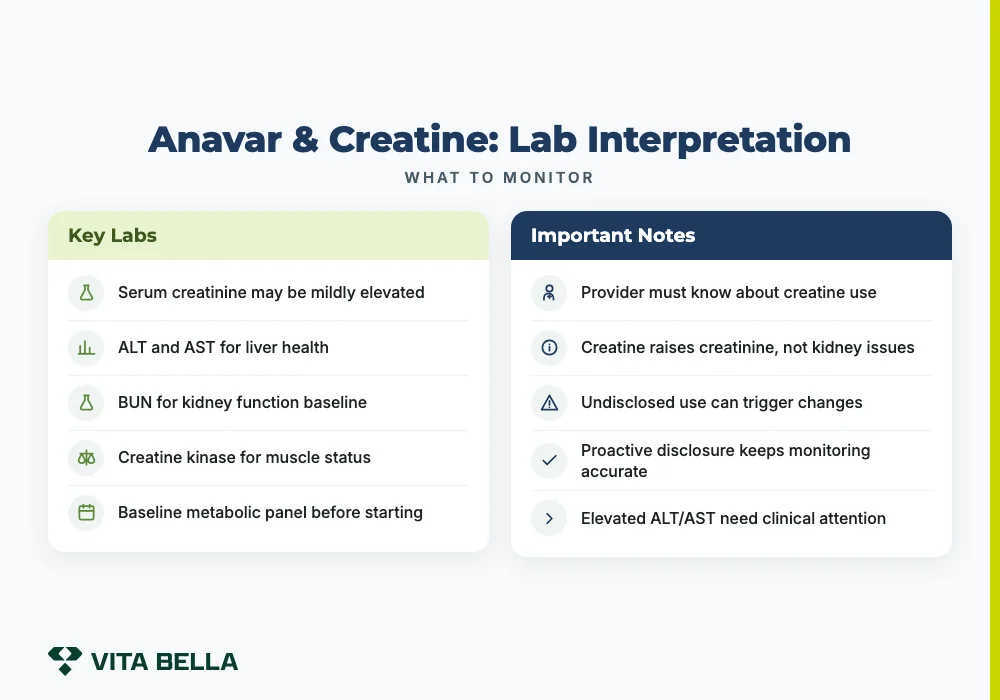
Yes. Creatine supplementation raises serum creatinine through phosphocreatine metabolism, not kidney dysfunction, and a provider monitoring oxandrolone therapy must account for this before interpreting the panel. Treating it as a kidney signal when creatine use has not been disclosed can trigger unnecessary protocol changes. When anavar and creatine are both in use, proactive disclosure is what keeps the monitoring system accurate, not a pharmacological concern, but a lab interpretation one.
For a broader look at how lab reference ranges apply to provider-monitored protocols, the article on reading normal versus optimal lab values provides useful context.
Lab values to monitor:
- Serum creatinine will likely read mildly elevated from creatine metabolism alone; your provider must know this before interpreting any reading as a kidney signal
- ALT and AST are the hepatic metabolism markers most relevant to oxandrolone monitoring; elevations here warrant direct clinical attention
- BUN provides a renal function baseline and adds context to any creatinine reading on the same panel
- Creatine kinase (CK) reflects muscle tissue status and can signal overexertion or tissue stress independent of either compound
- A complete metabolic panel before starting either compound establishes the clean baseline every subsequent reading is measured against
Is it safe to combine creatine and oxandrolone?
The combination carries no established contraindication under provider supervision, but safety depends entirely on the monitoring structure surrounding it. Using anavar and creatine together without informing your provider removes the primary feedback mechanism that makes the protocol manageable.
Quick-reference safety checklist:
- Disclose all supplements, including creatine brand and form, to your provider before any labs are drawn
- Establish a baseline complete metabolic panel before starting creatine, so your provider has a clean reference point for every comparison
- Schedule a follow-up lab review within the first four weeks to compare baseline and on-protocol values directly
- Flag any unusual fatigue, urinary changes, or GI symptoms to your provider rather than waiting for a scheduled visit
- Do not adjust either compound without provider guidance, regardless of how symptoms appear between check-ins
Creatine form and timing in a recovery context
Creatine monohydrate has the strongest evidence base of any available form, the compound studied in both Wang et al. (2026) and Zhang et al. (2025) and the form most providers reference when discussing supplementation in supervised recovery contexts. Kazeminasab et al. (2025) drew their systematic review exclusively from monohydrate-based trials. For patients in short-term, no-longer-than-8-week oxandrolone protocols, the provider conversation about anavar and creatine should address which creatine form and dosing approach fits the current lab picture. The evidence for alternative forms is considerably thinner.
Timing relative to rehabilitation sessions matters for phosphocreatine replenishment, though the optimal window remains debated. A licensed provider can evaluate which approach fits your current recovery state. For additional context on structuring supplementation alongside supervised protocols, the structured peptide protocols guide covers related principles.
Pairing anavar with creatine does not change which creatine form works best. Creatine forms compared:
- Creatine monohydrate: strongest published evidence base, longest study history, lowest cost per serving
- Creatine HCl: higher solubility, smaller serving volume, lower GI discomfort reported by some patients
- Micronized monohydrate: chemically identical to standard monohydrate, finer particle size improves mixing
- Creatine ethyl ester: limited evidence base, not generally recommended in supervised clinical recovery contexts
What to discuss with your provider before starting creatine
The conversation to have before adding creatine to a provider-monitored oxandrolone protocol is narrow and practical. Providers need to know what you are taking before they draw labs, because the creatinine reading depends on it. This is an interpretation accuracy question. If your recovery protocol includes provider-supported hormonal care alongside oxandrolone, accurate lab interpretation matters at every monitoring point.
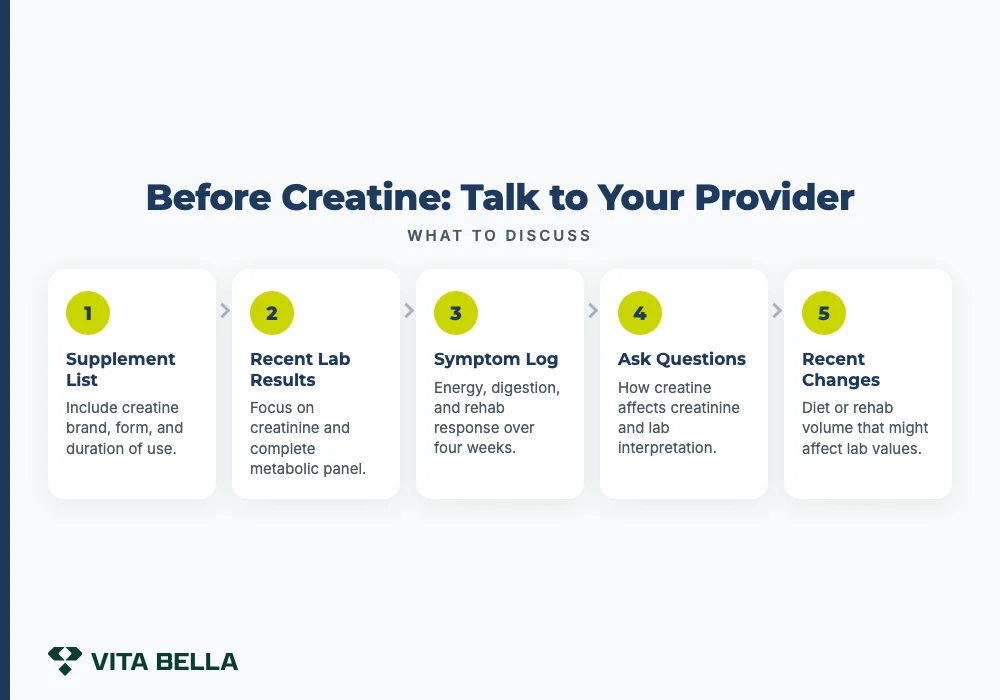
What to bring to your provider visit:
- Your current supplement list with creatine brand, form, and how long you have been taking it before the scheduled draw
- Most recent lab results for direct baseline comparison, with particular attention to serum creatinine and the complete metabolic panel
- A symptom log covering energy levels, digestive changes, and rehabilitation session response over the past four weeks
- Questions about how creatine affects creatinine on a standard panel and how your provider accounts for that when reading your results
- Any recent changes to diet or rehabilitation volume that could independently affect lab values before the next draw
Getting accurate lab interpretation starts with full transparency about everything you are taking. Take the 60-second quiz to connect with a licensed provider at Vita Bella.
Ready to work with a provider who knows your protocol?
Vita Bella provider-supported programs include a 45-minute initial consultation, quarterly 1:1 check-ins, and labs ordered and reviewed by your licensed provider, billed separately at most Quest Diagnostics locations. Medications ship discreetly from FDA-inspected U.S. pharmacies, and members receive wholesale pricing across medications plus free injection supplies. Your provider structures the protocol around your actual lab values.
Get Started to connect with a licensed provider. Book a Free Consult if you want to talk through your current protocol before you commit.
Frequently asked questions
Creatine is not clinically contraindicated alongside oxandrolone therapy, but both compounds affect serum creatinine readings through different metabolic pathways, making provider disclosure essential before any lab draw. Taking anavar and creatine together without disclosure creates a false creatinine elevation that looks identical to a kidney warning on a standard panel. The pharmacological interaction is not the concern; the monitoring accuracy is.
Creatine and oxandrolone operate through entirely separate mechanisms with no documented pharmacological synergy between them. Creatine replenishes phosphocreatine stores to support ATP regeneration during rehabilitative work, while oxandrolone is a short-term therapeutic compound prescribed for specific clinical indications under provider supervision. Any benefit from using both comes from each compound's independent mechanism within a structured protocol, not from a combined effect.
The combination carries no established contraindication under provider supervision, but safety depends on the monitoring structure in place. Undisclosed creatine use during oxandrolone therapy creates a false creatinine elevation that can delay detection of a real lab signal. A provider who knows you are taking creatine can account for it accurately before interpreting the panel.
Yes. Creatine supplementation raises serum creatinine through normal phosphocreatine turnover, a routine metabolic process, not a sign of kidney damage. The elevation is real and will appear on a standard panel, which is exactly why your provider needs to know you are taking creatine before labs are drawn. This is a lab interpretation issue, not a kidney issue.
Yes. Creatine supplementation raises serum creatinine, and that same marker is a standard monitoring target during oxandrolone protocols. Without disclosure, a normal creatine-related elevation can be misread as a kidney warning and trigger unnecessary protocol adjustments. Telling your provider before the first lab draw protects the accuracy of every reading that follows.
Sources
- Lou J et al. (2025). Oxandrolone for burn patients: a systematic review and updated meta-analysis of randomized controlled trials from 2005 to 2025. World Journal of Emergency Surgery. PubMed
- Wang H et al. (2026). Resistance training combined with creatine supplementation: a three-level meta-analysis of multidimensional outcomes from strength enhancement to body composition remodeling. Journal of the International Society of Sports Nutrition. PubMed
- Ring J et al. (2020). Oxandrolone in the Treatment of Burn Injuries: A Systematic Review and Meta-analysis. Journal of Burn Care and Research. PubMed
- Kazeminasab F et al. (2025). The Effects of Creatine Supplementation on Upper- and Lower-Body Strength and Power: A Systematic Review and Meta-Analysis. Nutrients. PubMed
- Zhang H et al. (2025). Effects of creatine supplementation on muscle strength gains: a meta-analysis and systematic review. PeerJ. PubMed