Anavar weight loss is a common search, but oxandrolone is not a weight-loss medication. Clinical research has studied it mainly in patients recovering from severe burns and muscle-wasting illness, and it has never been established as a weight-loss treatment for healthy adults. If reducing body fat is your goal, structured weight management programs built around that purpose are the evidence-based starting point.
What Is Oxandrolone (Anavar)?
Oxandrolone is a synthetic compound that clinics and hospitals have used for specific recovery conditions, including severe burns and illness-related muscle loss, under a licensed provider's prescription. It has no current FDA approval; the FDA withdrew approval of Oxandrin and all generics in June 2023. Today, oxandrolone is available only through compounding pharmacies under a valid provider prescription.
Oxandrolone Weight Loss Claims vs. What Research Actually Measured
Most published oxandrolone trials enrolled medically compromised patients, not healthy adults trying to lose fat. The burn trials in the reviews cited here tracked lean mass, weight regain, hospital stay, and survival, and the Turner syndrome trials tracked final adult height. None was designed to test oxandrolone as a weight-loss treatment. That distinction matters.
Clinical settings where oxandrolone has been studied or used:
- Severe burn injury, where lean mass preservation accelerates recovery
- HIV-related and illness-related muscle wasting
- Turner syndrome in girls also receiving growth hormone
- Chronic catabolic illness and unintended weight loss after extensive surgery, chronic infection, or severe trauma
A 2020 systematic review and meta-analysis in the Journal of Burn Care & Research, which pooled randomized and observational studies in burn patients, found that oxandrolone shortened hospital stays and increased weight regain and percent lean body mass, without changing mortality. It did not evaluate oxandrolone as a fat-loss treatment.
Is Oxandrolone Prescribed for Weight Management?
No. A 2024 review in Gastrointestinal Endoscopy Clinics of North America on weight loss pharmacotherapy identifies entirely different agents as the evidence-based options. Oxandrolone addresses muscle preservation in injury and recovery settings; GLP-1 medications work through appetite regulation and metabolic mechanisms and are among the agents the review lists for treating obesity. For patients whose goal is weight loss, GLP-1-based protocols supervised by a licensed provider are one evidence-backed option for that goal.
Who Has Oxandrolone Been Used For?
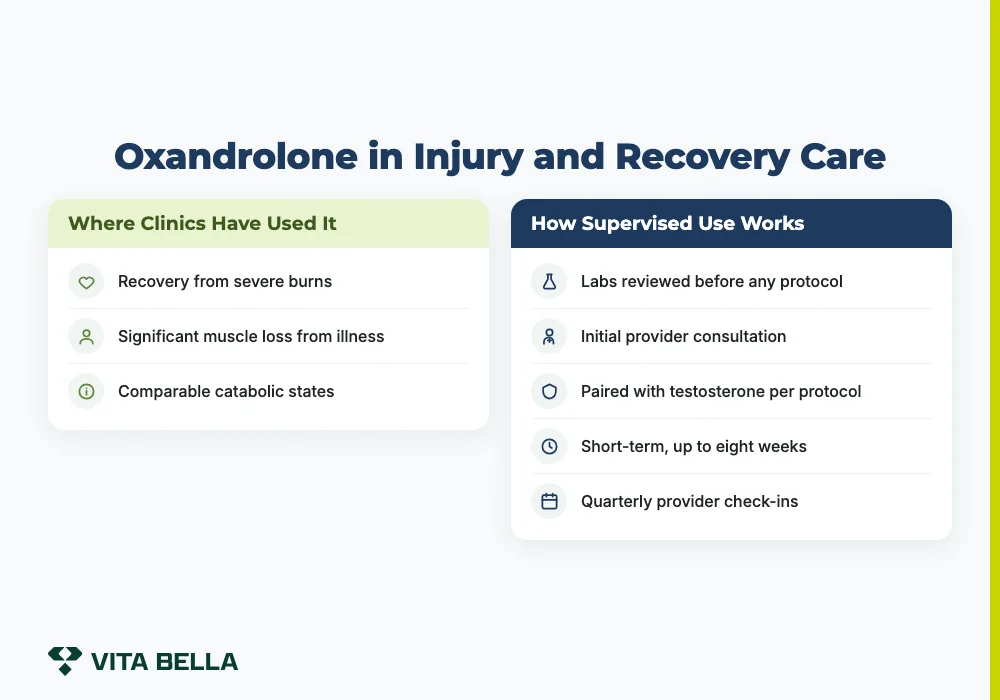
Clinics and hospitals have used oxandrolone for patients recovering from severe burns, significant muscle loss from illness, or comparable catabolic states. A 2025 updated meta-analysis in World Journal of Emergency Surgery supported an adjunctive role in burn recovery but found no mortality benefit. It also reported more liver enzyme elevations in adults and called for cautious interpretation and risk-stratified use.
At Vita Bella, oxandrolone is used within injury and recovery care, paired with testosterone therapy per protocol, with quarterly provider check-ins. Under that protocol, use is short-term, no longer than eight weeks, and supervised; a licensed provider determines the dose after labs. Supervision is essential.
Labs come first. Before any protocol begins, the guide to essential lab testing for hormones and peptides covers what a provider reviews before designing a plan.
What a provider-supervised recovery protocol involves:
- Labs ordered and reviewed before any protocol begins; billed separately.
- 45-minute initial provider consultation
- Provider-designed dosing determined after lab review
- Oxandrolone paired with testosterone per Vita Bella protocol
- Quarterly provider check-ins to assess progress and adjust the plan
Ready to Find the Right Approach for Your Goals?
If weight management is your goal, Vita Bella's licensed providers offer evidence-based weight loss options and GLP-1 protocols tailored to your labs and health history. Real providers. Real medicine. Honest prices. Get Started to begin your provider evaluation. Transform Your Life. You Owe It To Yourself.
Frequently asked questions
Research has not established it as a fat-burning medication. Clinical studies show oxandrolone helps preserve lean mass during recovery from severe burns or muscle-wasting illness. In burn trials, it was associated with more weight gain, not weight loss.
No. Oxandrolone is not prescribed for weight management. For weight loss goals, GLP-1-based protocols supervised by a licensed provider are an evidence-backed option.
Research in catabolic patients, such as people recovering from severe burns, documents effects on lean mass and weight regain; it has not been shown to raise metabolism in a clinically meaningful way in otherwise healthy adults. A provider evaluation is the right starting point to assess your metabolic health.
They serve different clinical purposes. Oxandrolone is used in injury and recovery protocols for muscle preservation in specific medical conditions. GLP-1 medications are used in provider-guided weight management and work through appetite regulation and metabolic mechanisms.
Sources
- Lou J et al. (2025). Oxandrolone for burn patients: a systematic review and updated meta-analysis of randomized controlled trials from 2005 to 2025. World Journal of Emergency Surgery. PubMed
- Ring J et al. (2020). Oxandrolone in the Treatment of Burn Injuries: A Systematic Review and Meta-analysis. Journal of Burn Care & Research. PubMed
- Jordan G et al. (2024). Weight Loss Pharmacotherapy: Current and Future Therapies. Gastrointestinal Endoscopy Clinics of North America. PubMed
- Mohamed S et al. (2019). Oxandrolone for growth hormone-treated girls aged up to 18 years with Turner syndrome. Cochrane Database of Systematic Reviews. PubMed
- Moore PW et al. (2023). GLP-1 Agonists for Weight Loss: Pharmacology and Clinical Implications. Advances in Therapy. PubMed