The full range of 5 amino 1MQ benefits for women starts with one mechanism: blocking NNMT, the enzyme that consumes NAD+ precursors and slows cellular metabolism. Higher NAD+ activates SIRT1 and sirtuin pathways that govern fat oxidation, mitochondrial repair, and energy production. Women exploring hormone and metabolic support options are increasingly asking about this NNMT inhibitor peptide because it targets cellular systems that aging and hormonal changes both affect.
What does 5-amino-1MQ do for women?
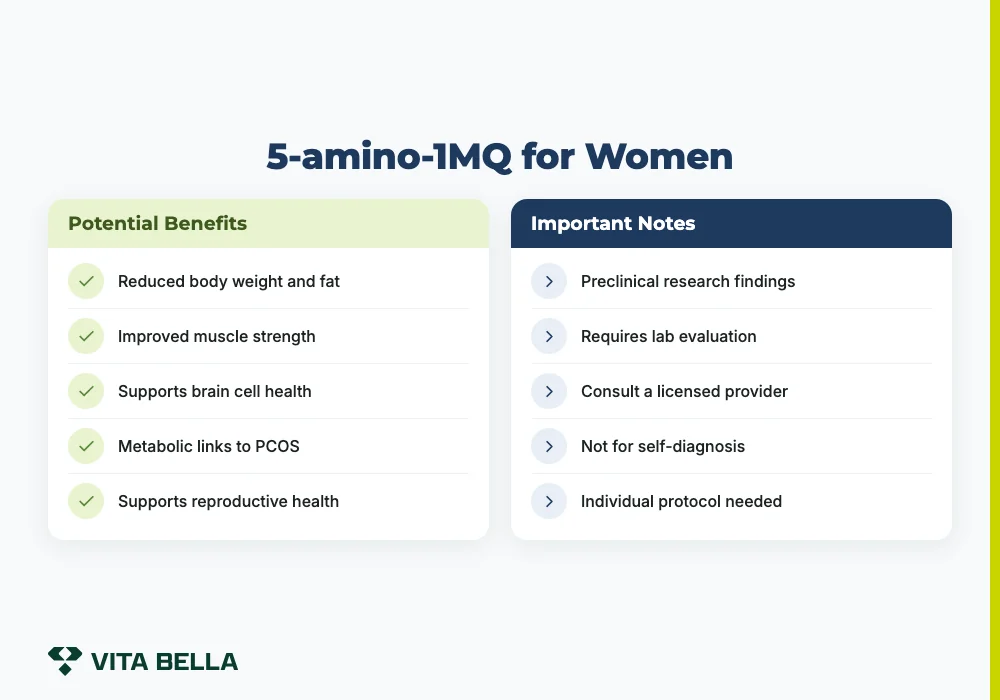
5-amino-1MQ selectively inhibits NNMT, raising intracellular NAD+ and activating sirtuin pathways that control metabolism, inflammation, and cellular repair. The 5 amino 1MQ benefits documented in preclinical research span several areas relevant to women's health:
| Benefit area | Research finding |
|---|---|
| Weight and metabolism | Reduced body weight, adipose tissue mass, and insulin levels in female mice on high-fat diets (Brachs et al., 2019) |
| Muscle strength | Approximately 40% grip strength gain in aged mice under sedentary conditions; up to approximately 60% when combined with exercise and therapy (Dimet-Wiley et al., 2024) |
| Cognitive function | SIRT1 and SIRT3 activation reduces oxidative stress and supports DNA repair in brain cells (Sun et al., 2024) |
| Women-specific conditions | Metabolic connections to PCOS, menopausal changes, and reproductive health reported in published research |
A licensed provider evaluates labs before confirming whether 5-amino-1MQ is appropriate for a given protocol.
How the NNMT inhibitor peptide works
NNMT converts nicotinamide into methylnicotinamide, depleting the precursors the body uses to synthesize NAD+. In obese and aging tissues, NNMT is overexpressed. NAD+ falls. Fat cells expand.
5-amino-1MQ selectively blocks this enzyme. A 2018 study in Biochemical Pharmacology (Neelakantan et al.) showed that membrane-permeable NNMT inhibitors reduced high-fat diet-induced obesity in mice by boosting intracellular NAD+ and restoring mitochondrial fat oxidation. Critically, the inhibition did not affect other enzymes in the NAD+ salvage pathway, which is the key point for specificity.
As a targeted NAD+ booster for women, 5-amino-1MQ works at the enzymatic level. Comparing NAD+ therapy options side by side clarifies the difference: this approach raises NAD+ by reducing its consumption, not by adding precursors from the outside.
How does 5-amino-1MQ help with weight loss?
5-amino-1MQ supports weight loss by restoring mitochondrial fat oxidation that NNMT overexpression disrupts. It preserves nicotinamide for NAD+ production, improving fat-burning efficiency at the cellular level.
The primary evidence comes from animal models. Brachs et al. (2019), published in Diabetes, found that genetic NNMT deficiency improved insulin sensitivity in diet-induced obesity without disrupting the broader NAD+ salvage pathway. Neelakantan et al. (2018) confirmed that pharmacological NNMT inhibition specifically reduced body weight and adipose tissue mass in female mice on a high-fat diet.
A 2021 review in Biomedical Research International (Liu et al.) confirmed that NNMT overexpression in adipose tissue directly impairs fasting blood glucose regulation. Inhibiting NNMT reduces that impairment.
5-amino-1MQ weight loss protocols are built on lab results. A licensed provider determines the appropriate approach after reviewing a patient's metabolic markers.
5 amino 1MQ benefits for energy and mitochondrial health
Low energy is one of the most reported symptoms in women over 35. Declining NAD+ is a direct cause. Mitochondria need NAD+ to generate ATP efficiently; when levels fall, the result is physical fatigue, brain fog, and slow recovery.
5-amino-1MQ energy support works at this cellular level. A 2019 study in Neurochemical Research (Klimova and Kristian) confirmed NAD+ as a core coenzyme in brain bioenergetic metabolism. Low NAD+ affects cognition and focus alongside physical stamina. These effects compound.
The fitness connection extends further. NAMPT, a key enzyme in NAD+ biosynthesis, rises in response to exercise demand. Research reviewed by Conlon and Ford (2022) found NAMPT protein levels increased by 127% after three weeks of exercise training in sedentary, non-obese participants. 5-amino-1MQ may amplify these gains by restoring the NAD+ baseline that training builds on. Understanding NAD+ age-related decline provides the broader context for why this pathway matters for women past 35.
5 amino 1MQ benefits for anti-aging and cellular repair
NAD+ drives cellular repair, DNA maintenance, and mitochondrial quality control. When it falls below the threshold the body needs, damage accumulates faster than cells can address it.
Maiese (2023), in Frontiers in Immunology, directly linked low NAD+ to oxidative stress, free radical accumulation, and age-related conditions including diabetes, neurodegenerative disease, and vascular damage. By inhibiting NNMT and raising NAD+, 5-amino-1MQ activates SIRT1 and SIRT3. These proteins govern DNA repair, mitochondrial quality control, and inflammatory regulation, reducing the oxidative burden on cells and protecting cellular structures from cumulative damage.
The 5-amino-1MQ anti-aging pathway is most relevant for women in perimenopause and after, when hormonal shifts compound the effects of declining NAD+. This is a parallel intervention to hormonal therapy, not a replacement. It addresses the cellular energy and repair capacity that both aging and hormone decline affect.
SIRT1 and SIRT3 activation also supports neuroprotection, reducing oxidative stress in brain cells and contributing to sustained cognitive clarity as women age.
5-amino-1MQ muscle recovery and strength with age
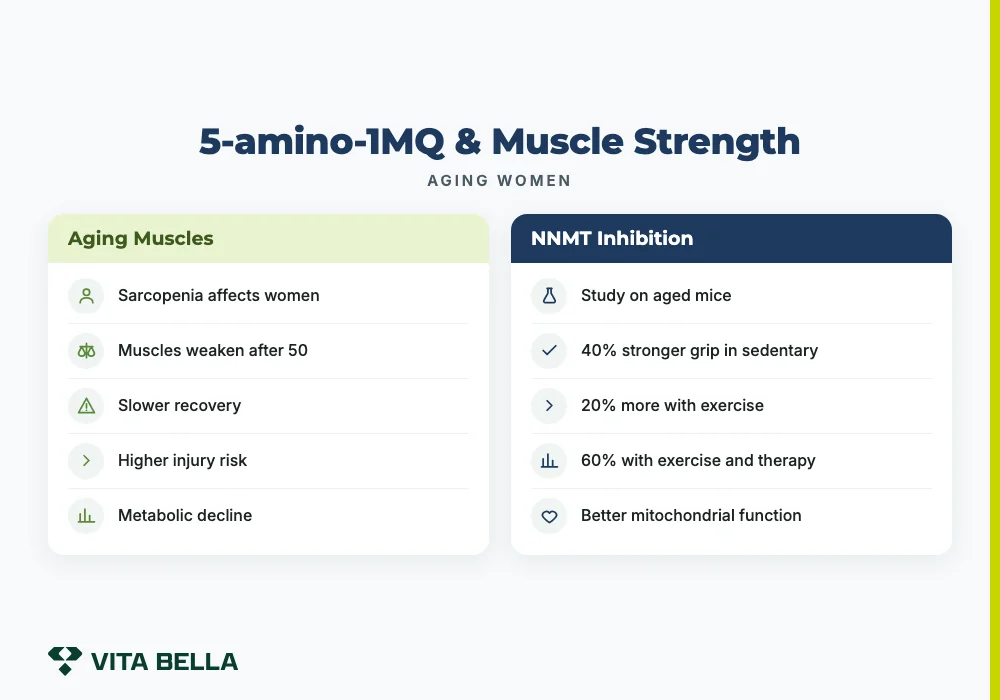
Sarcopenia, age-related muscle loss, affects women significantly after 50. Weaker muscles slow recovery, raise injury risk, and deepen metabolic decline.
A 2024 study in Scientific Reports (Dimet-Wiley et al.) measured NNMT inhibition in aged mice across three conditions:
- In sedentary aged mice, NNMT inhibition produced approximately 40% stronger grip strength than controls.
- With exercise added, improvement reached approximately 20% beyond the exercise-only group.
- When NNMT inhibition combined with exercise and therapy, grip strength improvement reached approximately 60%.
The authors concluded that NNMT inhibition mimics and amplifies exercise-mediated muscle function improvements in aging tissue. The effect held across activity levels, pointing to 5-amino-1MQ muscle recovery as an area with direct aging research support, not an extrapolation from metabolic data.
Better mitochondrial function also means faster recovery between sessions. Energy and muscle benefits reinforce each other at the cellular level.
Is 5-amino-1MQ safe for women to use?
Preclinical studies suggest a favorable safety profile. The compound's selectivity for NNMT, confirmed by Neelakantan et al. (2018), means it does not disrupt adjacent enzymes in the NAD+ salvage pathway, which reduces the risk of broad metabolic side effects.
Human clinical data remains limited. Women who are pregnant, nursing, or managing active medical conditions should consult a licensed provider before starting any protocol. At Vita Bella, the approach is consistent: labs establish a metabolic baseline, a provider reviews the results, and the protocol follows from there.
Who is a good candidate for 5-amino-1MQ for women?
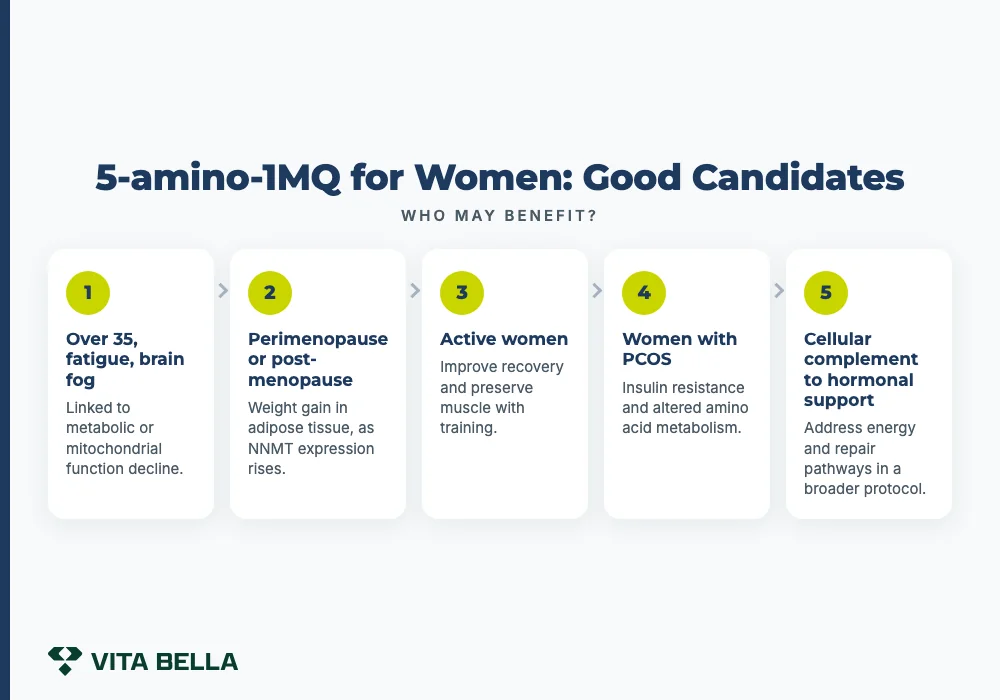
The research and clinical context point to profiles where 5-amino-1MQ for women offers the strongest rationale:
- Women over 35 who experience fatigue, brain fog, or declining physical capacity linked to metabolic or mitochondrial function
- Women in perimenopause or post-menopause who gain weight primarily in adipose tissue, a pattern that tends to worsen as NNMT expression rises
- Active women who want to improve recovery and preserve muscle alongside a training program
- Women with PCOS, where insulin resistance and altered amino acid metabolism affect energy and metabolic function (Unni et al., 2015)
- Women considering a cellular complement to hormonal support who want to address energy and repair pathways as part of a broader protocol
A provider reviews health history and labs before confirming eligibility. Nothing is prescribed without that evaluation.
Ready to explore your options
Vita Bella's peptide therapy program starts with a short intake quiz, followed by a provider-led review and a protocol built around your goals and health history. A licensed provider determines the dose; labs are recommended to help individualize it. No AI is involved in your care.
Frequently asked questions
Published preclinical research has not identified significant adverse effects at the doses studied. The compound's selectivity for NNMT limits the theoretical risk of broad metabolic disruption, but human trial data remains limited. A full provider review before starting is the appropriate step.
Published research has not established a standardized human timeline for clinical effects. A provider monitors labs and symptoms over time and adjusts the protocol based on what the individual data shows.
Yes. A licensed provider reviews your health history before prescribing 5-amino-1MQ. Lab work is recommended rather than required; when available, it helps match the protocol to your metabolic profile and account for existing health conditions.
Research connects NNMT activity to the metabolic disruptions seen in PCOS, including insulin resistance and amino acid dysregulation. Higher NAD+ from NNMT inhibition may support insulin sensitivity and energy balance, though clinical trials in women with PCOS specifically have not yet been published.
Sources
- Dimet-Wiley AL et al. (2024). Nicotinamide N-methyltransferase inhibition mimics and boosts exercise-mediated improvements in muscle function in aged mice. Scientific Reports. PubMed
- Neelakantan H et al. (2018). Selective and membrane-permeable small molecule inhibitors of nicotinamide N-methyltransferase reverse high fat diet-induced obesity in mice. Biochemical Pharmacology. PubMed
- Brachs S et al. (2019). Genetic Nicotinamide N-Methyltransferase (Nnmt) Deficiency in Male Mice Improves Insulin Sensitivity in Diet-Induced Obesity. Diabetes. doi.org
- Liu JR et al. (2021). Roles of Nicotinamide N-Methyltransferase in Obesity and Type 2 Diabetes. Biomedical Research International. PubMed
- Conlon N, Ford D. (2022). A systems-approach to NAD+ restoration. Biochemical Pharmacology. PubMed
- Klimova N, Kristian T. (2019). Multi-targeted effect of nicotinamide mononucleotide on brain bioenergetic metabolism. Neurochemical Research. Springer
- Maiese K. (2023). The impact of aging and oxidative stress in metabolic and nervous system disorders. Frontiers in Immunology. Frontiers
- Sun WD et al. (2024). Nicotinamide N-methyltransferase (NNMT): a novel therapeutic target for metabolic syndrome. Frontiers in Pharmacology. PubMed
- Unni SN et al. (2015). Alterations in the levels of plasma amino acids in polycystic ovary syndrome. Indian Journal of Medical Research. PubMed