A CJC-1295 ipamorelin injection combines a GHRH analogue with a selective GH secretagogue to raise growth hormone and IGF-1 in a controlled, pulsatile way. Clinical research published in JCEM found that the long-acting DAC version of CJC-1295 raises GH two- to ten-fold and IGF-1 one-and-a-half- to three-fold over baseline, with effects lasting several days after a single injection. The form used in provider protocols is CJC-1295 without DAC: its half-life is roughly 30 minutes, so it works by amplifying individual GH pulses and relies on regular dosing rather than one long-lasting injection. Results depend on technique. Knowing the right injection sites, how to reconstitute the peptides, and what side effects to monitor determines whether a protocol works safely. Your hormone therapy provider reviews your labs and designs the schedule that fits your body.
What are CJC-1295 and ipamorelin?
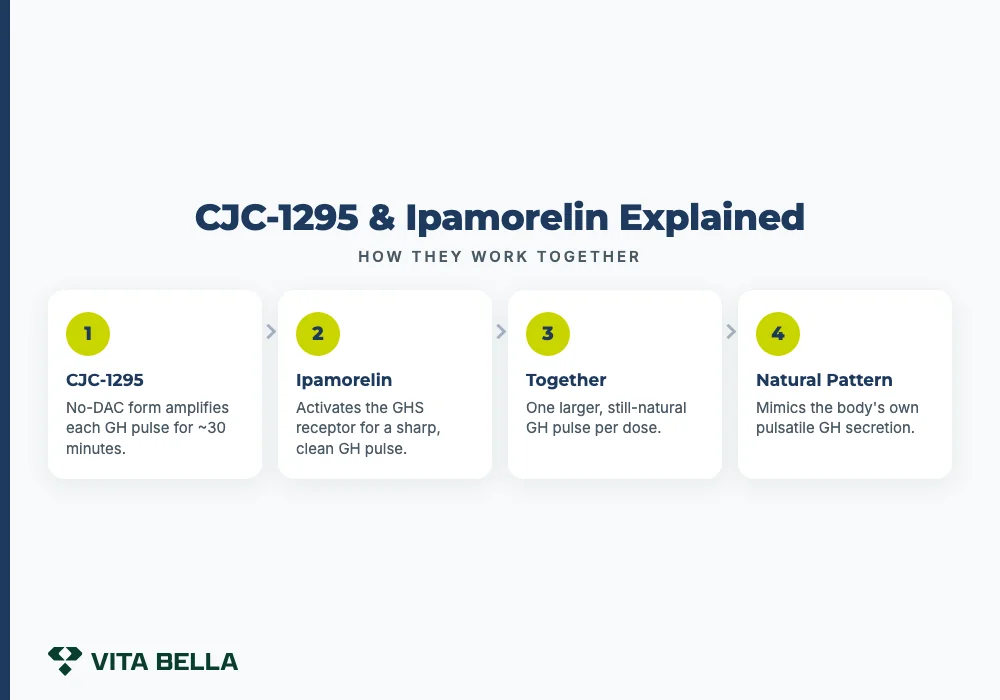
CJC-1295 is a synthetic GHRH analogue that comes in two forms. The DAC version binds to serum albumin, which extends its half-life to days. The no-DAC form used in provider protocols clears in roughly 30 minutes and instead amplifies the pituitary's own GH pulse at each dose. Ipamorelin is a pentapeptide that activates the GHS receptor to produce sharp, immediate GH pulses. A 1998 study in the European Journal of Endocrinology found that ipamorelin releases GH with high potency and specificity, without substantially raising cortisol or ACTH.
Together they act within the same pulse: CJC-1295 amplifies how much GH the pituitary releases, while ipamorelin triggers the release itself — a larger but still natural pulse, not a sustained artificial baseline. This pairing more closely matches the body's natural pulsatile GH secretion pattern than either compound alone.
| Feature | CJC-1295 | Ipamorelin |
|---|---|---|
| Mechanism | GHRH receptor agonist | GHS receptor agonist |
| Duration of effect | Several days | Hours |
| GH release pattern | Sustained elevation | Acute pulse |
| Cortisol impact | Minimal | Minimal |
For background on how peptides work at the cellular level, the guide on what peptides are and how they help covers the essentials.
How do you inject CJC-1295 and ipamorelin?
The correct approach to a CJC-1295 ipamorelin injection starts before you pick up the needle. Both peptides are delivered subcutaneously, into the fatty tissue just beneath the skin rather than into muscle. Correct peptide injection technique covers three phases: reconstitution, site preparation, and delivery.
Supplies you need
- Gather one vial each of CJC-1295 and ipamorelin in lyophilized powder form.
- Prepare bacteriostatic water for reconstitution.
- Use insulin syringes with a short, fine needle (typically 28 to 31 gauge).
- Have alcohol swabs on hand for both vial tops and skin.
Reconstitution
Draw the prescribed volume of bacteriostatic water into a syringe. Insert the needle along the vial wall at an angle and inject slowly to avoid foaming. Swirl gently to mix. Do not shake. Shaking degrades the peptide and reduces its potency. Once reconstituted, store both vials in the refrigerator and use them within the timeframe your provider specifies.
The injection
Clean the chosen site with an alcohol swab and let the skin dry fully. Pinch a small fold of skin, insert the needle at roughly a 45-degree angle, and press the plunger slowly. Release the fold, withdraw the needle, and press lightly with a clean swab. Discard the syringe immediately. Reusing needles raises infection risk and is not acceptable under any circumstances. Handelsman's Endotext chapter on performance-enhancing hormone doping notes that verified technique and strict sterility are prerequisites for safe, consistent outcomes.
Where is the best injection site for CJC-1295 ipamorelin?
Subcutaneous areas with a consistent fat layer work best for both peptides. The abdomen is the most common CJC-1295 injection site because it is easy to reach and has predictable tissue depth. The outer thigh is a reliable alternative. The back of the upper arm also works as an ipamorelin injection site, though it requires some flexibility to access comfortably.
Rotation matters as much as location. Using the same spot repeatedly causes tissue irritation and lipohypertrophy, which reduces absorption over time. A simple rotation pattern, such as cycling through four abdominal quadrants over several days, keeps tissue healthy and absorption consistent. Avoid any area with bruising, scarring, or active inflammation.
Where to inject ipamorelin or CJC-1295 is ultimately a secondary concern to consistency. Choose sites you can access reliably and vary them on a predictable schedule.
How often should you inject CJC-1295 and ipamorelin?
Injection frequency is part of your ipamorelin dosing protocol, and a licensed provider determines that schedule after reviewing your labs. CJC-1295 sustains GH and IGF-1 levels for several days after each injection, so daily administration is not required. Ipamorelin's shorter effect window influences how often it makes clinical sense to use it alongside CJC-1295.
Factors that shape the dosing protocol include baseline GH and IGF-1 levels, age, body composition goals, and any medications that affect GH secretion. Lab work at a certified diagnostics provider is where every protocol starts. A 2006 study by Alba et al. showed that once-daily CJC-1295 administration normalized growth in GHRH knockout mice, demonstrating that both consistency and frequency shape hormonal outcomes, though human protocols differ and require individualized provider guidance.
What are the side effects of CJC-1295 ipamorelin injections?
CJC-1295 ipamorelin side effects fall into two broad categories: injection site reactions and systemic effects.
Injection site reactions are the most common. Redness, mild swelling, and tenderness at the injection site typically appear and resolve within a day. Proper rotation and sterile equipment reduce them significantly.
Systemic effects include water retention and mild fatigue, particularly early in a protocol. Some users notice transient flushing or tingling shortly after injection. These typically ease as the body adjusts. Unexpected hormonal changes or persistent symptoms require prompt contact with your provider. Keep a log of injection times, sites, and any reactions. That record gives your provider the data to make protocol adjustments quickly and accurately.
Subcutaneous peptide injection is the standard delivery route. Intravenous administration carries serious risks and is not appropriate outside a supervised clinical setting.
Can you mix CJC-1295 and ipamorelin in the same syringe?
Yes. Drawing both reconstituted peptides into a single insulin syringe for one injection is a common approach that reduces the number of needle sticks. However, you must reconstitute each peptide separately first. Use a clean needle to draw from each vial, then transfer to the injection syringe. Never reinsert a needle that has touched skin into a peptide vial, as this introduces contamination.
Mixing is only appropriate when your provider has confirmed both peptides belong in your current protocol. For guidance on structuring multi-peptide programs over time, the peptide cycling overview covers how to approach longer-term protocols responsibly.
Start your CJC-1295 ipamorelin injection protocol
A licensed provider at Vita Bella determines the dose, frequency, and duration after reviewing your labs and health history. Lab results are the starting point, not the finish line.
Frequently asked questions
You need the lyophilized peptide vials, bacteriostatic water, insulin syringes, and alcohol swabs. Every injection requires a new, sterile needle with no exceptions. Reconstituted peptides must be refrigerated immediately after preparation.
Injection timing is part of your ipamorelin dosing protocol and is set by your provider. Certain times, such as before sleep or after exercise, may align better with the body's natural GH secretion rhythms, but your provider decides based on your specific labs and goals.
Follow-up labs measuring GH and IGF-1 levels are the most reliable indicator. Improved sleep, recovery, and body composition can signal a response, but lab results confirm whether the expected hormonal changes are actually occurring.
Mild redness or swelling is normal and typically resolves within a day. Rotate to a different site on your next injection. Persistent pain, significant swelling, warmth, or signs of infection require prompt contact with your provider.
Sources
- Teichman SL et al. (2006). Prolonged stimulation of growth hormone (GH) and insulin-like growth factor I secretion by CJC-1295, a long-acting analog of GH-releasing hormone, in healthy adults. The Journal of Clinical Endocrinology & Metabolism. PubMed
- Alba M et al. (2006). Once-daily administration of CJC-1295, a long-acting growth hormone-releasing hormone (GHRH) analog, normalizes growth in the GHRH knockout mouse. American Journal of Physiology – Endocrinology and Metabolism. PubMed
- Raun K et al. (1998). Ipamorelin, the first selective growth hormone secretagogue. European Journal of Endocrinology. PubMed
- Handelsman DJ (2020). Performance Enhancing Hormone Doping in Sport. Endotext [Internet]. PubMed