Does anavar increase libido? Research does not support oxandrolone as a libido-enhancing agent. Studies link anabolic steroids to HPG axis suppression, which can reduce endogenous testosterone and may lower sex drive or contribute to erectile dysfunction. Oxandrolone at Vita Bella is used only within injury and recovery programs, not as a treatment for sexual dysfunction.
What is oxandrolone and how do clinics use it?
Oxandrolone is a synthetic anabolic androgenic steroid available today only through compounding pharmacies, prescribed by a licensed provider. Clinics and hospitals have studied and applied it in specific medical contexts. Vita Bella applies it exclusively within supervised injury protocols.
Understanding the clinical frame matters before examining Anavar and libido effects. Any discussion of how oxandrolone interacts with sex drive is inseparable from the context of use, the hormone levels present at baseline, and how closely a provider monitors the protocol.
The clinical history of oxandrolone as a tool for wasting and recovery conditions, rather than a hormonal optimizer, is why the Anavar libido question requires a nuanced answer. Context shapes outcome. A supervised injury protocol is a different environment than unsupervised use.
Clinical contexts in which oxandrolone has been studied:
- Burn wound recovery has been evaluated in randomized controlled trials, and a 2025 systematic review in the World Journal of Emergency Surgery confirmed outcomes in this population (Lou J et al., 2025).
- Muscle-wasting conditions have been assessed in clinical trials examining lean mass preservation following illness or surgical stress.
- Short-term catabolic states after major procedures or severe injury have been studied in controlled settings.
- Pediatric growth applications in specific populations, such as Turner syndrome, have been evaluated in Cochrane-level systematic reviews (Mohamed S et al., 2019).
- Tissue recovery during physiologically stressed states has been examined in meta-analyses, including a 2020 review in the Journal of Burn Care and Research (Ring J et al., 2020).
How pairing oxandrolone with testosterone changes the picture
When oxandrolone is used alongside provider-prescribed testosterone, exogenous testosterone replaces what the suppressed HPG axis is no longer producing. This approach sustains the hormone levels that support sexual health during a short-term injury recovery protocol. The Anavar and libido risk shown in the table above is substantially lower when the protocol includes testosterone support alongside regular lab monitoring.
Vita Bella uses oxandrolone with testosterone, not in isolation. That structural difference changes the hormonal environment throughout the protocol. Endogenous testosterone declines as the HPG axis suppresses, but exogenous testosterone maintains the androgen levels that contribute to normal sexual function. Protocols are adjusted through quarterly provider check-ins based on how labs and the clinical picture evolve, and the oxandrolone and testosterone combination protocol article covers the mechanism and monitoring approach in detail.
Possible side effects on libido and sexual health
Possible sexual health side effects during oxandrolone use are uncommon at physiological doses within a supervised short-term protocol. Effects that do appear are generally mild and reversible under provider monitoring once the protocol concludes. A licensed provider determines the dose after labs. For blood pressure considerations during oxandrolone use, a separate article covers what providers monitor and how they respond if readings shift.
Possible sexual health side effects that may occur during oxandrolone use:
- Decreased libido may occur when HPG suppression reduces endogenous testosterone levels.
- Erectile difficulty may appear, particularly with unsupervised or prolonged use.
- Changes in ejaculatory function may be reported in some individuals during therapy.
- Mood shifts that affect sexual interest may develop if testosterone drops significantly.
- Effects may improve under provider monitoring once the protocol concludes.
What a provider evaluates when libido changes during oxandrolone use
A libido change or erectile complaint during an oxandrolone protocol is not dismissed. It triggers a proper sexual health evaluation. Providers review a hormone panel before and during the protocol, assess reported symptoms alongside the clinical timeline, and use quarterly check-ins to adjust the protocol if labs or symptoms signal a concern.
The answer to whether Anavar causes erectile dysfunction in any individual comes down to the lab panel. Total testosterone, SHBG, LH, and FSH together reveal whether HPG suppression is occurring and to what degree. The article on lab testing for peptide and hormone protocols explains which markers providers prioritize and why they matter when sexual function is a concern.
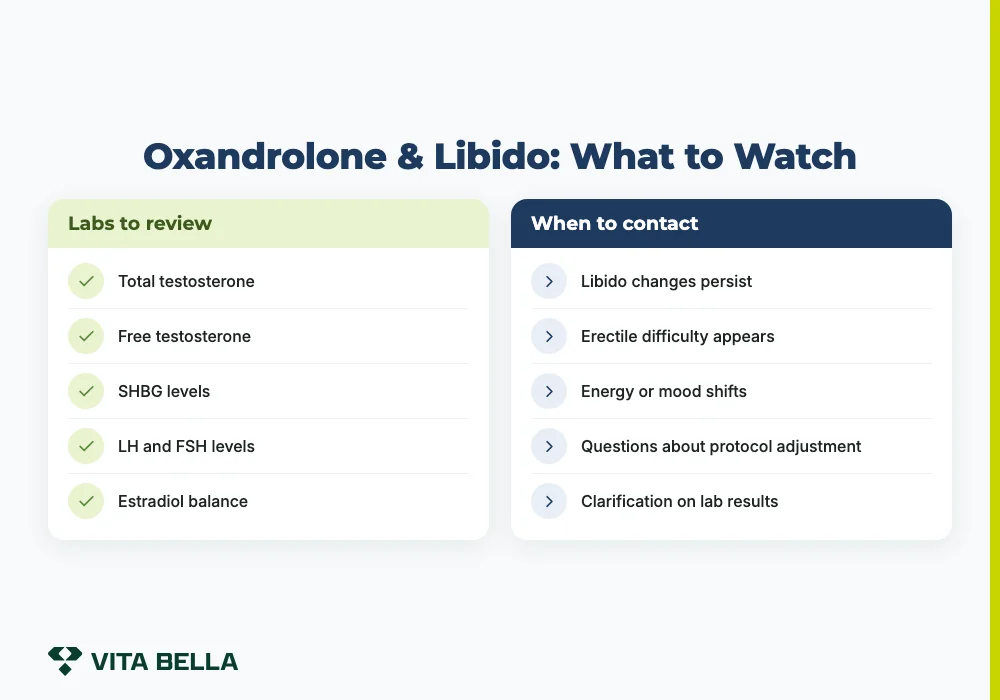
Labs providers typically review for hormone-related sexual health concerns:
- Total testosterone, to assess the overall androgen level relative to the individual's baseline.
- Free testosterone, to understand the biologically active fraction not bound to SHBG.
- SHBG, which oxandrolone reduces and which directly affects free testosterone availability.
- LH and FSH, to evaluate whether HPG axis suppression is present and to what degree.
- Estradiol, since the androgen-estrogen balance influences both sexual function and mood.
When to contact your provider during oxandrolone use:
- If libido changes persist beyond the first few weeks of the protocol.
- If erectile difficulty appears at any point during use.
- If energy or mood shifts become noticeable and affect daily function.
- If you have questions about adjusting your current protocol based on symptoms or lab results.
- If you want clarification on lab results and what they mean for your sexual health.
A provider through Vita Bella's sexual wellness program can evaluate whether hormones are contributing to changes in sex drive. For a broader hormone evaluation, the hormone therapy page outlines how providers approach initial assessment and ongoing monitoring.
Talk to a provider about your sexual health
If libido, sex drive, or sexual function is a concern during or after an oxandrolone protocol, a licensed Vita Bella provider can review your hormone levels and determine whether a protocol adjustment is appropriate. Transform Your Life. You Owe It To Yourself.
Frequently asked questions
Research does not support oxandrolone as a libido-enhancing agent. The more consistent finding is that oxandrolone may suppress the HPG axis, which can reduce endogenous testosterone and lower sex drive over time.
Oxandrolone may contribute to erectile dysfunction through HPG axis suppression and the resulting reduction in endogenous testosterone. Research in men receiving testosterone and oxandrolone shows an association between low SHBG and testosterone levels and erectile dysfunction.
Changes in sexual function that appear during short-term oxandrolone use may improve once the protocol ends and hormone levels normalize under provider oversight. A provider can assess your hormone panel and recommend appropriate next steps.
Contact your provider. Libido changes during oxandrolone use may signal a hormone shift that warrants a lab review. Vita Bella's sexual wellness evaluation can help determine whether hormones are a contributing factor.
A provider reviews a hormone panel including testosterone, SHBG, LH, and FSH alongside reported symptoms and the timeline of any changes. Quarterly check-ins allow the protocol to be adjusted based on lab results and the overall clinical picture.
Sources
- Lou J et al. (2025). Oxandrolone for burn patients: a systematic review and updated meta-analysis of randomized controlled trials from 2005 to 2025. World Journal of Emergency Surgery. PubMed
- Ring J et al. (2020). Oxandrolone in the Treatment of Burn Injuries: A Systematic Review and Meta-analysis. Journal of Burn Care and Research. PubMed
- Mohamed S et al. (2019). Oxandrolone for growth hormone-treated girls aged up to 18 years with Turner syndrome. Cochrane Database of Systematic Reviews. PubMed
- Barbonetti A et al. (2021). Erectile Dysfunction and Decreased Libido in Klinefelter Syndrome: A Prevalence Meta-Analysis and Meta-Regression Study. Journal of Sexual Medicine. PubMed
- Low sex hormone-binding globulin and testosterone levels in association with erectile dysfunction among HIV-infected men receiving testosterone and oxandrolone (PMID 17961146). PubMed