Hormone replacement therapy for women restores estrogen, progesterone, and sometimes testosterone that decline during perimenopause and menopause. It is prescribed to address hot flashes, disrupted sleep, mood shifts, low libido, and joint discomfort. A licensed provider determines whether a provider-reviewed hormone protocol is appropriate after reviewing your labs and medical history, because these symptoms overlap with other conditions and labs resolve the ambiguity.
What is hormone replacement therapy for women?
This therapy is a provider-supervised medical protocol that replenishes hormones the body produces in lower amounts during perimenopause and menopause. Perimenopause is the years-long lead-up to the final period; menopause is confirmed after 12 consecutive months without one. The timing of HRT initiation shapes the benefit-to-risk profile, which a provider evaluates before recommending a protocol.
Benefits of HRT for women
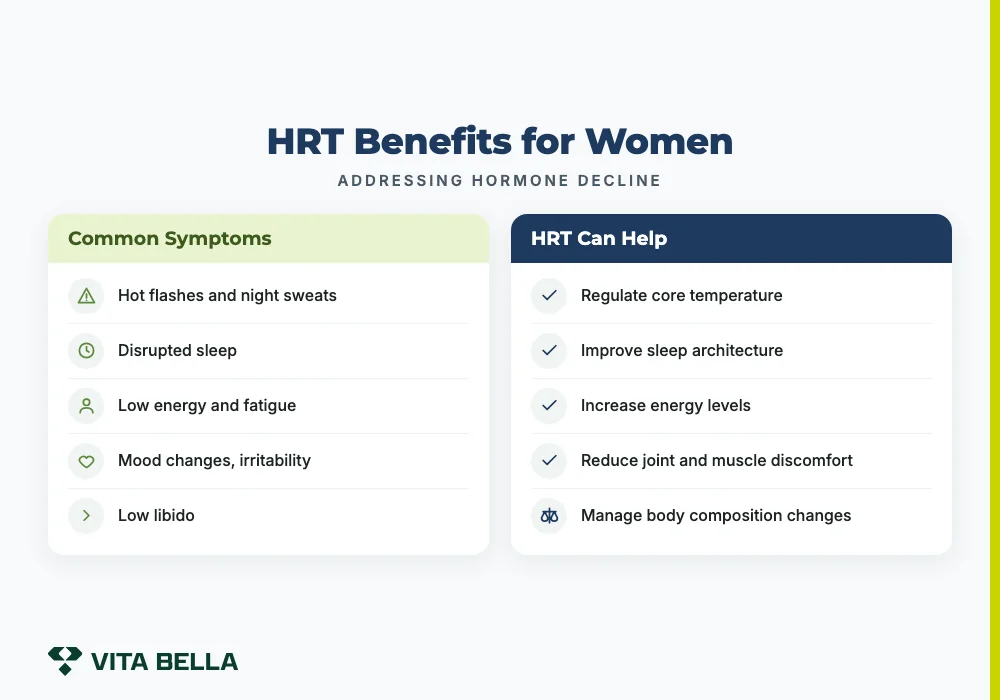
HRT is clinically used to address a specific set of symptoms tied to estrogen and progesterone decline, per Cagnacci et al. (2019) in Minerva Ginecologica:
- Hot flashes and night sweats occur as the body loses estrogen's role in regulating core temperature.
- Disrupted sleep often stems from nighttime sweats and hormonal fluctuations affecting sleep architecture.
- Low energy and daytime fatigue are frequently reported alongside declining hormone levels.
- Mood changes and irritability accompany the hormonal shifts of perimenopause.
- Low libido is associated with declining estrogen and testosterone.
- Joint and muscle discomfort: a 2026 systematic review by Overton et al. in Post Reproductive Health found that HRT reduced musculoskeletal pain in menopausal women.
- Changes in body composition and weight distribution are linked to estrogen decline; provider-supervised weight management is available alongside hormone care.
Types of HRT: estrogen-only, combined, and bioidentical
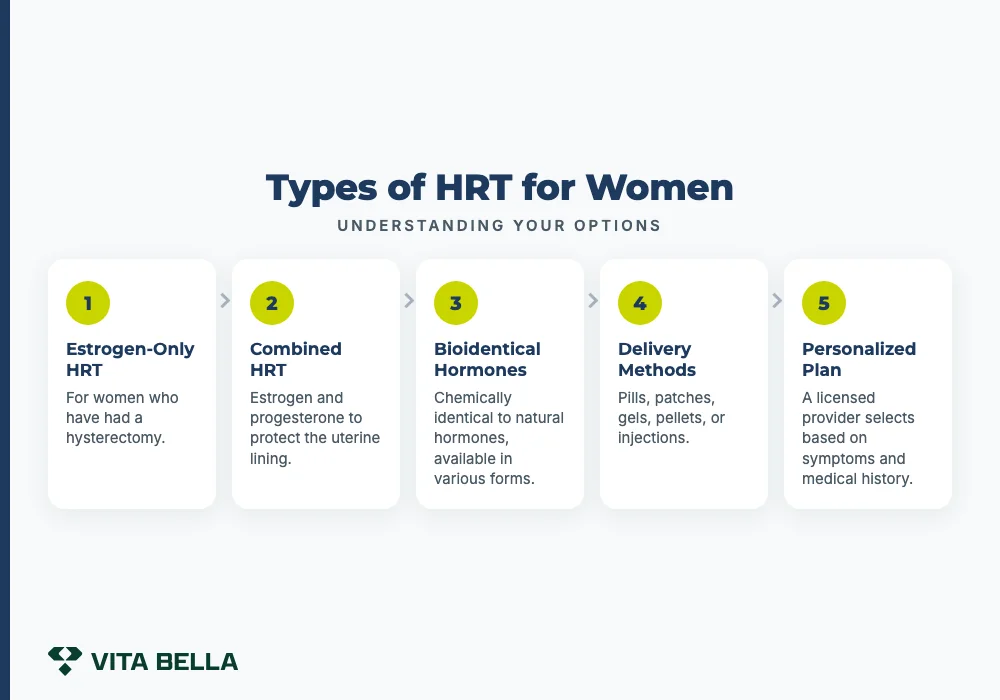
Three main HRT categories are used in clinical practice: estrogen-only, combined estrogen-progesterone, and bioidentical hormones. Estrogen-only therapy is typically prescribed for women who have had a hysterectomy. Combined therapy adds progesterone to protect the uterine lining.
Bioidentical hormones, sometimes called natural HRT, are chemically identical to those the body produces, available in standardized and compounded formulations from FDA-inspected U.S. pharmacies. A licensed provider selects the type and delivery method based on symptoms, medical history, and lab results. To explore your personalized plan, a clinical evaluation is the starting point.
HRT delivery methods
- Oral pills are convenient but undergo first-pass liver metabolism.
- Transdermal patches offer steady hormone release, changed one to two times per week.
- Topical gels and creams are applied daily, bypassing the liver.
- Subcutaneous pellets release hormones gradually over several months, suited for those who prefer infrequent dosing.
- Injections allow precise protocol adjustments and can be provider- or self-administered.
Does age change which HRT is right for you?
Yes. The benefit-to-risk profile shifts with age and time elapsed since menopause onset. For women in perimenopause or early menopause, the evidence base is strongest (Cagnacci et al., 2019). Hormone replacement therapy for women over 60 requires a provider to weigh time elapsed since menopause against current symptoms and lab values, the risk profile changes meaningfully, and more individualized evaluation is essential at this stage.
Is hormone replacement therapy safe for women?
Current clinical guidance supports HRT as appropriate for many women who begin within 10 years of menopause onset or before age 60, when prescribed by a licensed provider. The hormone replacement therapy side effects women report most often, such as breast tenderness, bloating, and spotting, are typically mild and dose-dependent. Broader risk depends on type, duration, delivery method, and personal history, including family history of breast cancer or blood clots (Cagnacci et al., 2019).
Much of the public uncertainty traces to a 2002 Women's Health Initiative study. Updated analysis has changed the safety picture for women who start treatment early in their menopausal transition. The article on when "normal" labs still leave you feeling suboptimal explains why optimal lab ranges matter as much as reference ranges.
Common side effects
Most side effects are mild and resolve within the first few months. Common short-term effects include breast tenderness, bloating, headaches, and irregular spotting. Contact your provider if you experience chest pain, unusual swelling, or vision changes.
How does online HRT for women work?
Provider-supervised HRT is now accessible via telehealth in 47 states without an in-person visit. Vita Bella's process begins with a quiz, moves to lab work through Quest Diagnostics, then connects you with a licensed provider who reviews your results before recommending any protocol. Whether you're exploring the best online HRT options or looking for local HRT providers near you, telehealth closes the gap that a distant clinic cannot.
Take the 60-second quiz to start your evaluation with a licensed provider.
What to expect: from labs to your first visit
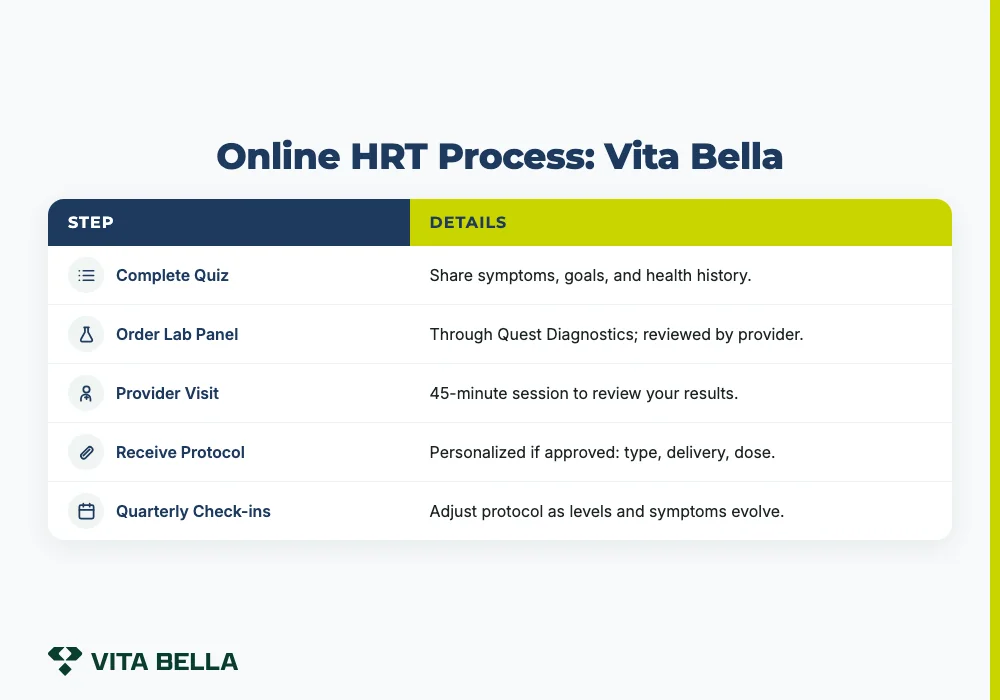
- Complete the intake quiz to share symptoms, goals, and health history.
- Order your lab panel through Quest Diagnostics; labs are reviewed by your provider and billed separately.
- Attend a 45-minute provider visit to review your results.
- Receive a personalized protocol covering type, delivery method, and dose if approved.
- Quarterly check-ins adjust the protocol as your levels and symptoms evolve.
See essential lab testing for hormones and peptides for an overview of which markers your provider will review.
How much does HRT cost?
Cost depends on the protocol and delivery method your provider recommends. Vita Bella offers member wholesale medication pricing, making programs more accessible than opaque clinic pricing. Labs are billed separately from your program.
Is HRT right for you?
A provider evaluates your symptoms, personal and family medical history, and lab values before recommending any protocol. If your symptoms match the list above and you are in perimenopause or menopause, the next step is a clinical evaluation. Transform Your Life. You Owe It To Yourself. Get Started.
Frequently asked questions
There is no single best option. The right type and delivery method depend on your symptoms, medical history, and lab results. A licensed provider reviews all three before recommending estrogen-only, combined, or bioidentical HRT and the delivery method that fits your lifestyle.
Provider-supervised HRT is available via telehealth in 47 states, so location is rarely a barrier. If you prefer in-person care, a local provider can follow the same evidence-based approach. Vita Bella's online model lets you start wherever you are.
Much of the hesitation traces to a 2002 Women's Health Initiative study that linked certain combined HRT formulations to elevated health risks. Updated analysis and revised clinical guidance have changed that picture for many women who begin treatment early in menopause.
Many women begin noticing changes within the first few months; your provider can give a more specific estimate based on your protocol.