Tirzepatide cost for a standard 28-day supply runs approximately $1,079 to $1,086 at U.S. retail pharmacies without insurance, according to a 2025 cost-effectiveness analysis by Hwang et al. published in JAMA Health Forum. At full list price, that totals more than $14,000 per year. Manufacturer savings programs and tirzepatide savings cards can reduce that number substantially for eligible patients, as can compounded tirzepatide alternatives. For an overview of provider-guided weight management, explore Vita Bella's weight loss program.
Knowing the full cost picture requires more than a single headline price. It is not a fixed number. Dosage level, pharmacy choice, insurance status, and the program structure your provider recommends each shift the final cost. The sections below cover every cost driver, clarify what insurance actually covers, and show where genuine savings exist.
Tirzepatide cost at a glance
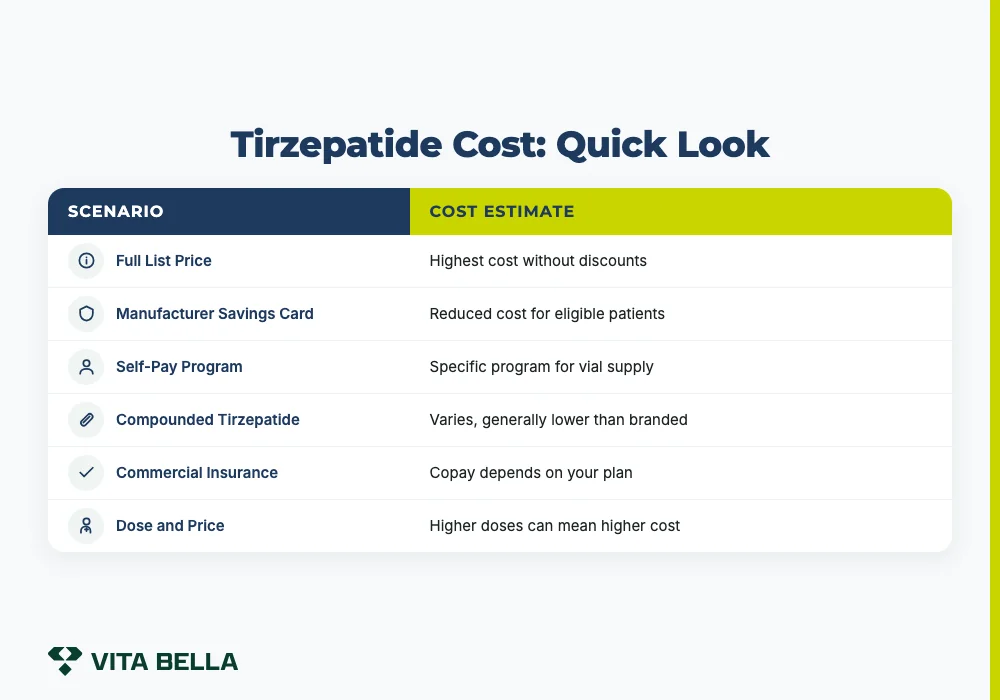
The table below summarizes the main pricing scenarios U.S. patients encounter. Figures are drawn from Hwang et al. (2025) and manufacturer-published self-pay program details.
| Pricing scenario | Estimated monthly cost |
|---|---|
| Branded tirzepatide, full list price | $1,079 – $1,200+ |
| Manufacturer savings card (eligible patients) | $349 – $499 |
| Self-Pay Journey Program (vial supply) | ~$499 |
| Compounded tirzepatide (varies by provider) | Below branded list price |
| With commercial insurance (covered indication) | Copay varies by plan |
A licensed provider determines the appropriate dose after reviewing your labs and health history. Higher doses generally carry a higher list price, which means tirzepatide monthly price varies across the treatment period, not just across pharmacies.
How much does tirzepatide cost per month without insurance?
Without insurance, tirzepatide monthly price at a U.S. retail pharmacy runs approximately $1,079 to $1,086 per 28-day supply, based on data reviewed in the Hwang et al. (2025) JAMA Health Forum analysis. That is the standard benchmark. Some pharmacies and certain regions report retail prices above $1,200 per month before discounts are applied.
How much is tirzepatide in real terms for an uninsured patient? Several variables shape the answer.
- Dosage level. A licensed provider determines the dose after reviewing your labs. Higher doses carry a higher list price; a lower starting dose costs less per fill.
- Pharmacy choice. Local retail, mail-order, and specialty pharmacies each negotiate differently with manufacturers. The same prescription can show a meaningful price spread across pharmacies in the same city.
- Geographic region. Regional pricing variation is real. Comparing pharmacies across zip codes can reveal a gap of $100 or more per month.
- Supply format. The Self-Pay Journey Program offers vial-based supply at approximately $499 per month, below the standard list price for the pen device.
For uninsured patients, the critical first question is whether you qualify for the manufacturer's savings program. Eligible uninsured patients have accessed branded tirzepatide for $349 to $499 per month through these programs, according to reporting included in Hwang et al. (2025). Program terms and eligibility requirements change; confirm current conditions directly with the manufacturer.
Annual tirzepatide cost exceeds $14,000 at the full retail list price. That figure has driven both the expansion of insurance coverage for obesity-related indications and the rise of compounded alternatives.
What is the difference in price between Mounjaro and Zepbound?
Both branded tirzepatide products carry list prices in the $1,079 to $1,086 range per 28-day supply, based on data from Hwang et al. (2025). Same active molecule. Same manufacturer. Different approved indications. Mounjaro price per month and Zepbound monthly price start from essentially the same list-price floor at the pharmacy counter.
The practical difference comes down to insurance coverage, not the list price itself.
- Mounjaro is approved for type 2 diabetes. It tends to be covered more consistently by commercial insurance when a type 2 diabetes diagnosis is documented.
- Zepbound is approved for obesity and weight management. Coverage depends on whether your plan includes obesity treatment benefits, a category that many employer-sponsored plans still exclude.
For uninsured patients, both brands draw on the same manufacturer savings infrastructure. Which brand your provider prescribes reflects your clinical situation, not a price advantage between the two labels.
If your insurer covers one brand but not the other, a conversation with your provider about formulary options is worth having before your first fill.
Some employer plans have added obesity treatment benefits in recent years, making it worth comparing plan drug formularies during open enrollment before starting treatment. The brand covered, and the tier it sits on, can change your monthly out-of-pocket total substantially, even within the same employer group.
Is tirzepatide covered by insurance?
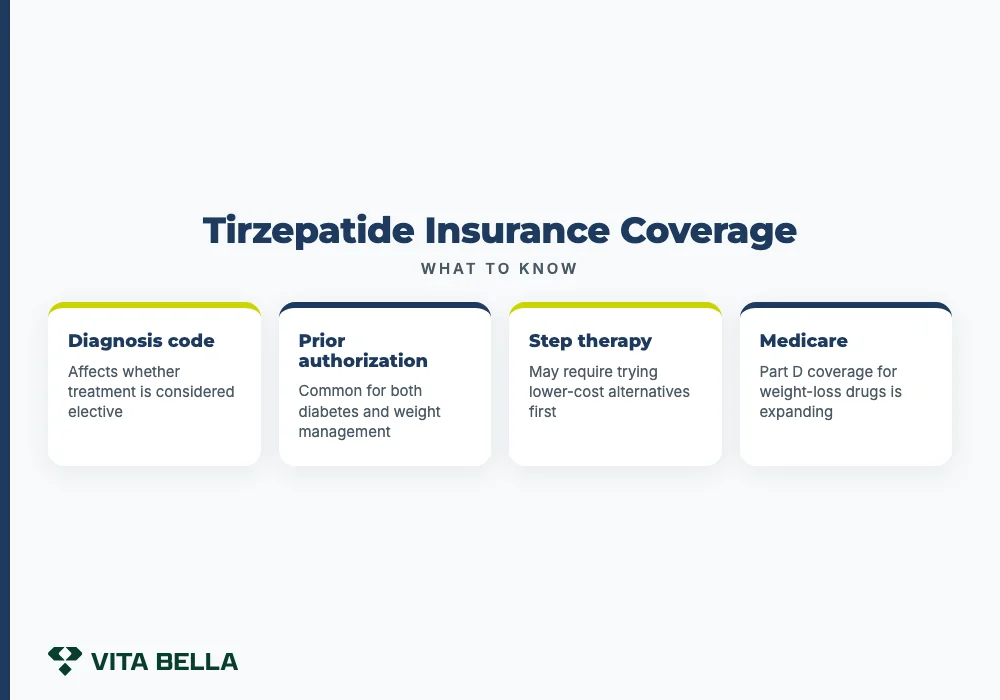
Coverage depends primarily on the diagnosis on your prescription. Most commercial insurance plans cover tirzepatide more readily when it is prescribed for type 2 diabetes than for weight management alone. Prior authorization is common under both indications.
Several factors shape coverage outcomes.
- Diagnosis code. A plan that classifies weight-loss treatment as elective will deny a weight-management prescription regardless of clinical evidence.
- Formulary tier. Even when covered in principle, tirzepatide may sit on a high-cost or specialty tier, raising the copay to several hundred dollars per month.
- Prior authorization. Most plans require documentation of prior treatments, body mass index thresholds, or comorbid conditions. Your provider can help assemble this documentation.
- Step therapy. Some plans require patients to try a lower-cost alternative first, delaying access by weeks or months.
- Medicare. Part D has historically excluded weight-loss drugs, though legislation has expanded coverage for certain Medicare beneficiaries. The specifics depend on your plan and diagnosis.
- Medicaid. State programs vary significantly in their coverage of GLP-1 therapies. Prior authorization is nearly universal.
Coverage policies for GLP-1 medications continue to evolve as long-term outcome data accumulates and as legislative proposals targeting Medicare obesity-drug coverage advance. Checking your plan's formulary at least annually, and again if you change employers or plan years, helps ensure you are not missing newly available coverage.
If your plan denies coverage, a formal appeal is worth pursuing. Your provider can submit lab results, prior treatment history, comorbid conditions, and clinical rationale. Many initial denials succeed on appeal when the clinical record is solid. The gap between covered and uncovered tirzepatide cost can exceed $700 per month at full retail list price, which makes a successful appeal or an informed plan selection during open enrollment one of the highest-leverage financial decisions in a multi-year treatment course.
For patients without workable insurance coverage, tirzepatide without insurance means relying on manufacturer savings programs or compounded alternatives, both covered below.
Compounded tirzepatide price: a lower-cost alternative
Compounded tirzepatide has become a relevant option for patients who cannot access manufacturer savings programs or whose insurance does not cover branded options. It is prescribed by a licensed provider and prepared by a licensed compounding pharmacy pursuant to a valid prescription. It is not the same formulation as branded tirzepatide products and should not be presented as equivalent to them.
Compounded tirzepatide cost varies by provider and program structure. Telehealth platforms typically bundle the medication with consultation and monitoring costs. Comparing options means reviewing the itemized breakdown, not just the headline monthly figure.
Before pursuing a compounded program, clarify the following.
- Provider oversight. A licensed provider should review your health history, determine candidacy, and monitor your ongoing response. A licensed provider determines the dose based on that review, not a preset menu.
- Pharmacy credentials. Choose state-licensed, FDA-inspected U.S. pharmacies for compounded tirzepatide. Pharmacies registered as 503B outsourcing facilities are subject to current good manufacturing practice standards, a higher bar than traditional 503A compounding pharmacies, which affects batch consistency and dosing reliability. Ask whether the dispensing pharmacy holds 503A or 503B registration before enrolling.
- Current FDA status. The FDA's allowance for compounding tirzepatide has shifted over time in relation to shortage designations. Confirm the current regulatory status before committing to a program.
- Itemized costs. Some programs include injection supplies and ongoing provider check-ins; others bill those separately. Request a full breakdown before you enroll.
Compounded options have made treatment accessible for patients who otherwise could not afford the branded list price. The considerations above warrant a direct conversation with a licensed provider before enrolling.
Does GoodRx lower tirzepatide cost?
GoodRx and similar discount platforms negotiate pre-set pricing with participating pharmacies. They can reduce tirzepatide cost at certain locations. The savings are variable and depend heavily on your zip code and which pharmacy you use.
For some patients, a GoodRx coupon will show a price below the pharmacy's standard cash rate. The key comparison is whether that discounted rate beats the manufacturer savings-card price. For most eligible uninsured patients, the manufacturer's assistance program offers a lower monthly cost than any third-party discount card.
Discount cards are most useful when:
- You do not qualify for the manufacturer's direct savings card.
- You are between program enrollments and need to fill a prescription temporarily.
- The cash price at your specific pharmacy is notably above the market average, and GoodRx closes that gap.
Compare three figures before filling: the GoodRx price at your pharmacy, the manufacturer savings-card price, and the self-pay vial program price. The difference can reach several hundred dollars per month. The comparison takes a few minutes and is worth making at this price point.
How can I reduce my tirzepatide monthly cost?
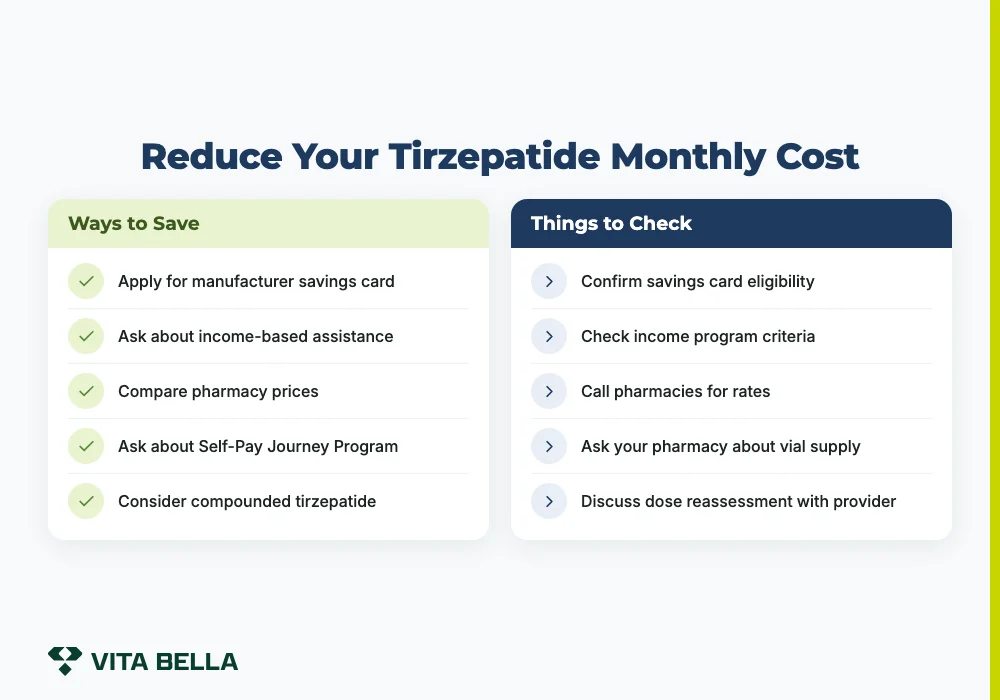
Several concrete steps can lower your monthly spending without compromising the quality of care.
Apply for the tirzepatide savings card. Eligible uninsured patients have accessed branded tirzepatide for $349 to $499 per month through manufacturer assistance programs. Program terms change; confirm current eligibility directly with the manufacturer's patient services line.
Ask about income-based patient assistance. Manufacturers offer separate income-based assistance programs, distinct from the savings card, that can provide tirzepatide at little or no cost to patients who meet income thresholds. Eligibility criteria differ from the standard savings card; your provider's office or the manufacturer's patient services line can confirm what you qualify for.
Compare pharmacies before filling. Mail-order pharmacies often price tirzepatide below local retail chains. Specialty pharmacy networks used by telehealth providers frequently negotiate rates unavailable to retail walk-in customers. A few phone calls before committing can make a real difference.
Ask about the Self-Pay Journey Program. The manufacturer has offered vial-based supply at approximately $499 per month. If the standard device is priced higher at your current pharmacy, ask specifically about this option.
Consider compounded tirzepatide. If branded tirzepatide remains out of reach and FDA compounding provisions allow it for your situation, a licensed provider can prescribe compounded tirzepatide through a state-licensed, FDA-inspected pharmacy at a lower cost.
Engage with your provider on dose reassessment. A licensed provider determines the dose after reviewing your labs and treatment response. Strong early responders may not need to stay at the highest dose indefinitely. Regular check-ins allow dose reassessment, which can reduce monthly cost over time. Measuring fat loss versus lean mass throughout your program gives your provider the data to guide those decisions efficiently.
Support the medication with consistent habits. Structured nutrition and exercise support tirzepatide's mechanism of action. Patients who make meaningful lifestyle changes alongside the medication often respond well at lower effective doses, which directly affects monthly cost.
Use GoodRx as a fallback. When other programs are unavailable, a discount card closes a specific gap at a specific pharmacy. Use it as a bridge, not a primary strategy.
Is tirzepatide cost-effective in the long run?
The list price is high. The long-term picture, viewed through peer-reviewed health economics, is more favorable than the sticker suggests.
A 2023 long-term analysis by Valentine et al. in Diabetes, Obesity and Metabolism compared tirzepatide to semaglutide for type 2 diabetes management in the United States. All three studied dose levels were linked to higher direct costs but also to better life expectancy, fewer diabetes-related complications, and greater quality-adjusted life expectancy. Incremental cost-effectiveness ratios ranged from roughly $48,785 to $75,803 per quality-adjusted life year (QALY) gained, depending on the dose studied. Tirzepatide remained more cost-effective than comparators across a wide range of sensitivity analyses.
A 2024 long-term analysis by Tang et al. in Value in Health found that the higher studied dose added approximately 0.69 QALYs and 0.58 extra life years. The probability that both studied dose levels are cost-effective exceeded 99% under standard U.S. willingness-to-pay thresholds. The midrange studied dose added approximately 0.60 QALYs and 0.49 extra life years at an incremental cost of roughly $1,855, translating to about $3,092 per QALY gained.
A 2023 short-term analysis by Zhang and McAdam Marx in the Journal of Managed Care and Specialty Pharmacy found that tirzepatide was linked to higher costs and meaningfully greater reductions in both weight and HbA1c compared to semaglutide. Their conclusion: given the clinical advantages in glucose control and weight reduction, the cost differential may be acceptable to payers.
A 2024 systematic review and network meta-analysis by Karagiannis et al. in Diabetologia confirmed tirzepatide's superiority over subcutaneous semaglutide for HbA1c reduction and weight loss in adults with type 2 diabetes. That consistent efficacy advantage across trials provides the clinical foundation for the cost-effectiveness arguments above.
A 2025 expert review by Hamza et al. in Expert Opinion on Pharmacotherapy summarized the evidence base for tirzepatide in overweight and obesity management. The review emphasizes that the drug's metabolic benefits extend beyond glycemic control alone.
The clinical efficacy data underpinning these economic models comes from the SURMOUNT and SURPASS trial programs, which documented meaningful weight reduction and HbA1c improvements across large patient populations over periods ranging from 40 to 72 weeks. Consistent, replicable results across multiple large-scale trials strengthen the reliability of the cost-effectiveness projections above.
Cost-effectiveness models work with population averages. Your individual outcome depends on factors your provider assesses directly, including metabolic status, comorbidities, and treatment response.
For patients using a GLP-1 medication, body composition changes alongside weight loss matter for the long-term quality of the result. Protecting lean tissue during GLP-1 treatment affects how much of the lost weight is fat versus muscle, which shapes both the clinical outcome and potentially how long treatment continues.
How to estimate your personal tirzepatide cost
A step-by-step approach helps you build a realistic monthly budget before starting treatment.
Step 1: Start with the list price. For the standard pen device, the list price runs approximately $1,079 to $1,086 per 28-day supply based on Hwang et al. (2025). For the self-pay vial program, use approximately $499 as the baseline.
Step 2: Apply available savings programs. If you qualify for the manufacturer savings card, subtract the applicable discount. Eligible uninsured patients have reduced monthly cost to $349 to $499. Your provider's office or the manufacturer's patient services line can confirm current eligibility.
Step 3: Add monitoring and consultation costs. Estimate periodic lab work, provider visits, and follow-up appointments. If you use a bundled telehealth program, request an itemized breakdown before enrolling. A rough estimate for out-of-pocket monitoring is around $100 per month, though actual costs vary by program.
Step 4: Add supplies and incidental costs. Injection supplies, side-effect remedies, and any additional tests add to the monthly total. Some programs include these; others bill separately.
Step 5: Divide the annual estimate by 12. This smooths out upfront costs, like the initial consultation fee, and gives a true monthly average.
As a concrete illustration: if the list price is $1,079, a savings card brings it to $499, and monitoring plus supplies add $100, with the initial consultation amortized to roughly $20 per month, the estimated out-of-pocket total runs approximately $619 per month. Your actual figure depends on real eligibility and program terms.
Take control of your tirzepatide cost
Tirzepatide cost is a real barrier for many patients. Understanding it, planning for it, and applying every available savings mechanism makes sustained treatment achievable for more people.
At Vita Bella, members get wholesale pricing on medications, billed separately from the membership fee, alongside 1:1 provider care every quarter, discreet shipping from FDA-inspected, state-licensed U.S. pharmacies, and free injection supplies. A licensed provider reviews your labs and health history before any prescription is written. Get Started with the intake process to see what fits your situation.
Frequently asked questions
Without insurance, tirzepatide cost at a U.S. retail pharmacy runs approximately $1,079 to $1,086 per 28-day supply based on data from Hwang et al. (2025), with some locations reporting prices above $1,200 before discounts. Manufacturer savings programs can reduce monthly cost to $349 to $499 for eligible patients, so your actual out-of-pocket total may be significantly below the list price.
Most commercial plans cover tirzepatide more readily when prescribed for type 2 diabetes than for weight loss alone, and coverage for obesity treatment varies widely across employer-sponsored plans. Prior authorization is common under both indications. Contact your insurer to verify your specific benefit, and ask your provider about supporting a formal appeal if your initial claim is denied.
Compounded tirzepatide is prescribed by a licensed provider and prepared by a licensed compounding pharmacy pursuant to a valid prescription; it is not the same formulation as branded Mounjaro or Zepbound, and pricing varies by provider and program structure. For patients without access to manufacturer savings programs, compounded options have offered a lower-cost alternative when FDA compounding provisions are active. Confirm the pharmacy's credentials and current FDA status before enrolling.
Yes. Lab work, provider consultations, injection supplies, and side-effect management each add to the monthly total, and most are billed separately from the medication itself. Build all of these line items into your budget from the start to avoid unexpected financial gaps mid-treatment.
Yes. The manufacturer offers a savings program that can lower tirzepatide cost to $349 to $499 per month for eligible patients who do not have government insurance. This program cannot be combined with Medicare, Medicaid, or other federal programs. Eligibility requirements and program terms change periodically; confirm current conditions directly with the manufacturer's patient services line or through your provider's office.
Sources
- Hwang JH, Laiteerapong N, Huang ES, Kim DD. (2025). Lifetime health effects and cost-effectiveness of tirzepatide and semaglutide in US adults. JAMA Health Forum. Full text
- Valentine WJ, Hoog M, Mody R, Belger M, Pollock R. (2023). Long-term cost-effectiveness analysis of tirzepatide versus semaglutide 1.0 mg for the management of type 2 diabetes in the United States. Diabetes, Obesity and Metabolism. PubMed
- Tang M, Shi L, Guan D, Winberg D, Tang T, Shao H, Fonseca V. (2024). Long-term cost-effectiveness of tirzepatide for individuals with type 2 diabetes and comorbid obesity. Value in Health. Full text
- Zhang X, McAdam Marx C. (2023). Short-term cost-effectiveness analysis of tirzepatide for the treatment of type 2 diabetes in the United States. Journal of Managed Care and Specialty Pharmacy. PubMed
- Karagiannis T et al. (2024). Subcutaneously administered tirzepatide vs semaglutide for adults with type 2 diabetes: a systematic review and network meta-analysis of randomised controlled trials. Diabetologia. PubMed
- Hamza M et al. (2025). Tirzepatide for overweight and obesity management. Expert Opinion on Pharmacotherapy. PubMed