HRT can help with libido for many women in perimenopause and menopause, though the response depends on which hormone is deficient and how it is delivered. Estrogen, testosterone, and progesterone each affect sexual function differently, as a 2024 review in the Journal of Pharmacy Practice confirms. A provider evaluation identifies which deficits are driving desire loss, making personalized hormone care the right starting point.
Why libido drops during perimenopause and menopause
Perimenopause and the transition into menopause bring declining levels of estrogen, testosterone, and progesterone. These shifts alter desire, arousal, and physical comfort. Perimenopause involves fluctuating hormone levels; postmenopause presents a consistently lower baseline. That distinction matters clinically, because the two stages call for different approaches when HRT and libido are both treatment goals.
Common signs that low libido may have a hormonal component:
- Reduced interest in sex that developed gradually alongside hot flashes, sleep disruption, or other perimenopausal changes
- Difficulty becoming aroused even when circumstances are otherwise favorable
- Vaginal discomfort or pain during sex that has decreased interest over time
- Low energy and mood shifts that appeared during the same period as other hormonal symptoms
- Sleep disruption that compounds fatigue and reduces desire
The role of estrogen
Declining estrogen reduces vaginal tissue health, natural lubrication, and genital blood flow. Sex becomes uncomfortable. That discomfort erodes desire over time, because intimacy associated with pain reduces the motivation to initiate it. Cameron et al. (2024) in the Journal of Pharmacy Practice identify estrogen deficiency as a central driver of genitourinary changes that affect sexual function during menopause.
The role of testosterone and why SHBG matters
Testosterone drives central desire in women. How much biologically active testosterone circulates depends on sex hormone binding globulin (SHBG), a protein that binds testosterone and removes it from active use. Oral estrogen raises SHBG, which reduces free testosterone and limits the libido benefit of that delivery route.
A 2023 systematic review by Goldštajn et al. in Archives of Gynecology and Obstetrics found that transdermal estrogen has a more favorable effect on SHBG than oral forms. This difference has direct consequences for free testosterone availability and HRT and sex drive outcomes. For a deeper look at how SHBG shapes the hormone picture, our article on why total testosterone often misses the full story covers the mechanism in practical terms.
The role of progesterone
Not all progestogens behave the same way. Synthetic progestins can suppress desire in some women. Bioidentical progesterone tends to have a more neutral effect on libido. Cameron et al. (2024) note that progestogen selection is a meaningful clinical variable when managing HRT for low libido, and providers weigh this choice when desire is part of the treatment goal.
Does HRT increase libido?
Does HRT increase libido? For women in perimenopause and menopause, HRT can help with low libido when the underlying cause is hormonal. The effect depends on which hormone is deficient, which type is prescribed, and how it is delivered. Whether HRT can increase sex drive depends on the same variables, which hormones are deficient and how therapy addresses them.
HRT and libido outcomes are not uniform across individuals. The clinical distinction between vaginal symptoms and central desire matters greatly. Conflating the two leads to incomplete treatment and unrealistic expectations about what estrogen alone can address.
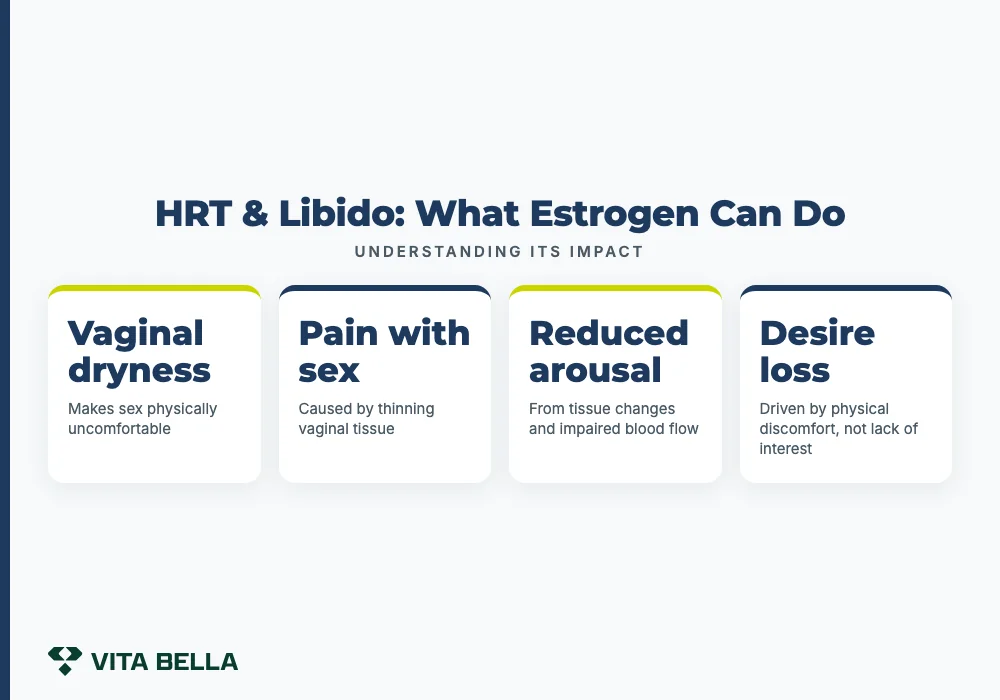
What estrogen therapy can address for sexual function:
- Vaginal dryness that makes sex physically uncomfortable
- Pain with sex caused by thinning vaginal tissue, known as genitourinary syndrome of menopause
- Reduced arousal stemming from tissue changes and impaired genital blood flow
- Desire loss that was being driven by physical discomfort, not an absence of underlying interest
For women managing both physical symptoms and desire changes, the full scope of sexual health treatment options can complement what estrogen therapy addresses.
What estrogen therapy addresses, and what it doesn't
Estrogen therapy is effective at treating vaginal and tissue-level symptoms that make sex uncomfortable. It does not reliably restore central desire on its own. Central desire involves different neural mechanisms than vaginal atrophy does. Women whose primary concern is an absence of interest in sex may need a broader hormone evaluation rather than estrogen therapy alone.
Does HRT Help With Libido When Both Hormones Are Deficient?
The question "does hrt help with libido" has a more nuanced answer when both estrogen and testosterone are measurably low. Estrogen therapy addresses tissue-level symptoms; testosterone evaluation targets central desire. HRT libido outcomes tend to improve most when free testosterone is also assessed alongside estrogen. For women asking whether HRT helps with low libido that persists after starting estrogen, a testosterone evaluation is typically the next clinical step.
Testosterone therapy: the often-overlooked piece
Some providers evaluate testosterone levels when desire loss persists despite estrogen therapy, particularly when free testosterone is measurably low. No testosterone product carries FDA approval for this indication in women. All such use is off-label and directed by a licensed provider. The clinical rationale rests on testosterone's role as a driver of central desire, and a licensed provider determines the evaluation pathway and approach after reviewing lab values and symptom history.
A testosterone-focused evaluation may include:
- Total testosterone and free testosterone measurements
- SHBG, to assess how much testosterone is biologically active
- A full medication review, since some common drugs suppress androgen activity
- Symptom duration and how desire loss relates to the onset of other hormonal changes
- Estrogen levels and current HRT regimen, if therapy is already underway
Perimenopause vs. postmenopause: does timing affect outcomes?
The stage of the transition shapes how HRT affects sex drive. During perimenopause, hormone levels fluctuate unpredictably, producing symptoms that can shift from week to week. In postmenopause, ovarian estrogen production has largely ceased and the hormone baseline is persistently low. These are different clinical pictures, and HRT for low libido is approached differently in each.
During perimenopause, a woman may still produce some estrogen and testosterone, with variability that makes symptoms inconsistent. In postmenopause, deficits are more stable but more complete, and the response to HRT is often more predictable. Cameron et al. (2024) note that stage and timing inform individual HRT decisions, and a provider who distinguishes between the two sets more accurate expectations.
How long does HRT take to improve sex drive?
How long it takes for HRT to increase sex drive depends on which symptoms are being addressed. Vaginal comfort changes typically emerge within 4 to 12 weeks of starting estrogen therapy. Central desire takes longer. Some women notice a shift within three months; others see gradual improvement over six months or more, particularly when testosterone evaluation is also part of the process.
Physical symptoms respond faster than the motivational dimensions of desire. A provider sets realistic expectations based on which hormones are involved and what the baseline evaluation showed.
When low libido isn't only hormonal
Hormones are not the only driver of desire. Sleep disruption, mood changes, relationship dynamics, thyroid dysfunction, certain medications, and chronic stress all affect libido. A thorough provider evaluation looks at all of these alongside hormone panels. Treating one variable when several are active produces incomplete results.
Dan et al. (2023) in Health Communication note that low libido in women is frequently framed too simply, with a single cause standing in for a multifactorial picture. When lab values appear normal but symptoms persist, the gap between normal and optimal ranges can matter. That distinction is explored further in our article on what it means when labs are normal but you still feel suboptimal.
How a provider evaluates low libido
A licensed provider reviews symptom history, hormone lab values, medication history, and lifestyle factors before recommending hormone therapy for low libido. In a telehealth context, this begins with lab work through a certified network such as Quest Diagnostics, followed by a consultation where results and symptom history are reviewed together. You can review what the HRT evaluation process involves before deciding on a next step.
Signs worth raising with a provider:
- Desire loss that began alongside perimenopausal symptoms such as hot flashes, sleep disruption, or mood shifts
- Physical discomfort during sex that has reduced frequency or interest
- Prior HRT that provided partial relief but did not fully address the desire component
- Persistent low desire lasting weeks or months without a clear situational explanation
A provider can review your hormone picture and help you understand what may be driving the change. Get Started to begin the evaluation.
Ready to talk to a provider?
The most direct path to understanding whether HRT can help with libido is a provider-led evaluation. Hormonal causes of low libido are identifiable through lab work and symptom review. Results shape which approach fits. Vita Bella's licensed provider network covers 47 states, connecting you with a clinician who reviews your individual picture before recommending any direction.
Get Started to connect with a licensed provider and begin your hormone evaluation.
Frequently asked questions
HRT can support libido for women whose desire loss is tied to hormone changes during perimenopause or menopause. Estrogen therapy addresses tissue-level symptoms, while providers may evaluate testosterone levels when central desire remains low. Response depends on which hormones are involved and how therapy is delivered.
Some women notice changes in desire after starting HRT, particularly when low estrogen or low free testosterone was the primary driver. HRT addresses hormonal contributors, not every factor that influences sex drive, and a provider evaluation helps clarify whether hormones are the main cause. Results vary based on the full clinical picture.
There is no single best option. Estrogen therapy is typically the first step, with progestogen type chosen to minimize any dampening effect on libido. When desire loss continues despite estrogen therapy, a provider may evaluate whether testosterone levels are contributing.
Vaginal and physical comfort changes often appear within 4 to 12 weeks of starting estrogen therapy. Changes in central desire take longer and vary by individual; some women notice a difference within three months, others after six or more. A provider sets realistic expectations based on which hormones are being addressed.
Synthetic progestins can suppress desire in some women. Bioidentical progesterone may have a more neutral effect on libido, which is one reason providers consider progestogen type when sex drive is a concern on HRT. Discussing this distinction before starting therapy can help optimize the initial protocol.
Sources
- Goldštajn MŠ et al. (2023). Effects of transdermal versus oral hormone replacement therapy in postmenopause: a systematic review. Archives of Gynecology and Obstetrics. PubMed
- Dan V et al. (2023). Empowered, Handmaid, or Rejector? The Framing of Low Libido in Women according to Scholarly Investigations of Public Communication. Health Communication. PubMed
- Cameron CR et al. (2024). The Art of Hormone Replacement Therapy (HRT) in Menopause Management. Journal of Pharmacy Practice. PubMed