Symptoms of low testosterone in women include persistent fatigue, low libido, brain fog, and mood changes that are frequently misread as stress or normal aging. Low testosterone levels in women may be linked to changes in energy, mood, and sexual desire, and the decline often goes unnoticed because routine checkups rarely include a testosterone panel. A blood test measuring total and free testosterone, reviewed by a licensed provider alongside your symptoms, helps clarify whether low T may be contributing. Vita Bella's hormone evaluation for women page explains how a licensed provider decides which labs to order and reviews results directly with you.
What testosterone does in the female body
Testosterone is produced primarily in the ovaries and adrenal glands, and it is involved in energy metabolism, lean muscle mass, bone density, and sexual desire. Researchers are still studying its role in cognition. When levels fall, changes tend to build slowly rather than all at once. That pattern is why this hormonal decline so often gets attributed to burnout or aging rather than investigated as a hormonal issue.
Testosterone receptors exist in brain tissue, bone, skeletal muscle, and the cardiovascular system. That receptor distribution helps explain why symptoms of low testosterone in women can span so many body systems at once rather than appearing as a single isolated complaint. Vita Bella's hormone therapy for women page explains how a licensed provider builds a complete hormone picture before recommending any protocol.
10 signs of low testosterone in women
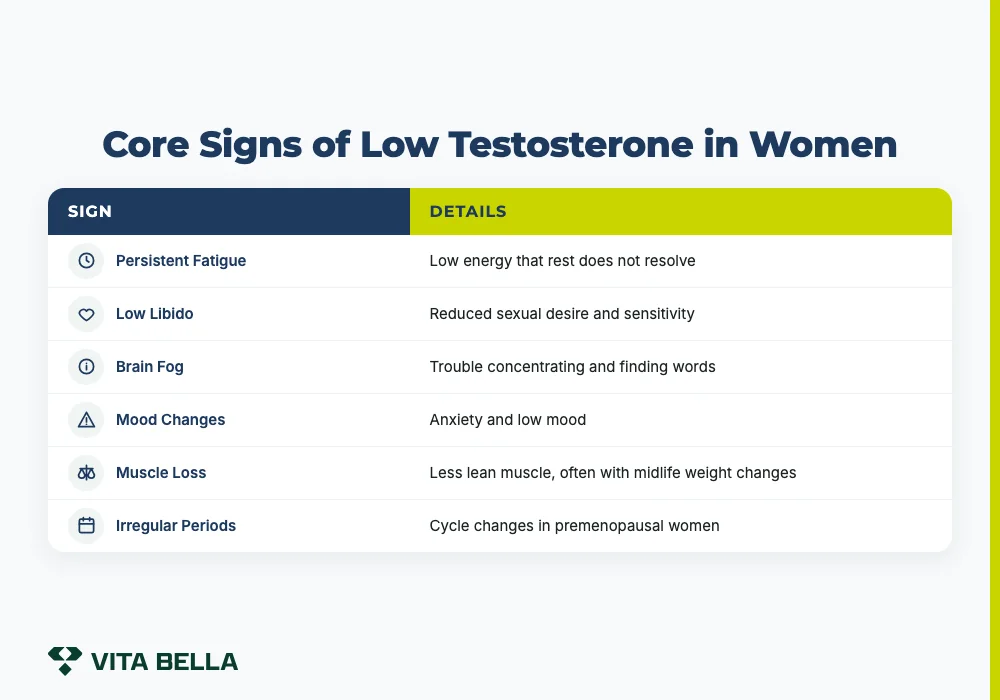
The symptoms listed below often appear together, and they overlap with thyroid dysfunction, anemia, and perimenopause. Labs help clarify the driver. Start by recognizing the pattern.
- Persistent fatigue and low energy that does not resolve with rest
- Low libido and reduced genital sensitivity
- Brain fog, difficulty concentrating, and word-retrieval problems
- Mood changes including anxiety and low-grade depression
- Muscle loss and weight gain despite consistent diet and exercise
- Sleep disturbances unrelated to hot flashes
- Diffuse scalp hair thinning, which has several possible causes
- Irregular or lighter periods in premenopausal women
- Bone density loss that progresses silently
- Slower processing speed and progressive memory gaps
Why symptoms of low testosterone in women cluster rather than appear in isolation
These signs tend to accumulate gradually. Because each symptom can be explained away individually, fatigue as overwork, low libido as stress, brain fog as poor sleep, a possible hormonal pattern can go unrecognized until the cluster becomes hard to ignore and labs are finally checked.
Persistent fatigue and low energy
Some women with low testosterone levels describe waking unrefreshed and hitting an energy wall by early afternoon, even after a full night of sleep. Testosterone supports red blood cell production, but research has not established how much low testosterone contributes to fatigue in women. Fatigue has many causes. Labs help sort them out.
Low libido and reduced arousal
Testosterone is one of several influences on sexual desire in women, alongside estrogen, overall health, medications, mood, and relationship context. Lower free testosterone may contribute to reduced arousal, but research has not found a testosterone level that reliably separates women with and without sexual dysfunction. Desire has both physical and psychological drivers. A full evaluation looks at both.
Brain fog and difficulty concentrating
Cognitive complaints are among the low testosterone symptoms women report. Difficulty recalling words, losing focus mid-task, and feeling mentally slow have many possible causes, and research has not established that declining testosterone causes them in women. Rest alone may not resolve them. Persistent symptoms deserve a closer look.
Mood changes, anxiety, and depression
Anxiety and low mood are common in midlife, and research has not separated how much low androgens add to the estrogen-driven mood shifts of perimenopause. A 2024 meta-analysis by Jia et al. in the Journal of Affective Disorders estimated a pooled depression prevalence of 35.6% among menopausal women worldwide. It measured how common depression is, not what causes it, so it cannot show a hormonal cause. A provider weighs mood symptoms together with labs before discussing any next step.
Muscle loss and weight gain
Testosterone is one of several hormones involved in maintaining lean muscle mass in women. Midlife often brings a shift toward more fat and less muscle, but research has not established that low testosterone levels alone drive weight gain in women. Age, estrogen changes, sleep, activity, and diet all play a role. Resistance training helps, and a provider can check whether hormones are part of the picture.
Sleep disturbances
Difficulty falling and staying asleep is sometimes reported with low T, separate from hot-flash-driven disruption caused by estrogen decline, though the link is less well studied. Both mechanisms can coexist. Women who attribute poor sleep entirely to night sweats may be missing a second driver. A broader hormone panel, not just estrogen and FSH, can help a provider sort them out.
Thinning hair
Diffuse scalp hair thinning has many possible causes in women, including thyroid disease, iron deficiency, and female pattern hair loss, which can involve sensitivity to androgens rather than a shortage of them. A direct link to low testosterone is not established. Because the same diffuse pattern across the crown can come from very different causes, the pattern alone does not identify the driver. New shedding is a reason for labs and a provider review, not proof of low T.
Irregular periods
Testosterone works alongside estrogen and progesterone in the hormonal cycle. But irregular or lighter periods have many possible causes, including thyroid conditions, perimenopause, stress, and conditions involving excess androgens such as PCOS. A link to low testosterone in premenopausal women is not well established. Cycle changes are worth evaluating with a provider.
Bone density loss
Androgens support bone in women, partly through conversion to estrogen, but estrogen loss drives most postmenopausal bone loss. Declining androgen levels may add to that loss over time, although studies of testosterone treatment in women have not shown a clear effect on bone density. Bone loss progresses silently. A DEXA scan can catch it early.
Reduced cognitive function
Slower processing speed and progressive memory gaps differ from the day-to-day brain fog described earlier. They tend to build gradually and are often put down to aging. Evidence linking testosterone to cognition in women is still limited, so progressive memory changes call for a broader clinical evaluation rather than a lifestyle adjustment alone. Labs are one part of that workup.
How do symptoms of low testosterone in women change during perimenopause and menopause?
The symptoms of low testosterone in menopausal women can become more noticeable in midlife. Testosterone declines gradually with age, while surgical removal of the ovaries causes an abrupt fall.
Testosterone levels in women are highest in early adulthood and fall slowly from there. During perimenopause, fatigue and libido changes can appear before or alongside hot flashes. Standard menopause workups focus on estrogen and FSH, so testosterone often goes unchecked unless a patient or provider raises it.
Surgical menopause following oophorectomy produces an immediate and steep fall in testosterone rather than a gradual one. Because the surgery also ends ovarian estrogen production in women who have not yet reached menopause, fatigue, libido loss, and mood changes can appear together soon after surgery. A full lab panel is still needed before any protocol is considered. Women in this situation benefit from a provider familiar with the surgical context rather than one applying a generic perimenopause framework.
Is it low testosterone or something else?
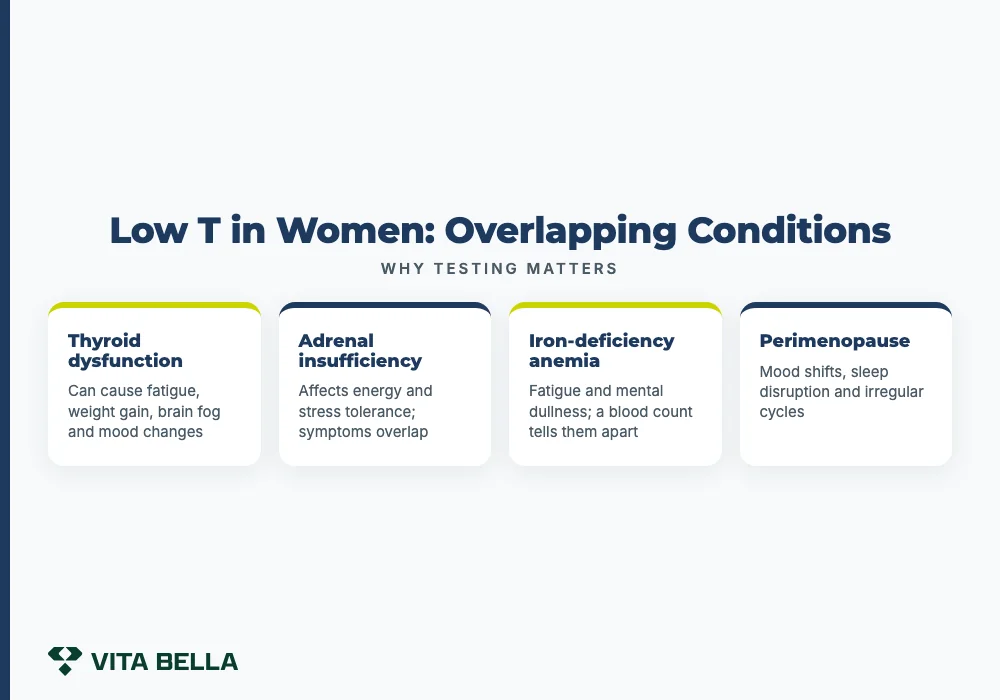
A targeted blood panel, reviewed alongside your symptoms and history, helps separate low testosterone from overlapping conditions. Without it, alternatives such as thyroid dysfunction, adrenal insufficiency, iron-deficiency anemia, burnout, and estrogen-dominant perimenopause are easy to miss.
Thyroid dysfunction, particularly subclinical hypothyroidism, can produce fatigue, weight gain, brain fog, and mood changes that mirror these hormonal symptoms almost exactly. Adrenal insufficiency affects energy and stress tolerance through a different hormonal axis but overlaps significantly in daily experience. Iron-deficiency anemia generates fatigue and cognitive dullness indistinguishable from hormonal causes until a complete blood count is ordered.
Burnout and chronic stress raise cortisol and can suppress testosterone production, so the two can coexist. Accurately mapping female androgen deficiency symptoms against these overlapping conditions is what makes the lab panel essential rather than optional.
Estrogen-dominant perimenopause adds another layer of overlap. Estrogen excess relative to progesterone produces mood shifts, sleep disruption, and irregular cycles that can look like low testosterone symptoms in women but require a different clinical response. Ordering total testosterone, free testosterone, SHBG, estradiol, and FSH together is a common approach before any protocol is discussed. The goal is identifying the actual driver, not the most probable one.
For more on why lab results often miss clinically significant patterns, the article When "Normal" Labs Still Leave You Feeling Suboptimal explains why standard reference ranges fall short for many patients.
What is the difference between free and total testosterone in women?
Total testosterone measures all circulating testosterone, including the fraction bound to sex hormone-binding globulin (SHBG) and albumin. Free testosterone is the unbound fraction that is available to tissues. This distinction is central to understanding symptoms of low free testosterone in women.
A woman can have a total testosterone result within the lab's reference range and still report symptoms associated with low T. This can happen when SHBG is elevated, binding more testosterone and reducing what is available to tissues. Oral contraceptives, oral estrogen, and an overactive thyroid are among the factors that raise SHBG. A result labeled "normal" on a standard panel can therefore coexist with genuine symptoms of low free testosterone in women, which is why providers typically order both values alongside SHBG.
The AUA Guideline by Mulhall et al. (2018) in the Journal of Urology was written for men and centers diagnosis on accurate total testosterone measurement plus symptoms and signs. It sets no criteria for women. For female patients, providers often add free testosterone and SHBG, because total testosterone alone does not tell the full story when SHBG is elevated. The article Sex Hormone-Binding Globulin: Why Total Testosterone Is Not the Whole Story walks through how SHBG values change clinical interpretation.
What causes low testosterone in women?
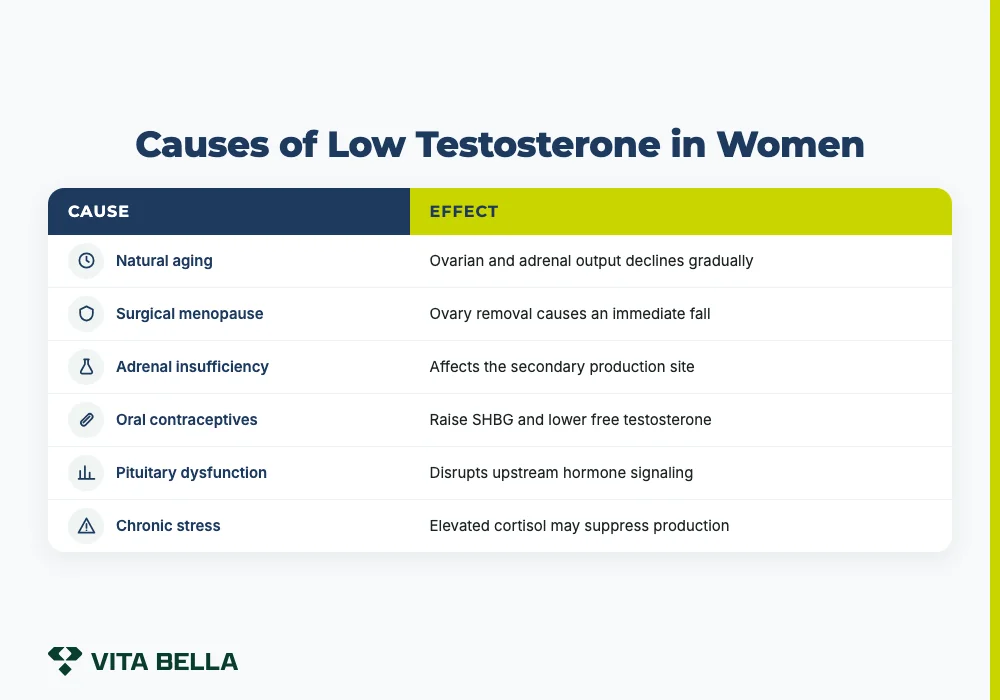
Low testosterone in women most often results from natural aging, surgical menopause, adrenal dysfunction, or oral contraceptive use elevating SHBG, though chronic stress and nutritional factors also contribute. Each cause has a distinct mechanism.
- Natural aging reduces ovarian and adrenal testosterone output gradually from early adulthood onward.
- Surgical menopause (oophorectomy) removes the primary production organs at once, causing an immediate fall rather than a gradual one.
- Adrenal insufficiency compromises the secondary production site and often produces testosterone deficiency alongside cortisol problems.
- Oral contraceptive use raises SHBG and reduces free testosterone even when total levels appear within range.
- Pituitary dysfunction disrupts the upstream signaling cascade that regulates ovarian hormone output.
- Chronic stress chronically elevates cortisol, suppressing testosterone production over time.
- Nutritional and lifestyle factors, including diet, sleep, and activity level, can affect testosterone through multiple pathways.
How is low testosterone in women diagnosed?
Diagnosis starts with a blood draw measuring total testosterone, free testosterone, and SHBG. Providers typically add estradiol, FSH, and a thyroid panel to rule out the overlapping conditions described above.
Reference ranges for testosterone in women vary by lab and life stage, and ranges calibrated for men do not apply to female patients. Providers assess values against age-specific norms and weigh the numbers against the clinical picture. A value at the bottom of the reference range can still be symptomatic if a patient's personal baseline was historically higher.
What symptom pattern typically leads to testosterone testing in women?
Providers may recommend a hormone panel when several core symptoms appear together, such as persistent fatigue, low libido, brain fog, or unexplained mood changes, especially when they persist without a clear lifestyle explanation. The panel is a starting point for that conversation, not a diagnosis on its own.
Vita Bella works with Quest Diagnostics for lab processing. Labs are ordered and reviewed by a licensed provider and billed separately from the membership fee. The typical sequence: labs are ordered first, results come back through Quest, and the provider reviews values with you in a scheduled visit before any protocol is discussed.
In a provider-led evaluation, a licensed provider decides which panel fits and explains each result. Vita Bella's hormone therapy for women page explains how providers review low testosterone levels in women alongside your symptoms and history.
Ready to find out what your levels are?
Recognizing these hormonal symptoms is the first step. Getting a blood panel that helps clarify what is driving them is the second. With Vita Bella, you pick your provider, and the conversation starts with your history and labs.
The path is straightforward. Take the 60-second quiz to begin the intake process. Any next step depends on a licensed provider's review of your labs and history, not a predetermined protocol.
Learn more about what provider-led testosterone evaluation covers or visit vitabella.com to see how Vita Bella works.
Frequently asked questions
Commonly reported symptoms include fatigue, low libido, brain fog, mood changes, and muscle loss. Symptoms vary by age and hormonal stage, and they overlap significantly with thyroid dysfunction and perimenopause. A blood panel measuring total testosterone, free testosterone, and SHBG, reviewed by a licensed provider with your history, helps clarify whether low T may be playing a role.
It may contribute, but the link is not well established. Testosterone is one of several hormones that help maintain lean muscle in women, and midlife weight gain usually has several drivers at once. A licensed provider can review labs to see whether low testosterone levels in women are part of the picture.
The conditions overlap significantly, and many women experience both simultaneously. A blood panel measuring total testosterone, free testosterone, SHBG, estradiol, and FSH helps a provider look for the underlying driver, since symptoms alone cannot separate the two. Because hormone levels can fluctuate during perimenopause, a licensed provider reads results alongside your symptoms and history.
Reference ranges vary by lab and life stage, and age-specific norms apply differently at 35 than at 55. Free testosterone context often matters more than the total value when SHBG is elevated. A licensed provider interprets results in the context of your symptoms and health history rather than applying a single threshold number.
A licensed provider reviews labs and symptoms together before recommending any protocol, and options depend on the individual health profile. The provider determines the appropriate approach after evaluation, not before. Self-diagnosis is not a reliable starting point because the same symptoms can arise from multiple causes that require different responses.